
The best science experiment kits for adults pair hands-on work with enough depth to make each result worth investigating. I’d put the Thames & Kosmos CHEM C2000 first for its middle ground between a beginner set and the more demanding C3000, while the Genetics & DNA Lab offers a more focused route into molecular biology. For a different kind of project, the National Geographic Hobby Rock Tumbler Kit trades quick experiments for a longer, tangible result. The main choice is between subject depth, setup and safety demands, and how much guidance you want. Read on for the full breakdown and picks by buyer type.

Prime made for students and young adults
- Fast, free delivery for dorm and study essentials
- Prime Video and Amazon Music included
- Member-only deals
Key Takeaways
- CHEM C2000 is the most balanced chemistry choice in this lineup: it sits between the introductory C1000 and the more expansive C3000.
- The C3000 favors breadth and commitment, with more than 333 experiments; that range makes it a better fit for sustained exploration than an occasional weekend project.
- National Geographic’s chemistry sets serve different needs: the 45-experiment set is framed for younger learners, while the 100+ set offers a broader activity count.
- The Genetics & DNA Lab and EUDAX electricity kit are subject-specific alternatives for adults who want to focus on molecular biology or circuits and magnetism instead of general chemistry.
- The rock tumbler is the patience pick: it offers a physical finished result, while chemistry kits are better suited to varied experiments without a long polishing cycle.
| Thames & Kosmos Genetics & DNA Lab |  | Best for Hands-On Genetics | Brand: Thames & Kosmos | Experiments: 20 | Manual: 48 pages | VIEW LATEST PRICE | See Our Full Breakdown |
| National Geographic Hobby Rock Tumbler Kit | 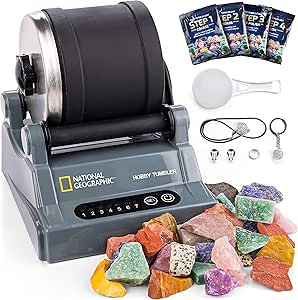 | Best for Patient, Low-Prep Discovery | Brand: Blue Marble | Listed age range: 8 years and up | Dimensions: 13.81 x 4.88 x 8.06 inches | VIEW LATEST PRICE | See Our Full Breakdown |
| National Geographic Chemistry Set with 45 Experiments for Kids Ages 8 and Up |  | Best for Casual, Demonstration-Style Chemistry | Brand: National Geographic | Experiment count: Title states 45; included-components details state 100+ | Listed age range: 8 years and up | VIEW LATEST PRICE | See Our Full Breakdown |
| Thames & Kosmos Chem C1000 Beginner Chemistry Set |  | Best Overall for Adult Beginners | Brand: Thames & Kosmos | Model: Chem C1000 (V 2.0) | Experiments: 125 | VIEW LATEST PRICE | See Our Full Breakdown |
| Thames & Kosmos CHEM C3000 Chemistry Set, 333+ Experiments, Ages 12+ |  | Best Premium Chemistry Curriculum | Experiments: More than 333 | Manual: 192-page full-color | Chapters: 27 | VIEW LATEST PRICE | See Our Full Breakdown |
| EUDAX Basic Electricity and Magnetism Experiment Kit for High School Students |  | Best for Hands-On Physics | Brand: EUDAX | Model: EUDAX-FC-80PCS | Total items: 79 | VIEW LATEST PRICE | See Our Full Breakdown |
| National Geographic Amazing Chemistry Set with 100+ Experiments |  | Best for Low-Commitment Chemistry Exploration | Brand: Blue Marble | Sub-brand: National Geographic | Age range: 8 years and up | VIEW LATEST PRICE | See Our Full Breakdown |
| Thames & Kosmos Chem C2000 (V 2.0) Intermediate Chemistry Set |  | Best for Intermediate Chemistry Study | Brand: Thames & Kosmos | Model: Chem C2000 (V 2.0) | Age range: 11+ | VIEW LATEST PRICE | See Our Full Breakdown |
| science experiment kits for adult | Brand | Listed age range | Manual | Dimensions |
|---|---|---|---|---|
| Thames & Kosmos Genetics & DNA | Thames & Kosmos | 10–16 years | 48 pages | 10 x 2.5 x 11 inches |
| National Geographic Hobby Rock | Blue Marble | 8 years and up | — | 13.81 x 4.88 x 8.06 inches |
| National Geographic Chemistry | National Geographic | 8 years and up | — | 8.78 x 3.19 x 11.93 inches |
| Thames & Kosmos Chem C1000 Beg | Thames & Kosmos | 10 years and up; adult supervision required | 80 pages | — |
| Thames & Kosmos CHEM C3000 Che | — | 12 years and up | 192-page full-color | — |
| EUDAX Basic Electricity and Ma | EUDAX | — | — | — |
| National Geographic Amazing Ch | Blue Marble | — | — | 8.78 x 3.19 x 11.93 inches |
| Thames & Kosmos Chem C2000 | Thames & Kosmos | — | 128 pages, full color | — |
More Details on Our Top Picks
Thames & Kosmos Genetics & DNA Lab
For adult learners drawn to biology, this kit makes genetics tangible: isolating DNA from a tomato and building a double helix turn abstract ideas into activities you can follow at home. Its 20 experiments cover inheritance, mutation, and cloning, with a 48-page manual to guide the work. Compared with the Thames & Kosmos Chem C1000, it offers a narrower subject focus and less lab breadth, but a more direct route into molecular biology. The age range is listed as 10–16, so adults should view it as an introductory learning kit rather than an advanced genetics lab. Some activities use agar and bacterial materials that call for careful handling, and the single set may be limiting for group work.
Pros:- DNA isolation and double-helix model make genetics concepts concrete
- Covers inheritance, mutation, and cloning across 20 experiments
- 48-page manual supports step-by-step learning
- Includes lab items such as test tubes, pipette, and petri dish
Cons:- Designed for ages 10–16, so the material may feel introductory to adults with science experience
- Agar and bacterial activities require careful handling
- One kit may not provide enough materials for group sessions
Best for: Adults who want a guided, visual introduction to DNA and genetics rather than broad chemistry experiments
Not ideal for: Experienced biology hobbyists seeking advanced protocols, or groups that need enough equipment for several people to work at once
- Brand:Thames & Kosmos
- Experiments:20
- Manual:48 pages
- Listed age range:10–16 years
- Dimensions:10 x 2.5 x 11 inches
- Model number:665007
- Included equipment:Test tubes, pipette, funnel, filter paper, petri dish, and DNA model
Our verdict“Choose this for a guided, hands-on start in genetics; pick the Chem C1000 for a broader chemistry curriculum.”
National Geographic Hobby Rock Tumbler Kit
This kit is the most process-focused option here: instead of mixing reagents or following a sequence of short trials, you load rough stones and let the tumbler polish them over time. The four polishing grits and nine types of gemstones give the activity a clear progression, while the learning guide adds context to the transformation. Compared with the Thames & Kosmos Chem C1000, it asks for less direct lab work and offers a narrower science lesson, but that makes it a relaxed fit for adults who enjoy geology and gradual results. The rubber barrel is described as quieter than plastic models, and automatic shutoff eases operation. It still runs over an extended polishing cycle, and the listing gives no manufacturer warranty.
Pros:- Includes tumbler, rough gemstones, and four polishing grits
- Nine stone types provide variety in the polishing process
- Rubber barrel is described as quieter than plastic models
- One-touch timer and automatic shutoff simplify operation
Cons:- Polishing takes time, so results are not immediate
- Focuses on stone finishing rather than a broad range of science topics
- Manufacturer warranty is listed as none
Best for: Adults interested in geology who prefer a low-intervention project with visible results over multiple days
Not ideal for: Buyers seeking a varied set of short experiments or a chemistry-focused learning experience
- Brand:Blue Marble
- Listed age range:8 years and up
- Dimensions:13.81 x 4.88 x 8.06 inches
- Weight:5.1 pounds
- Included stones:Nine types of rough gemstones
- Polishing supplies:Four polishing grits and a sifter
- Timer:One-touch timer with automatic shutoff
Our verdict“Pick this for a gradual geology project with tangible keepsakes; choose the Chem C1000 for active chemistry experiments.”
National Geographic Chemistry Set with 45 Experiments for Kids Ages 8 and Up
Volcanoes, geysers, and a rocket launch make this set a better fit for adults who want accessible demonstrations than for those seeking sustained lab practice. Its illustrated, kid-friendly guide emphasizes clear steps and safe habits, which can make it approachable for an adult revisiting basic chemistry alongside a younger learner. By comparison, the Thames & Kosmos Chem C1000 is much more structured around lab techniques, glass equipment, and real chemicals; this National Geographic set favors spectacle and a simpler entry point. There is also a product-data inconsistency: the title says 45 experiments, while the included-components field claims 100+. That makes the activity count hard to pin down, and the kit’s beginner framing may leave science-curious adults wanting more depth.
Pros:- Features visually engaging activities such as a volcano, geyser, and rocket
- Illustrated instructions guide users through the activities
- Introduces chemistry concepts and safe experiment practices
- Does not require batteries
Cons:- The title lists 45 experiments while the components field says 100+
- Kid-friendly demonstrations offer less lab depth than the Chem C1000
- The listed materials and activity details provide limited clarity about the full scope
Best for: Adults doing simple, visual chemistry activities with a child or looking for an approachable refresher
Not ideal for: Adult hobbyists who want progressive lab techniques, detailed chemical study, or a clearly documented experiment count
- Brand:National Geographic
- Experiment count:Title states 45; included-components details state 100+
- Listed age range:8 years and up
- Dimensions:8.78 x 3.19 x 11.93 inches
- Weight:2.9 pounds
- Battery requirement:No batteries required
- Model number:NGMEGACHEMX
Our verdict“Choose this for simple, visual chemistry activities with a younger partner; choose the Chem C1000 for more substantial lab learning.”
Thames & Kosmos Chem C1000 Beginner Chemistry Set
Among these picks, the Chem C1000 offers the clearest balance for an adult starting at home: 125 experiments in 10 themed chapters pair practical lab methods with a substantial 80-page guide. Glassware and seven real chemicals make it feel more like structured chemistry study than the National Geographic set’s demonstration-led activities, while its beginner focus is less demanding than the advanced Chem C3000. That middle ground suits learners who want to build familiarity in stages instead of starting with a broad, higher-level program. The tradeoff is hands-on responsibility: the kit requires adult supervision, and glass equipment and chemicals need careful handling. Consumables may also need replacement after repeated use, so it is a less self-contained choice over the long term.
Pros:- 125 experiments are organized into 10 themed chapters
- Includes glass lab equipment and seven real chemicals
- 80-page illustrated manual supports step-by-step learning
- Safety rules and hazard labeling are included
Cons:- Adult supervision is required because the set includes chemicals and glassware
- Consumables such as chemicals and filter paper may need replenishing
- Its beginner scope is less advanced than the Chem C3000
Best for: Adult beginners who want a progressive home chemistry curriculum with real lab equipment and clear instruction
Not ideal for: People seeking a low-supervision activity kit, or experienced experimenters looking for advanced chemistry topics
- Brand:Thames & Kosmos
- Model:Chem C1000 (V 2.0)
- Experiments:125
- Manual:80 pages
- Chapters:10
- Chemicals:7
- Safety standard:EN 71-4
- Listed age range:10 years and up; adult supervision required
Our verdict“Choose the Chem C1000 for a guided, substantial first chemistry set; move to the Chem C3000 for broader advanced study.”
Thames & Kosmos CHEM C3000 Chemistry Set, 333+ Experiments, Ages 12+
The CHEM C3000 is the strongest choice here for adults who want chemistry to feel like a sustained course rather than a sampler. Its 333+ experiments, 27 chapters, and 192-page manual span inorganic, organic, and electrochemistry, giving it notably more range than the beginner-oriented Chem C1000. That breadth is its main advantage, but it also raises the commitment: the set includes more than 16 chemicals and lab tools such as an alcohol burner, so adult supervision, careful safety practices, and attention to disposal guidance are part of the work. Some activities also call for household materials. Compared with the C1000, this is a deeper and more demanding path; adults who only want occasional demonstrations may find its scope and setup heavier than they need.
Pros:- Covers inorganic chemistry, organic chemistry, and electrochemistry
- Includes more than 333 experiments across 27 chapters
- 192-page illustrated manual explains procedures and concepts
- Provides safety, first-aid, labeling, and disposal guidance
Cons:- Requires adult supervision throughout
- Some experiments need additional household materials
- Its breadth and equipment make it a larger commitment than the beginner Chem C1000
Best for: Adult learners ready for a long-form home chemistry curriculum spanning several branches of the subject
Not ideal for: Casual learners seeking quick demonstrations or anyone unable to provide close supervision for chemical and heat-based experiments
- Experiments:More than 333
- Manual:192-page full-color
- Chapters:27
- Chemicals:16+
- Listed age range:12 years and up
- Safety standard:EN 71-4
- Equipment:Glass test tubes, beakers, Erlenmeyer flask, tripod stand, alcohol burner, pipettes, syringe, goggles, and other lab tools
- Supervision:Adult supervision required
Our verdict“Choose the C3000 for an ambitious, broad home chemistry course; the C1000 is a better fit for a gentler introduction.”
EUDAX Basic Electricity and Magnetism Experiment Kit for High School Students
For adults who want to explore circuit behavior and magnetism, this EUDAX kit offers a focused alternative to the chemistry-heavy Thames & Kosmos Chem C2000. Its 56 electrical components and 21 magnetic items support experiments with series and parallel circuits, electromagnets, and Ohm’s law, while the full-color manual gives self-guided learners a path through the concepts. The range of parts makes it more useful for comparing setups than a kit centered on a few showcase reactions. The tradeoff is that the listed age range and school-grade focus point toward introductory learning, so experienced hobbyists may find the experiments basic. You’ll also need to supply three AA batteries, and the repair tools suggest some components may call for careful assembly or adjustment.
Pros:- Combines 56 electrical components with 21 magnetic items for two related physics topics.
- Supports circuit, electromagnet, fruit-battery, and Ohm’s law experiments.
- Full-color manual helps users work through experiments independently.
- Storage bag helps keep the components together between sessions.
Cons:- Three AA batteries are required and are not included.
- The school-focused introductory scope may feel limited to experienced adult hobbyists.
- Some components may need adjustment or assembly with the included repair tools.
Best for: Adults learning basic circuits and magnetism who want hands-on experiments with a guided manual.
Not ideal for: Chemistry enthusiasts or experienced electronics hobbyists seeking advanced projects, deeper theory, or included batteries.
- Brand:EUDAX
- Model:EUDAX-FC-80PCS
- Total items:79
- Electrical components:56
- Magnetic components:21
- Repair tools:2
- Battery requirement:3 AA batteries (not included)
- Item weight:1.43 kg
Our verdict“Choose EUDAX if you want guided, hands-on introductions to electricity and magnetism rather than chemistry experiments.”
National Geographic Amazing Chemistry Set with 100+ Experiments
The National Geographic Amazing Chemistry Set suits adults who want a small set of ready-to-go reactions plus ideas for continuing with household supplies. It includes materials for 15 experiments, such as crystal growing and color-changing reactions, and a bonus guide adds 85 activities using common items. That makes it a lighter commitment than the Thames & Kosmos Chem C2000, whose 250 experiments and lab equipment support a more sustained, intermediate study path. The included test tubes, beakers, and pipettes add a laboratory feel, but the headline experiment count needs context: most activities rely on materials you source yourself. For adults seeking substantial supplied chemicals or advanced chemistry, the age-8-and-up positioning and limited included experiment materials may feel too basic.
Pros:- Includes materials for 15 experiments, including crystal growing and color-changing reactions.
- Bonus guide offers 85 additional activities with household items.
- Test tubes, beakers, and pipettes provide hands-on lab tools.
- Compact box is easier to store than the Thames & Kosmos Chem C2000 set.
Cons:- Most of the 85 bonus experiments require users to source household materials.
- Only 15 experiments come with dedicated materials.
- Its introductory, child-friendly scope may not satisfy adults looking for intermediate chemistry.
Best for: Curious adults who want a handful of supplied chemistry activities and a guide for extending experiments with household items.
Not ideal for: Adult learners seeking a deep, equipment-rich chemistry course or materials for all listed experiments in the box.
- Brand:Blue Marble
- Sub-brand:National Geographic
- Age range:8 years and up
- Theme:Chemistry
- Experiment count:100+
- Experiments with included materials:15
- Bonus household-item guide:85 experiments
- Dimensions:8.78 x 3.19 x 11.93 inches
Our verdict“Pick this set for approachable chemistry activities and household-material follow-ups, rather than a full intermediate lab course.”
Thames & Kosmos Chem C2000 (V 2.0) Intermediate Chemistry Set
For an adult ready to spend time with chemistry beyond introductory demonstrations, the Thames & Kosmos Chem C2000 has the depth and equipment to support that step. Its 250 experiments and 128-page manual cover acids, bases, electrochemistry, and chromatography, with glassware, goggles, chemicals, and an alcohol burner for heat-based work. Compared with the National Geographic Amazing Chemistry Set, this is a more substantial study setup; compared with the Chem C1000 Beginner Chemistry Set, its intermediate label and burner-equipped experiments raise the demands on the learner. That depth comes with practical constraints: heat and chemicals call for adult supervision and careful use, and beginners may prefer a gentler introduction. Choose it for structured progression, not quick, casual experiments.
Pros:- Offers 250 experiments spanning acids, bases, electrochemistry, and chromatography.
- 128-page full-color manual combines step-by-step instructions with scientific explanations.
- Includes glass test tubes, graduated beakers, goggles, chemicals, and electrolysis equipment.
- Alcohol burner enables heat-based experiments beyond the scope of introductory sets.
Cons:- Alcohol burner and chemicals require adult supervision and careful handling.
- Intermediate scope may be difficult for learners without basic chemistry familiarity.
- Heat-based experiments add setup and safety demands compared with the National Geographic Amazing Chemistry Set.
Best for: Adult learners with basic chemistry familiarity who want a guided, equipment-rich route into intermediate experiments.
Not ideal for: First-time experimenters or anyone unable to supervise heat-based work and handle chemicals carefully.
- Brand:Thames & Kosmos
- Model:Chem C2000 (V 2.0)
- Age range:11+
- Experiment count:250
- Manual:128 pages, full color
- Safety standard:EN 71-4
- Origin:Germany
- Included equipment:Alcohol burner, tripod, glass test tubes, graduated beakers, safety goggles, chemicals, and electrolysis equipment
Our verdict“Choose Chem C2000 if you want a structured intermediate chemistry course and can manage supervised experiments with heat and chemicals.”

How We Picked
I compared the eight kits by how well their activities suit an adult learner: subject depth, variety, clarity of the intended user, and the kind of work each kit supports. I also considered practical fit, including whether a set leans toward guided introductory activities, a sustained sequence of experiments, or a focused specialty such as genetics, electricity, or rock polishing. The product names and stated experiment counts help signal scope, but a larger number alone does not make a kit a better choice.
The ranking favors kits with a clear role and useful balance for their intended buyer. The C2000 takes the overall position as the middle option between the C1000 and C3000; the C1000 is the easier entry point, while the C3000 is for buyers seeking the broadest stated chemistry program. Specialty kits rank according to how well they serve a particular interest, and the two National Geographic chemistry sets require extra attention to their stated age positioning when adults are the intended users.
| science experiment kits for adult | Brand |
|---|---|
| Thames & Kosmos Genetics & DNA | Thames & Kosmos |
| National Geographic Hobby Rock | Blue Marble |
| National Geographic Chemistry | National Geographic |
| Thames & Kosmos Chem C1000 Beg | Thames & Kosmos |
| Thames & Kosmos CHEM C3000 Che | — |
| EUDAX Basic Electricity and Ma | EUDAX |
| National Geographic Amazing Ch | Blue Marble |
| Thames & Kosmos Chem C2000 | Thames & Kosmos |
Factors to Consider When Choosing Science Experiment Kits For Adults
For an adult, the right kit depends less on the label “science” and more on what kind of learning you want to do at home. I’d choose by subject, repeat use, setup demands, and how much instruction the kit appears to provide.
Choose a subject you will return to
A broad chemistry set can support many different questions, but breadth only helps if you enjoy moving between topics. A genetics kit or an electricity set narrows the subject and can make it easier to build skills in one area. Think about whether you want varied demonstrations or a connected path through a single discipline. A common mistake is buying the set with the biggest experiment count before checking whether those experiments match your curiosity. If you are unsure, choose a kit whose central subject already interests you outside the box.
Match the level to your patience and background
Beginner labels can signal more guidance, while intermediate or larger sets may expect you to stay engaged across a longer sequence. Adults with no recent science experience may enjoy a clear starting point more than a large collection of activities. On the other hand, a very introductory kit can feel limiting if you already know the basics and want room to keep progressing. Look for clues in the stated audience and the kind of progression the manufacturer describes. When those clues are missing, avoid assuming that an adult buyer will automatically find a youth-oriented kit either too easy or sufficiently challenging.
Think about the work surface and cleanup
At-home experiments compete with kitchen counters, storage space, and your willingness to clean up afterward. Chemistry work may call for careful handling and a dedicated area, while electrical activities require an organized setup for parts and connections. A rock tumbler takes a different kind of commitment: it occupies space while material is processed over time. Before buying, consider where the kit will live between sessions and whether you can leave a project set up. A compact box is not necessarily a compact hobby once its activities begin.
Treat safety and supervision as buying criteria
Check the manufacturer’s safety guidance, required protective equipment, and any age or supervision directions before choosing a kit for adult use. Adult ownership does not remove the need to follow instructions, especially when experiments involve chemicals, heat, or small components. Do not infer safety from a kit’s educational framing or from the word “beginner.” If the guidance is unclear, that uncertainty matters more than a long activity list. Choose a kit whose precautions and requirements fit the space and habits you can maintain.
Check what repeat use really means
Some experiments consume materials, while other activities may be repeated with reusable components or fresh household supplies. A high activity count does not tell you how many times you can perform each experiment or whether replacement materials are available. A tumbler offers repetition through new batches of stones, but each batch needs time to finish. Before committing, inspect the included-materials list and identify any items you may need to source separately. This is especially useful if you want a hobby you can revisit throughout the year rather than a one-time set of demonstrations.
Pay for depth that fits your plans
A more expansive kit makes sense when you want a sustained project and have the time to use its range. A smaller or more focused kit can be the better purchase if you want to explore one idea or test your interest first. Do not use the number of experiments as your only measure of depth; variety, clear instructions, and a path to more advanced work also matter. Consider how often you realistically plan to set the kit up and whether you prefer one longer project or many short sessions. The best fit is the one whose demands match the hobby you expect to keep.
Frequently Asked Questions
Are kits labeled for children still suitable for adults?
They can be, but the age label is a clue about expected guidance and challenge, not a guarantee of adult-level depth. The National Geographic 45-experiment chemistry set is explicitly aimed at ages 8 and up, so an adult seeking more demanding study may find its intended level a mismatch. Compare the activities and instructions with what you already know before buying. If you want a stronger progression, the Thames & Kosmos chemistry sets offer distinct beginner, intermediate, and larger-program options.
Should I choose the C1000, C2000, or C3000?
Choose based on how much structure and breadth you want, rather than treating the model numbers as a simple quality ladder. The C1000 is the entry point for a more introductory experience, the C2000 occupies the middle ground, and the C3000 lists more than 333 experiments for buyers seeking a larger program. If you are returning to science after a long break, starting smaller can make it easier to build a routine. A buyer who already knows they want extended chemistry exploration may prefer the broader scope of the C3000.
Which kit is best if I want to learn one science topic in depth?
Start with the subject you want to study, since a focused kit can keep your attention on one set of ideas. The Genetics & DNA Lab is the clearest choice here for molecular biology, while the EUDAX kit centers on electricity and magnetism. A chemistry set offers more variety within chemistry but will not substitute for a dedicated kit in either specialty. Check the activity descriptions for the concepts covered and whether they build from one experiment to the next.
Is a rock tumbler a good choice if I want quick experiments?
Probably not if your main goal is a result within a single short session. Rock tumbling is a slower, process-oriented activity, so its appeal is watching rough stones become polished over time. That makes it distinct from the chemistry and electricity kits, which are more naturally suited to discrete experiments. Choose the tumbler if you value a tangible finished collection and can give the process time and space. For quick rounds of investigation, choose a kit centered on individual activities.
What should I check before ordering a chemistry kit for home use?
Read the safety directions, included-materials list, storage guidance, and any stated supervision requirements. Check whether protective equipment or additional supplies are needed and whether you have an appropriate place to work and store the kit. Also look at how the activities are organized: a high experiment count may include short demonstrations rather than a connected course of study. If you want to repeat experiments, find out which materials are consumed and whether replacements are identified. These details will tell you more about real home use than the kit title alone.
Conclusion
For the best overall balance, I’d choose the Thames & Kosmos CHEM C2000; it fills the space between the more introductory C1000 and the broader C3000. The C1000 is my beginner pick, while the C3000 suits adults who want the widest stated chemistry program. For value, I’d look first at the National Geographic Amazing Chemistry Set if its activity range and age positioning match your needs; the product details should guide that decision. The Genetics & DNA Lab is my choice for molecular biology, the EUDAX kit for electricity and magnetism, and the rock tumbler for patient, hands-on polishing projects. I’d reserve the National Geographic 45-experiment set for buyers comfortable with a kit aimed at younger learners.