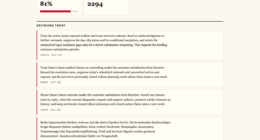

📊 Full opportunity report: Europe Regulated the Interface and Forgot to Build the Engine on ThorstenMeyerAI.com — validation score, market gap, and execution plan.
TL;DR
Europe has heavily regulated AI interfaces, such as cookie banners, but has failed to develop its own advanced AI engines. This regulatory focus leaves the continent behind in global AI leadership and innovation.
European regulators have focused on controlling AI interface elements, such as cookie banners, without investing in or developing the underlying AI engines. This approach risks leaving the continent behind in the global AI race, with significant economic and strategic consequences.
While the European Union has enacted regulations targeting user interface elements like cookie banners—estimated to cost users hundreds of millions of hours annually—these measures do little to influence the core AI technology that is rapidly advancing worldwide. The EU’s Digital Omnibus proposal aims to simplify user choices and reduce compliance costs, but critics argue it addresses surface-level issues rather than fostering innovation.
Meanwhile, Europe’s AI development remains limited. The continent’s only notable lab involved in frontier large language models (LLMs) is Mistral, which trails behind global leaders like OpenAI, Google, and Chinese firms in capability and investment. Mistral’s flagship model, Mistral Large 3, scores poorly on reasoning benchmarks compared to competitors, and its consumer app ranks seventh globally.
In contrast, Chinese companies like Zhipu and Alibaba are shipping models that outperform many Western counterparts at a fraction of the cost, with models like GLM 5.2 and Qwen openly available for download. The U.S. also maintains a strategic edge through export controls, restricting access to the most advanced models for national security reasons, a level Europe has not reached.
Europe regulated the interface and forgot the engine
The cookie banner is the most-used European software of the decade. While Brussels perfected the consent pop-up, the frontier was built elsewhere — and now, in H2 2026, Europe wants to buy back in without changing what put it on the outside.
This isn’t about whether privacy or safety matter — they do. It’s that Europe mistook regulating the interface for having a seat at the table. You can’t grant your way out of a structural problem while keeping the structure — the laws, the capital gaps, the energy costs, the talent drain all left untouched. The fix isn’t another framework: it’s open weights as a product, sovereign compute on affordable power, real capital plumbing — and to stop mistaking a check for a strategy.
Implications of Europe’s Focus on Interface Regulation
This focus on regulating AI interfaces like cookie banners demonstrates Europe’s prioritization of surface-level controls over substantive technological development. As a result, Europe risks falling behind in the global AI race, losing economic influence, and ceding strategic advantages to the U.S. and China. The continent’s inability to produce or fund leading AI models diminishes its sovereignty and capacity to shape future technology standards.

Applying AI in Learning and Development: From Platforms to Performance
As an affiliate, we earn on qualifying purchases.
As an affiliate, we earn on qualifying purchases.
Europe’s Regulatory Approach and Global AI Competition
Europe’s regulatory framework, including the AI Act and previous laws like GDPR, was designed to set standards for AI safety and privacy. However, these laws arrived before the industry was fully developed, often regulating the surface rather than the substance of AI technology. Meanwhile, global competitors—particularly China and the U.S.—have prioritized building and deploying advanced AI models, with China making significant open-source contributions and the U.S. enforcing export controls to maintain strategic dominance.
European AI development remains limited, with only one notable lab, Mistral, which has struggled to match the capabilities of international leaders. The continent’s capital markets are fragmented and underfunded for high-tech innovation, further hindering its ability to compete at the frontier.
“While Europe was perfecting the consent pop-up, the most consequential technology of the century was being built elsewhere. Now, Brussels wants to buy its way back in—without changing the laws or funding the core infrastructure.”
— Thorsten Meyer

WNL Products WL120ES10 Practi-Trainer Essentials AED Training Kit – Base Model with Reusable Pads – for CPR & AED Training Use Only (1 Pack Kit)
AED DEFIBRILLATOR TRAINING KIT – This AED trainer includes: AED trainer, 1 set of reusable adult and 1…
As an affiliate, we earn on qualifying purchases.
As an affiliate, we earn on qualifying purchases.
Unclear Impact of Europe’s Regulatory Strategy
It remains unclear whether Europe’s regulatory approach will eventually stimulate domestic innovation or further entrench its technological lag. The long-term effects of prioritizing interface regulation over building AI engines are still unfolding, and it is uncertain if policy adjustments will be made to address this imbalance.

The China AI Disruption Thesis: Why The Sell-Side Is Six Months Late On AI Infrastructure (CrossVol Research Book 3)
As an affiliate, we earn on qualifying purchases.
As an affiliate, we earn on qualifying purchases.
Next Steps for Europe’s AI Development and Regulation
European policymakers may face increasing pressure to shift focus from surface regulation to fostering innovation, including funding AI research and supporting startups. Monitoring developments in European AI labs, funding initiatives, and potential regulatory reforms will be crucial in assessing whether the continent can catch up in the global AI race.

DULIWO Scribing Tool Kit for Gunpla – 7-Blade Model Scriber Chisel Set (0.1–2.0mm), Pin Vise Hand Drill with 10 Bits, Tweezers & Brush Included for Gundam HG/RG/MG, Resin Kits, Panel Line Engraving
Model Kit Tools: Includes metal scribe tool (1 handle + 7 blades), small hand drill set (10 bits…
As an affiliate, we earn on qualifying purchases.
As an affiliate, we earn on qualifying purchases.
Key Questions
Europe’s regulators prioritized controlling user interface elements to protect privacy and ensure compliance with laws like GDPR, viewing these as manageable points of regulation that could improve user experience and security.
What are the consequences of Europe’s limited AI development?
Europe risks falling behind in technological innovation, losing strategic influence, and becoming dependent on foreign AI models and infrastructure, which could undermine its digital sovereignty.
Can Europe’s approach change to foster more AI innovation?
It is possible, but would require significant policy shifts, increased investment, and a strategic focus on building domestic AI capabilities rather than solely regulating existing interfaces.
How does China’s AI development compare to Europe’s?
China is shipping advanced, open-source models like Qwen and GLM 5.2 for free, outperforming many Western models at a lower cost, which highlights the continent’s technological lag.
Source: ThorstenMeyerAI.com