
Educational science reference charts range from pocket-sized laminated study guides to large classroom wall posters, and the right choice depends on where and how the material will actually get used. For a single chart that covers the most ground, the Earth Science QuickStudy Laminated Reference Guide stands out as my best overall pick — it is durable, densely packed with curriculum-aligned content, and works equally well in a binder or on a wall. Students focused on chemistry will get more mileage from the Jauisus Double-Sided Periodic Table, which packs two complementary views of the elements into one laminated sheet, while teachers outfitting a whole classroom should look at the 17-poster physics set for sheer wall coverage. The main tradeoff in this category is portability and depth versus display size: QuickStudy guides condense a lot of information into a small footprint, while large posters are easier to reference from across a room but cover less detail per topic. Keep reading for the full breakdown of all eight charts and which one fits your situation best.
Key Takeaways
- The QuickStudy laminated guides dominated this comparison on information density — no poster set matched the depth packed into their binder-friendly format.
- Periodic table charts made up half the lineup, and the double-sided Jauisus sheet offered better study value than single-sided posters because it pairs a standard table with extra reference data on the reverse.
- The 17-poster physics set is the clear classroom-display winner, but its per-topic depth is thin compared with any single-subject QuickStudy guide.
- Lamination quality separated the top performers: charts that resisted glare and held up to handling earned higher rankings than similarly priced options that scuffed or curled.
- Grade-level labeling matters more here than price — the middle-school life science chart and the college-level physics guide cover overlapping disciplines at very different depths, so matching the chart to the student’s level is the single biggest buying decision.
| Earth Science: A QuickStudy Laminated Reference Guide |  | Best Overall Study Companion | Format: Laminated reference guide | Subject: Earth science | Publisher Series: QuickStudy Laminated Reference Guide | VIEW LATEST PRICE | See Our Full Breakdown |
| 2 A5-Size Periodic Table Of Elements Chart For High School & College |  | Best Value Pick | Size: 8.5 x 6 inches (A5) | Quantity: 2 charts | Content: All elements with atomic numbers, symbols, weights | VIEW LATEST PRICE | See Our Full Breakdown |
| Science Fundamentals 1 – Life Science – Cells, Plants & Animals: for Middle School – QuickStudy Laminated Reference & Study Guide | 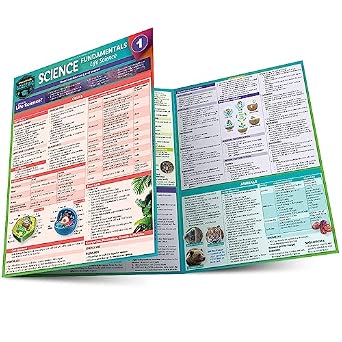 | Best for Middle Schoolers | Format: Laminated reference and study guide | Subject: Life science — cells, plants, animals | Publisher Series: QuickStudy Science Fundamentals | VIEW LATEST PRICE | See Our Full Breakdown |
| Jauisus Laminated Periodic Table of Elements Chart, Double-Sided Chemistry Reference Sheet |  | Best Desk Reference | Material: Laminated paper | Size: 8.7 x 11.65 inches | Type: Educational reference poster | VIEW LATEST PRICE | See Our Full Breakdown |
| gisgfim 3 Pieces Large Periodic Table of Elements Chemistry Posters |  | Best Classroom Display | Size: 43 x 29 cm (17 x 11.5 inches) per poster | Quantity: 3 posters | Material: Durable paper with waterproof film | VIEW LATEST PRICE | See Our Full Breakdown |
| 17 Laminated Physics Posters – Forces, Electrical Circuits, Energy, Acceleration – Educational Science Charts for Middle & High School, 11”x16” |  | Best In-Depth Physics Wall Set | Number of Posters: 17 | Size: 11″ x 16″ | Material: Laminated thick paper with PET film coating | VIEW LATEST PRICE | See Our Full Breakdown |
| Physical Science – Physics & Chemistry: A QuickStudy Laminated Reference Guide |  | Best Portable Study Reference | Format: Laminated quick-reference guide | Subjects: Physics and Chemistry | Content Type: Concise summaries and essential formulas | VIEW LATEST PRICE | See Our Full Breakdown |
| Science Posters for Classroom Middle School – 4-Pack Periodic Table Poster |  | Best Classroom Decor Bundle | Number of Posters: 4 | Size: 11″ x 17″ | Material: Laminated | VIEW LATEST PRICE | See Our Full Breakdown |
| educational science reference chart | Size | Durability | Material |
|---|---|---|---|
| Earth Science: A QuickStudy La | — | Laminated, wipe-clean surface | — |
| 2 A5-Size Periodic Table Of El | 8.5 x 6 inches (A5) | — | — |
| Science Fundamentals 1 | — | Laminated surface | — |
| Jauisus Laminated Periodic Tab | 8.7 x 11.65 inches | — | Laminated paper |
| gisgfim 3 Pieces Large Periodi | 43 x 29 cm (17 x 11.5 inches) per poster | — | Durable paper with waterproof film |
| 17 Laminated Physics Posters | 11" x 16" | Waterproof and tear-resistant | Laminated thick paper with PET film coating |
| Physical Science | — | Laminated for frequent use | — |
| Science Posters for Classroom | 11" x 17" | — | Laminated |
More Details on Our Top Picks
Earth Science: A QuickStudy Laminated Reference Guide
When I weigh reference charts for actually learning and reviewing rather than decorating a wall, this Earth Science guide stands out as the most balanced pick in the lineup. Its condensed, syllabus-style layout condenses broad concepts into a format a student can slip into a backpack and revisit before an exam — something the larger decorative options like the gisgfim 3 Pieces Periodic Table Posters simply aren’t built for. Compared with the Science Fundamentals 1 middle school guide, this one spans a wider subject range, which explains its top billing: it serves more students across more courses. The tradeoff is depth. Anyone expecting textbook-level explanations or practice problems will find it thin, and it covers Earth science only, so chemistry students should look at the periodic table options instead.
Pros:- Extremely portable — fits in a binder or backpack without folding
- Laminated surface survives daily handling and spilled drinks
- Covers broad Earth science topics in one concise sheet
- Well-suited to rapid pre-exam review sessions
Cons:- Too brief for advanced or honors-level coursework
- No practice questions or self-assessment material
Best for: High school and early college students who need a durable, portable cheat sheet for Earth science exams and quick review
Not ideal for: Students who need worked examples, practice questions, or advanced AP-level depth — this is a summary tool, not a textbook substitute
- Format:Laminated reference guide
- Subject:Earth science
- Publisher Series:QuickStudy Laminated Reference Guide
- Durability:Laminated, wipe-clean surface
- Portability:Binder-compatible single sheet
- Intended Use:Quick study and review
- Audience:Students and science enthusiasts
Our verdict“Buy this if you want a rugged, grab-and-go summary of Earth science concepts rather than a wall display.”
2 A5-Size Periodic Table Of Elements Chart For High School & College
Two charts for the price of one is the whole argument here, and it’s a good one. This dual-pack A5 set makes the most sense for students who want a periodic table at home and in a school binder without paying twice — a smarter spend than buying a single larger sheet like the Jauisus Double-Sided Chart, which offers similar information but only one copy. The inclusion of chemical equations alongside element data adds homework utility that pure decoration posters lack. The honest limitation is size: A5 means small type and cramped detail, so students doing serious stoichiometry work may squint at atomic weights. It’s also strictly analog — no digital companion — so buyers wanting richer interactivity will need a separate app. For budget-conscious chemistry students, though, the value math is hard to beat.
Pros:- Two-chart pack lets students keep one at home and one at school
- Includes atomic numbers, symbols, weights, plus chemical equations
- Compact size slips into binders and notebooks easily
- Low cost per chart compared with single-poster alternatives
Cons:- A5 dimensions make fine details hard to read
- Reference-only design with no interactive or digital component
Best for: High school and college chemistry students on a budget who want periodic table access in multiple locations
Not ideal for: Students or teachers who need a large, wall-visible reference for group study — the A5 format is too small for shared viewing
- Size:8.5 x 6 inches (A5)
- Quantity:2 charts
- Content:All elements with atomic numbers, symbols, weights
- Extras:Essential chemical equations
- Audience:High school and college students
- Intended Use:Homework, study sessions, lab reference
Our verdict“Grab this two-pack if you want affordable, portable periodic table coverage for study sessions in two places at once.”
Science Fundamentals 1 – Life Science – Cells, Plants & Animals: for Middle School – QuickStudy Laminated Reference & Study Guide
Age-appropriateness is where this guide earns its slot. While the Earth Science QuickStudy guide casts a wider net, this one is purpose-built for middle school life science curricula, matching what students actually see on cells, plants, and animals at that grade level — no overwhelming college detail, no babyish simplification either. The laminated format means it can live in a messy backpack all year, a durability advantage over unlaminated classroom posters like the 17 Laminated Physics Posters set’s paper-based cousins. Where it falls short is engagement and reinforcement: there are no practice questions or exercises, so it works as a review aid rather than a teaching tool, and advanced learners will outgrow it quickly. Compared with the A5 periodic table pack, it’s a single-subject purchase, so families covering multiple sciences will need additional guides.
Pros:- Content maps directly to middle school life science standards
- Laminated build handles daily backpack wear
- Focused scope keeps young students from feeling overwhelmed
- Effective for quick pre-quiz concept reinforcement
Cons:- No practice questions or exercises to test understanding
- Too shallow for advanced learners or high school review
Best for: Middle school students and parents who need a curriculum-matched life science review sheet that survives a school year
Not ideal for: Advanced or gifted students who need deeper explanations — the content deliberately stays at grade level
- Format:Laminated reference and study guide
- Subject:Life science — cells, plants, animals
- Publisher Series:QuickStudy Science Fundamentals
- Grade Level:Middle school
- Durability:Laminated surface
- Intended Use:Learning and quick review
- Practice Material:None included
Our verdict“This is the right pick for a middle schooler who needs a durable, grade-appropriate life science summary — skip it for anything above that level.”
Jauisus Laminated Periodic Table of Elements Chart, Double-Sided Chemistry Reference Sheet
The double-sided design is the differentiator here, and it changes how the chart functions in practice. Where the A5 two-pack splits content across two small sheets, this 8.7 x 11.65-inch single chart uses its front and back to deliver more reference material in one desk-sized footprint — big enough to read comfortably, small enough to store flat in a drawer or prop beside a laptop. That middle sizing is its real advantage over both the tiny A5 charts and the larger gisgfim wall posters, which demand wall space. The laminated surface handles lab environments well. The compromises are real though: content stays at the basic element-information level, so it won’t replace a detailed chemistry study guide, and unlike the gisgfim set, mounting hardware isn’t part of the package. It’s a workhorse, not a showpiece.
Pros:- Double-sided layout doubles reference content without doubling footprint
- Desk-friendly size balances readability with storage
- Laminated surface wipes clean and tolerates lab conditions
- Flat single-sheet format stores easily in drawers or folders
Cons:- Limited to basic element information and formulas
- No mounting accessories included for wall display
Best for: Chemistry students and lab users who want a readable, storable single-sheet reference at their workspace
Not ideal for: Teachers wanting bold classroom wall decor — this size is easy to read up close but hard to see across a room
- Material:Laminated paper
- Size:8.7 x 11.65 inches
- Type:Educational reference poster
- Sides:Double-sided
- Content:Element information and formulas
- Audience:High school and college students
- Mounting Hardware:Not included
Our verdict“Choose this if you want one durable, readable periodic table for a desk or lab bench rather than a wall or binder.”
gisgfim 3 Pieces Large Periodic Table of Elements Chemistry Posters
If the goal is a room students actually look at every day, this set wins on presence. The 17 x 11.5-inch posters are larger and more visually assertive than anything else here — the Jauisus desk chart reads well at arm’s length, but these are legible from across a classroom, which is the whole point of wall-mounted reference material. Three copies mean a teacher can cover multiple walls or share between rooms, and the waterproof film coating plus included adhesive dots make installation genuinely simple, unlike options that ship with no mounting solution. The tradeoffs: at this size and quantity, it’s a bigger spend, and the posters prioritize visual clarity over dense study detail — a student cramming for an exam gets more from the QuickStudy guides. Home users with limited wall space will also find three posters excessive.
Pros:- Large format is readable from across a classroom
- Three-poster set covers multiple walls or rooms
- Waterproof, durable material holds up long-term
- Adhesive dots included for easy, damage-conscious mounting
Cons:- Higher total cost than single-sheet alternatives
- Designed for display rather than detailed close-up study
Best for: Chemistry teachers and tutors outfitting classrooms or study spaces who want large, always-visible periodic tables
Not ideal for: Home users or dorm residents with limited wall space — three large posters is more display than most personal setups need
- Size:43 x 29 cm (17 x 11.5 inches) per poster
- Quantity:3 posters
- Material:Durable paper with waterproof film
- Mounting:2 sheets of adhesive dots included
- Subject:Periodic table of elements / chemistry
- Design:Vibrant, detailed educational artwork
- Primary Setting:Classrooms and learning environments
Our verdict“Buy this set for a classroom or tutoring space where visibility matters most; choose a laminated guide instead if studying, not displaying, is the priority.”
17 Laminated Physics Posters – Forces, Electrical Circuits, Energy, Acceleration – Educational Science Charts for Middle & High School, 11”x16”
For physics teachers who want full wall coverage of a single subject, this 17-poster set is the strongest pick here. Compared with the Science Posters for Classroom Middle School 4-Pack, it trades colorful decor for genuine instructional depth — forces, circuits, energy, acceleration, and Newton’s Laws each get dedicated space with diagrams and explanations rather than a single-summary treatment. The PET film lamination holds up to daily classroom handling, which matters more at this scale since you’ll be mounting and remounting 17 sheets. The tradeoff is focus: it pairs well with a broad reference like the Physical Science QuickStudy guide for chemistry, but on its own it leaves that entire discipline uncovered.
Pros:- 17 posters give each physics topic room for real diagrams and explanations
- Waterproof, tear-resistant lamination survives daily classroom use
- Covers Newton’s Laws and circuits with clear, concise layout
- Spans both middle and high school difficulty levels
Cons:- Physics-only scope; chemistry and biology are absent entirely
- Requires substantial wall space to display the full set effectively
- 11×16 sheets can overwhelm small classrooms or home study areas
Best for: Physics teachers and middle/high school science departments building a dedicated physics wall for a semester or full year
Not ideal for: General science teachers or homeschoolers with limited wall space — 17 posters at 11×16 inches demand a lot of display real estate
- Number of Posters:17
- Size:11″ x 16″
- Material:Laminated thick paper with PET film coating
- Topics Covered:Forces, Electrical Circuits, Energy, Acceleration, Newton’s Laws
- Grade Level:Middle & High School
- Durability:Waterproof and tear-resistant
Our verdict“Buy this if you teach physics specifically and have the wall space; skip it if you need multi-subject coverage.”
Physical Science – Physics & Chemistry: A QuickStudy Laminated Reference Guide
Where the 17 Laminated Physics Posters set lives on the wall, this QuickStudy guide lives in a backpack — and that portability is its whole value proposition. It condenses both physics and chemistry into a laminated sheet of summaries and formulas, making it a natural desk companion for test prep or homework review rather than classroom decoration. Compared with the 4-Pack Periodic Table Poster set, it covers far more ground in a fraction of the space, but the density cuts both ways: there’s little room for worked examples or extended explanation, so students who need conceptual scaffolding will still need a textbook or teacher. Like the Earth Science QuickStudy guide, it shines as a rapid-review tool, not a primary learning resource.
Pros:- Combines physics and chemistry in one affordable reference
- Laminated surface survives daily handling and spilled drinks
- Fits in folders and backpacks for on-the-go review
- Concise formula summaries speed up test preparation
Cons:- Summaries only — lacks the step-by-step explanations struggling students need
- Does not extend into advanced or AP-level topics
- No blank space for personal notes or annotations
Best for: Middle and high school students who need a durable, carry-anywhere formula and concept sheet for homework and exam review
Not ideal for: Visual learners or younger students who benefit from large diagrams — the compact format skips detailed explanations
- Format:Laminated quick-reference guide
- Subjects:Physics and Chemistry
- Content Type:Concise summaries and essential formulas
- Durability:Laminated for frequent use
- Portability:Fits standard folders and backpacks
- Intended Users:Students and educators
Our verdict“This makes the most sense as a supplement for students who already understand the material and just need fast recall.”
Science Posters for Classroom Middle School – 4-Pack Periodic Table Poster
This 4-pack takes the opposite approach from the Physical Science QuickStudy guide: instead of dense reference material, it prioritizes visual engagement and room atmosphere. The rainbow color palette and modern styling are designed to make a middle school classroom feel inviting, and the periodic table, scientific method, and themed posters simplify big concepts into digestible visuals. Compared with the 17 Laminated Physics Posters, you give up subject depth and sheer quantity — four posters can’t anchor a full curriculum the way seventeen can — but you gain an affordable, low-commitment way to decorate a science wall. The 11×17 laminated format wipes clean easily, which teachers rotating rooms each period will appreciate.
Pros:- Four coordinated posters create a cohesive classroom theme in one purchase
- Vivid rainbow design makes science feel approachable for middle schoolers
- Laminated surface wipes clean for easy maintenance
- Simplifies complex concepts like the periodic table for younger learners
Cons:- Only four posters — far less topic coverage than larger sets like the 17-poster physics bundle
- Decor-first styling sacrifices the detail serious students need
- No stated age range, so fit varies by grade level
Best for: Middle school teachers decorating a science classroom on a budget who want fun, colorful visual anchors
Not ideal for: High school teachers or advanced students needing detailed, curriculum-matched reference content in depth
- Number of Posters:4
- Size:11″ x 17″
- Material:Laminated
- Topics:Periodic table, scientific method, science themes
- Orientation:Portrait and Landscape
- Style:Modern rainbow classroom decor
- Mounting Type:Wall mount, indoor use
Our verdict“Choose this if classroom environment matters as much as content; skip it if you need rigorous reference depth.”

How We Picked
I evaluated each chart against four criteria: content accuracy and depth, durability of the physical format, readability at its intended viewing distance, and value relative to price. Depth was judged by whether a chart could genuinely support study sessions — not just decorate a wall — which is why densely packed laminated guides ranked higher than flashier posters with thinner content. Durability came down to lamination quality, edge construction, and whether the chart could survive daily handling by students.
Readability was weighted differently depending on format: a pocket guide only needs to be legible at arm’s length, while a classroom poster fails if students in the back row cannot read it. Finally, I factored in versatility — charts that serve multiple grade levels or subjects scored better than narrowly focused ones at the same price. The final ranking favors options that balance all four criteria rather than excelling in just one, which is why the QuickStudy guides and the double-sided periodic table sit near the top while single-purpose poster packs land lower despite their visual appeal.
| educational science reference chart | Durability | Material |
|---|---|---|
| Earth Science: A QuickStudy La | Laminated, wipe-clean surface | — |
| 2 A5-Size Periodic Table Of El | — | — |
| Science Fundamentals 1 | Laminated surface | — |
| Jauisus Laminated Periodic Tab | — | Laminated paper |
| gisgfim 3 Pieces Large Periodi | — | Durable paper with waterproof film |
| 17 Laminated Physics Posters | Waterproof and tear-resistant | Laminated thick paper with PET film coating |
| Physical Science | Laminated for frequent use | — |
| Science Posters for Classroom | — | Laminated |
Factors to Consider When Choosing Educational Science Reference Charts
Before picking a specific chart, it helps to understand what actually separates a useful science reference from wall decoration. These are the factors that shaped my rankings and the ones most buyers get wrong.Match the Chart to the Actual Grade Level
The most common mistake in this category is buying a chart that is too advanced or too basic for the student using it. A college-level periodic table with electron configurations and electronegativity trends will overwhelm a middle schooler, while a simplified elementary chart will leave a high school AP student without the data they need for homework. Publishers label their charts by grade band for a reason, and those labels are generally reliable in this lineup. When in doubt, choose the slightly more advanced option — a student can grow into a detailed chart, but a chart that is too simple becomes useless within a semester. Also check whether the chart aligns with the curriculum your student is actually following, since state standards vary in when they introduce topics like atomic structure or force diagrams.
Laminated Guide Versus Wall Poster
This is the single biggest fork in the road, and it determines everything else about your purchase. A laminated reference guide lives in a binder or backpack, gets pulled out during homework and test prep, and rewards high information density. A wall poster works through passive exposure — students absorb the material by seeing it repeatedly over months. Neither is inherently better, but they serve completely different study habits. If your student crams at a desk, buy the guide; if they study in a room where a poster will stay visible daily, the poster delivers more value per dollar. Families often get this backwards and buy a beautiful poster that ends up behind a door, or a dense guide that never leaves the shelf.
Lamination and Print Quality
Not all laminated charts are made the same, and the differences show up within months of classroom use. Cheap lamination separates at the edges, curls in humid rooms, and produces glare under classroom fluorescent lighting that makes small text unreadable. Quality charts use thicker stock with sealed edges and a matte or low-gloss finish that holds up to handling and cleaning. Print resolution matters too — periodic tables are dense with small text, and low-resolution printing makes element symbols fuzzy at exactly the size students need to read them. If you are buying for a classroom rather than a single student, durability should weigh heavily, because a chart that gets touched by thirty students a day wears out ten times faster than one used at home.
Single Topic Versus Multi-Chart Sets
Bundles look like better value on paper, but only if every chart in the set is one you would have bought anyway. A 17-poster physics set costs more upfront than a single laminated guide, yet the per-chart price can be dramatically lower — the catch is that you may only need four or five of the topics. Sets also create a consistency problem in mixed classrooms, where a teacher covering both physics and chemistry may prefer mixing single-subject guides from the same publisher so the formatting stays familiar. My advice: buy a set when you are outfitting a full classroom or a dedicated science study space, and buy individual charts when you are targeting one specific subject or student weakness.
Size and Viewing Distance
Chart size should be dictated by where it will hang or how it will be handled, not by the assumption that bigger is better. An A5-size periodic table is genuinely useful as a desk reference but illegible from more than a couple of feet away, while a large-format poster reads clearly across a classroom but wastes its potential taped inside a binder. Measure the wall space before buying poster sets, because a 17-poster collection needs substantial room to display properly — cramming them together defeats the purpose. For dorm rooms and home study spaces, mid-size charts in the 11 by 16 inch range hit a practical middle ground. Also consider that larger charts cost more to ship and are harder to store between school years.
When to Pay More for a Reference Chart
Most single science charts sit in a low price band, so the real question is when a premium option justifies its cost. Pay more when a chart covers multiple years of coursework — a well-made periodic table serves a student from middle school through college, which amortizes the price over six-plus years. Pay more for double-sided formats that effectively give you two charts in one, and for classroom-grade lamination that survives daily use. Do not pay more for decorative styling, extra color, or branded packaging, because none of that improves study outcomes. The cheapest acceptable option is usually fine for a single subject a student will finish in one semester; spending up makes sense only for the reference charts that stay in use year after year.
Frequently Asked Questions
Is a laminated study guide better than a wall poster for actually learning the material?
It depends on how the student studies, and this is where most buyers misjudge their own habits. A laminated guide like the QuickStudy series rewards active use — pulling it out during homework, quizzing from it, annotating with dry-erase markers — so it works best for students who sit down and study deliberately. A wall poster works through repetition and passive exposure, which suits students who spend hours in the same room but rarely sit down to review. If a student is preparing for a specific exam within weeks, the guide wins clearly. For long-term familiarity with something like the periodic table, a visible poster can be surprisingly effective because the student absorbs the layout without conscious effort. Ideally, serious science students use both formats for different purposes.
How many periodic table charts do I actually need for a high school student?
One well-chosen chart is enough for most students, and the best option in this roundup is a double-sided version that pairs a standard table with supplementary data like element properties or common ions. A second chart only makes sense if it serves a different function — for example, a small desk-size table for homework alongside a large wall version for quick glances. Buying multiple single-sided periodic table posters is usually redundant, since they tend to show nearly identical information at different sizes. The exception is a multi-poster classroom pack, where the periodic table is one of several charts covering different topics. For a single student at home, put the budget toward one detailed, durable table rather than three similar ones.
Are the cheap multi-poster classroom sets worth buying for home use?
They can be, but only if the home has the wall space and the student is studying multiple covered topics. A 17-poster physics set designed for a classroom assumes you can dedicate substantial wall area, and pinning a dozen posters in a bedroom often is not realistic. The per-poster price is attractive, yet half the topics may not align with what the student is currently learning, which reduces the set to decoration until those units arrive. For home use, two or three individually chosen charts on the student’s current weak subjects deliver more study value. Sets make the most sense for teachers, tutors, or homeschool families with a dedicated classroom space.
What grade level are these charts actually appropriate for?
The lineup spans roughly middle school through college, and the labels are worth taking seriously. The middle-school life science chart covers cells, plants, and animals at a level that assumes no prior chemistry, while the physical science guides blend introductory physics and chemistry suited to grades 8 through 10. The college-oriented periodic tables include electron configurations, oxidation states, and trends that high schoolers in regular chemistry may not need yet but AP students will. A useful rule: if the chart contains vocabulary the student has not encountered in class, it is probably a year or two ahead and will still be useful later. Buying one level up is safer than buying one level down, since students outgrow simplified charts quickly but grow into advanced ones.
Do double-sided reference charts actually get used on both sides?
Honestly, less often than buyers expect, and that is worth knowing before paying a premium for the format. A double-sided chart hanging on a wall only displays one side at a time, so the reverse content goes unseen unless someone flips it deliberately. Where the format shines is desk and binder use, where flipping the sheet takes a second and the student genuinely benefits from the supplementary data. The Jauisus periodic table works well in this regard because both sides are designed for close-up study rather than wall display. If the chart is going on a wall, treat a double-sided purchase as buying one visible chart plus a backup. If it lives on a desk, both sides earn their keep.
Conclusion
After comparing all eight charts, the right pick comes down to who is using it and where. For the best overall value, the Earth Science QuickStudy Laminated Reference Guide delivers the most usable reference material per dollar in a format that survives years of handling. Students who want the best chemistry-specific option should choose the Jauisus Double-Sided Periodic Table, which effectively bundles two study references into one sheet. The best premium pick is the 17-poster physics set — it costs the most, but no other option covers as much wall space for a classroom or dedicated study room. For younger students and beginners, the Science Fundamentals 1 life science guide matches content to a middle schooler’s level without overwhelming them. Budget-conscious buyers get the best value from the A5 periodic table two-pack, which keeps one chart at the desk and one in a binder for pocket change. Whatever you choose, match the chart to the student’s grade level and study habits first — that decision matters more than any feature on the box.