
🔍 Read the full analysis: Inside The Creative Process For “Luciole — The Synchronous Fireflies Of Vallon Creux” on ThorstenMeyerAI.com

Prime made for students and young adults
- Fast, free delivery for dorm and study essentials
- Prime Video and Amazon Music included
- Member-only deals
TL;DR
“Luciole — The Synchronous Fireflies of Vallon Creux” is Room 155 in an AI-built exhibition series. Its fictional fireflies run in a live simulation that visitors can disturb and watch resynchronize; the exhibit also exposes the creative brief behind its design. The source describes the site and its intended features, but does not provide independent testing or visitor data.
Room 155 of the FABLE/175 exhibition series presents “Luciole — The Synchronous Fireflies of Vallon Creux,” an AI-built interactive website centered on a simulated group of fireflies whose flashes gradually synchronize, as described in the original analysis. The exhibit makes its creative process part of the presentation: its source material includes the art-direction prompt, while the experience lets visitors disturb the simulation and watch its pattern recover.
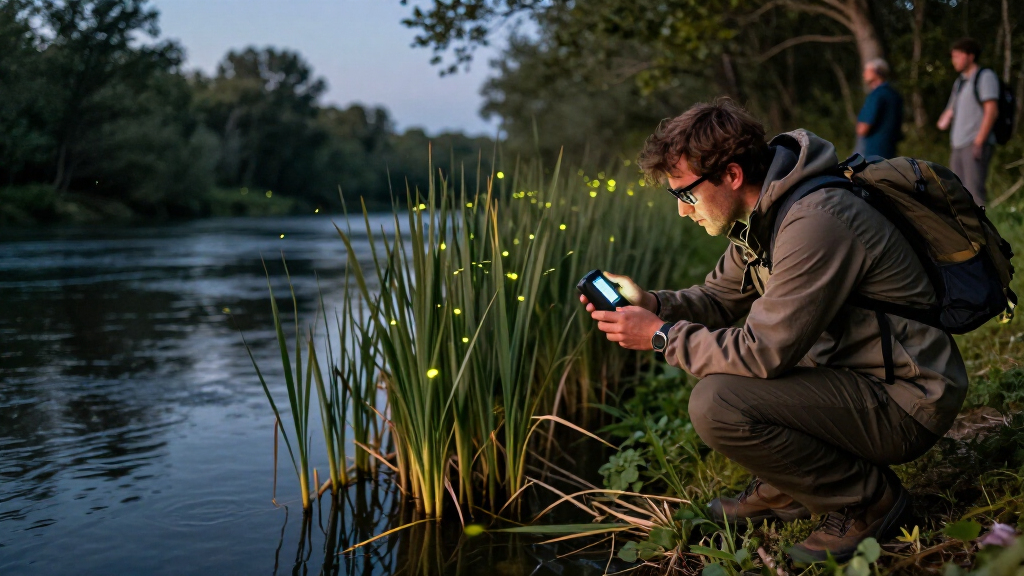
The room is an interactive field notebook, not a record of real fireflies or field research. Its source explicitly says that Luciole and Vallon Creux are fictional. The visual field begins with 96 simulated fireflies flashing out of sync. Visitors can change how strongly the simulated insects influence nearby neighbors, or use pointer interaction to scatter their phases. A live coherence measure, trace and phase diagram show changes in the simulation as they happen.
The exhibit’s design separates the imagined field from the observer’s notebook. A near-black green palette sets off chartreuse flashes, while muted mauve marks notes and annotations. Literary serif text carries the main narrative; a handwritten-style face appears in marginal details. The source describes long passages and off-center notes as choices intended to encourage a slower visit rather than a quick scan.
Its visuals are described as generated with HTML, CSS, SVG and canvas, without downloaded image assets or a prerecorded firefly sequence. CSS shapes form the insects, and prepared glow sprites support the animation. The source also lists accessibility and performance features, including reduced-motion handling, focus styling, announced state changes, a mobile field map, and pausing the simulation when relevant views are offscreen or the page is hidden.
FABLE/175 · Room 155 · Creative process
Inside the Creative Process for Luciole
A fictional firefly field becomes an interactive notebook: visitors can unsettle its rhythm, watch it resynchronize, and inspect the art-direction brief behind the experience.
01 / The premise
A field notebook that changes as you touch it
The exhibit begins with a group of simulated fireflies flashing out of step. Visitors can change how strongly neighbors influence one another or scatter the phases with pointer interaction, then follow the pattern as it recovers.
Interaction
Disturb the rhythm
Pointer input disrupts the simulated phases, making the visitor an active observer of the model’s changing pattern.
Live signals
Read the response
A coherence measure, trace, and phase diagram display changes in the simulation as they happen.
What it is
Fiction, made legible
Luciole and Vallon Creux are fictional. This is an interactive field notebook, not field research or a record of real fireflies.
02 / The simulation
Local nudges, emerging order
The exhibit frames each firefly as an oscillator with its own phase and tempo. Signals from nearby neighbors nudge its timing; a coupling control adjusts the strength of that influence. This model creates the visual behavior and does not document a real species.
03 / The creative brief
From art direction to field guide
The source says the room’s footer links to the verbatim prompt. Its brief specifies visual language, technical limits, and the interaction concept, allowing visitors to compare stated intent with the published experience.
“Every visual is code (CSS/SVG/canvas/WebGL) — no image assets required.”Art-direction brief reproduced by the exhibition
The source describes HTML, CSS, SVG, and canvas visuals, including CSS-shaped insects and prepared glow sprites. It says the site uses no downloaded image assets or prerecorded firefly sequence.
04 / Design language
Two layers: imagined field, observer’s notes
The visual system separates the firefly scene from the notebook around it. The source describes these choices as a way to encourage a slower visit rather than a quick scan.
The field
Darkness & chartreuse
A near-black green palette sets off chartreuse flashes, giving the simulated field a sense of depth and focus.
The notebook
Literary, annotated
Serif text carries the narrative; muted mauve and handwritten-style marginal details mark the observer’s notes.
The pace
Room to linger
Long passages and off-center notes are described as deliberate choices that reward a slower reading rhythm.
05 / Evidence boundary
What the source does not verify
The supplied material describes the site and its intended features. It does not include independent testing or visitor data.
06 / Visitor guide
Questions the room invites
Is Vallon Creux a real place?
No. The source identifies both Vallon Creux and Luciole as fictional creations for the exhibit.
How does synchronization work?
Each simulated firefly has a phase and tempo. Neighbor signals influence its rhythm, and coupling changes the strength of that influence.
Can visitors change the simulation?
Yes. They can adjust coupling and use pointer interaction to disturb phases, then watch the field respond under the same model rules.
Was the site made entirely by AI?
The source calls it AI-built and reproduces its prompt, but does not explain the tools or human involvement enough to establish that every part was made by AI.
Does it use real firefly footage?
The source describes generated visuals made with HTML, CSS, SVG, and canvas, with no downloaded image assets or prerecorded firefly sequence.
Where can the brief be found?
The source points to the live Luciole room and says its footer includes a “Prompt” link to the creative brief.
Making the Simulation Part of the Art
The exhibit’s central idea is visible in its interaction: order emerges from local adjustments, rather than being presented as a fixed animation. A visitor can interrupt the apparent rhythm and observe whether the model settles again. That makes the underlying process legible and gives the audience a role in testing what the screen depicts.
It also offers a compact example of AI-assisted creative production in which the prompt is not hidden from view. The brief supplied with the source spells out the desired visual language, technical constraints and interaction concept. Showing that material lets visitors compare a stated intention with the finished experience. The source does not establish how much work was automated, how the AI system was used at each stage, or whether the described features have been independently evaluated.
interactive firefly simulation software
As an affiliate, we earn on qualifying purchases.
As an affiliate, we earn on qualifying purchases.
From Creative Brief to Field Guide
The source identifies Luciole as Room 155 of 175 and links to a live version hosted on Netlify. It describes the entry as built by AI and says the exhibition exposes the verbatim art-direction brief through a “Prompt” link in the room’s footer. The brief calls for a single-page showcase using self-contained HTML, CSS and JavaScript, with no frameworks, external requests or image assets.
The prompt frames the site around Kuramoto synchronization, a mathematical model of coupled oscillators. In the exhibit’s account, each firefly has a phase and tempo; neighboring signals nudge its timing, while a coupling control changes the strength of that influence. This is a model used to create the visual behavior, not evidence about a real species or a documented field study. The source also includes proposed content about invented species and a two-week season calendar, but does not detail how those elements appear in the live experience.
““Breaking the sync and watching it heal.””
— Art-direction brief reproduced by the exhibition
As an affiliate, we earn on qualifying purchases.
What the Source Does Not Verify
The supplied material describes the site’s design and behavior but provides no independent technical review, performance measurements, accessibility audit or visitor figures. It does not specify when the site went live, whether all parts of the original brief were implemented, or what AI tools and human contributions were involved in each production pass.
The source mentions 96 simulated fireflies in its description, while the reproduced brief requests “hundreds.” It does not explain whether this reflects a change during development or different versions of the experience. The fictional setting should not be read as a report about real firefly populations, their mating behavior or seasonal patterns.
As an affiliate, we earn on qualifying purchases.
The Live Room and Its Prompt
The source points readers to the live Luciole room and says the creative brief can be opened from the page footer. Visitors can use those materials to compare the stated design goals with the published experience. No later update, exhibition event or additional reporting milestone is specified in the source.
As an affiliate, we earn on qualifying purchases.
Key Questions
Is Vallon Creux a real place?
No. The source says Vallon Creux and Luciole are fictional creations for the exhibit, not a real location, company or field study.
How does the firefly synchronization work?
The exhibit models each simulated firefly as an oscillator with its own phase and tempo. Signals from nearby neighbors influence those rhythms, and a coupling control changes the strength of that influence.
Can visitors change the simulation?
Yes. According to the source, visitors can adjust coupling and use pointer interaction to disturb the phases, then watch the field respond under the same model rules.
Was the site made entirely by AI?
The source describes the site as AI-built and reproduces its art-direction prompt, but it does not explain the tools, human involvement or division of work in enough detail to establish that every part was made by AI.
Does the exhibit use real firefly footage?
The source says the visuals are generated with HTML, CSS, SVG and canvas, with no downloaded image assets or prerecorded firefly sequence. The animated insects are part of the simulation.
Source: ThorstenMeyerAI.com
Halloween Picks
halloween
As an affiliate, we earn on qualifying purchases.