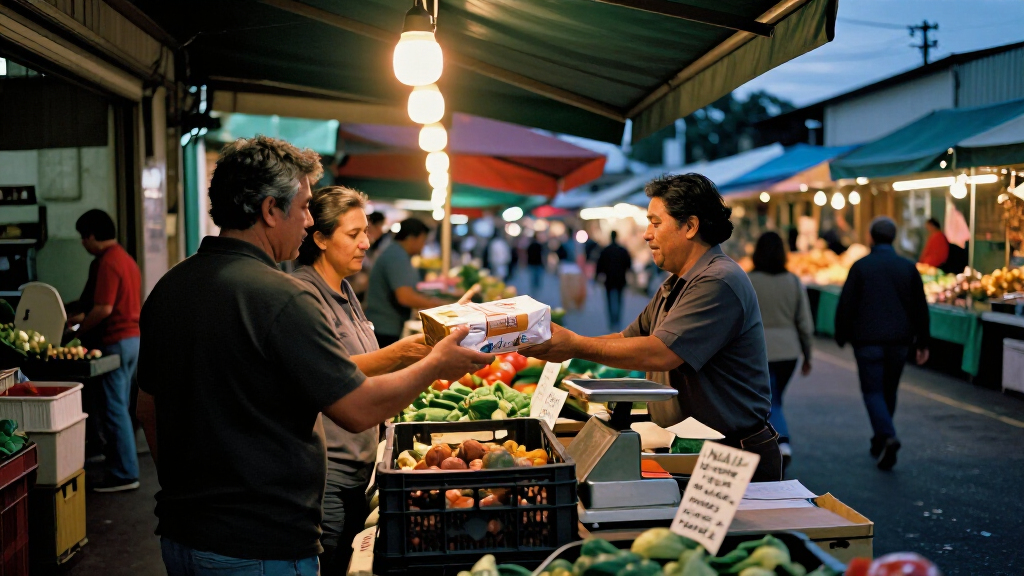

🔍 Read the full analysis: At The Closing Bell: Inside “Nightmarket — Mercado De Medianoche” (FABLE/175) on ThorstenMeyerAI.com

Prime made for students and young adults
- Fast, free delivery for dorm and study essentials
- Prime Video and Amazon Music included
- Member-only deals
TL;DR
ThorstenMeyerAI.com has published a field guide to “Nightmarket — Mercado de Medianoche,” a live digital scene designed to change as closing time approaches. The guide describes time-based visual changes, but provides no technical specifications, performance data or details about how the live room is implemented.
ThorstenMeyerAI.com has published a field guide to “Nightmarket — Mercado de Medianoche”, a live digital market scene designed to change as the evening winds down. The project uses time as a design mechanism, with shifts in lighting, steam and stall activity intended to make the space feel less busy and eventually nearly empty.
The guide presents Nightmarket as both a live room and a design teardown. Its central idea is that a digital environment can convey the passage of time through a sequence of small atmospheric changes, rather than remaining a fixed image or merely displaying a status update. The described scene combines lantern-like warmth, imperfect neon and rising steam to evoke a market operating after dark.
As the scene progresses, the market is described as moving from busy toward nearly gone, with the final stalls beginning to disappear. The guide says the effects work together to suggest a lived-in place, rather than a polished backdrop. It does not provide code samples, a named software stack, timing intervals or a detailed account of the mechanics behind the changes.
The page invites readers to see the room live and read the full teardown. It frames the project for readers interested in AI tools and automation, while describing a design concept rather than reporting a measured test or a claim that the approach has been adopted elsewhere.
Field Guide · Live Digital Scene · FABLE/175
At the Closing Bell: Inside “Nightmarket — Mercado de Medianoche”
A digital market winds down through small shifts in light, steam, and activity. Its central design idea is simple: let time shape the atmosphere.
Paired with a design teardown
Atmosphere changes as closing nears
Stalls begin to disappear
No measured user or performance results
A market with a clock
Rather than remain a fixed image, Nightmarket is described as a scene that gradually changes. Visual details work together to suggest a place with a routine and an approaching end to the trading night.
Lantern-like warmth
Warm light establishes the nighttime setting and gives the market an inviting glow.
Imperfect neon
Uneven neon contributes a lived-in quality, rather than the feel of a polished backdrop.
Rising steam
Steam adds visible motion to the scene as activity gradually subsides around it.
Night market
Warm light and neon establish the scene.
In motion
Steam and stall activity suggest a working market.
Winding down
The atmosphere shifts from busy toward quiet.
Nearly gone
The final stalls begin to disappear.
A design proposition, not a measured result
The project frames time-based details as a way to make a digital space feel more lived-in. The description offers a design concept to explore, without reporting whether visitors respond differently.
“Instead of treating atmosphere as a static visual layer, the room uses time as a design mechanism.”
ThorstenMeyerAI.com“When the final stalls begin to disappear, one question remains: what does the scene leave behind?”
ThorstenMeyerAI.comSmall atmospheric changes become the story of a market reaching the end of its night.
Reading of the stated design premiseVisit the room. Watch the sequence.
The guide points readers to a live room and a full design teardown. Observing the experience over time is the practical next step for judging how the visual sequence supports the idea.
What changes?
Note how light, neon, steam, and stall activity shift as the room approaches closing.
Does it feel coherent?
Consider whether the details build a convincing progression rather than isolated effects.
What remains unknown?
Implementation details and visitor evaluations are not included in the available description.
What we know—and what is open
What is Nightmarket?
A live digital market scene accompanied by a field guide describing how its atmosphere changes as closing time approaches.
What changes as it winds down?
Lantern-like warmth, imperfect neon, rising steam, and activity that fades toward a nearly empty market.
Does the guide explain the implementation?
No. The available description does not name the software, code, timing intervals, or clock mechanics.
Has the approach been shown to work better?
No user-testing results or performance comparisons are supplied. The effect remains a design premise.
Where can readers explore it?
ThorstenMeyerAI.com links to the live room and the full design teardown.
Is a next phase announced?
The description gives no release date, roadmap, or planned next phase.
Why a Digital Market Needs a Clock
Nightmarket offers a specific example of how time-based interaction can shape the mood and meaning of a digital environment. A gradual winding-down sequence gives visitors cues about what is happening in the scene without relying only on text or a conventional interface indicator. That could be relevant to designers of generative environments and responsive interfaces, although the guide does not establish how well the approach works with users.
The concept also shifts attention from a scene’s appearance at one moment to its changes over time. If the details accumulate coherently, a space may feel as though it has a routine and a history. For readers working with AI and automation, that is a design proposition to explore—not evidence, on its own, of a new technical capability or a proven improvement in engagement.
As an affiliate, we earn on qualifying purchases.
From Static Backdrop to Closing Time
The project’s stated premise is that a convincing digital market may feel more alive when it has a closing time. Rather than treating atmosphere as a fixed visual layer, the guide describes a scene that changes in stages: warm lights and neon establish the night market, steam adds movement, and the activity gradually subsides.
The title pairs the English word “Nightmarket” with the Spanish phrase “Mercado de Medianoche.” The available description does not explain the setting’s narrative, identify a particular market or provide a broader production timeline. Its focus is the design logic behind the live scene and the combined effect of its visual details.
“What if the most convincing way to make a digital market feel alive were to give it a closing time?”
— ThorstenMeyerAI.com
As an affiliate, we earn on qualifying purchases.
How the Live Scene Is Built
The available description does not specify which tools or code power the room, how its clock is set, or whether the changes run on a fixed schedule or respond to visitor activity. It also does not state how long the scene takes to wind down, whether visitors can alter its progression, or what remains visible once the stalls disappear.
No user testing, performance figures or comparisons with static scenes are supplied. The claim that time-driven details can make a digital space feel more lived-in is presented as the project’s design premise; its effects on visitors are not quantified in the material provided.
As an affiliate, we earn on qualifying purchases.
Live Visit and Full Design Teardown
Readers can visit the live Nightmarket room and consult the full design teardown linked by ThorstenMeyerAI.com. Those materials may offer more detail about the visual sequence and implementation. The available description does not announce a release date, roadmap or planned next phase, so it is unclear whether further technical information or updates are expected.
The main next step for anyone assessing the idea is to inspect the room as it changes and compare that experience with the guide’s explanation. Until implementation details or user evaluations are published, the project is best understood as a design example built around the passage of time.
Source: ThorstenMeyerAI.com
As an affiliate, we earn on qualifying purchases.
Key Questions
What is “Nightmarket — Mercado de Medianoche”?
It is a live digital market scene accompanied by a field guide that describes how its atmosphere changes as closing time approaches.
What changes as the scene winds down?
The guide describes lantern-like warmth, imperfect neon, rising steam and a gradual shift from a busy market toward a nearly empty one, with final stalls beginning to disappear.
Does the guide explain the technical implementation?
It describes the clock-driven design idea, but the available description does not identify the code, software stack, timing intervals or other implementation specifics.
Has the project shown that time-based scenes work better?
No user-testing results or performance comparisons are provided. The guide presents time as a way to make a digital space feel more lived-in, but does not quantify that effect.
Where can readers see the project?
ThorstenMeyerAI.com links to a live room and the full design teardown for Nightmarket.
Source: ThorstenMeyerAI.com
Halloween Picks
halloween
As an affiliate, we earn on qualifying purchases.