TL;DR

Prime made for students and young adults
- Fast, free delivery for dorm and study essentials
- Prime Video and Amazon Music included
- Member-only deals
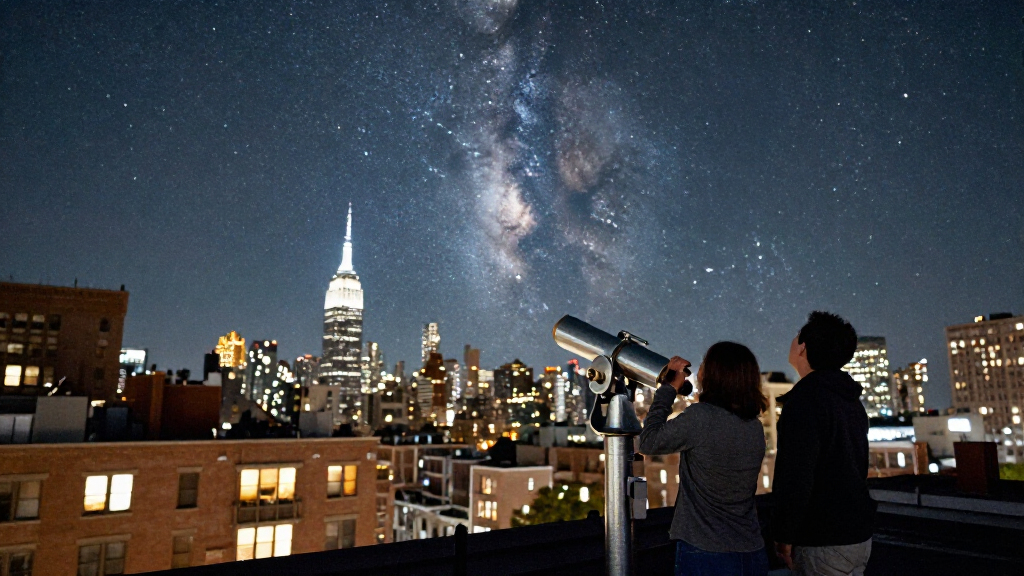
NASA’s Astronomy Picture of the Day for October 15, 2026, features the Milky Way above Manhattan in an image credited to Jason Kurth and Ty Buckley. The photograph uses a near-infrared filter that blocks much of the visible-light pollution from the city, while still recording stars that emit near-infrared light.
NASA’s Astronomy Picture of the Day for October 15, 2026, shows the Milky Way above Manhattan, an image made using a near-infrared filter to reduce much of the city’s visible-light glow. The photograph, credited to Jason Kurth and Ty Buckley, illustrates how changing the part of the light spectrum recorded can reveal stars against an urban setting.
The NASA Science explanation says the image was taken through a filter that blocks most visible light and captures light in the near-infrared, which has lower energy than visible light. The setup reduces interference from some sources of artificial lighting, making the Milky Way visible in the resulting photograph despite Manhattan’s bright surroundings.
NASA notes that the filtering is not a universal fix for city light. Incandescent bulbs and some neon lights remain bright in near-infrared, while fluorescent and LED lights do not, according to the explanation. Stars also emit near-infrared light, allowing them to appear in the image. The agency does not give technical details about the camera, exposure, filter specifications or the location and time of the photograph.
The daily image feature pairs an astronomical photograph with an explanation written by a professional astronomer. The October 15 entry is credited to Kurth and Buckley, with NASA listing Cecilia Chirenti, Robert Nemiroff, Jerry Bonnell and Keighley Rockcliffe as authors and editors. The page identifies the service as supported by NASA’s Astrophysics Science Division at Goddard Space Flight Center, NASA Science Activation and Michigan Technological University.
How Near-Infrared Reveals City Skies
The image offers a practical example of how astronomers can observe light beyond the range people see with their eyes. In this case, a filter changes which wavelengths reach the camera, reducing the contribution of several kinds of urban lighting while retaining near-infrared light from stars. The result does not mean Manhattan’s light pollution has disappeared; it shows that a photograph made in a different wavelength range can present the sky differently.
For readers, the distinction matters because the picture is not a straightforward view of what someone standing on a Manhattan street would see unaided. It is an image produced with specialized equipment and a filter, and its appearance reflects both the sky and the selected wavelength. NASA’s explanation makes the photograph a concise demonstration of how observational tools can extend what is visible from an urban environment.
The agency also frames the image as a reminder that people share the same sky and that astronomy can help explain humanity’s place in the cosmos. That is NASA’s stated interpretation of the picture, rather than a separate scientific finding reported with the image.
near-infrared astrophotography camera
As an affiliate, we earn on qualifying purchases.
As an affiliate, we earn on qualifying purchases.
The Daily Astronomy Picture
NASA’s Astronomy Picture of the Day presents a different image or photograph each day alongside an explanatory text. The format combines images from astronomy with short descriptions intended to explain what viewers are seeing and how it was recorded. The October 15 entry applies that format to an urban night-sky photograph, focusing on the role of a near-infrared filter.
The central contrast in the NASA account is between the visible-light glow that dominates a city sky and the near-infrared light recorded for this image. Different types of lamps emit differently across the spectrum. NASA says incandescent bulbs and some neon lighting still appear bright in near-infrared, but fluorescent and LED sources do not. Since stars also shine in near-infrared, the filter can reduce some forms of urban light while preserving the stellar signal.
The page lists “Chasing the ISS” as the picture scheduled for the following day. It does not provide further details about that upcoming image in the October 15 entry.
light pollution filter for telescopes
As an affiliate, we earn on qualifying purchases.
As an affiliate, we earn on qualifying purchases.
Details Behind the Photograph
NASA’s page does not specify the image’s exact exposure settings, camera equipment, filter passband or the precise viewing location. It also does not quantify how much artificial light the filter blocked or provide measurements comparing the image with a visible-light photograph of the same scene. Those details cannot be inferred from the explanation alone.
The entry describes which lighting types remain bright or are not bright in near-infrared, but it does not identify the individual light sources visible in the photograph. Nor does it claim that the Milky Way would be readily visible to the naked eye from Manhattan. The confirmed point is that the image was captured in near-infrared using a filter designed to block most visible light; its appearance is not presented as an unaided view.
urban night sky astrophotography kit
As an affiliate, we earn on qualifying purchases.
As an affiliate, we earn on qualifying purchases.
The Next APOD on October 16
NASA’s listing names “Chasing the ISS” as the next Astronomy Picture of the Day, scheduled for October 16, 2026. The October 15 page does not describe the upcoming image or offer additional technical information about the Manhattan photograph, so readers seeking those specifics would need a separate source or later publication from NASA.
The current entry stands as a visual and explanatory feature rather than an announcement of a new mission, instrument or research result. Its immediate takeaway is the method NASA describes: recording near-infrared light can limit some city-light interference and show stars in a setting where visible city lights otherwise dominate.
As an affiliate, we earn on qualifying purchases.
Key Questions
What does NASA’s October 15, 2026, APOD show?
It shows the Milky Way over Manhattan. NASA credits the photograph to Jason Kurth and Ty Buckley.
How was the Milky Way captured above the city?
NASA says the photographer used a filter that blocks most visible light and captures near-infrared light. Stars also emit near-infrared light, so they can appear in the photograph.
Does the photograph show what people can see with their eyes in Manhattan?
Not as described by NASA. The picture was made with a near-infrared filter, so it records light outside the visible range and should not be treated as a direct, unaided view of the night sky.
Does the filter block all city lighting?
No. NASA says old incandescent bulbs and some neon lights remain bright in near-infrared, while fluorescent and LED lights do not. The page does not give a measurement of how much city light was removed from this particular image.
What is the next Astronomy Picture of the Day?
The October 15 entry lists “Chasing the ISS” for October 16, 2026. It does not provide further information about that image.
Source: primary
Halloween Picks
halloween
As an affiliate, we earn on qualifying purchases.