For kids who prefer glowing slime, cobwebs, and gross-out chemistry to ordinary worksheets, these three kits turn spooky themes into hands-on STEM activities. I rank the Learning Resources Beaker Creatures Monsterglow Lab first for its black-light glow and younger age range, the Playz Disgusting & Gross Science Experiments Kit for its broad activity selection, and the National Geographic Gross Science Kit for families who want an illustrated guide with plenty of experiments to extend at home.

Prime made for students and young adults
- Fast, free delivery for dorm and study essentials
- Prime Video and Amazon Music included
- Member-only deals
The tradeoffs are practical: Monsterglow is the most atmospheric but relies on small button-cell batteries; Playz supplies many tools and ingredients but its gross theme is not for every child; and National Geographic lists 45 experiments, though only 15 use materials included in the kit. I focus on spooky appeal, usable activities, age fit, and what families need to supply, so the right choice depends on whether glow, variety, or a guided gross-science theme matters most.
Key Takeaways
- Best for glowing, creature-themed play: Learning Resources Beaker Creatures Monsterglow Lab combines more than 10 activities with a black light blaster and two collectible glow-in-the-dark creatures.
- Best for a wide supplied activity set: Playz includes over 34 tools and ingredients, with a colorful guide for gross-themed experiments aimed at ages 8–12.
- Best for extending experiments with household supplies: National Geographic lists 45 activities, but 30 require materials from home rather than the kit.
- Best younger-age fit: Monsterglow is listed for ages 5–10, while the two gross-science kits are aimed at older children, starting at age 8.
- Main choice to make: Pick Monsterglow for glow effects, Playz for included activity materials, or National Geographic for an illustrated guide and at-home follow-ons.
| Learning Resources Beaker Creatures Monsterglow Lab |  | Best Overall for Glowing Experiments | Brand: Learning Resources | Age range: 5–10 years | Experiments: More than 10 activities | VIEW LATEST PRICE | See Our Full Breakdown |
| Playz Disgusting & Gross Science Experiments Kit for Kids Ages 8-12 |  | Best for Gross-Themed Variety | Brand: Playz | Age range: 8–12 years | Activities: 34+ activities listed in the product highlights | VIEW LATEST PRICE | See Our Full Breakdown |
| National Geographic Gross Science Kit with 45 Experiments for Kids |  | Best for Home-Supply Follow-Up Experiments | Brand: Blue Marble | Age range: 8 years and up | Total experiments: 45 | VIEW LATEST PRICE | See Our Full Breakdown |
| spooky science experiment kits for kid | Brand | Age range | Batteries |
|---|---|---|---|
| Learning Resources Beaker Crea | Learning Resources | 5–10 years | Three 1.5V AG3/LR41 button-cell batteries, included |
| Playz Disgusting & Gross Scien | Playz | 8–12 years | — |
| National Geographic Gross Scie | Blue Marble | 8 years and up | None required |
More Details on Our Top Picks
Learning Resources Beaker Creatures Monsterglow Lab
Among these three, Monsterglow Lab makes the clearest connection between spooky play and a visible science effect. Its theme centers on bioluminescence, with more than 10 activities that include glowing slime and cobwebs. The black light blaster and centrifuge give the set a more distinctive lab feel than the two gross-science kits, which focus more broadly on chemistry, polymers, and biology.
The age listing of 5–10 years also gives it the widest younger-child fit in this lineup. That does not mean every child in that range can manage every step alone, but the booklet and included lab pieces make it a plausible choice for a parent-led first science activity. By comparison, both Playz and National Geographic start at age 8, so they are more naturally aimed at older elementary-age children.
There is a play element as well as an experiment element: two Reactor Pods contain collectible glow-in-the-dark creatures. That may help the kit appeal to children drawn to monster characters, while Playz and National Geographic lean more heavily on gross substances and science demonstrations. The tradeoff is that the collectibles and lighting effects may be more compelling than repeating the scientific activities for some children; the booklet provides more than 10 experiments, not an open-ended supply of projects.
Families should also account for the three included AG3/LR41 button-cell batteries. They are supplied, so the kit does not call for an extra battery purchase at the outset, but button cells are small and require careful adult handling and storage. If the child would rather mix a broader set of gross-themed experiments with supplied ingredients, Playz may be the stronger fit. I rank Monsterglow first for its specific glow-in-the-dark identity, hands-on lab tools, and younger age range—not because it has the largest activity count.
Pros:- More than 10 hands-on activities, including glowing slime and cobwebs.
- Black light blaster and centrifuge add a distinctive lab-style experience.
- Two glow-in-the-dark creature collectibles support the monster theme.
- Listed for ages 5–10, younger than the two gross-science alternatives.
Cons:- Requires three small AG3/LR41 button-cell batteries, even though they are included.
- The glow-and-creature theme may matter more to some children than repeat experiment depth.
- Its age range and activities may feel less suited to older kids who want gross chemistry.
Best for: Children ages 5–10 who are drawn to glowing effects, monster collectibles, and guided science activities with adult support as needed.
Not ideal for: Families seeking a gross-chemistry kit for older children, a large set of repeatable experiments, or a product without small button-cell batteries.
- Brand:Learning Resources
- Age range:5–10 years
- Experiments:More than 10 activities
- Booklet:16-page experiment booklet
- Set contents:13-piece lab set
- Notable tools:Centrifuge and black light blaster
- Collectibles:Two Reactor Pods with glow-in-the-dark creatures
- Batteries:Three 1.5V AG3/LR41 button-cell batteries, included
Our verdict“Choose Monsterglow Lab when glow effects, monster play, and a younger listed age range matter more than a gross-science focus or the largest experiment count.”
Playz Disgusting & Gross Science Experiments Kit for Kids Ages 8-12
Playz Disgusting & Gross Science is the most direct match for children who want their science to involve gels, slime, and biology with an intentionally gross twist. It is listed for ages 8–12, putting it closer to National Geographic than Monsterglow on age fit, while its 34-plus tools and ingredients make the supplied materials a stronger part of its pitch.
The kit’s colorful, step-by-step instruction guide helps turn that assortment into activities rather than a box of loose components. Compared with National Geographic, whose total of 45 includes 30 household-supply projects, Playz describes over 34 tools and ingredients for its activities. That makes Playz a sensible choice for families who want a substantial kit-based experience, though the listing does not give the same clear split between experiments that use included versus home materials.
Its science themes include gels and cross-linked polymers, so the gross-out angle has a learning purpose beyond making something unpleasant-looking. The product information also names biology and chemistry as themes, but does not provide a precise experiment count comparable to Monsterglow’s “more than 10” or National Geographic’s 45 total. I would choose it for the range of materials and older elementary age fit, not for a guaranteed number of independent activities.
The main drawback is right in the theme: gross slime may put off some children, even if they enjoy other science projects. It also has less of a strong visual hook than Monsterglow’s black-light effects and creature collectibles. Families who want glowing experiments should choose Monsterglow; those who prefer a guide with many household follow-ups may find National Geographic more appealing. Playz fits best when a child enjoys gross-out science and a parent values a substantial collection of tools and ingredients in one set.
Pros:- Over 34 tools and ingredients support a varied gross-science activity set.
- Colorful, step-by-step guide gives children a structured route through activities.
- Explores gels, cross-linked polymers, biology, and chemistry through hands-on play.
- Age range of 8–12 suits older children than Monsterglow’s listed range.
Cons:- Gross slime and similar themes will not appeal to every child.
- The supplied details do not state an exact number of experiments.
- Lacks the distinct black-light and collectible-creature hook found in Monsterglow.
Best for: Children ages 8–12 who enjoy slime, gels, biology, and gross-out activities, and families looking for a kit with over 34 tools and ingredients.
Not ideal for: Children who dislike slime or gross themes, or buyers who need a clearly stated count of experiments using only included materials.
- Brand:Playz
- Age range:8–12 years
- Activities:34+ activities listed in the product highlights
- Tools and ingredients:Over 34
- Guide:Colorful step-by-step instruction guide
- Science themes:Gels, cross-linked polymers, biology, and chemistry
- Theme:Disgusting and gross science
- Measurements:10.59 x 10.59 x 2.6 inches
Our verdict“Pick Playz for older kids who want a broad, gross-themed science set with many tools and ingredients, rather than a glow-focused lab or a household-supply activity count.”
National Geographic Gross Science Kit with 45 Experiments for Kids
National Geographic Gross Science advertises the largest activity total in this group: 45 experiments. The detail that changes the buying decision is the split: 15 use materials in the kit, while 30 use common household items. That can be a plus for families who want experiments to continue beyond the box, but it is a less complete ready-to-go package than the total may suggest.
The included activities are supported by an illustrated, kid-friendly guide that introduces polymers, chemical reactions, and pH science. Those concepts give the gross theme a clearer STEM framework, and the illustrated instructions are a useful fit for children who like a visual sequence. Compared with Playz, National Geographic is more transparent about which activities rely on supplied kit materials and which call for items from home. Playz, by contrast, emphasizes over 34 tools and ingredients without listing an equivalent 15-versus-30 breakdown.
This kit is listed for ages 8 and up, making it a reasonable option for older children who can follow a sequence and help gather household supplies. Its no-battery setup is simpler than Monsterglow’s battery-powered black-light feature, although National Geographic does not offer the same dramatic glow effect. If the child wants a monster-themed visual experience, Monsterglow is the better match; if they want gross slime and a more substantial assortment of tools and ingredients in the box, Playz may be easier to choose.
The main tradeoff is practical rather than scientific: families should not treat all 45 experiments as fully supplied. Thirty activities require common household products, so the actual convenience depends on what is already in the kitchen or cupboard. I rank this option third because its at-home extension potential is real, but its headline activity count requires more preparation than the included experiment count alone implies. It makes most sense for a family happy to source materials and stretch a kit across several sessions.
Pros:- Lists 45 experiments, including 30 additional activities using household items.
- Illustrated instructions are designed to be kid-friendly and easy to follow.
- Introduces polymers, chemical reactions, and pH science through gross-themed activities.
- No batteries are required.
Cons:- Only 15 of the 45 experiments use materials included in the kit.
- The other 30 activities require families to gather household products.
- Does not offer the black-light effects or creature collectibles of Monsterglow.
Best for: Children ages 8 and up who enjoy gross-themed experiments and families who want an illustrated guide with extra projects using household items.
Not ideal for: Buyers expecting all 45 experiments to be supplied in the box, or parents who want a glow-focused kit with minimal home-material gathering.
- Brand:Blue Marble
- Age range:8 years and up
- Total experiments:45
- Experiments with included materials:15
- Household-item experiments:30
- Educational objective:STEM
- Science topics:Polymers, chemical reactions, and pH science
- Batteries:None required
- Model number:NGMEGAGRS
Our verdict“Choose National Geographic when an illustrated guide and household-supply follow-ups matter more than having every activity’s materials included.”
How We Picked
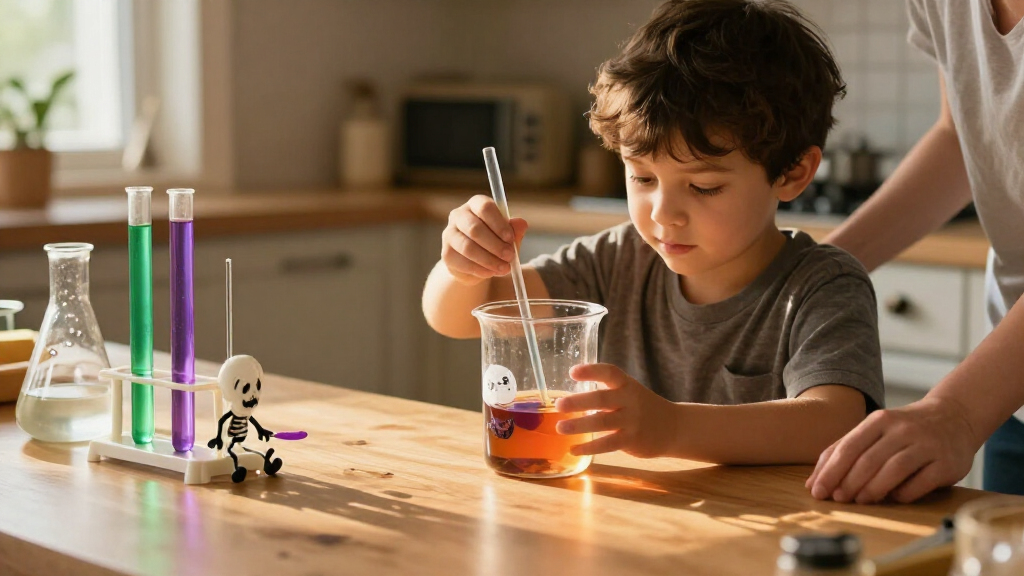
I ranked these kits by how closely they meet the search for spooky science experiments kids can actually carry out. A spooky label alone is not enough: the activities should connect a kid-friendly theme to a science idea, and the product details should make clear what comes in the box and what the family must provide.
I compared the kits across four decision points. Theme and visual payoff matter because glow, slime, and gross-out effects can help children stay engaged. Activity range and materials matter because a large experiment count can be misleading if most activities depend on unlisted household supplies. Age guidance and instructions help parents match the kit to a child’s reading and activity skills. I also looked at practical setup details, including the button-cell batteries required by Monsterglow.
The ranking reflects different strengths rather than a claim that one kit is right for every child. Monsterglow leads for its distinctive glowing theme and younger listed age range. Playz comes next for its substantial collection of tools and ingredients, with a clear age range and gross-science focus. National Geographic places third because its 45-activity total includes 30 projects that use common household items, making the headline count less representative of what arrives in the package. Each can suit a different household; the reviews below explain the tradeoffs.
| spooky science experiment kits for kid | Brand | Batteries |
|---|---|---|
| Learning Resources Beaker Crea | Learning Resources | Three 1.5V AG3/LR41 button-cell batteries, included |
| Playz Disgusting & Gross Scien | Playz | — |
| National Geographic Gross Scie | Blue Marble | None required |
Factors to Consider When Choosing Spooky Science Experiment Kits For Kids
I would choose a spooky science kit by matching the child’s preferred kind of fun to the materials and support the activities require. These three products share gross or monster-themed STEM, but they differ in age range, visual effect, and how much work happens before the first experiment.Choose the kind of spooky appeal your child likes
Glow effects are the defining draw of Learning Resources Beaker Creatures Monsterglow Lab. The black light blaster, glowing activities, and creature collectibles make it the clearest choice for a child who wants a monster-lab atmosphere. Playz and National Geographic instead use gross science as their hook, leaning toward slime, gels, reactions, and other hands-on demonstrations. That distinction matters: a child who loves the visual drama of glowing creatures may not be as interested in a broader chemistry activity, while a child who enjoys slime may not need a collectible theme.
I would ask what the child means when they ask for “spooky.” If they mean luminous, creature-based play, Monsterglow fits. If they mean messy, strange, or gross experiments, Playz and National Geographic are closer matches. The products do not offer interchangeable experiences just because all three use playful science themes.
Read experiment counts alongside material lists
An experiment total only tells part of the story. National Geographic lists 45 activities, but 30 use common household items rather than included kit materials. That makes it attractive for families who want follow-up projects and do not mind collecting supplies, but less suited to buyers expecting 45 fully equipped experiments. Monsterglow lists more than 10 activities and a 13-piece lab set. Playz highlights over 34 tools and ingredients, though the supplied details do not state a precise experiment count.
For a kit intended as a gift or an easy activity to start, I would pay close attention to what arrives in the box, not just the largest number in the product name. For recurring home science sessions, extra household-item projects may be welcome. Before choosing National Geographic, check whether the family is comfortable gathering supplies; before choosing Playz, remember that its activity total is not specified in the supplied product details.
Match the listed age range and plan for adult involvement
Monsterglow is listed for ages 5–10, while Playz is aimed at ages 8–12 and National Geographic at ages 8 and up. These ranges are useful starting points, not a promise that every child will be ready to work independently. Young children may need an adult to read instructions, organize materials, and supervise the use of small parts or experiment components. Older children may value having enough steps and science ideas to work through with less prompting.
I would look at the child’s comfort with following written directions and handling the type of activities described, then decide how much adult participation is realistic at home. Monsterglow’s booklet is 16 pages; National Geographic emphasizes illustrated, kid-friendly directions; Playz highlights a colorful step-by-step guide. Those details point toward guided activities, but parents should still review instructions and supervise as appropriate.
Think about cleanup, supplies, and storage
Gross science often means materials that can spread, spill, or need a clear work surface. Playz and National Geographic are the more direct picks for slime and gross-themed activities, so a tray or washable work area can make setup more manageable. National Geographic also asks families to supply household items for many of its projects. That can reduce the need for another dedicated kit, yet it adds a preparation step and may mean a parent needs to check the guide before each session.
Monsterglow’s standout tool is its black light blaster, and the product includes three button-cell batteries. Those batteries are included, but small button cells should be stored securely and handled by adults. Think about where the components will live between experiments, especially if the kit is shared among siblings or stored within reach of younger children. The right choice is the one whose materials and setup fit the family’s normal activity space.
Use the science theme as a way to keep the activity engaging
A spooky effect can make a science idea memorable, but the best fit depends on what the child wants to learn or make. Monsterglow connects its activities to bioluminescence; National Geographic names polymers, chemical reactions, and pH science; Playz describes gels, cross-linked polymers, and biology. If a child is curious about why slime behaves differently from a liquid, Playz or National Geographic may feel more relevant. If a child wants to see something glow and connect that effect to a science activity, Monsterglow is the more focused option.
I would not choose solely by the most dramatic product name. Look for a theme that can lead to questions, predictions, and explanations after the activity. The kit can provide the starting point, while an adult helps connect what happened to the concepts named in the guide. That approach makes the spooky styling part of the learning rather than the whole activity.
Frequently Asked Questions
Which kit is best for a child who wants glowing experiments?
Learning Resources Beaker Creatures Monsterglow Lab is the clearest fit because it includes a black light blaster, glow-themed activities, and two glow-in-the-dark creatures. It is listed for ages 5–10 and offers more than 10 experiments. Choose it over Playz or National Geographic when the child is especially interested in light effects and monster collectibles; choose one of the gross-science kits if slime, gels, or chemical demonstrations are the bigger draw.
Are all 45 National Geographic experiments supplied in the box?
No. The kit lists 15 experiments with included materials and 30 additional activities that use common household items. This can give a family more ways to continue experimenting, but it does not mean the box contains everything needed for all 45. I would choose it if household-supply projects sound convenient, and look at Playz or Monsterglow if the priority is a more kit-centered set of activities.
Which of these kits is aimed at the youngest children?
Monsterglow Lab is listed for ages 5–10, making it the youngest-age option here. Playz is listed for ages 8–12, and National Geographic is for ages 8 and up. Age ranges are a guide rather than a guarantee of independent use, so an adult may still need to help with reading, setup, and supervision, particularly for younger children.
Do any of these kits require batteries?
Monsterglow Lab requires three 1.5V AG3/LR41 button-cell batteries, and the product details say they are included. National Geographic requires no batteries; the supplied details for Playz do not list a battery requirement. If avoiding button cells is a priority, National Geographic is the clear option based on the listed specifications, while Playz has no battery detail stated in the information provided.
How should I choose between Playz and National Geographic?
Choose Playz if the child likes gross slime and you want a kit described as containing over 34 tools and ingredients, with a colorful step-by-step guide. Choose National Geographic if illustrated instructions, named science concepts, and extra activities using household supplies are more appealing. The key difference is that National Geographic clearly says 30 of its 45 experiments need household items, while Playz’s supplied details do not specify an exact experiment count or an equivalent included-versus-home-material breakdown.
Conclusion
For a child who wants a glowing monster-lab experience and fits the listed 5–10 age range, I would choose Learning Resources Beaker Creatures Monsterglow Lab. For an older child who enjoys slime, gels, and gross-out science, Playz is the better match for its collection of tools and ingredients. If your household is happy to gather materials and wants a guide that extends beyond the kit, National Geographic offers the most listed activities, with the clear caveat that only 15 use included materials.
My ranking puts Monsterglow first for its distinctive spooky visual theme and broad younger-age fit, Playz next for its supplied gross-science materials, and National Geographic third because much of its activity count depends on household supplies. The best choice is the one that matches the child’s idea of fun and the family’s willingness to prepare materials—not simply the kit with the biggest experiment number.
Halloween Picks
halloween
As an affiliate, we earn on qualifying purchases.