Advanced meteorology weather stations vary most in how much local data they capture, how they share it, and how much setup they demand. I name the Ambient Weather WS-2000 best overall for buyers prioritizing connected monitoring, while the WS-2902 is a strong alternative for those who want smart features in a simpler package. The Sainlogic 12-in-1 stands out for broad sensor coverage, though more readings do not automatically mean better placement or more useful forecasts. Your main tradeoff is between detailed measurements and a system that is easy to install, read, and maintain. Continue for the full comparison and guidance on choosing a station that fits your site and monitoring habits.

Prime made for students and young adults
- Fast, free delivery for dorm and study essentials
- Prime Video and Amazon Music included
- Member-only deals
Key Takeaways
- The WS-2000 leads this comparison for buyers who value a connected station and a dedicated display; its appeal depends on wanting more than a basic indoor-outdoor readout.
- The WS-2902 is the simpler smart alternative to the WS-2000, making it a better fit when connected data matters more than a feature-heavy console.
- Sainlogic’s 12-in-1 setup prioritizes breadth of measurements; its larger set of readings is most useful when the sensor can be installed in a suitable, unobstructed location.
- AcuRite Iris models and the La Crosse full-color station lean toward accessible home monitoring, rather than the connected, data-focused role of the Ambient options.
- Connectivity, display style, and installation constraints separate these picks more than the word “advanced” does; check the exact sensor package and required network features before choosing.
| Sainlogic 12-in-1 Wireless Weather Station with Rain Gauge |  | Best for Broad Local Measurement | Measurements: Temperature, humidity, rainfall, wind speed and direction, barometric pressure, dew point, and perceived temperature | Display: 6.5-inch LCD with three adjustable backlight levels | Temperature range: -40°F to 140°F | VIEW LATEST PRICE | See Our Full Breakdown |
| AcuRite Iris 5-in-1 Home Weather Station with Wi-Fi |  | Best for Weather Underground Sharing | Model: 01540M | Measurements: Indoor and outdoor temperature and humidity, wind speed and direction, barometric pressure, and rainfall | Sensors: Anemometer, wind vane, barometer, hygrometer, rain gauge, and thermometer | VIEW LATEST PRICE | See Our Full Breakdown |
| Ambient Weather WS-2000 Smart Weather Station | 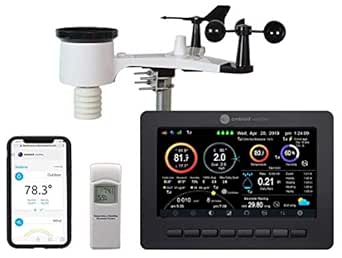 | Best for Advanced Remote Monitoring | Model: WS-2902-ARRAY+2000C | Measurements: Wind speed and direction, temperature, humidity, rainfall, UV, and solar radiation | Display: TFT color display | VIEW LATEST PRICE | See Our Full Breakdown |
| La Crosse Technology Advanced Weather Station with Full-Color LCD |  | Best for Indoor Comfort Monitoring | Display: Full-color LCD with adjustable backlight | Measurements: Indoor and outdoor temperature and humidity | Additional readings: Heat index and dew point | VIEW LATEST PRICE | See Our Full Breakdown |
| Ambient Weather WS-2902 Wi-Fi Smart Weather Station |  | Best for Smart-Home Integration | Measurements: Wind speed and direction, temperature, humidity, rainfall, UV intensity, and solar radiation | Connectivity: Wi-Fi; supports Google Home, Alexa, and IFTTT | Sensor technology and frequency: RF; 2.4 GHz | VIEW LATEST PRICE | See Our Full Breakdown |
| AcuRite Iris (01512MCB) Indoor/Outdoor Wireless Weather Station – Color Screen |  | Best for Clear, At-a-Glance Local Readings | Weather data points: More than 55 | Forecast: Up to 12 hours ahead; self-calibrating barometer | Display: Large color LCD with adjustable brightness | VIEW LATEST PRICE | See Our Full Breakdown |
| advanced meteorology weather station | Display | Measurements | Temperature accuracy | Power |
|---|---|---|---|---|
| Sainlogic 12-in-1 Wireless Wea | 6.5-inch LCD with three adjustable backlight levels | Temperature, humidity, rainfall, wind speed and direction, barometric pressure, dew point, and perceived temperature | ±2°F (±1°C) | Solar powered with battery backup; requires 3 AA batteries, not included |
| AcuRite Iris 5-in-1 Home Weath | Color LCD with adjustable brightness | Indoor and outdoor temperature and humidity, wind speed and direction, barometric pressure, and rainfall | ±2°F | — |
| Ambient Weather WS-2000 Smart | TFT color display | Wind speed and direction, temperature, humidity, rainfall, UV, and solar radiation | ±2°F | Solar-powered sensor array; console uses included 5V DC adapter |
| La Crosse Technology Advanced | Full-color LCD with adjustable backlight | Indoor and outdoor temperature and humidity | — | 5V adapter; optional backup requires 3 AAA batteries |
| Ambient Weather WS-2902 Wi-Fi | LCD | Wind speed and direction, temperature, humidity, rainfall, UV intensity, and solar radiation | ±1°C | Solar powered; includes AC adapter for console |
| AcuRite Iris | Large color LCD with adjustable brightness | — | ±1.11°C | Corded electric console; outdoor sensor requires ten AA batteries |
More Details on Our Top Picks
Sainlogic 12-in-1 Wireless Weather Station with Rain Gauge
The Sainlogic earns its place for buyers who want a wide set of readings on a straightforward local display: alongside temperature, humidity, wind, and rainfall, it reports barometric pressure, dew point, and perceived temperature. That extra context is useful for tracking changing conditions around a home or garden without relying on an online service. Its 6.5-inch LCD has three backlight levels, and manual rain calibration gives owners a way to adjust rainfall readings. Compared with the Ambient Weather WS-2000, it lacks Wi-Fi, UV, and solar-radiation measurements, so it is less suited to remote monitoring or solar-weather tracking. In return, the Sainlogic keeps the setup focused on local readings. Its rain accuracy also varies with rainfall intensity, and three AA backup batteries are not included.
Pros:- Covers a broad mix of weather readings, including pressure, dew point, and perceived temperature
- Large display offers three adjustable backlight levels
- Wireless outdoor sensor allows flexible placement
- Manual rainfall calibration allows adjustment of rain readings
Cons:- No Wi-Fi for remote monitoring or data sharing
- Three AA backup batteries are required and not included
- Rainfall accuracy is lower in heavy rain than in light rain
Best for: Home weather watchers who want pressure, dew point, perceived temperature, and rainfall readings on a large local display without needing Wi-Fi.
Not ideal for: Data-sharing enthusiasts and remote users who want Wi-Fi access, alerts, or UV and solar-radiation readings.
- Measurements:Temperature, humidity, rainfall, wind speed and direction, barometric pressure, dew point, and perceived temperature
- Display:6.5-inch LCD with three adjustable backlight levels
- Temperature range:-40°F to 140°F
- Temperature accuracy:±2°F (±1°C)
- Humidity range:10% to 99%
- Barometric pressure range:300–1100 hPa
- Rainfall accuracy:±1 mm in light rain; ±7% in heavy rain
- Power:Solar powered with battery backup; requires 3 AA batteries, not included
- Connectivity and material:Wireless, no Wi-Fi; ABS plastic
Our verdict“Choose the Sainlogic if you want a broad set of on-site readings, but pick the Ambient Weather WS-2000 if remote access and UV data matter more.”
AcuRite Iris 5-in-1 Home Weather Station with Wi-Fi
The AcuRite Iris is the clearest fit here for buyers who want to share home-station readings through Weather Underground. Its sensor suite covers wind, rain, pressure, temperature, and humidity, while the color display adds a forecast, clock, and historical information. The listing also describes access to more than 25 weather data points, giving data-minded users more to follow than a basic indoor-outdoor thermometer. Compared with the Ambient Weather WS-2000, the Iris is centered on Weather Underground sharing rather than the WS-2000’s listed remote monitoring and alerts. It also does not list UV or solar-radiation measurements, which limits its appeal for broader outdoor analysis. The display’s adjustable brightness is useful indoors, but battery power means owners need to plan for battery replacement; the supplied weight figure appears unreliable.
Pros:- Wi-Fi connection supports sharing readings with Weather Underground
- Measures wind, rainfall, pressure, temperature, and humidity
- Historical information and more than 25 data points support closer tracking
- Color LCD includes adjustable brightness and a clock
Cons:- Battery-powered operation requires ongoing battery management
- UV and solar-radiation measurements are not listed
- The listed weight appears potentially inaccurate
Best for: Home weather observers who want to contribute local readings to Weather Underground and review historical data from a color display.
Not ideal for: Buyers seeking UV and solar-radiation measurements, or those who want a station whose listed feature set includes remote alerts.
- Model:01540M
- Measurements:Indoor and outdoor temperature and humidity, wind speed and direction, barometric pressure, and rainfall
- Sensors:Anemometer, wind vane, barometer, hygrometer, rain gauge, and thermometer
- Temperature range:32°F to 122°F
- Temperature accuracy:±2°F
- Display:Color LCD with adjustable brightness
- Connectivity:Wi-Fi and 433 MHz
- Power source:Battery powered
Our verdict“Choose the AcuRite Iris for Weather Underground sharing and historical data, while the Ambient Weather WS-2000 is a stronger match for UV readings and listed alerts.”
Ambient Weather WS-2000 Smart Weather Station
The WS-2000 stands out for combining a substantial outdoor measurement set with Wi-Fi remote monitoring and alerts. In addition to wind, temperature, humidity, and rain, it tracks UV and solar radiation, adding useful exposure data for gardening and other outdoor observations. Its TFT color console supports imperial and metric units, and the listed calibration capability gives detail-oriented owners room to tune readings. Compared with the Sainlogic 12-in-1, this model trades the Sainlogic’s dew point and perceived-temperature readings for UV, solar radiation, and network access. The costs in convenience are practical rather than feature-related: the console needs its included 5V adapter, while the sensor array requires three AAA batteries that are not included. Buyers who want a simpler, battery-backed local setup may prefer the Sainlogic.
Pros:- Tracks UV and solar radiation as well as standard wind, rain, temperature, and humidity readings
- Wi-Fi enables remote monitoring and alerts
- TFT color display supports imperial and metric units
- Calibration options suit owners who want to fine-tune readings
Cons:- Console requires the included 5V DC adapter
- Sensor array requires three AAA batteries that are not included
- Does not list dew point or perceived temperature readings
Best for: Weather hobbyists who want UV and solar-radiation data, remote access, alerts, and a console that can display metric or imperial units.
Not ideal for: Buyers who need a fully self-contained, battery-powered console or who prefer a local display without Wi-Fi features.
- Model:WS-2902-ARRAY+2000C
- Measurements:Wind speed and direction, temperature, humidity, rainfall, UV, and solar radiation
- Display:TFT color display
- Temperature accuracy:±2°F
- Upper temperature range:149°F
- Connectivity and frequency:Wi-Fi; 915 MHz
- Power:Solar-powered sensor array; console uses included 5V DC adapter
- Sensor batteries:3 AAA batteries, not included
- Included components:Console and sensor array
Our verdict“Choose the WS-2000 for remote monitoring and solar-related measurements; choose the Sainlogic if dew point, perceived temperature, and a simpler local setup matter more.”
La Crosse Technology Advanced Weather Station with Full-Color LCD
The La Crosse is the lineup’s focused choice for households monitoring indoor and outdoor temperature and humidity, rather than a full suite of meteorological variables. Its heat-index and dew-point readings add practical context for comfort, while custom temperature alerts and min/max records help users spot conditions that need attention. Atomic timekeeping with automatic daylight-saving updates is another useful everyday feature. Compared with the Sainlogic 12-in-1, this station gives up wind, rainfall, and barometric pressure, so it is not the pick for tracking changing outdoor weather in depth. It is also less capable than the Wi-Fi-enabled Ambient Weather WS-2000 for remote observation. Its strength is a simpler, readable home display; the backlight on battery power only illuminates temporarily on demand, and backup batteries are not included.
Pros:- Shows indoor and outdoor temperature and humidity
- Heat index and dew point add context to comfort readings
- Customizable temperature alerts and min/max records support monitoring
- Atomic time and automatic daylight-saving updates reduce clock adjustments
Cons:- Does not measure wind, rainfall, or barometric pressure
- Battery-only backlight illuminates temporarily on demand
- Optional backup requires three AAA batteries, which are not included
Best for: Households focused on indoor comfort, temperature alerts, and outdoor temperature and humidity checks rather than wind or rainfall analysis.
Not ideal for: Weather hobbyists who need wind, rain, pressure, UV, solar-radiation, or Wi-Fi monitoring.
- Display:Full-color LCD with adjustable backlight
- Measurements:Indoor and outdoor temperature and humidity
- Additional readings:Heat index and dew point
- Temperature units:°F or °C
- Sensor transmission range:Up to 330 ft in open air
- Time and calendar:Atomic self-setting time with automatic daylight-saving updates
- Alerts and records:Customizable temperature alerts and min/max records
- Power:5V adapter; optional backup requires 3 AAA batteries
Our verdict“Pick the La Crosse for household temperature and humidity monitoring with comfort alerts, not for comprehensive outdoor weather tracking like the Sainlogic or Ambient stations.”
Ambient Weather WS-2902 Wi-Fi Smart Weather Station
The WS-2902 is a strong choice for owners who want a broad outdoor sensor array tied into a Wi-Fi and smart-home setup. It measures wind, temperature, humidity, rainfall, UV intensity, and solar radiation, then adds customizable alerts and compatibility with Google Home, Alexa, and IFTTT. Compared with the WS-2000, it shares much of the same measurement territory but is the more explicitly smart-home-oriented pick in the supplied details. The WS-2000, by contrast, lists a TFT color display and imperial/metric settings; the WS-2902 lists an LCD and emphasizes integrations and Ambient Weather Network sharing. Its solar-powered sensor array still requires three AAA batteries, and some network or community features are described as optional or coming soon, so buyers should not assume every service is available immediately.
Pros:- Measures wind, temperature, humidity, rainfall, UV intensity, and solar radiation
- Wi-Fi supports remote monitoring and customizable alerts
- Works with Google Home, Alexa, and IFTTT
- Can share data with the Ambient Weather Network
Cons:- Requires three AAA batteries for the sensor array
- Some network and community features are optional or described as coming soon
- The listed temperature range begins at 14°F, limiting stated cold-weather coverage
Best for: Smart-home owners and weather hobbyists who want outdoor sensor data, remote access, alerts, and compatibility with voice assistants or IFTTT.
Not ideal for: Buyers who want a purely local station, need every community feature available at setup, or prefer a console with specified TFT display details.
- Measurements:Wind speed and direction, temperature, humidity, rainfall, UV intensity, and solar radiation
- Connectivity:Wi-Fi; supports Google Home, Alexa, and IFTTT
- Sensor technology and frequency:RF; 2.4 GHz
- Temperature range:14°F to 149°F
- Temperature accuracy:±1°C
- Display:LCD
- Power:Solar powered; includes AC adapter for console
- Batteries:3 AAA batteries required
- Included components:Sensor array, console, AC adapter, and user manual
Our verdict“Choose the WS-2902 if smart-home links and remote alerts are priorities; favor the WS-2000 if you want its specified TFT console and unit options.”
AcuRite Iris (01512MCB) Indoor/Outdoor Wireless Weather Station – Color Screen
The AcuRite Iris earns its place for buyers who want a broad set of local measurements presented on a screen that is easy to read across a room. It tracks more than 55 weather data points, including wind, rainfall, pressure, temperature, and humidity; the self-calibrating barometer uses pressure trends to refine forecasts up to 12 hours ahead. Compared with the AcuRite Iris 5-in-1 Home Weather Station with Wi-Fi and the Ambient Weather smart models, this version emphasizes a large, adjustable color display and straightforward wireless sensor setup rather than Wi-Fi-linked monitoring. That makes it a practical choice for a home display, but less suited to remote access or connected data logging. The tradeoff is power: the console needs corded electricity, has no battery backup, and the outdoor sensor uses ten AA batteries with a listed life of about 1,000 hours.
Pros:- Displays more than 55 weather data points, including rainfall, wind, pressure, temperature, and humidity.
- Large color LCD with adjustable brightness makes readings easier to scan indoors.
- Wireless outdoor sensor is designed for straightforward setup and pole mounting.
- Self-calibrating barometer supports forecasts up to 12 hours ahead.
Cons:- Indoor console requires corded power and has no battery backup.
- Outdoor sensor requires ten AA batteries, which are not included.
- Listed sensor battery life is about 1,000 hours, so battery replacement is a recurring task.
Best for: Home weather watchers who want a large, readable local display with many measurements and do not need Wi-Fi or remote monitoring.
Not ideal for: Buyers who want app access, online data sharing, or a console that keeps operating during a power outage; the indoor unit is corded and has no battery backup.
- Weather data points:More than 55
- Forecast:Up to 12 hours ahead; self-calibrating barometer
- Display:Large color LCD with adjustable brightness
- Sensor frequency:433 MHz radio frequency
- Temperature accuracy:±1.11°C
- Upper temperature range:120°F
- Power:Corded electric console; outdoor sensor requires ten AA batteries
- Sensor battery life:About 1,000 hours
- Dimensions and weight:2.63 × 8.13 × 6.75 inches; 5 pounds
Our verdict“Choose the AcuRite Iris if a clear, feature-rich home display matters more than Wi-Fi access, remote monitoring, or backup power.”

How We Picked
I compared these six stations on the factors that change day-to-day usefulness: the range of measurements described for each model, wireless and Wi-Fi capabilities, how readings are presented, and the likely effort involved in setup and upkeep. I also looked at whether a station is better suited to local observation, remote access, or a straightforward indoor-outdoor display. A broader sensor count can add context, but it does not make a station more accurate by itself; sensor placement and ongoing maintenance still matter.
The ranking favors options that combine useful monitoring with a clear reason to choose them, rather than treating every added feature as an automatic advantage. The WS-2000 ranks first for its connected, dedicated-console approach; the WS-2902 follows as a more straightforward smart option. Sainlogic earns a distinct place for measurement breadth, while the AcuRite and La Crosse models suit buyers who put accessible home readings ahead of a more connected monitoring setup. Exact capabilities can vary by model package, so I recommend checking the current listing for included sensors and network requirements.
| advanced meteorology weather station | Measurements | Temperature accuracy |
|---|---|---|
| Sainlogic 12-in-1 Wireless Wea | Temperature, humidity, rainfall, wind speed and direction, barometric pressure, dew point, and perceived temperature | ±2°F (±1°C) |
| AcuRite Iris 5-in-1 Home Weath | Indoor and outdoor temperature and humidity, wind speed and direction, barometric pressure, and rainfall | ±2°F |
| Ambient Weather WS-2000 Smart | Wind speed and direction, temperature, humidity, rainfall, UV, and solar radiation | ±2°F |
| La Crosse Technology Advanced | Indoor and outdoor temperature and humidity | — |
| Ambient Weather WS-2902 Wi-Fi | Wind speed and direction, temperature, humidity, rainfall, UV intensity, and solar radiation | ±1°C |
| AcuRite Iris | — | ±1.11°C |
Factors to Consider When Choosing Advanced Meteorology Weather Stations
Choosing an advanced station is less about collecting the largest number of readings and more about getting dependable data you will actually use. I would start with the monitoring job, the installation site, and how you want to view results; those choices can rule out a model before its feature list matters.
Match Sensor Coverage to the Questions You Want Answered
Begin with the weather decisions you expect the station to support: tracking rainfall, monitoring wind, or comparing indoor and outdoor conditions. A wider sensor package, such as the Sainlogic 12-in-1, may record more types of data, but some readings matter only if you can place the sensors correctly. Avoid choosing by count alone, especially if nearby buildings, trees, or roof edges could distort measurements. Read the included-sensor list carefully because product names and bundles may not tell the whole story. If a measurement will not affect your planning, a simpler station may be easier to maintain without giving up useful information.
Plan the Sensor Location Before Buying
Many disappointing weather readings come from the site rather than the console. Wind sensors need exposure that reflects local airflow, while rain collection can be compromised by overhangs or nearby obstructions. Think through mounting height, safe access for maintenance, wireless range, and whether the installation point can remain clear through changing seasons. A station with many sensors can become a poor fit if its best location is hard to reach. Before ordering, map a practical mounting spot and check whether the included hardware and wireless arrangement suit it.
Choose Between Local Display and Connected Monitoring
A full-color console makes readings quick to check at home, while Wi-Fi features may be more useful when you want to view information away from the station. These are different priorities, not interchangeable measures of quality. The Ambient WS-2000 and WS-2902 address connected monitoring more directly than the display-focused La Crosse and AcuRite options in this lineup. Confirm which app, network access, and data-sharing functions are supported by the exact model you plan to buy. A common mistake is assuming that wireless sensor transmission automatically means internet access or remote viewing.
Treat Data Granularity as a Workflow Decision
More frequent readings and a broader set of measurements can help people who regularly compare local conditions, but they also create more data to interpret. Decide whether you want a quick glance, a record for personal analysis, or information available remotely. Check how the station presents history and whether any data features depend on an app, account, or network connection. A dense display is not automatically easier to use, particularly for household members who just want current conditions. Prioritize a format you will check consistently over technical detail that may go unused.
Account for Maintenance and Seasonal Access
Outdoor sensors need periodic attention: rain collection areas can gather debris, exposed components weather over time, and batteries or power arrangements require planning. A complex sensor array may offer more observations, but it can also mean more points to inspect. Consider whether you can safely reach the mounting position and whether replacement parts or upkeep instructions are readily available for the model. Buyers often focus on installation day and overlook the recurring work of keeping sensors clear and powered. If access is difficult, a simpler setup may produce more dependable long-term use.
Pay for Features That Change Your Decisions
A premium or more connected model makes sense when its added information supports a real routine, such as remote checks or regular local-data tracking. If you mainly want current indoor and outdoor conditions, a straightforward console like the AcuRite Iris or La Crosse option may be a closer match. Do not treat a high sensor count, colorful screen, and Wi-Fi as a single bundle of “advanced” capability; each solves a different problem. Compare included components, display needs, and network dependence before deciding where extra complexity is worthwhile. The best fit is the station whose useful features you can install and maintain, not simply the one with the longest feature list.
Frequently Asked Questions
Is the Ambient Weather WS-2000 a better choice than the WS-2902?
I would choose between them based on how much you value the console and connected-monitoring setup, rather than assuming one is universally better. The WS-2000 is the stronger match in this roundup for buyers seeking a dedicated display alongside smart monitoring. The WS-2902 makes more sense if you want a connected Ambient Weather option without making the more feature-heavy console the deciding factor. Check the current model package for included sensors and supported network functions before ordering. If you rarely view readings at home, prioritize the app and data features you will actually use.
Does a 12-in-1 weather station provide more accurate forecasts?
Not by sensor count alone. A wider range of measurements can give you more local observations, but accuracy depends on sensor quality, placement, upkeep, and what the station means by a forecast. Poor exposure or an obstructed rain gauge can undermine otherwise useful readings. I would treat Sainlogic’s broader coverage as an advantage for buyers who want more types of data, not as a promise that its predictions will outperform every simpler station. Check which measurements matter to your use and whether you can install the sensors in a suitable location.
Can I use a Wi-Fi weather station if my sensor location is far from my router?
Do not assume that Wi-Fi capability solves every range issue. The outdoor sensor typically communicates with the station or receiver, while internet access depends on the console’s connection to your home network; these are separate links. Walls, building materials, and distance can affect either connection. Before buying, check the manufacturer’s stated transmission range and network requirements, then consider where the console can sit relative to both the sensor and router. A practical placement plan is more useful than relying on a maximum range figure alone.
Should I choose a color-screen station or one with remote data access?
Choose a color display if quick, at-home checks are your main habit; choose remote access if you need readings when you are away. The La Crosse and AcuRite options in this lineup lean toward accessible local viewing, while the Ambient models are stronger candidates for connected monitoring. A screen can be easier for a household to share, but it cannot substitute for online access when you need to check conditions remotely. Conversely, an app-dependent setup may add little if you only glance at readings in one room. Decide where and how often you will check the station before paying for either capability.
What should I verify before mounting an outdoor weather station?
Confirm that the mounting site can give sensors the exposure their measurements need and that you can reach them for cleaning or battery service. Look for nearby roofs, trees, walls, and other obstructions that could affect wind or rainfall readings. Check the mounting hardware, wireless path to the console, and any power requirements against the actual location. Also consider seasonal access: a spot that is easy to reach in mild weather may be awkward or unsafe later. If the site cannot support the sensor placement, a station with fewer measurements may be the more useful choice.
Conclusion
For the strongest all-round connected setup in this comparison, I recommend the Ambient Weather WS-2000. Buyers seeking a more straightforward smart option should look at the WS-2902, while the Sainlogic 12-in-1 best suits people who specifically want broad measurement coverage and can place its sensors well. For a beginner who values a readable home display over remote data, the La Crosse Advanced Weather Station or either AcuRite Iris model is a more approachable direction; compare the exact package and features before choosing between them. My premium pick is the WS-2000 for its more feature-rich connected-console approach, and my value-oriented pick is the WS-2902 for smart monitoring without making the console the main draw. Match the station to your site and viewing habits first: the most advanced feature set is only useful when its readings are practical to install, check, and maintain.
Halloween Picks

ELAMAS 11ft Animatronic Flying Witch Halloween Decoration

Spirit Halloween Scary Sitting Scarecrow Animatronic, 4 ft 6 in

Haunted Hill Farm 4.6‑Ft Head‑Spinning Beatrix Halloween Animatronic Prop
As an affiliate, we earn on qualifying purchases.