
🔍 Read the full analysis: A Guide To Self-Checkout And Customer-Powered Kiosks on ThorstenMeyerAI.com

Prime made for students and young adults
- Fast, free delivery for dorm and study essentials
- Prime Video and Amazon Music included
- Member-only deals
TL;DR
A November 26, 2026, article traces customer-powered retail from Piggly Wiggly’s 1916 self-service model to barcode scanning and self-checkout kiosks. U.S. cashier employment fell from about 3.6 million in 2019 to roughly 3.1 million in 2025, and the Bureau of Labor Statistics projects a further 6% decline by 2035; some retailers have also scaled back self-checkout.
ThorstenMeyerAI.com published a history of self-service retail on November 26, tracing a shift that began with customers selecting their own groceries in 1916 and later extended to scanning and paying at kiosks. The account connects those systems to a declining U.S. cashier workforce, while noting that cashier jobs remain numerous and that some retailers have reduced self-checkout use.
The account begins with Memphis grocer Clarence Saunders, whose Piggly Wiggly store opened in 1916. Shoppers selected goods from shelves rather than asking clerks to retrieve each item. Saunders filed a patent for a “self-serving store” on October 21, 1916; it was granted the following year. The Tennessee Encyclopedia says the store’s model left staff to check purchases and take payment. The article describes this as an early transfer of part of retail work from employees to customers, decades before computerized checkout.
The next technical step depended on barcodes. According to GS1, the first barcode-scanned retail product was a ten-pack of Juicy Fruit gum, scanned on June 26, 1974, at a Marsh supermarket in Troy, Ohio. In 1984, David R. Humble and two colleagues filed a patent for a shopper-operated checkout system. The patent, granted in 1987, described a laser scanner, a scale that checked item weight, and a conveyor. The article says early versions were installed at Kroger supermarkets; a shopper still took a printed list to a cashier to pay.
The U.S. Bureau of Labor Statistics counted 3,089,410 cashiers in May 2025, down from 3,596,630 in May 2019, according to the figures cited in the article. The BLS projects cashier employment to decline by 6% from 2025 to 2035, or about 200,600 jobs. The agency attributes the projected decline to self-service checkout and rising online sales. These figures describe employment, not the share of checkout transactions completed by machines.
Infographic 01 · A short history of self-service
From the clerk to the customer, 1916 to today
Each step moved a piece of the work across the counter: first fetching the goods, then reading the price, then scanning and ordering.
How the customer took over the clerk's work
- Before 1916: a clerk fetched, weighed and wrapped every item at the counter.
- 1916, Piggly Wiggly (Memphis): shoppers take the goods off the shelves themselves and pass a checking station to pay. Clarence Saunders files his patent on 21 October 1916.
- 26 June 1974, Troy, Ohio: a ten-pack of Juicy Fruit gum is the first product scanned with a barcode. A machine now reads the price.
- 9 July 1984: David R. Humble and two colleagues file the CheckRobot patent: the shopper scans, a scale checks the weight, a tunnel stops unscanned items. Payment still goes to a cashier.
- From 1986: CheckRobot machines in several Kroger supermarkets, as reported by CNN (2022).
- 2018: McDonald’s has kiosks in nearly 17,000 restaurants; in France, Italy and Spain well over half of in-restaurant orders go through them (company filing).
Sources differ on the exact opening day of the first Piggly Wiggly (6 or 11 September 1916). The Kroger installation is reported second-hand; we did not retrieve the 1987 newspaper original.
Sources: C. Saunders, US Patent 1,242,872 (1916/17); Tennessee Encyclopedia; GS1 Belgium & Luxembourg; Humble et al., US Patent 4,676,343 (1984/87); CNN (2022); McDonald's Form 10-K 2018.
Powered by Thorsten Meyer AI
How Kiosks Reshape Retail Work
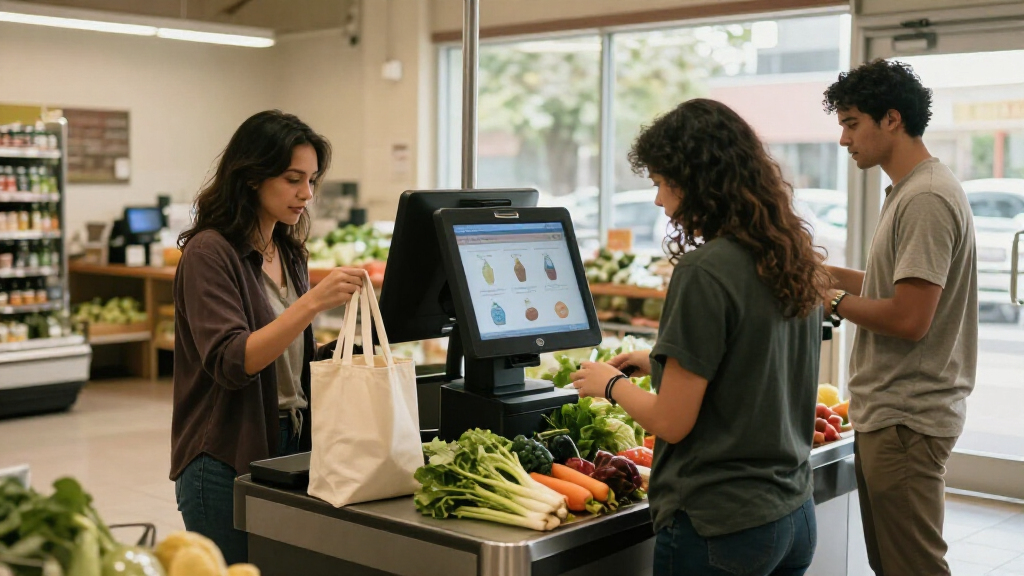
Self-checkout changes who performs routine parts of a purchase. Customers may scan, bag and sometimes troubleshoot items themselves, while one employee supervises multiple stations. The BLS says this arrangement can reduce the labor required for scanning and bagging. The employment outlook gives readers a measurable sign of the shift, but the projection does not establish that kiosks alone caused the decline in cashier jobs.
The effects are not uniform across retailers or countries. The source account says some U.S. chains and Booths in England pulled back from self-checkout between 2023 and 2024, citing service, losses or speed. It also reports wider adoption in Germany and Japan. For shoppers, the change can mean faster or more flexible checkout in some stores, but it can also mean taking on tasks that staff once performed. For workers, automation is one pressure on a job category that still employs millions.
Popular right now

De'Longhi Classic Signature Espresso Machine with Adjustable Milk Frother

Breville Barista Express Espresso Machine with Built-In Grinder, Brushed Stainless Steel (BES870XL)

Dyson HushJet Compact Air Purifier, White/Silver
As an affiliate, we earn on qualifying purchases.
From Piggly Wiggly to Scanners
The retail history described here has several stages: customer-selected goods in 1916, barcode-based price reading in 1974 and a shopper-operated checkout patent filed in 1984. Each step moved part of the transaction away from a clerk, but the technologies did not eliminate staff at once. The early patented system still used a cashier to collect payment, illustrating that customer-operated equipment and employee labor can coexist.
The source also cites the idea of “shadow work,” discussed by social critic Ivan Illich in his 1981 book of that name: unpaid tasks that customers or households perform within an industrial economy. Applied to checkout, the term describes shoppers doing work such as scanning and bagging. It is an interpretive framework, not a government classification of kiosk use or a measure of retail employment.
“Instead shoppers selected from items placed on shelves within easy reach.”
— The Tennessee Encyclopedia, on Piggly Wiggly
What Employment Figures Cannot Show
The figures do not isolate the effect of self-checkout from other forces. The source notes that the 2019-to-2025 comparison spans the pandemic and growth in online shopping; the BLS itself cites online sales alongside checkout stands when explaining its projection. The cited employment counts therefore cannot show how many jobs changed specifically because of kiosks.
The account does not provide comparable store-level data on kiosk use, customer wait times, theft or service quality. Retailers’ reasons for scaling back are reported in broad terms, without figures that would allow their results to be compared. The reported adoption levels in Germany and Japan also do not, by themselves, establish how kiosk use affects employment in those countries.
The source material contains two slightly different 2025 cashier totals: 3,089,410 in the May employment survey and 3,106,300 in the Occupational Outlook Handbook count. The article rounds the figures to about 3.1 million; readers should not treat the two underlying totals as identical measures.
Watch the 2035 Job Projection
The next broad benchmark is the BLS projection period ending in 2035, which forecasts a 6% decline in cashier employment from 2025. That is a forecast, not a count of jobs already lost. Future employment data will show whether the decline matches the agency’s estimate, while retailer decisions will indicate whether stores continue expanding kiosks or adjust their use.
For a clearer picture of how the technology is affecting shoppers and workers, further reporting would need comparable measures of staffing, kiosk use, transaction speed, customer assistance and losses across stores. The historical record shows how customer-operated checkout developed; the available figures do not settle how much it will change retail work in the years ahead.
Key Questions
When did self-service grocery shopping begin?
The account traces the model to Piggly Wiggly in Memphis in 1916, where customers selected goods from shelves instead of having clerks retrieve each item.
When was the first barcode-scanned product?
GS1 says a ten-pack of Juicy Fruit gum was scanned on June 26, 1974, at a Marsh supermarket in Troy, Ohio.
How many cashiers did the United States have in 2025?
The source cites a BLS May 2025 count of 3,089,410 cashiers. It also gives a separate Occupational Outlook Handbook figure of 3,106,300; both are roughly 3.1 million, but they are not identical counts.
Does the BLS say self-checkout will eliminate cashier jobs?
No. The BLS projects cashier employment to fall by 6% from 2025 to 2035, about 200,600 jobs, and identifies self-service checkout and online sales as contributing factors. The projection does not say the occupation will disappear.
Are retailers still using self-checkout?
Yes, though the source describes different directions: some retailers scaled back between 2023 and 2024, while adoption continued in Germany and Japan. It does not provide a single current global measure of kiosk use.
Source: ThorstenMeyerAI.com