
TL;DR

Prime made for students and young adults
- Fast, free delivery for dorm and study essentials
- Prime Video and Amazon Music included
- Member-only deals
Archaeologists have discovered a 4,400-year-old tomb of an Egyptian judge at Saqqara, notable for its preserved wall paintings with colors. The find offers new insights into early Egyptian burial practices and governance.
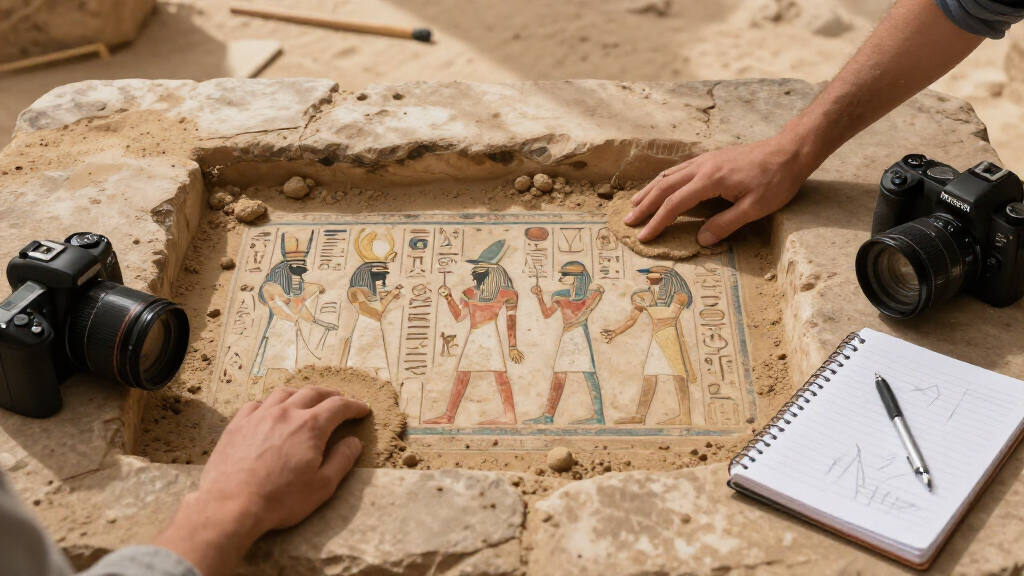
Archaeologists at Saqqara have uncovered a 4,400-year-old tomb belonging to an Egyptian judge, featuring remarkably preserved wall paintings with original colors. The discovery offers new insights into early Egyptian judicial and funerary practices. The find is considered one of the most significant recent discoveries at Saqqara in years, highlighting ongoing efforts to explore Egypt’s ancient history.
The tomb was unearthed during recent excavations led by Egypt’s Ministry of Tourism and Antiquities. It is believed to date back to the Fifth Dynasty of Egypt, approximately 2400 BCE, based on preliminary dating methods. The tomb’s walls still display vibrant colors, which archaeologists say are rare for structures of this age, providing a vivid glimpse into ancient Egyptian art and religious symbolism.
Initial examination indicates the tomb belonged to a high-ranking judge, whose name and titles are yet to be fully deciphered. The tomb’s architecture includes a rectangular burial chamber and an antechamber, with inscriptions that are currently being studied by specialists. The preservation of wall paintings suggests that the tomb was well-maintained and possibly sealed shortly after its construction, helping to protect its interior from erosion over millennia.
Implications for Understanding Ancient Egyptian Justice and Art
This discovery is significant because it provides tangible evidence of the role of judges in ancient Egypt, a facet of society that is not extensively documented. The well-preserved wall paintings may depict scenes of judgment, religious rituals, or daily life, offering valuable visual data. Additionally, the vibrant colors on the walls challenge previous assumptions about the degradation of ancient Egyptian wall art, opening new avenues for research into ancient materials and techniques.
The find also underscores the importance of Saqqara as an archaeological site, which continues to yield important artifacts that deepen understanding of Egypt’s dynastic history. Experts believe that further analysis could reveal more about the social hierarchy, legal practices, and religious beliefs of the period.
As an affiliate, we earn on qualifying purchases.
Saqqara’s Ongoing Role in Egyptology
Saqqara, a vast necropolis serving as the burial ground for Memphis, has been a focus of archaeological activity for decades. It is home to numerous pyramids, tombs, and burial complexes from various dynasties. Recent excavations have uncovered several significant tombs, but discoveries like this one—featuring exceptional preservation—are relatively rare. The site’s rich history spans over 3,000 years, making it a key location for understanding the evolution of Egyptian funerary practices and social organization.
Previous notable finds at Saqqara include the Step Pyramid of Djoser and numerous tombs from the Old Kingdom. The recent discovery of this judge’s tomb adds to the growing list of important finds, driven by advances in archaeological techniques and increased international collaboration. It also comes amid renewed interest in Egypt’s ancient history, partly fueled by increased media coverage and academic research.
As an affiliate, we earn on qualifying purchases.
Details on the Tomb’s Owner and Exact Date Still Unclear
While preliminary assessments place the tomb in the Fifth Dynasty, the precise identity of the judge and the full scope of the inscriptions remain under study. Researchers are also working to confirm the exact dating through radiocarbon analysis and stylistic comparisons. It is not yet clear whether the wall paintings depict specific scenes of judgment or religious rituals, as interpretations are still in progress.
Egyptian hieroglyphs decoding book
As an affiliate, we earn on qualifying purchases.
As an affiliate, we earn on qualifying purchases.
Further Excavations and Analyses Expected in Coming Months
Archaeologists plan to continue detailed examinations of the tomb’s inscriptions, paintings, and architecture. Laboratory analyses, including material studies of the pigments used in the wall paintings, are underway to better understand ancient Egyptian artistic techniques. Future publications are expected to clarify the tomb owner’s identity and reveal more about the social and religious context of the period.
Additionally, the team aims to explore nearby structures that may be linked to this tomb, potentially uncovering a larger burial complex or administrative site. International interest and collaboration are likely to increase as more findings emerge from Saqqara’s ongoing excavations.
As an affiliate, we earn on qualifying purchases.
Key Questions
What makes this tomb discovery so important?
The tomb’s exceptional preservation, especially the wall paintings with original colors, offers rare insights into Egyptian art, religion, and social hierarchy from over 4,400 years ago.
Who was the owner of this tomb?
Its owner is believed to be a high-ranking judge from the Fifth Dynasty, but their exact identity is still under investigation.
What do the wall paintings depict?
It is not yet confirmed, but early interpretations suggest scenes related to judgment, religious rituals, or daily life, pending further analysis.
When will more details about this discovery be available?
Further excavations, analyses, and scholarly publications are expected over the next several months as research continues.
How does this find compare to previous discoveries at Saqqara?
This tomb is notable for its exceptional preservation and the presence of vibrant wall colors, which are rare for structures of this age, making it a significant addition to Saqqara’s archaeological record.
Source: hn
Halloween Picks
halloween
As an affiliate, we earn on qualifying purchases.