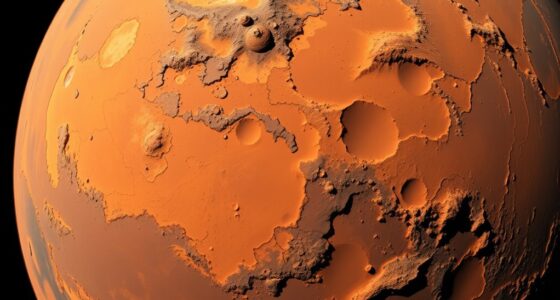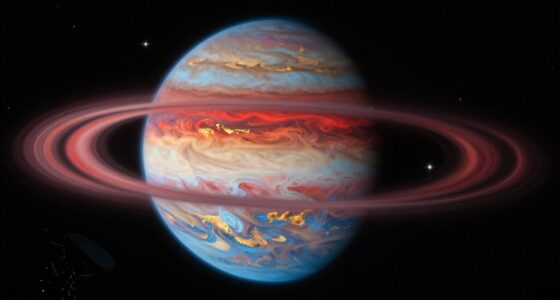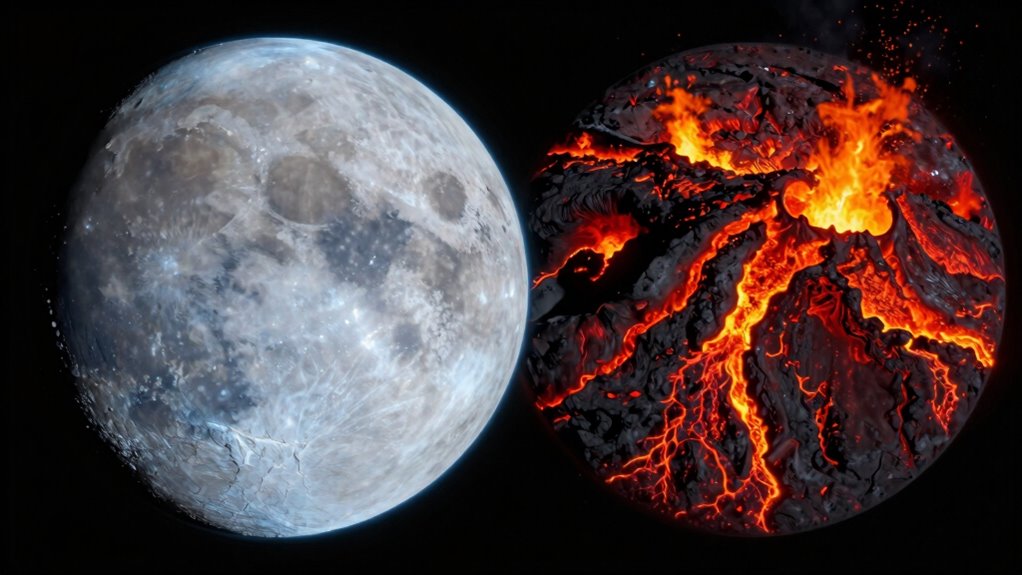
Europa and Io are two of the most extreme moons in our solar system, each offering unique environments that challenge our understanding of life. Europa’s icy crust hides a subsurface ocean that could harbor life thanks to possible chemical nutrients and energy sources. In contrast, Io’s surface is dominated by intense volcanic activity fueled by tidal heating, making it a volatile environment. Exploring these moons reveals how vastly different worlds could support biology, if at all—discover more to see what surprises await.
Key Takeaways
- Europa’s subsurface ocean offers a stable, water-rich environment with potential chemical nutrients, making it a promising candidate for life.
- Io’s extreme volcanic activity and sulfur-rich surface create a highly energetic, volatile environment less conducive to stable life forms.
- Europa’s icy crust and possible hydrothermal vents could provide energy sources similar to Earth’s deep-sea ecosystems.
- Io’s intense radiation and constantly changing surface pose significant challenges for sustaining or detecting life.
- Both moons showcase extreme environments that could dramatically alter our understanding of life’s resilience and adaptability beyond Earth.

ArtSkills Epic Lab Dig Kit, Ocean Discovery STEM Treasure Hunting Science Kit Arts & Crafts Activity, 30 Assorted Treasures, Tools Included
Epic Lab Ocean Discovery Treasure Craft Activity is perfect as a party or playtime craft activity.
As an affiliate, we earn on qualifying purchases.
As an affiliate, we earn on qualifying purchases.
What Are Europa and Io, and Why Do They Matter?
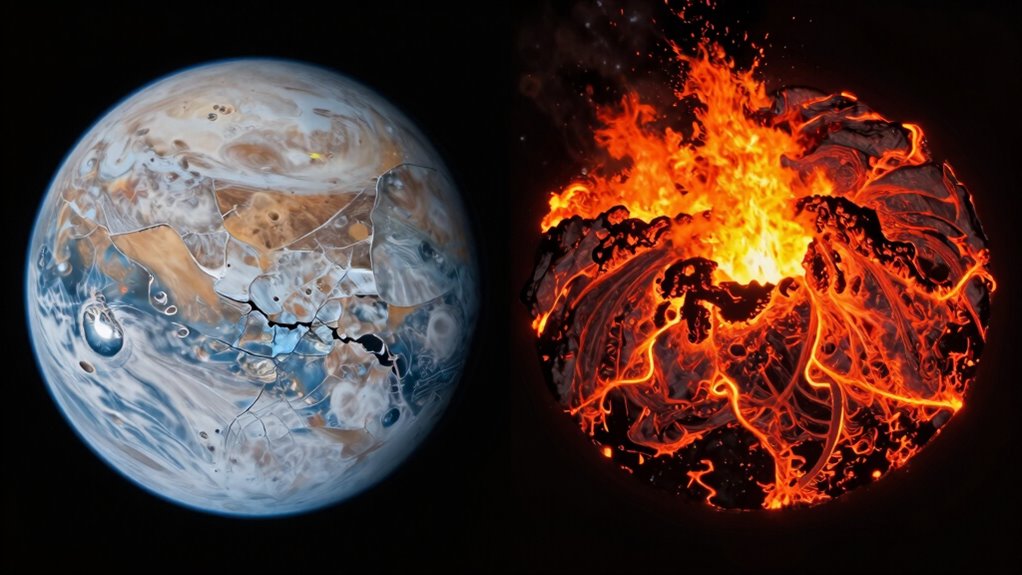
Have you ever wondered what makes Europa and Io two of the most intriguing moons in our solar system? These moons captivate scientists because of their unique surface compositions and astrobiology potential. Europa’s icy crust hides a subsurface ocean, hinting at the possibility of life beneath the surface, while its surface features—cracked ice, ridges, and cryovolcanoes—suggest active geology. Io, on the other hand, boasts a volcanic surface filled with sulfur and silicate lava, making it the most geologically active body in the solar system. Their contrasting surface compositions reveal different evolutionary paths and environmental conditions. Understanding what these moons are made of helps scientists evaluate their potential to support life and provides clues about planetary processes across our solar system. Additionally, studying their surface and internal structures advances our knowledge of planetary formation and geophysical activity.

Herwicm Compound Trinocular Microscope 40X-5000X Magnification, Research Grade Professional Microscope, Two Levels of Mechanical Stage LED Illumination, USB Video Camera with Microscope for Adults
Laboratory professional microscope: 195 flat-field achromatic objective lens can magnify up to 40X, 100X, 250X, 400X, 1000X and…
As an affiliate, we earn on qualifying purchases.
As an affiliate, we earn on qualifying purchases.
How Could Europa’s Subsurface Ocean Support Life?

Europa’s icy surface conceals a vast, salty ocean lying beneath, making it one of the prime candidates in the search for extraterrestrial life. This subsurface ocean could serve as a unique extraterrestrial habitat, offering the necessary ingredients for life, such as water, energy, and chemical nutrients. If hydrothermal vents exist on the ocean floor, they could provide energy sources similar to those supporting deep-sea life on Earth. To detect potential life, scientists focus on biosignature detection—looking for chemical signs, like specific gases or organic compounds, that indicate biological activity. The presence of air quality in Europa’s ocean could also influence its habitability, as it impacts the chemical processes essential for sustaining life. Additionally, understanding the chemical composition of the ocean could reveal how such environments support or inhibit biological processes. If Europa’s ocean harbors life, these biosignatures could reveal itself through future missions, transforming our understanding of life’s potential beyond Earth.
Furthermore, studying extreme environments on Earth helps scientists better interpret potential biosignatures in extraterrestrial oceans, providing insights into life’s resilience. Moreover, analyzing energy sources available in Europa’s ocean environment could help determine how life might thrive in such alien conditions.

National Geographic Glow-in-the-Dark Solar System Model Kit for Kids – Build & Paint a 3D Planetary Model with Movable Arms, STEM Projects for Kids Ages 8-12, Space Themed Bedroom Decor
BUILD & DISPLAY A MOVING, GLOWING SOLAR SYSTEM – With this kit, kids can customize all 8 planets…
As an affiliate, we earn on qualifying purchases.
As an affiliate, we earn on qualifying purchases.
What Makes Io’s Volcanoes So Extreme and Unique?
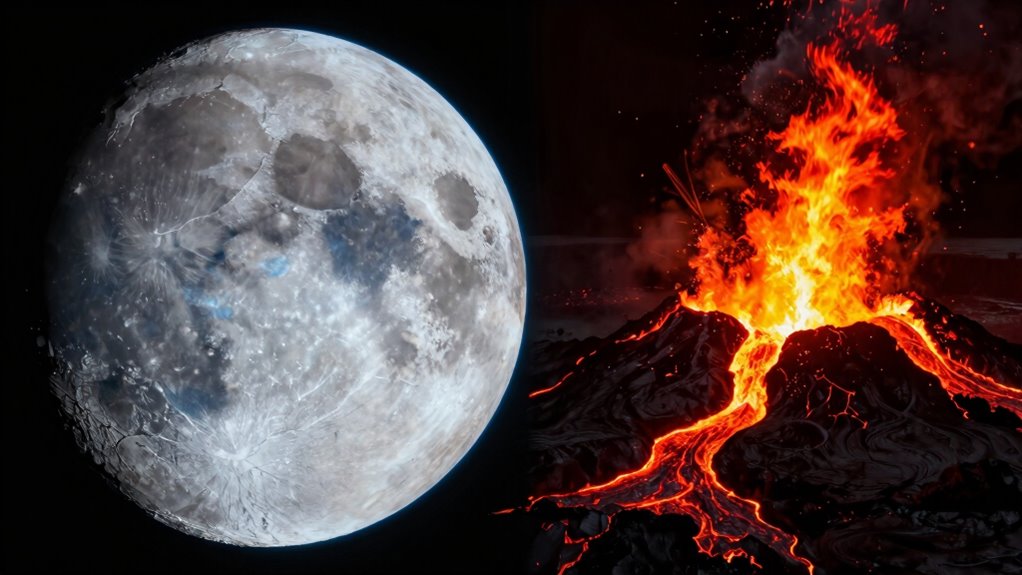
Io’s volcanoes stand out as some of the most extreme and active on any celestial body, driven by intense tidal forces from Jupiter’s gravity. This relentless gravitational tug creates immense internal heating, fueling volcanic activity that reshapes its surface constantly. Unlike other moons, Io’s surface composition is a mosaic of sulfur, silicates, and volcanic deposits, giving it a colorful, chaotic landscape. The volcanic processes on Io are also responsible for its dynamic surface, constantly renewed by eruptive activity. This ongoing volcanism is a prime example of how tidal heating can power geological phenomena far beyond Earth. The volcanoes erupt with lava fountains reaching hundreds of kilometers high. To better understand, consider this table:
| Volcano Name | Eruption Style | Surface Material |
|---|---|---|
| Loki Patera | Lava lake | Sulfur, silicates |
| Pillan Patera | Explosive eruptions | Sulfur dioxide |
| Tvashtar | Lava fountains | Silicate lava |
| Prometheus | Lava flows | Sulfur deposits |
| Pele | Continuous eruptions | Sulfur and ash |
This volcanic activity makes Io’s surface composition uniquely dynamic and extreme.
NASA Lunar Telescope for Kids – 90x Magnification, Includes Two Eyepieces, Tabletop Tripod, and Finder Scope- Kids Telescope for Astronomy Beginners, Space Toys, NASA Gifts (Amazon Exclusive)
INSPIRE CURIOSITY – The NASA Lunar Telescope allows your child to see the moon in incredible detail; the…
As an affiliate, we earn on qualifying purchases.
As an affiliate, we earn on qualifying purchases.
How Do Scientists Search for Life on Europa and Io?

How do scientists search for signs of life on moons like Europa and Io? They rely on remote sensing techniques from orbiting spacecraft and robotic probes. These probes orbit the moons, collecting data on surface composition, temperature, and magnetic fields. Instruments can detect chemicals that might indicate biological activity or conditions suitable for life. For Europa, scientists focus on analyzing surface ice and possible subsurface oceans, using radar and spectrometers. Io’s extreme volcanic activity demands different strategies, like monitoring thermal emissions and surface changes. Robotic probes provide real-time data, helping scientists identify promising areas for future exploration. Because these moons are distant and harsh, remote sensing with robotic technology remains our best tool to search for potential signs of life without direct contact. Additionally, power and performance upgrades on spacecraft can improve data collection and mission success. remote sensing techniques enable the gathering of vital information from afar, reducing the risk and cost associated with direct exploration. Advances in sensor technology further enhance our ability to detect faint chemical signatures indicative of biological processes, especially when combined with data analysis algorithms that interpret complex datasets more efficiently and accurately. Moreover, ongoing developments in instrument sensitivity allow scientists to detect even subtler signs of life or habitability indicators.
Could Life Survive in Europa’s Oceans or on Io’s Volcanoes?
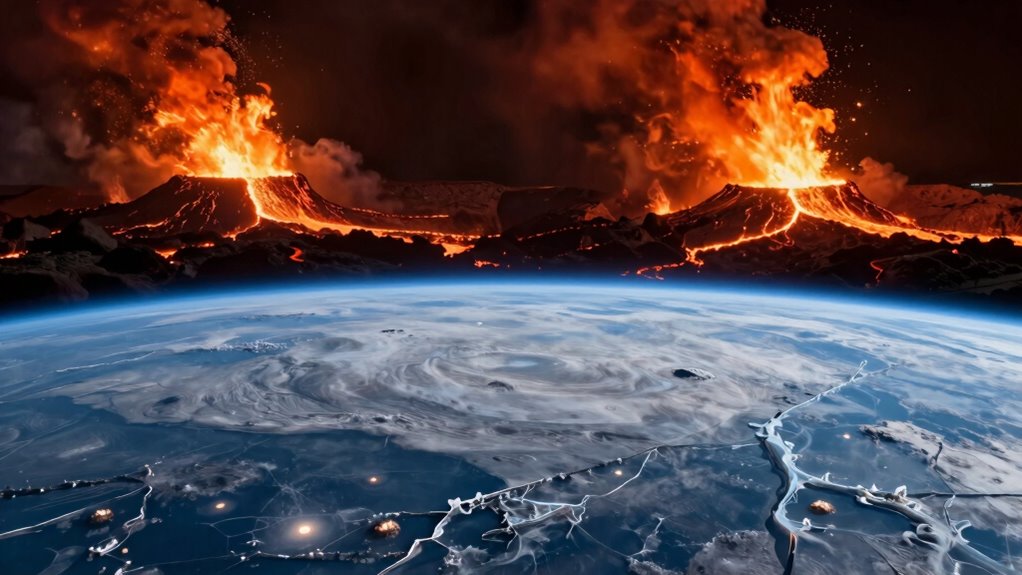
You might wonder if life could exist beneath Europa’s icy crust or on Io’s fiery volcanoes. The chemistry of Europa’s subsurface ocean and Io’s volcanic activity determine if conditions are just right for life to survive. Factors like temperature extremes and available energy sources play a vital role in this possibility. Additionally, the presence of protective atmospheres and chemical nutrients could influence the potential for sustaining life on these moons. Understanding the chemical composition of their environments can help assess how hospitable these extraterrestrial habitats might be. Moreover, exploring energy sources such as tidal heating or chemical reactions is crucial to determine if these environments could support biological processes. The availability of liquid water beneath the ice and the chemical interactions occurring there are essential elements in evaluating their habitability. Furthermore, studying energy transfer mechanisms can reveal how energy might support or inhibit life processes in these extreme conditions.
Subsurface Ocean Chemistry
Despite their contrasting environments, both Europa and Io possess intriguing subsurface ocean chemistries that could influence the potential for life. Europa’s ocean likely contains a diverse mix of salts, organics, and minerals, creating a rich chemistry diversity essential for life’s emergence. In contrast, Io’s ocean, if it exists, might be dominated by sulfur compounds from intense volcanic activity, shaping its unique ocean composition. This chemistry diversity sparks hope and curiosity about possible life forms adapting to such extreme environments. Consider the following:
| Europa’s Ocean Chemistry | Io’s Ocean Chemistry |
|---|---|
| Rich in salts, organics | Sulfur-rich, volcanic |
| Stable, complex molecules | Volcanic, volatile |
| Potential energy sources | Harsh, energetic |
| Supports life possibilities | Challenges survival |
Your exploration of these worlds reveals surprising possibilities for life’s resilience.
Extreme Temperature Tolerance
Both Europa and Io face extreme temperature conditions that challenge the survival of any potential life forms. Europa’s icy surface experiences temperatures well below freezing, requiring organisms to develop exceptional extreme temperature tolerance to endure the cold. On the other hand, Io endures intense volcanic activity, with surface temperatures soaring to hundreds of degrees Celsius, demanding equally specialized adaptation strategies. Life, if it exists, would need to withstand rapid and drastic temperature fluctuations. Adaptation strategies might include specialized enzymes that function across wide temperature ranges, protective biofilms, or internal heating mechanisms. These resilience tactics could enable life to persist in such harsh environments, making Europa’s icy oceans and Io’s volcanic landscapes intriguing frontiers for understanding the limits of biological survival.
Energy Sources Available
Understanding the available energy sources is essential when evaluating the potential for life on Europa and Io. On Europa, chemical energy could fuel life through interactions between water and minerals from the rocky mantle, creating a steady supply of nutrients. Tidal heating, caused by Jupiter’s gravitational pull, keeps Europa’s ocean liquid beneath its icy crust, providing a continuous energy source. On Io, intense tidal heating drives volcanic activity, releasing energy that creates extreme surface conditions. While this energy powers volcanic eruptions, it’s less likely to support stable, life-friendly environments. The key difference is that Europa’s tidal heating sustains a subsurface ocean capable of supporting life, whereas Io’s constant volcanic activity presents a more hostile environment with limited potential for biological development. Additionally, the presence of nutrient-rich environments beneath Europa’s icy shell could further enhance its habitability.
What Challenges Do Researchers Face Exploring These Moons?
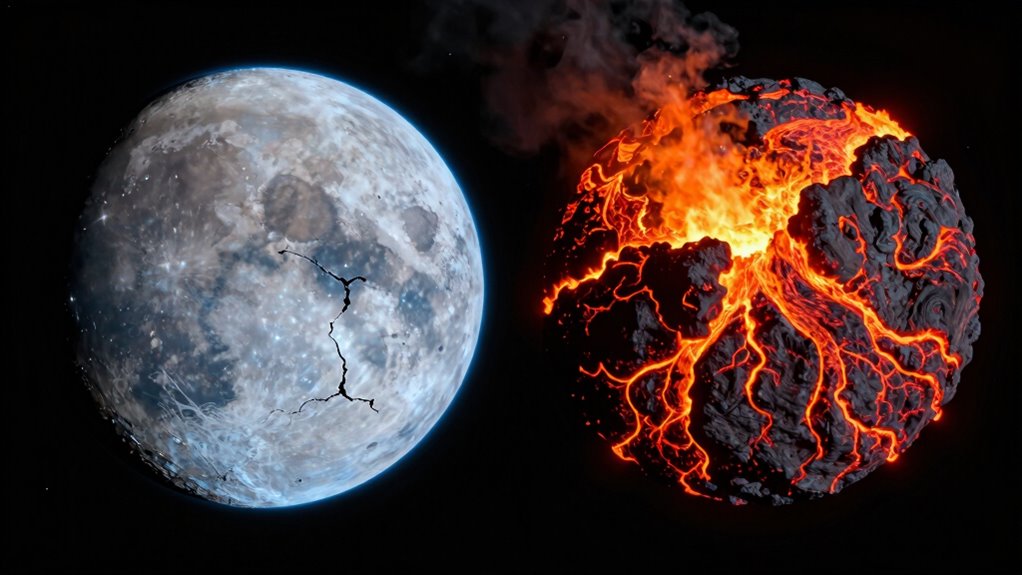
Exploring Europa and Io presents significant challenges because of their extreme environments and distance from Earth. To study their subsurface oceans or volcanic activity, you need advanced subsurface imaging techniques, which are difficult in such harsh conditions. Radiation shielding is vital because both moons are bombarded by intense radiation belts, risking equipment and human explorers. These factors demand robust technology capable of surviving extreme heat, cold, and radiation. Developing specialized robotic explorers is crucial to navigate and operate effectively in these unpredictable terrains. Additionally, designing systems that can reliably operate in extreme temperature fluctuations is essential for successful exploration. The table below highlights key obstacles:
| Challenge | Impact | Solution |
|---|---|---|
| Extreme radiation | Damages instruments and poses risks | Heavy radiation shielding |
| Subsurface imaging | Difficult to access hidden oceans | Innovative sensor technology |
| Harsh surface conditions | Limits equipment durability | Durable, heat-resistant materials |
| Distance from Earth | Delays communication and data transfer | Autonomous exploration systems |
| Environmental Extremes | Require specialized materials and design to withstand harsh conditions |
Frequently Asked Questions
What Types of Organisms Might Evolve in Europa’s Subsurface Ocean?
In Europa’s subsurface ocean, you might see organisms that perform extraterrestrial photosynthesis using light from hydrothermal vents or chemical sources. Chemosynthetic ecosystems could thrive around energy-rich mineral deposits, supporting diverse life forms that don’t rely on sunlight. These organisms could develop unique metabolisms, harnessing chemicals like sulfur or methane, and form complex communities similar to deep-sea vent ecosystems on Earth, but adapted to Europa’s icy, dark environment.
How Do Io’s Volcanic Eruptions Influence Its Surface Chemistry?
Ever wonder how chaos shapes worlds? Io’s volcanic eruptions dramatically influence its surface chemistry through volcanic mineralization, injecting sulfur and other minerals into the crust. These eruptions drive surface alteration processes, constantly reshaping the landscape and creating new chemical environments. This intense activity not only transforms Io’s surface but also hints at a dynamic system where surface chemistry evolves rapidly, fueling curiosity about the moon’s potential for unique phenomena and possibly even life.
Could Europa’s Ice Shell Harbor Microbial Life in Cracks?
Yes, Europa’s ice shell could harbor microbial life in cracks. Ice tectonics create fractures that might trap nutrients and liquid water beneath the surface, providing a habitat. Surface radiation breaks down ice, creating chemical energy sources that microbes could use. You should explore these cracks with future missions, as they could reveal signs of life sheltered beneath Europa’s icy exterior.
What Tools Are Used to Detect Biosignatures on These Moons?
Start by studying spectral signatures with spectral analysis, which helps identify chemical clues indicating biosignatures. Remote sensing tools, like orbiters and spectrometers, scan the moons’ surfaces and ice shells from afar, detecting subtle signals that suggest biological activity. These techniques allow scientists to analyze surface compositions, identify organic molecules, and search for evidence of life, all without physically landing or drilling into the icy crusts.
How Might Future Missions Overcome the Moons’ Extreme Environments?
You can overcome the moons’ extreme environments by focusing on subsurface exploration with advanced drilling and ice-penetrating tools, allowing you to access hidden biosignatures beneath the surface. Incorporate robust radiation shielding into your spacecraft and instruments to protect against intense radiation, especially on Io. These strategies will enable you to study these moons safely, increasing your chances of discovering signs of life in their extreme conditions.
Conclusion
As you explore Europa and Io, it’s clear these moons could rewrite biology, much like discovering a new continent in the age of exploration. With Europa’s hidden ocean and Io’s fiery volcanoes, you’re on the brink of uncovering life’s secrets beyond Earth. Keep your curiosity alive, and remember, future generations might look back and call this era the “golden age” of space discovery. Who knows? You might just be part of that historic adventure.