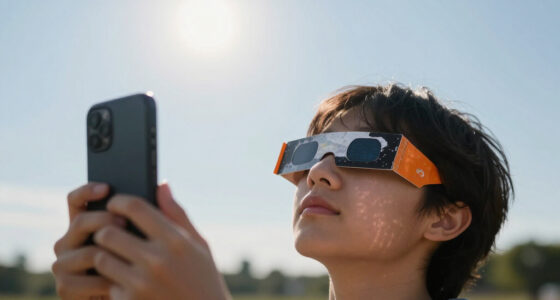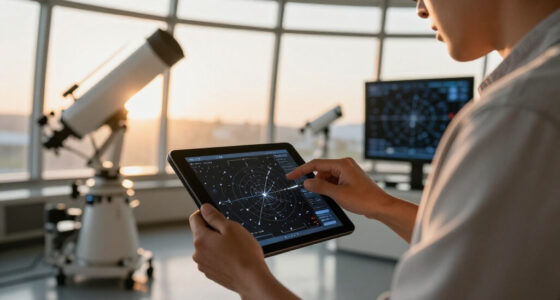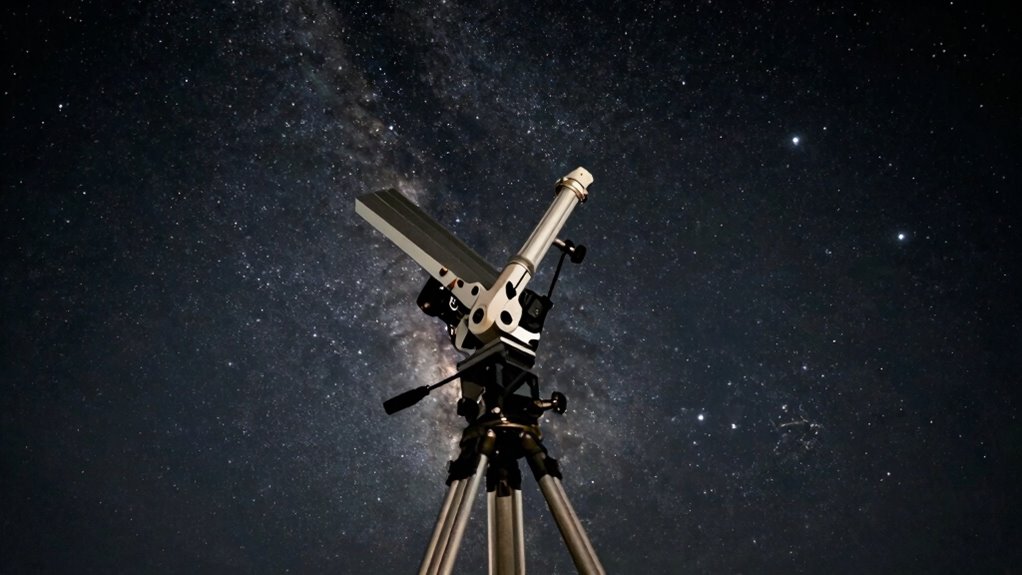

Star trackers help you capture the night sky by precisely aligning your camera or telescope with celestial objects. They analyze star positions in your view and compare them to star catalogs, correcting for movement and drift. This allows for longer exposure times and sharper images of faint objects like nebulae and galaxies. With a star tracker, you’ll get clearer, more detailed shots and can enjoy easier astrophotography—if you continue exploring, you’ll discover even more ways it enhances your night sky experiences.

Prime made for students and young adults
- Fast, free delivery for dorm and study essentials
- Prime Video and Amazon Music included
- Member-only deals
Key Takeaways
- Star trackers precisely align cameras or telescopes, enabling longer exposures without star trails.
- They help track celestial objects accurately, revealing faint nebulae, galaxies, and star clusters.
- Star trackers automate equipment positioning, simplifying setup for high-quality astrophotography.
- They improve image clarity by maintaining consistent alignment during extended exposures.
- Star trackers assist in celestial navigation, ensuring correct orientation for capturing the night sky.

When you look up at the night sky, you’re seeing a vast, moving tapestry of stars that have guided explorers and inspired dreamers for centuries. If you’re into space photography, capturing those stars in stunning detail can be both rewarding and challenging. That’s where star trackers come into play. These devices are essential tools that help you pinpoint your position and keep your camera steady, allowing you to take clear, long-exposure shots of the cosmos. Without them, the slightest movement or misalignment can blur your images, ruining what could have been a perfect shot of the Milky Way or a distant galaxy.
Star trackers work by analyzing the position of stars in your camera’s field of view, comparing them to a star catalog, and then calculating your precise orientation. This process is vital for celestial navigation, especially when you’re out in remote locations with no GPS signals. With a star tracker, you can automatically align your camera or telescope with the night sky, ensuring that your equipment points exactly where you want it. This precision is especially important for astrophotographers aiming to capture detailed images of celestial objects, as even a small misalignment can cause star trails or blurry images. Accurate star positioning is fundamental for both space imaging and celestial navigation, making star trackers invaluable tools for explorers of the night sky.
Star trackers precisely analyze star positions to align equipment and achieve clear, detailed astrophotography even in remote locations.
Using a star tracker, you can extend exposure times significantly without star trails, which is essential for high-quality space photography. The longer the exposure, the more light your camera collects, revealing faint nebulae, distant galaxies, and intricate star clusters that are invisible to the naked eye. This ability transforms your night sky images from simple snapshots into breathtaking, detailed photographs. Plus, many star trackers are portable and easy to set up, making them perfect companions for outdoor adventures or astrophotography trips far from city lights. The integration of advanced tracking technology ensures even beginners can achieve impressive results with minimal setup time. Additionally, understanding celestial mechanics can further enhance your ability to plan and execute successful astrophotography sessions. Gaining knowledge of the night sky’s movement can help you anticipate the best times for capturing specific celestial events and objects.
In addition to improving your photography, star trackers serve as powerful tools for celestial navigation. They help you determine your exact position by cross-referencing star positions with known celestial maps. This capability has historically been vital for navigation at sea and in remote wilderness areas. Today, it’s a modern twist that allows amateur astronomers and space enthusiasts to explore the cosmos with confidence. When you combine stellar tracking technology with your passion for space photography, you not only capture the beauty of the night sky but also deepen your understanding of navigation and the universe itself.
star tracker for astrophotography
As an affiliate, we earn on qualifying purchases.
As an affiliate, we earn on qualifying purchases.
Frequently Asked Questions
Can Star Trackers Be Used With Smartphone Cameras?
Yes, star trackers can be used with smartphone cameras. Many models offer smartphone compatibility, allowing you to connect directly via Bluetooth or Wi-Fi. Plus, they often feature app integration, making it easy to control the tracker and capture stunning astrophotography images. With these tools, you can enhance your night sky photography experience, achieving clearer, longer-exposure shots without complicated equipment setup.
How Long Do Star Tracker Batteries Last?
Star tracker batteries typically last between 4 to 12 hours, depending on the device and usage. To maximize battery lifespan, you should use effective power management strategies like turning off unnecessary features and reducing screen brightness. Keep an eye on the battery indicator during your session, and consider carrying a portable power bank for extended stargazing trips. Proper power management guarantees you capture star trails without interruptions.
Are Star Trackers Suitable for Beginner Astronomers?
Yes, star trackers are suitable for beginner astronomers. Did you know that over 60% of new hobbyists find star trackers easy to install and operate? They require simple star tracker installation and minimal star tracker maintenance, making them accessible. As a beginner, you’ll enjoy tracking stars and celestial objects without complex setups. With patience, you’ll quickly learn to navigate the night sky, enhancing your astronomy experience.
What Is the Cost Range of Quality Star Trackers?
Quality star trackers typically cost between $300 and $1,500, depending on features and precision. If you’re on a budget, you’ll find some reliable budget options around $300 to $600, perfect for beginners. For advanced astrophotography, consider higher-end models in the $1,000 to $1,500 range, which offer better accuracy and stability. Comparing costs helps you choose a star tracker that balances your needs and budget effectively.
Do Star Trackers Work in Cloudy or Light-Polluted Conditions?
Cloud cover limitations and light pollution challenges do affect star trackers. They struggle in cloudy conditions because clouds block celestial signals, making tracking unreliable. Light pollution challenges diminish star visibility, reducing accuracy. However, some advanced star trackers use algorithms to mitigate these issues, but they’re not foolproof. To get the best results, you’ll want clear, dark skies. Planning your stargazing sessions around weather and choosing remote, low-light locations will help you get the most out of your star tracker.
automatic star tracker telescope
As an affiliate, we earn on qualifying purchases.
As an affiliate, we earn on qualifying purchases.
Conclusion
With a star tracker, you’re like a modern-day Galileo, effortlessly exploring the night sky’s mysteries. It’s your trusty compass, turning celestial chaos into clarity, all while you enjoy the cosmic show. Just imagine, centuries ago, astronomers relied on basic tools—today, you harness cutting-edge tech to reveal the universe’s secrets. So, keep your gaze up and your star tracker ready; the universe’s wonders are waiting for you to discover them, no DeLorean needed.
long exposure star tracker camera
As an affiliate, we earn on qualifying purchases.
As an affiliate, we earn on qualifying purchases.
As an affiliate, we earn on qualifying purchases.
Halloween Picks
halloween
As an affiliate, we earn on qualifying purchases.