
TL;DR

Prime made for students and young adults
- Fast, free delivery for dorm and study essentials
- Prime Video and Amazon Music included
- Member-only deals
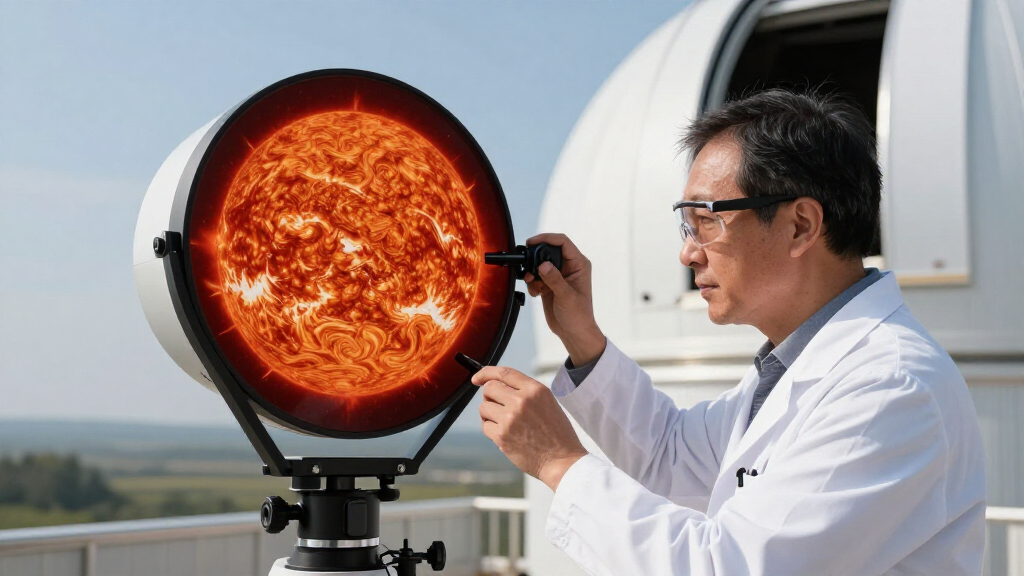
Scientists have confirmed the presence of Kelvin-Helmholtz instability on the Sun’s surface. This discovery enhances understanding of solar activity and space weather phenomena, with implications for Earth’s space environment.
Scientists have confirmed the observation of Kelvin-Helmholtz instability on the surface of the Sun, a phenomenon previously seen in other astrophysical contexts but not directly documented on the Sun itself. This discovery was announced by researchers based on recent high-resolution solar imaging, and it provides new insights into solar surface dynamics and space weather phenomena that can affect Earth.
The discovery was made using advanced solar telescopes equipped with high-resolution imaging capabilities, which captured features characteristic of Kelvin-Helmholtz instability — a fluid dynamic phenomenon where shear velocity causes wave-like formations at the interface of different layers. Researchers from the European Space Agency and collaborating institutions published their findings after analyzing data from the Solar Orbiter mission and ground-based observatories.
According to the study, the instability was observed at the boundary of solar plasma flows, where velocity shear leads to wave formations similar to those seen in Earth’s atmosphere and other astrophysical settings. The phenomenon was identified through detailed analysis of solar surface images taken over several days, showing characteristic rolling and wave patterns consistent with Kelvin-Helmholtz instability.
Implications for Solar Physics and Space Weather
This confirmation of Kelvin-Helmholtz instability on the Sun’s surface is a significant advancement in understanding solar magnetic activity and coronal mass ejections. It suggests that shear flows and wave formations contribute more actively to solar surface dynamics than previously thought, potentially influencing the initiation of solar eruptions that can impact satellite operations, communications, and power grids on Earth.
The finding also provides a new observational basis for modeling solar surface behavior, which can improve predictions of space weather events and their effects on Earth’s technological infrastructure.
As an affiliate, we earn on qualifying purchases.
Previous Observations and Theoretical Expectations of Solar Surface Waves
While Kelvin-Helmholtz instability is well-documented in Earth’s atmosphere and in laboratory plasmas, its direct observation on the Sun has remained elusive. Solar physicists have long theorized that shear flows at the boundary of different plasma layers could generate such wave phenomena, but definitive visual evidence was lacking until now.
This discovery builds on prior research showing complex plasma flows and wave activity on the Sun, but it is the first time the specific wave pattern characteristic of Kelvin-Helmholtz instability has been captured and confirmed through high-resolution imaging and data analysis.
“This observation confirms a long-standing theoretical prediction and opens new avenues for studying the dynamic processes on the Sun’s surface.”
— Dr. Maria Lopez, Solar Physicist
As an affiliate, we earn on qualifying purchases.
Unresolved Questions About Instability Formation and Impact
While the presence of Kelvin-Helmholtz instability has been confirmed, it is still unclear how widespread this phenomenon is across different regions of the Sun or how it precisely influences larger solar eruptions. Researchers are also investigating how these wave formations interact with magnetic fields and plasma flows to trigger solar flares or coronal mass ejections.
Further observational data and modeling are needed to determine the full implications of this instability for solar activity and space weather forecasting.
As an affiliate, we earn on qualifying purchases.
Future Observations and Modeling of Solar Surface Dynamics
Scientists plan to analyze additional high-resolution solar data from ongoing missions like the Solar Orbiter and the Parker Solar Probe to assess the prevalence of Kelvin-Helmholtz instability across the Sun. Enhanced computer models are also being developed to simulate how these wave phenomena influence larger-scale solar eruptions and magnetic activity.
Next steps include targeted observations during solar activity peaks and collaboration between observational and theoretical teams to incorporate these findings into space weather prediction models.
As an affiliate, we earn on qualifying purchases.
Key Questions
What is Kelvin-Helmholtz instability?
It is a fluid dynamic phenomenon where shear velocity between two layers creates wave-like patterns, often seen in Earth’s atmosphere and astrophysical plasmas.
Why is this discovery important?
It provides new insights into solar surface behavior and space weather processes, potentially improving predictions of solar eruptions that affect Earth.
Has Kelvin-Helmholtz instability been observed before on the Sun?
Direct visual confirmation was lacking until now, although it had been theorized based on plasma flow models.
How might this affect space weather forecasting?
Understanding the role of Kelvin-Helmholtz waves could help improve models predicting solar eruptions and their impact on Earth’s technological infrastructure.
Source: hn
Columbus Day / Indigenous Peoples' Day Picks
long weekend sales
As an affiliate, we earn on qualifying purchases.





![Terence Tao: Math 2.0 [Pdf]](https://curiousminds.info/wp-content/uploads/2026/10/terence-tao-math-2-0-pdf-featured-260x140.jpg)