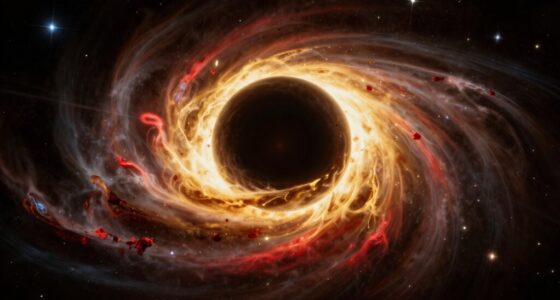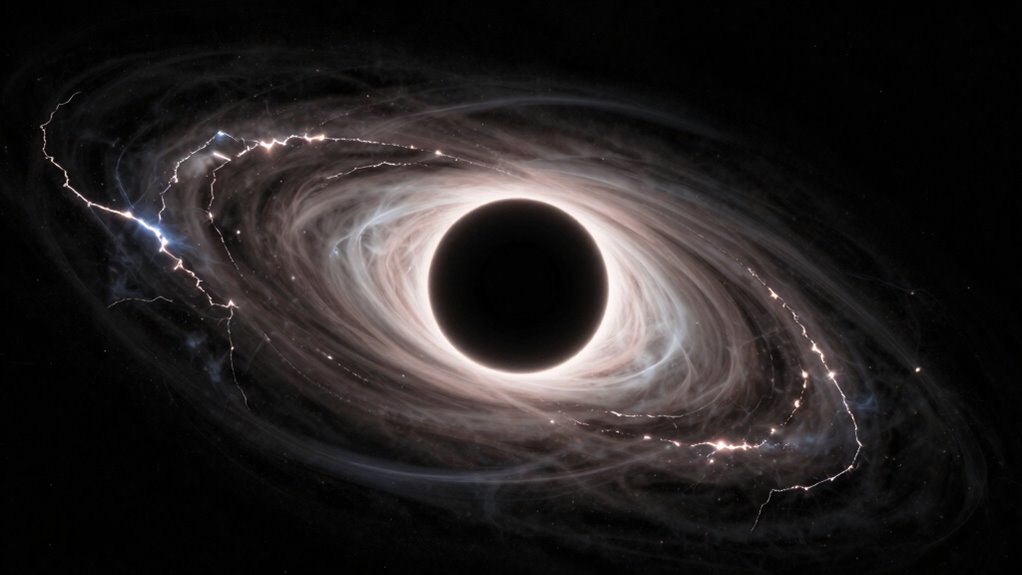

Black holes are harder to understand than they seem because they challenge our knowledge of gravity, quantum physics, and spacetime. The event horizon and core involve conditions that current theories can’t fully explain, like singularities where physics breaks down. Conflicting ideas from general relativity and quantum mechanics make it difficult to create a unified picture. Keep exploring, and you’ll discover the fascinating reasons why black holes remain one of science’s biggest mysteries.

Prime made for students and young adults
- Fast, free delivery for dorm and study essentials
- Prime Video and Amazon Music included
- Member-only deals
Key Takeaways
- Black holes involve extreme conditions where classical physics fails and quantum effects become significant.
- The event horizon presents a boundary where information loss conflicts with quantum principles.
- The singularity inside black holes defies current physics, making their true nature unknowable.
- Conflicting theories of general relativity and quantum mechanics hinder unified understanding.
- Limited observational tools restrict direct exploration of black hole interiors, complicating comprehension.
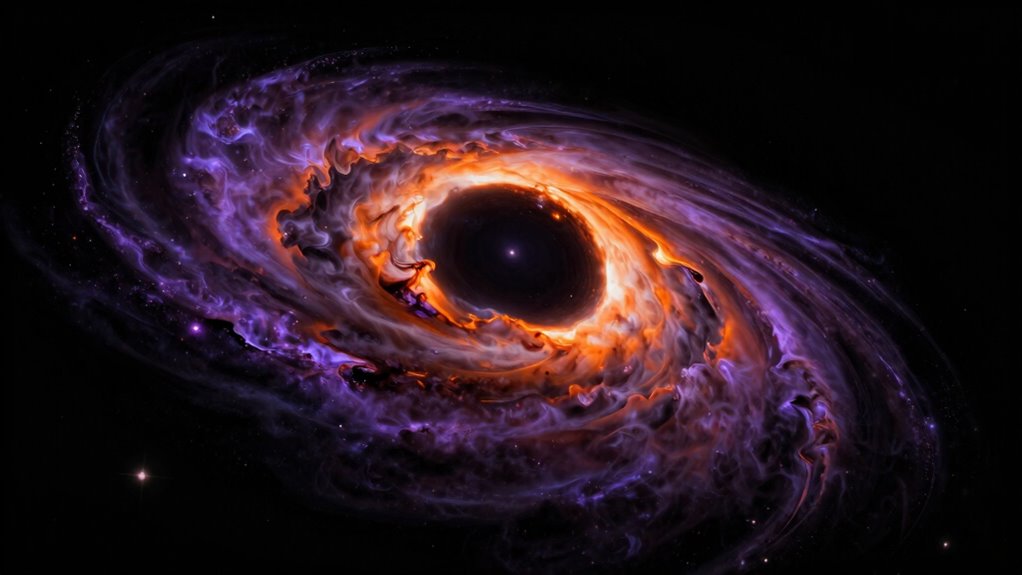
Have you ever wondered why black holes remain one of the most mysterious objects in the universe? It’s because they challenge our understanding of physics in fundamental ways. At their core, black holes push the limits of what we know about gravity, quantum effects, and the fabric of spacetime. The event horizon, the point of no return surrounding the black hole, exemplifies this complexity. It’s not just a boundary; it’s a zone where classical physics breaks down and quantum effects become significant. Understanding what happens at and beyond the event horizon is one of the biggest puzzles scientists face.
Black holes challenge our understanding of gravity, quantum effects, and spacetime at their mysterious event horizon.
One reason black holes are so hard to comprehend is because of the conflicting theories that describe them. General relativity predicts how gravity warps spacetime, creating the event horizon and singularity at the core. But, at the same time, quantum mechanics suggests that what occurs at the event horizon involves subtle quantum effects. These effects lead to phenomena like Hawking radiation, where black holes emit particles and slowly evaporate. The problem is, these two frameworks—relativity and quantum mechanics—don’t mesh well in extreme environments like black holes. This discrepancy makes it difficult to formulate a complete, unified theory. Reconciling physics remains one of the greatest challenges in theoretical science. Developing a consistent quantum gravity theory could eventually help us understand how these opposing ideas can coexist.
The event horizon itself presents unique challenges. It’s often thought of as a point where information is lost forever, which conflicts with quantum principles that forbid information from disappearing. This paradox has sparked intense debate among physicists. Some suggest that quantum effects at the event horizon might allow information to be preserved in ways we don’t yet understand, perhaps through subtle quantum correlations. But until we develop a theory that combines the quantum world with gravity, the true nature of the event horizon remains elusive. Quantum effects at the event horizon are believed to hold clues to resolving this paradox, but much research remains to be done.
Furthermore, the interior of a black hole—the singularity—is a place where our current physics breaks down entirely. The extreme density and curvature defy the laws we rely on, leaving us with more questions than answers. We can observe black holes indirectly, through their gravitational effects, but we can’t directly probe their interiors. This limits our understanding, making black holes not just cosmic phenomena but also puzzles that expose the gaps in our scientific knowledge. Advances in quantum gravity may someday help us bridge these gaps and reveal more about their mysterious nature. Interestingly, ongoing developments in quantum gravity theories aim to unify general relativity and quantum mechanics, potentially shedding light on these enigmas. This ongoing research offers hope that a comprehensive understanding of black holes might emerge in the future.
In essence, black holes are harder to understand than they seem because they sit at the intersection of incompatible theories and contain phenomena that defy our intuition. The interplay of quantum effects at the event horizon, the mysterious nature of the singularity, and the limits of our observational tools all contribute to their enigmatic reputation. Until we reconcile these fundamental aspects, black holes will continue to challenge and inspire scientists trying to unravel their secrets.
As an affiliate, we earn on qualifying purchases.
Frequently Asked Questions
Can Black Holes Eventually Evaporate Completely?
Yes, black holes can eventually evaporate completely through Hawking radiation, which causes them to lose mass over time. As the event horizon dynamics change, this radiation increases, speeding up the evaporation process. You should note that this process could take an immense amount of time for large black holes, but theoretically, they do shrink and vanish, leaving behind only radiation and no singularity.
Do Black Holes Have Different Types or Classifications?
Think of black holes like cosmic chameleons; they do have different types and classifications. You have stellar black holes, formed from collapsed stars, and supermassive black holes lurking at galaxy centers. Quantum effects near the event horizon influence their behaviors, making each type unique. Understanding these distinctions helps unravel the mysteries of our universe, much like decoding a secret message hidden within the fabric of spacetime.
How Do Black Holes Influence Their Surrounding Space?
Black holes influence their surrounding space through their intense gravitational pull, which warps spacetime and affects nearby objects. You’ll see this at the event horizon, the boundary beyond which nothing escapes, not even light. As matter gets close, it’s pulled inward, forming accretion disks and emitting radiation. This gravitational pull also distorts light, creating phenomena like gravitational lensing, revealing just how powerful and influential black holes truly are in shaping their cosmic neighborhoods.
Are Black Holes Connected to Other Universes?
Black holes might be connected to other universes through concepts like the multiverse theory. Some scientists speculate that black holes could serve as gateways, linking different universes via quantum entanglement. While these ideas are intriguing, there’s no concrete evidence yet to prove such connections. You can think of black holes as mysterious cosmic phenomena that challenge our understanding, possibly hinting at deeper realities beyond our universe.
What Is the True Nature of the Singularity?
You might think the singularity is just a point of infinite density, but quantum effects suggest it’s more complex, potentially involving a quantum state or a new kind of physics. The event horizon marks the boundary where gravity becomes so intense that nothing escapes, but the true nature of the singularity remains elusive. It could be a bridge to new physics, or a place where our current understanding breaks down entirely.
hubble space telescope telescope
As an affiliate, we earn on qualifying purchases.
As an affiliate, we earn on qualifying purchases.
Conclusion
Black holes may seem like cosmic monsters, but they remind us of our humbling ignorance—an echo of our endless quest for understanding. As you gaze into the darkness, remember, it’s not just the universe that’s mysterious, but also the curiosity that drives us to seek answers. In the end, black holes teach us that some secrets are worth chasing, even if they swallow the light of understanding. Keep wondering; that’s what makes us truly human.
quantum physics books for beginners
As an affiliate, we earn on qualifying purchases.
As an affiliate, we earn on qualifying purchases.
astronomy telescope for deep space observation
As an affiliate, we earn on qualifying purchases.
As an affiliate, we earn on qualifying purchases.
Halloween Picks
halloween
As an affiliate, we earn on qualifying purchases.