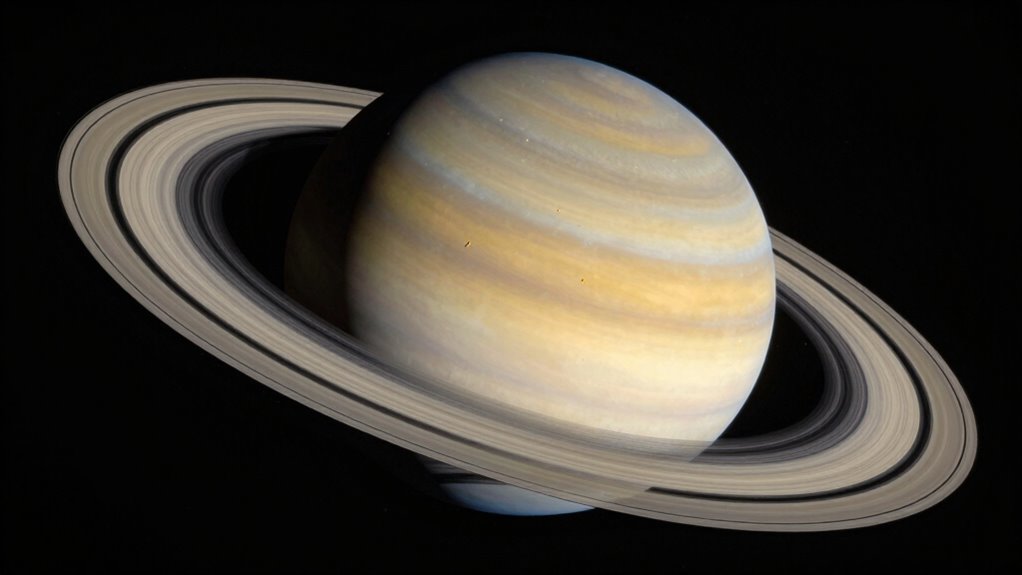

Saturn’s instantly recognizable look comes from its massive, shimmering ring system that encircles the planet and reflects sunlight brilliantly. Its striking, broad rings make it stand out easily in images and the night sky. Additionally, the planet’s atmospheric stripes of clouds and storms add a layered, textured appearance. Together, these features create a unique, mesmerizing profile that’s hard to forget. If you’re curious, you’ll discover even more about what makes Saturn truly extraordinary.

Prime made for students and young adults
- Fast, free delivery for dorm and study essentials
- Prime Video and Amazon Music included
- Member-only deals
Key Takeaways
- Its massive, shimmering ring system encircles the planet, making it visually striking and unique in the solar system.
- The distinctive, broad, flat rings reflect sunlight brilliantly, enhancing its iconic appearance.
- Prominent atmospheric stripes of clouds and storms create a layered, textured look on Saturn’s surface.
- The combination of rings and atmospheric features gives Saturn a highly recognizable and harmonious profile.
- Its overall appearance, including the rings and dynamic atmosphere, makes Saturn one of the most instantly identifiable planets.
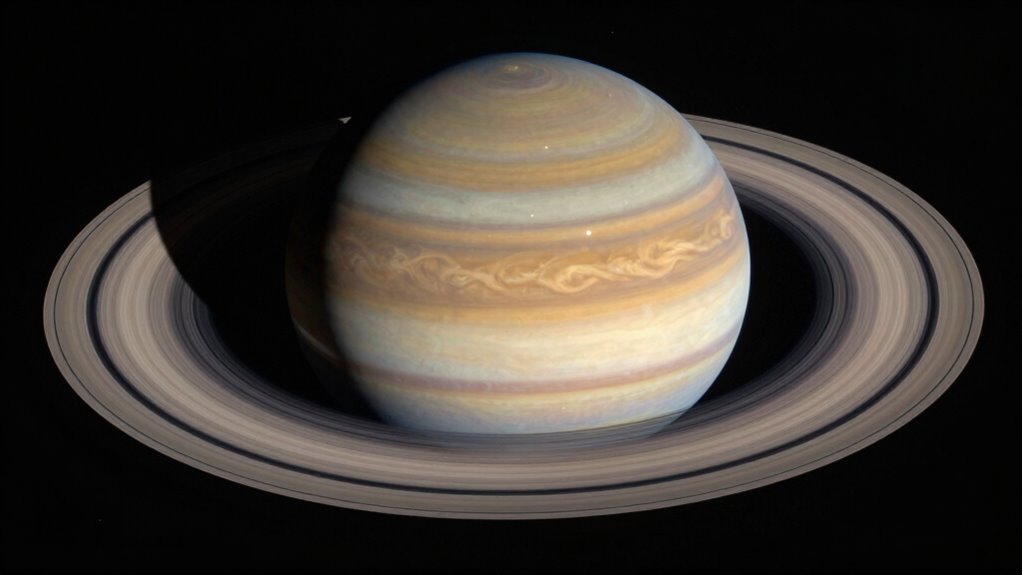
Have you ever wondered what makes Saturn instantly recognizable among the planets? It’s the striking combination of its massive, shimmering ring system and the subtle atmospheric stripes that truly set it apart. When you look up at the night sky or see an image of the solar system, Saturn’s rings are impossible to miss. They encircle the planet in a broad, flat disc that glints brilliantly under the Sun’s light, creating a spectacle that no other planet boasts. These rings aren’t just a thin line; they’re a complex system made up of countless particles, ranging from tiny ice grains to larger chunks, all orbiting in harmony. The sheer size and clarity of Saturn’s rings make it a visual marvel and a defining feature that captures your imagination. They stretch out thousands of miles, giving Saturn a distinctive profile that’s easily distinguishable from neighboring planets like Jupiter or Uranus.
But it’s not just the rings that make Saturn stand out. If you observe the planet closely through a telescope or even a detailed image, you’ll notice atmospheric stripes running parallel to its equator. These stripes are bands of clouds and storms that give Saturn a layered, textured appearance. They’re caused by the planet’s dynamic atmosphere, which features high-speed winds and varying temperatures. These atmospheric stripes might seem subtle at first glance, but they contribute markedly to its recognizable look. They give Saturn a sense of depth and complexity, hinting at the turbulent weather patterns swirling within. When combined with the brilliance of its rings, the stripes create a visual harmony that makes Saturn instantly familiar and awe-inspiring. The atmospheric stripes are also evidence of the planet’s active weather systems that have persisted over millions of years, adding to its dynamic atmosphere and mystery. Additionally, the composition of its clouds influences the appearance of these bands, further enhancing Saturn’s distinctive look. Moreover, the precise arrangement of particles in the rings adds to their striking appearance, making Saturn one of the most visually captivating planets in our solar system.
As an affiliate, we earn on qualifying purchases.
Frequently Asked Questions
How Old Is Saturn Compared to Other Planets?
Saturn is about 4.5 billion years old, making it roughly the same age as other planets in our solar system. During planet formation, it took millions of years for Saturn to develop its massive rings and gaseous atmosphere. Its celestial age aligns closely with Jupiter, Neptune, and Uranus, reflecting the early days of our solar system’s formation. So, while Saturn’s features are unique, its age is similar to its planetary neighbors.
Are There Moons Visible From Earth’s Surface?
Yes, you can see some of Saturn’s moons from Earth’s surface. For example, during planetary observation, amateur astronomers often spot Titan, Saturn’s largest moon, through a telescope. Its visibility varies depending on your equipment and conditions, but with a good telescope, you might observe this moon. Keep in mind, many of Saturn’s smaller moons are invisible without advanced telescopes. Still, Titan stands out as a bright, recognizable satellite.
What Is the Temperature on Saturn’s Surface?
Saturn’s temperature averages around -178°C (-288°F), making it extremely cold. You won’t find a solid surface like on Earth; instead, you’d encounter thick layers of gas and liquid. The ring composition, mainly ice particles with some rock, reflects sunlight and adds to its brightness, making Saturn recognizable. Its frigid temperature influences the composition and appearance of its rings, giving the planet its distinctive, shimmering look.
Can Saturn’s Rings Be Seen With a Small Telescope?
Yes, you can see Saturn’s rings with a small telescope, but their clarity depends on your equipment. Think of the rings as a shimmering symbol of the universe’s elegance, and your telescope as the key to revealing this beauty. With good ring composition and clear optics, even modest telescopes reveal the stunning structure. So, with patience and proper gear, you’ll witness Saturn’s iconic rings dancing in the night sky.
How Does Saturn’s Atmosphere Differ From Jupiter’s?
Saturn’s atmosphere differs from Jupiter’s mainly in composition and weather patterns. You’ll find that Saturn’s atmospheric composition has a higher concentration of hydrogen and helium, with fewer traces of other gases. Its weather patterns are also less intense, with calmer storms compared to Jupiter’s massive, turbulent storms. This results in a more subdued appearance, with the iconic rings adding to its distinctive, recognizable look, setting it apart from Jupiter’s more dynamic atmosphere.
As an affiliate, we earn on qualifying purchases.
Conclusion
Saturn’s iconic rings are like a signature, making it instantly recognizable in the vast theater of space. They act as a celestial fingerprint, setting it apart from other planets. With its striking appearance and unique features, Saturn captures your imagination and stands as a shining beacon of wonder. Just as a masterpiece commands attention in a gallery, Saturn’s beauty leaves an indelible mark on your mind, forever etched in the cosmos of your memory.
As an affiliate, we earn on qualifying purchases.
As an affiliate, we earn on qualifying purchases.
Fall Picks
fall essentials
As an affiliate, we earn on qualifying purchases.