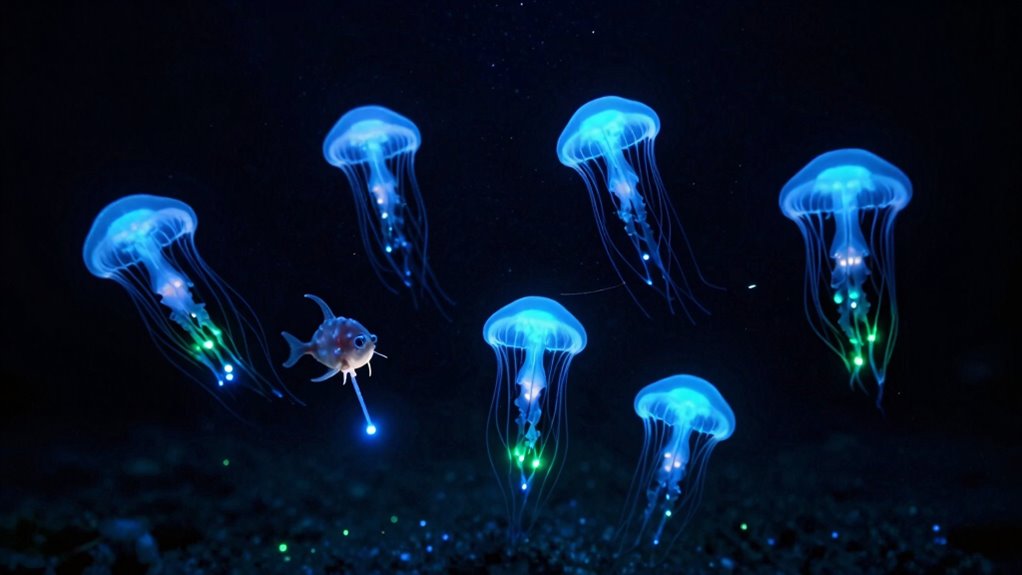

Animals glow through bioluminescence as an evolutionary survival tool. This ability helps them hide from predators, attract prey, and communicate in dark environments. They use their glow to blend into faint light, signal health to mates, or startle enemies. Over time, these features evolved to improve their chances of survival and reproduction. To discover how these fascinating adaptations work and what they reveal about nature, keep exploring this intriguing topic.

Prime made for students and young adults
- Fast, free delivery for dorm and study essentials
- Prime Video and Amazon Music included
- Member-only deals
Key Takeaways
- Bioluminescence evolved to improve survival by aiding camouflage, predator deterrence, and prey attraction in dark environments.
- It enhances reproductive success through visual signals like flashing patterns that attract mates or communicate social status.
- Glowing features help animals avoid predators by startling or confusing them or mimicking predator eyes.
- Bioluminescence facilitates navigation and hunting in habitats with limited or no sunlight, such as deep oceans.
- It results from chemical innovations that have been naturally selected to optimize communication, camouflage, and ecological interactions.
As an affiliate, we earn on qualifying purchases.
What Is Bioluminescence and How Do Animals Make Their Own Light?

Bioluminescence is the ability of certain animals to produce their own light through chemical reactions inside their bodies. You’ve probably seen bioluminescent fungi glowing in damp forests or noticed glowing plant phenomena in some tropical areas. These organisms generate light through a chemical process involving luciferin and luciferase enzymes, which produce a visible glow. This process isn’t limited to animals; fungi and some plants also emit light naturally. When you observe bioluminescence, you’re witnessing a sophisticated biological system that allows organisms to shine without external light sources. The chemical reaction involved is highly efficient, enabling these creatures to produce light with minimal energy expenditure. This natural light production can serve various purposes, from attracting prey to communication. Understanding how these animals and fungi produce light reveals a fascinating aspect of nature’s ability to generate its own illumination.
As an affiliate, we earn on qualifying purchases.
Why Do Animals Evolve the Ability to Glow? Exploring Survival Benefits
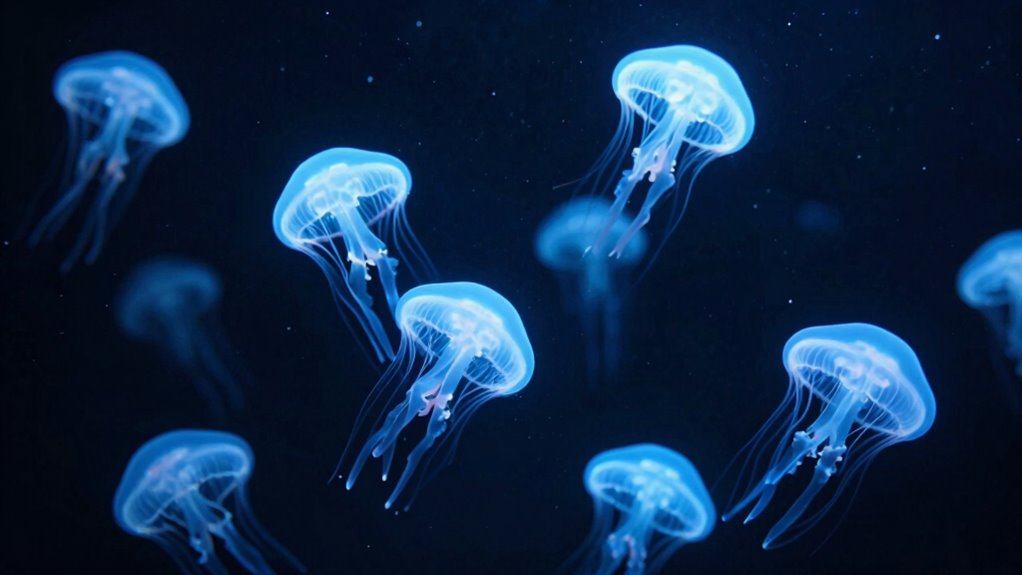
Bioluminescence helps animals hide from predators or sneak past prey through camouflage and concealment. It also attracts mates more effectively, increasing their chances of reproduction. Additionally, glowing signals can warn predators to stay away, giving animals a natural defense. Some species may even use bioluminescence to communicate within their social groups, enhancing coordination and survival strategies. This ability to produce light is an example of biochemical adaptation, which has evolved to improve survival in various environments. The environmental pressures faced by these animals have driven the development of this remarkable trait. Furthermore, environmental conditions such as darkness and scarce resources have selected for bioluminescent features that provide specific advantages in their habitats. These adaptive traits can also influence their behavior and ecological roles, further supporting their survival.
Camouflage and Concealment Strategies
Many animals have evolved the ability to glow as a clever way to blend into their surroundings or avoid predators. Bioluminescent camouflage helps them stay hidden by matching their environment’s faint light, making it harder for predators to spot them. Glow in the dark concealment allows these creatures to fade into the darkness of the ocean or forest floor, providing a perfect hiding spot. For example, some deep-sea fish emit light that mimics the faint glow of their surroundings, making them nearly invisible. This survival strategy reduces the risk of being eaten and increases their chances of hunting or resting undetected. By mastering bioluminescent camouflage, these animals turn their glow from a warning signal into an effective concealment tool.
Attracting Mates Effectively
Animals that glow often do so to attract mates and increase their chances of reproduction. Bioluminescence enhances their courtship displays, making them more visible in dark environments. Bright, flashing lights or steady glows can signal health, vitality, and genetic fitness to potential mates. During mate selection, these luminous signals help animals stand out from competitors, increasing the likelihood of being chosen. Some species use specific light patterns or colors to communicate their readiness to mate, effectively showcasing their suitability. By evolving bioluminescence, these animals improve their chances of successful reproduction through more effective courtship displays. The ability to glow therefore becomes a crucial adaptation, helping animals attract mates and secure their reproductive success in challenging environments.
Deterring Predators Naturally
Have you ever wondered how glowing creatures avoid becoming prey in the dark? Bioluminescence naturally deters predators by making animals more noticeable or confusing them. Some species use glowing as a form of territorial signal, warning others to stay away from their territory. Others incorporate it into mating displays, where sudden flashes can startle predators or signal that the animal is alert and ready to defend itself. In some cases, the glow mimics the eyes of larger predators, deterring smaller animals from approaching. This survival strategy reduces the risk of attack and helps animals protect themselves without relying on speed or armor. Additionally, evolutionary adaptations such as bioluminescence often develop to provide animals with a competitive edge in their ecosystems. Moreover, bioluminescence can also serve as a form of communication among individuals, aiding in coordinated behaviors and social interactions in dark environments. By evolving bioluminescence, these animals enhance their chances of survival in predator-rich environments.
As an affiliate, we earn on qualifying purchases.
How Does Bioluminescence Help Animals Find Food and Avoid Predators?

Bioluminescence serves as an essential tool for animals to locate food and evade predators in the dark depths of the ocean. Through bioluminescent hunting, animals can illuminate their surroundings, revealing prey that would otherwise stay hidden in the darkness. Some creatures produce flashing or glowing patterns to attract smaller fish or invertebrates, making it easier to catch their next meal. Conversely, bioluminescence can also serve as predator warning signals. When threatened, certain animals emit bright or sudden flashes to startle predators or alert them that they’re toxic or unpalatable. This combination of illuminating prey and signaling danger helps animals survive in an environment where visibility is limited, giving them a crucial advantage in finding food and avoiding becoming someone else’s meal. Additionally, some scientists believe that bioluminescent displays influence the evolutionary development of these animals, enabling them to adapt more effectively to their elusive habitats.
underwater bioluminescent fishing light
As an affiliate, we earn on qualifying purchases.
As an affiliate, we earn on qualifying purchases.
How Do Animals Use Bioluminescence to Communicate and Attract Mates?
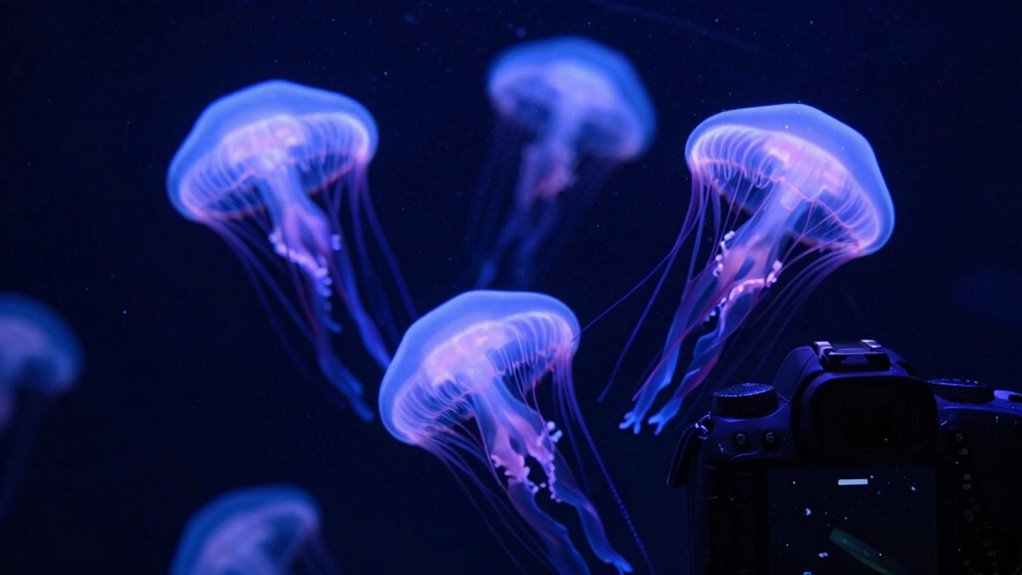
Since bioluminescence creates striking visual signals in the dark ocean, creatures often use it to communicate with each other and attract mates. They produce unique mating signals through glowing patterns, flashing lights, and synchronized visual displays that stand out in the dark. These signals help mates recognize each other and select the best partners. Many species, like deep-sea fish and squid, coordinate their bioluminescent flashes to create mesmerizing displays that signal readiness to mate. The table below highlights some common bioluminescent mating signals:
| Species | Visual Display Type | Purpose |
|---|---|---|
| Fireflies | Flashing light patterns | Mate attraction |
| Lanternfish | Synchronized flashes | Recognize mates |
| Deep-sea shrimp | Color-changing glows | Signal reproductive status |
| Comb Jelly | Pulsating light | Courtship communication |
These visual displays are essential for successful reproduction in the dark, vast ocean. Bioluminescent communication plays a crucial role in maintaining species diversity and reproductive success in deep-sea environments. Additionally, some animals utilize bioluminescent signals to establish territory or ward off predators, further emphasizing their importance in survival strategies. Evolutionary adaptations have fine-tuned these signals over millions of years, ensuring effective communication in challenging environments. For example, some species have developed specific signaling patterns that are unique to their group, reducing the chance of mistaken identity. In some cases, these signals also serve to deter predators, providing a survival advantage in addition to aiding reproduction.
What Environmental Factors Drive the Evolution of Animal Bioluminescence?
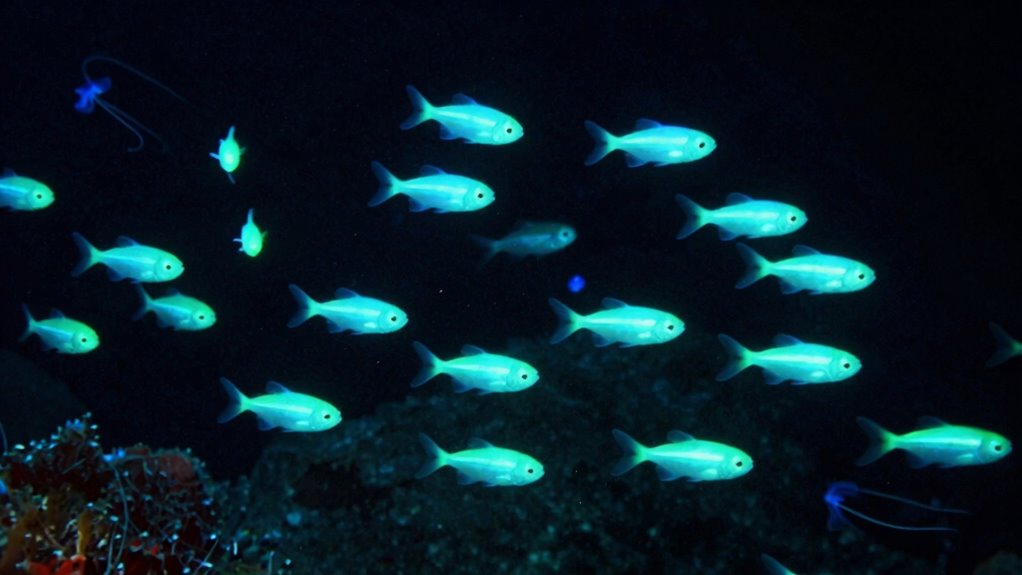
Environmental factors such as the scarcity of sunlight in deep sea habitats and the need for effective communication have driven animals to develop bioluminescence. In these dark environments, light becomes a vital tool for navigation, hunting, and avoiding predators. You’ll find that predator-prey interactions heavily influence bioluminescent evolution; prey may glow to distract or warn predators, while predators use light to locate and capture prey more effectively. The deep sea’s extreme conditions favor animals that can produce their own light, giving them a survival advantage. Bioluminescence evolves as a response to these environmental pressures, helping animals adapt to the challenges of life in the darkness and ensuring their continued existence in these harsh habitats. This evolution is also influenced by market dynamics that encourage innovation and adaptation among deep-sea species. Additionally, the ability to produce light can serve as a mating signal, increasing reproductive success in the dark environment. In some cases, bioluminescence can also serve as a camouflage strategy, allowing animals to blend into their surroundings and evade predators. Furthermore, the development of bioluminescent organs can be driven by evolutionary pressures that favor traits enhancing survival and reproduction in extreme environments. For example, some species have evolved to use bioluminescence for territory defense, deterring rivals and asserting dominance.
Examples of Bioluminescent Animals and Their Unique Adaptations
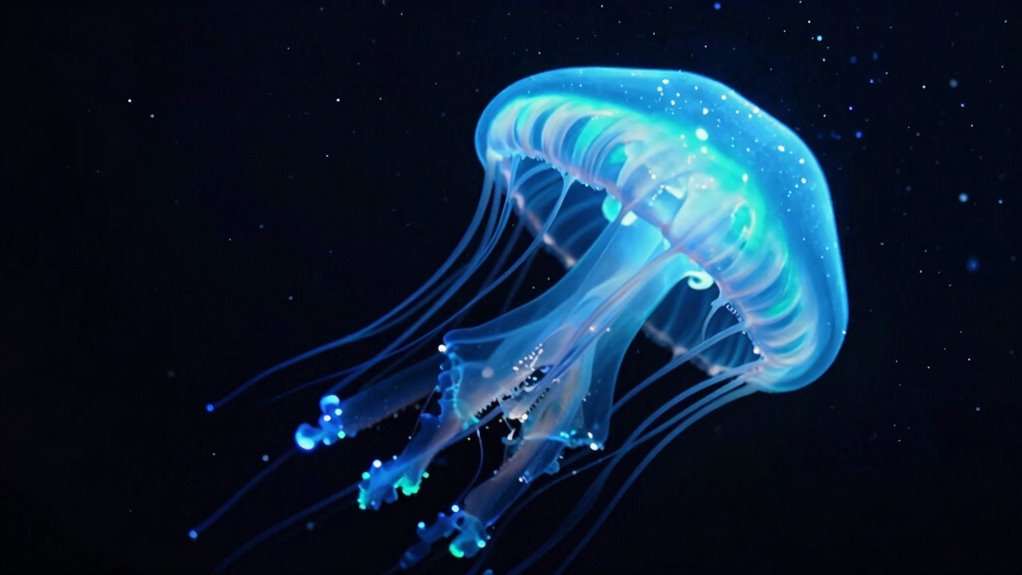
Among the many fascinating bioluminescent animals, the anglerfish stands out for its remarkable hunting adaptation. Using deep sea illumination, it lures prey close with a glowing bioluminescent appendage that resembles a tiny fishing lure. This unique adaptation helps it survive in the pitch-black depths where light is scarce. Similarly, fireflies produce flashes of bioluminescence to attract mates and deter predators. Their flashes serve as a visual signal, standing out against the darkness of their environment. These examples highlight how animals have evolved different strategies to use bioluminescence for survival—whether to hunt, communicate, or camouflage. Each adaptation showcases the incredible diversity of bioluminescent animals and how their glowing abilities serve specific ecological purposes in their environments. Additionally, some species, such as certain jellyfish, have developed bioluminescence as a defense mechanism to ward off predators by dazzling or confusing them. Recent studies suggest that the evolution of bioluminescence is closely linked to nanoscience in the development of bio-inspired materials that mimic these natural light-emitting processes, which could lead to innovative applications in biotechnology. The study of these natural light-emitting systems also provides insights into the evolutionary biology behind such complex adaptations. These advancements demonstrate how understanding natural bioluminescence can inspire cutting-edge technological innovations, bridging biology and engineering.
What Can Bioluminescence Teach Us About Evolution and Nature?

Bioluminescence reveals how species adapt to their environments through chemical innovations. These glowing traits show us the creative ways evolution shapes survival strategies. By studying these adaptations, you gain insight into nature’s endless capacity for innovation. For example, some animals use bioluminescence for camouflage or attracting prey, demonstrating the diverse ways this trait enhances survival.
Evolutionary Adaptations Explored
Bioluminescent animals reveal remarkable insights into how species adapt to their environments over time. For example, bioluminescent fungi have evolved to attract insects for spore dispersal, showcasing adaptation for survival. Similarly, glowing coral reefs demonstrate how symbiotic relationships develop, with corals and their algae producing light to deter predators and attract prey. These adaptations highlight natural selection’s role in shaping traits that improve survival chances. By studying bioluminescence, you see evolution in action—organisms developing specialized features to thrive in their niches. The diversity of bioluminescent strategies across species emphasizes how evolution fosters innovation. These adaptations reveal that bioluminescence isn’t just for show; it’s a crucial evolutionary tool for communication, defense, and reproduction in challenging environments.
Nature’s Chemical Innovations
Bioluminescence reveals how nature’s chemical innovations have evolved to serve specific functions in diverse species. These innovations enhance survival through mechanisms like chemical signaling and predator confusion. By producing light, animals communicate, attract mates, or warn predators. The ability to generate light chemically showcases how evolution refines biological processes. For example, some species use bioluminescence to create confusing flashes, making predators struggle to target them. This chemical signaling can also alert others or deter enemies. Understanding these adaptations helps us appreciate evolution’s ingenuity.
| Function | Example Species | Purpose |
|---|---|---|
| Chemical signaling | Fireflies | Mating communication |
| Predator confusion | Deep-sea fish | Avoiding predators |
| Camouflage | Comb Jelly | Blending into surroundings |
Frequently Asked Questions
How Does Bioluminescence Vary Among Different Animal Species?
You’ll notice that bioluminescence varies greatly among species because each has unique bioluminescent mechanisms. Some animals produce bright flashes, while others display subtle glows. These species-specific displays serve different purposes, like attracting prey or mates, or camouflaging themselves. The mechanisms behind these glows differ in how they produce and control light, creating fascinating diversity in how animals use bioluminescence for survival and communication in their environments.
Can Humans Harness Bioluminescence for Practical Uses?
Sure, you can harness bioluminescence for practical uses, like glowing medical devices or bioluminescent farming. It’s ironic that nature’s glow might soon light up your life, making tech more eco-friendly and innovative. By tapping into these natural light sources, you could reduce energy consumption and create new medical tools. So, while animals glow in the dark for survival, humans might soon turn that glow into a bright future.
Are There Any Risks Associated With Bioluminescent Animals?
Yes, there are risks with bioluminescent animals. Their glow can attract predators, increasing your chances of being seen and attacked. Additionally, producing light requires energy, which could otherwise go toward growth or reproduction. If you’re an animal relying on bioluminescence, you might balance the benefits of attracting mates or prey against the risks of predator attraction and energy expenditure, affecting survival and reproductive success.
How Quickly Can Animals Turn Their Bioluminescence on or Off?
You can often see animals turn their bioluminescence on or off very quickly, thanks to rapid light modulation. This bioluminescent signaling allows them to communicate, attract prey, or evade predators efficiently. In some species, this process happens within milliseconds, giving them a swift response to their environment. This quick control over light helps them adapt instantly, making bioluminescence a powerful tool for survival and interaction in dark habitats.
Is Bioluminescence Always Visible, or Are Some Types Invisible to Humans?
Bioluminescence often acts like a secret handshake, visible to some and invisible to others. You might not see all glowing animals with your naked eye, as some emit light in wavelengths outside human vision. They use this subtle glow for camouflage strategies and predator avoidance, blending into their environment. So, while their light might be invisible to you, it’s a vital tool in their survival toolkit.
Conclusion
As you uncover the secrets behind animal bioluminescence, you realize there’s still so much left to explore. What other astonishing adaptations await discovery in the depths of our oceans and forests? The more you learn, the more you wonder—could bioluminescence hold the key to understanding evolution itself? Stay curious, because the glowing mysteries of nature might just change how you see the world forever. The next discovery could be closer than you think.
Evergreen bestsellers Picks
bestsellers
As an affiliate, we earn on qualifying purchases.