

To measure things too small to see, you need advanced tools that use quantum physics and nanotechnology. These techniques include atomic force microscopy and scanning tunneling microscopy, which can capture atomic details. Quantum sensors leverage phenomena like superposition to detect tiny changes in magnetic fields or temperature with high precision. As you continue exploring, you’ll discover how scientists push the limits of measurement and reveal the secrets of the microscopic world.

Prime made for students and young adults
- Fast, free delivery for dorm and study essentials
- Prime Video and Amazon Music included
- Member-only deals
Key Takeaways
- Nanoscale measurement relies on advanced tools like atomic force microscopy and scanning tunneling microscopy for atomic resolution.
- Quantum effects, such as discrete energy levels and wave-particle duality, enable high-precision sensing at tiny scales.
- Quantum sensors utilize coherence and superposition to detect minute changes in magnetic, thermal, or force properties.
- Combining nanotechnology and quantum physics pushes measurement capabilities beyond classical limits.
- Future innovations will further enhance understanding and manipulation of structures at the atomic and molecular levels.
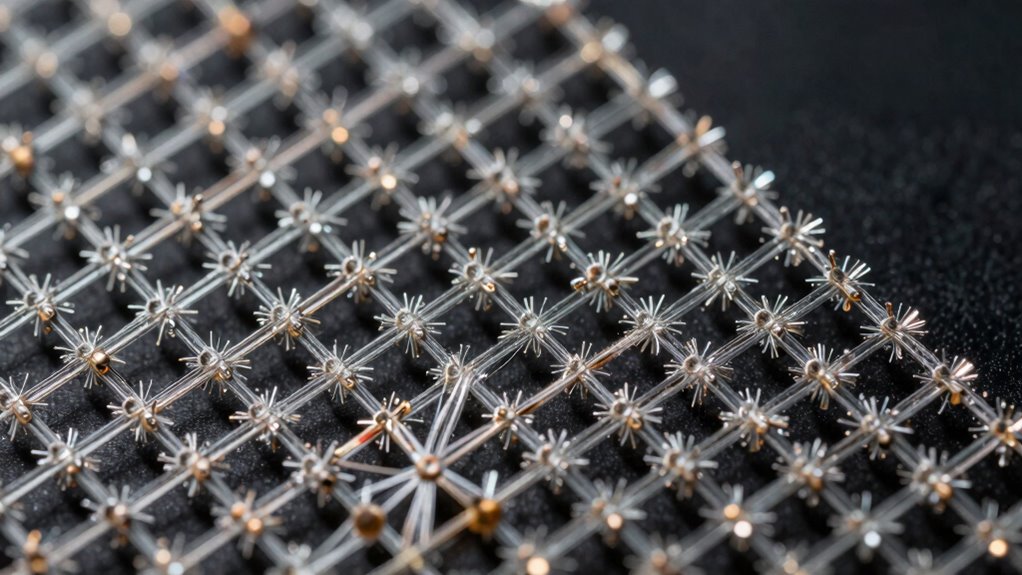
Measuring tiny things might seem impossible, but scientists have developed incredible tools to do just that. When dealing with objects at the nanoscale—thousands of times smaller than a human hair—traditional measuring methods fall short. Instead, researchers rely on advanced techniques that harness the peculiarities of quantum effects and the rapid progress in nanotechnology advancements. These breakthroughs enable you to observe, manipulate, and quantify matter at an unimaginably small scale.
Quantum effects play a crucial role in measuring at the nanoscale. When objects shrink to such tiny dimensions, their behavior no longer follows classical physics but exhibits quantum phenomena. For example, the energy levels of electrons become discrete, and particles behave more like waves than solid objects. Scientists use this knowledge to develop highly sensitive instruments, like quantum sensors, which can detect minute changes in magnetic fields, temperature, or force. These sensors leverage quantum coherence and superposition to measure with extraordinary precision, often surpassing classical counterparts. Such quantum effects are essential because they allow measurement of phenomena that would otherwise be too subtle or elusive for traditional tools.
Quantum sensors exploit coherence and superposition to detect subtle changes beyond classical measurement limits.
Simultaneously, nanotechnology advancements have revolutionized how you can measure and interact with the nanoscale world. Techniques like atomic force microscopy (AFM) and scanning tunneling microscopy (STM) give you the ability to visualize surfaces and structures at atomic resolution. These instruments work by scanning tiny probes across a surface, feeling the forces at play, and translating those interactions into detailed images. Nanotechnology also enables the development of nanoscale sensors and devices that can directly measure properties like electrical conductivity, surface texture, or molecular composition with unprecedented accuracy. The integration of these tools allows scientists to not only see but also manipulate individual atoms and molecules, providing insights into the fundamental building blocks of matter. Additionally, ongoing research in quantum measurement techniques continues to expand the limits of what can be detected and analyzed at such small scales. Advances in nanofabrication are making these tools more accessible and versatile, further pushing the boundaries of nanoscale measurement. As scientists develop more sophisticated instruments, the range of phenomena you can observe at the atomic and molecular level continues to grow exponentially.
The ongoing improvements in measurement accuracy further enhance our ability to explore these minuscule worlds with greater detail and reliability. The combination of quantum effects and nanotechnology advancements means you’re no longer limited by the scale of your instruments. Instead, you can explore the quantum realm, where new measurement strategies emerge, offering unparalleled sensitivity and resolution. As research continues, expect even more refined tools that push the boundaries of what’s measurable. These innovations will deepen your understanding of the smallest structures, from quantum dots to biological molecules, opening doors to groundbreaking applications in medicine, electronics, and materials science. In essence, the science of measuring tiny things has become an extraordinary frontier, blending quantum physics with cutting-edge nanotech to reveal a universe invisible to the naked eye.
As an affiliate, we earn on qualifying purchases.
Frequently Asked Questions
How Do Scientists Visualize Objects That Are Impossible to See With the Naked Eye?
You can visualize tiny objects by using electron microscopy, which employs electrons instead of light to achieve much higher resolution. Scientists also explore phenomena like quantum tunneling, helping them understand particles’ behavior at a minuscule scale. These tools and concepts allow you to see and analyze structures far too small for the naked eye, revealing details at the atomic and subatomic levels that are otherwise invisible.
What Everyday Devices Rely on Measuring Extremely Small Quantities?
Imagine a world where tiny miracles happen every day—your smartphone, for instance. Devices like digital thermometers, blood glucose monitors, and even your car’s engine sensors rely on measuring extremely small quantities, often at atomic precision. These tools tap into quantum effects, enabling precise readings that keep your life running smoothly. Without them, modern technology would be nothing but a distant dream, lost in the domain of the invisible.
How Accurate Are Measurements at the Nanoscale?
Measurements at the nanoscale are highly accurate but limited by quantum uncertainties, which cause slight fluctuations. You can improve precision through advanced calibration techniques that account for these quantum effects. While no measurement is perfect, these methods enable you to attain extremely precise results, making nanoscale measurements reliable for scientific and technological applications. However, always remember that some inherent uncertainties remain due to the fundamental nature of quantum mechanics.
What Are the Biggest Challenges in Measuring Tiny Particles?
You face a real uphill climb when measuring tiny particles because quantum uncertainties and measurement limitations keep you on your toes. Quantum effects can cause unpredictable results, making precise readings tricky. Additionally, the tools often hit their physical and technological limits, like trying to measure a hair’s breadth with a yardstick. Overcoming these challenges means pushing the boundaries of science and technology, but it’s a game of patience and innovation.
How Has Measuring Small Things Advanced Medical Science?
Measuring tiny things has advanced medical science by revealing quantum effects and atomic interactions that influence health at a cellular level. You can now detect diseases earlier, develop targeted treatments, and improve drug delivery precision. These measurements help you understand how molecules behave in the body, leading to more effective therapies. As technology improves, you’ll gain deeper insights into the microscopic world, revolutionizing diagnostics and personalized medicine.
As an affiliate, we earn on qualifying purchases.
Conclusion
Now that you understand how scientists measure things so tiny they’re almost invisible, it’s like wielding a modern microscope instead of a magnifying glass. With each new invention, you’re stepping into a world where the tiniest details matter—almost as if you’ve traveled back to the days of Galileo’s telescope, but with today’s tech. Keep exploring, and you’ll discover that even the smallest measurements can reveal giant mysteries of the universe.
Quantum Sensors for Magnetic Fields
As an affiliate, we earn on qualifying purchases.
As an affiliate, we earn on qualifying purchases.
Nanoscale Measurement Instruments
As an affiliate, we earn on qualifying purchases.
As an affiliate, we earn on qualifying purchases.
Fall Picks
fall essentials
As an affiliate, we earn on qualifying purchases.