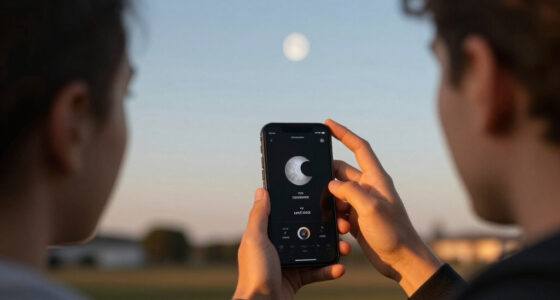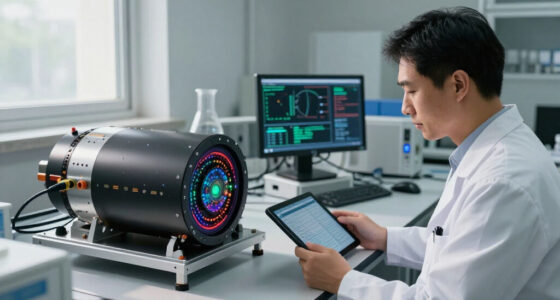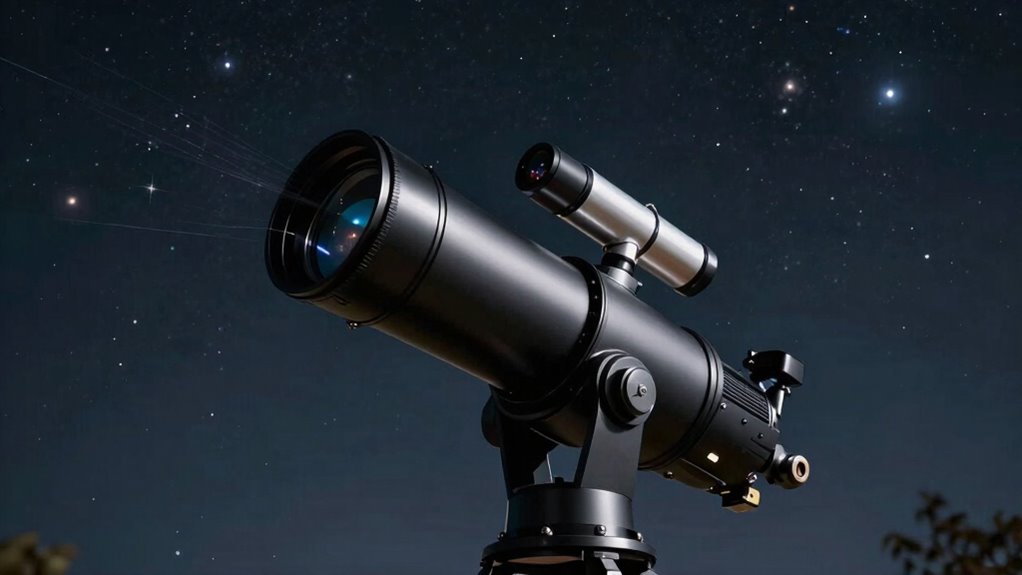

Telescopes turn faint light from distant objects into discoveries by using spectral analysis to identify elements and understand their properties. Advanced technologies like adaptive optics correct atmospheric turbulence, sharpening images and improving data quality. Improved telescope designs push the limits of detecting and analyzing weak signals, revealing details about the universe’s composition, motion, and history. By mastering these tools and techniques, astronomers can uncover cosmic secrets—if you’re curious about how this all works, there’s much more to explore.

Prime made for students and young adults
- Fast, free delivery for dorm and study essentials
- Prime Video and Amazon Music included
- Member-only deals
Key Takeaways
- Telescopes collect and focus faint light from distant objects to make it detectable and analyzable.
- Spectral analysis breaks down light into spectra to identify elements and understand celestial compositions.
- Adaptive optics correct atmospheric distortions, sharpening images and improving data quality from faint sources.
- Advanced telescope technology enhances resolution and sensitivity, enabling the study of dim, distant objects.
- Data processing transforms collected light into detailed scientific insights about the universe’s properties.
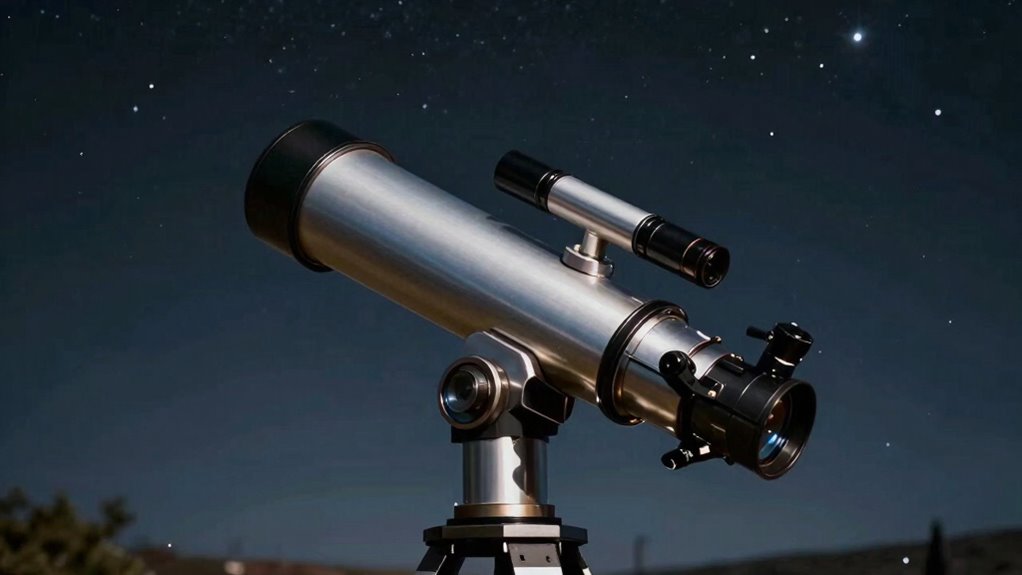
Have you ever wondered how we see distant stars and galaxies? It all comes down to the incredible technology inside telescopes that transform faint light into meaningful discoveries. When light from these celestial objects reaches Earth, it’s often incredibly dim, making it a challenge to analyze and interpret. That’s where spectral analysis and adaptive optics come into play, enabling astronomers like you to reveal the universe’s secrets.
Spectral analysis is a powerful technique that breaks down the light collected by telescopes into its component colors, or spectra. By examining these spectra, you can identify specific elements and molecules present in stars and galaxies. Each element leaves a unique fingerprint—a set of lines in the spectrum—that tells you about its composition, temperature, and even motion. This process allows you to differentiate between objects that might appear similar in brightness but are vastly different in their makeup. Spectral analysis transforms raw light into a detailed story about the universe’s building blocks, giving you insights into how stars form, evolve, and interact.
Spectral analysis reveals the universe’s secrets by identifying elements and understanding stellar and galactic compositions.
However, capturing clear and detailed spectra from faint, distant objects isn’t straightforward. Earth’s atmosphere distorts incoming light, causing stars to twinkle and blurring images. To overcome this, modern telescopes use adaptive optics—a technology that actively adjusts the shape of a telescope’s mirrors in real-time. When atmospheric turbulence tries to distort the incoming light, adaptive optics corrects these distortions instantly, sharpening the image and allowing you to see faint objects with remarkable clarity. This correction is essential for precise spectral analysis because it guarantees that the light you study isn’t muddled by atmospheric interference. Atmospheric distortions can significantly impact the quality of the data, making these corrections vital for accurate observations. Additionally, advancements in atmospheric correction techniques have significantly improved the ability of telescopes to gather accurate data from distant celestial sources.
Furthermore, improvements in technology continually push the boundaries of what telescopes can achieve, making it possible to detect even fainter objects and study their spectra with greater detail. These advancements are especially important for spectral resolution, which determines how well a spectrum can reveal detailed information about an object’s composition and motion. Together, spectral analysis and adaptive optics revolutionize how you observe the universe. Adaptive optics provides the crisp, high-resolution images needed to collect high-quality spectra, even from distant, faint sources. Once you have a clean, detailed spectrum, analyzing it reveals the physical properties of celestial objects, from their chemical composition to their velocities and ages. This synergy enables you to peer deeper into space and uncover phenomena that would otherwise remain hidden.
In essence, telescopes equipped with these advanced technologies turn faint, elusive light into a wealth of knowledge. They allow you to explore the universe’s history, composition, and dynamics with unprecedented precision. What once seemed like distant points of light now become stories written in the spectra, waiting for you to decode and understand.
amateur telescope with spectral analysis
As an affiliate, we earn on qualifying purchases.
As an affiliate, we earn on qualifying purchases.
Frequently Asked Questions
How Do Telescopes Detect Objects Millions of Light-Years Away?
You use powerful telescopes to detect objects millions of light-years away by collecting faint light and analyzing cosmic background radiation. These telescopes focus on signals that have traveled vast distances, revealing details about distant galaxies and dark matter. By studying this light, you can infer the presence of unseen matter and understand the universe’s structure, turning faint signals into groundbreaking discoveries about our cosmic history.
What Technological Advancements Have Improved Telescope Sensitivity?
Did you know modern telescopes can detect objects billions of light-years away? Technological advancements like quantum sensors considerably boost sensitivity by reducing noise, while adaptive optics correct atmospheric distortions in real-time. These innovations allow telescopes to capture sharper images and faint signals more accurately, making it possible to study distant galaxies and cosmic phenomena in greater detail. Together, they revolutionize our ability to explore the universe’s deepest secrets.
How Do Different Types of Telescopes Compare in Light Collection?
You’ll find that telescopes with mirrors, like reflecting telescopes, often collect more light because they can be built larger and reduce chromatic aberration, compared to lens-based refractors. Space-based telescopes avoid atmospheric distortion, capturing clearer, more detailed images of faint objects, while ground-based ones are limited by Earth’s atmosphere but are easier to upgrade and maintain. Both types excel in different scenarios, maximizing light collection for discovery.
Can Telescopes Detect All Wavelengths of Light?
You might think telescopes can detect every wavelength of light, but that’s not the case—they’re limited by design. Some telescopes excel at spectral analysis, revealing detailed light signatures, while others use light amplification to boost faint signals. To see beyond visible light, specialized instruments like radio or X-ray telescopes are necessary. So, while telescopes are incredible, they don’t capture all light, making multi-wavelength observations essential for a full cosmic picture.
How Is Faint Light Processed to Produce Clear Images?
You process faint light in telescopes through light amplification, which boosts weak signals for clearer observation. Image stabilization systems help you keep the view steady, preventing blurriness caused by Earth’s movement. By combining these technologies, you transform faint, distant signals into sharp, detailed images, allowing you to explore the universe in greater detail. This process makes even the faintest light sources accessible and understandable.
As an affiliate, we earn on qualifying purchases.
Conclusion
You now hold the secret to how telescopes transform tiny whispers of faint light into cosmic symphonies of discovery. Like a master alchemist, these marvels turn invisible glimmers into dazzling tales of distant worlds and ancient stars. With each observation, you’re peering through a celestial kaleidoscope, revealing the universe’s hidden treasures. So, next time you gaze up, remember—you’re holding a magic window that turns whispers of light into stories waiting to be told.
high resolution astronomical telescope
As an affiliate, we earn on qualifying purchases.
As an affiliate, we earn on qualifying purchases.
faint light astrophotography telescope
As an affiliate, we earn on qualifying purchases.
As an affiliate, we earn on qualifying purchases.
Halloween Picks
halloween
As an affiliate, we earn on qualifying purchases.