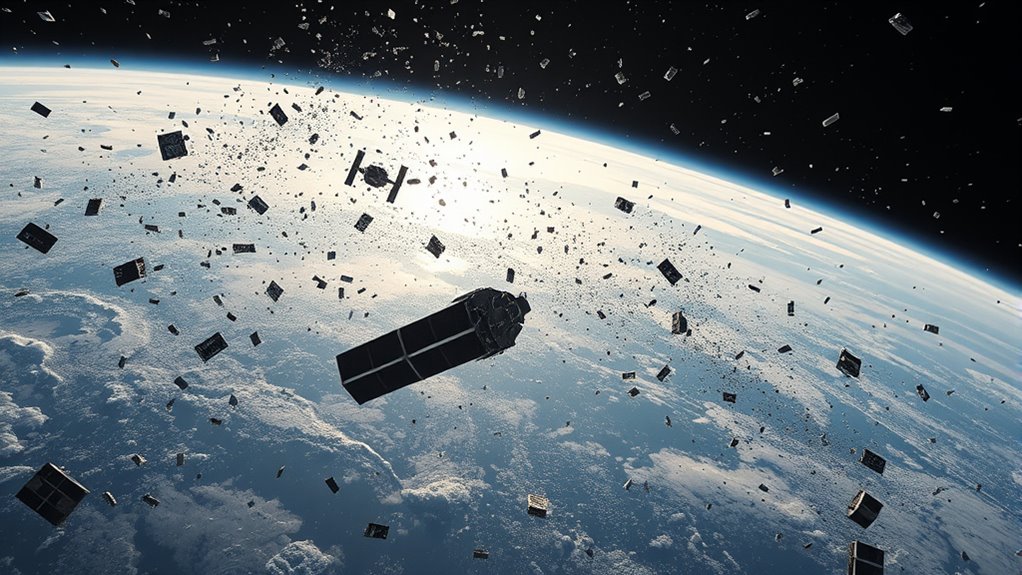

When satellites encounter space debris traveling at thousands of miles per hour, operators must perform sudden maneuvers to avoid collisions. These evasive actions use fuel, which shortens their operational lives and slightly increases collision risks. As debris accumulation grows, the chances of such near-misses become more common, threatening satellite safety and future missions. If you want to know how space agencies are tackling this growing crisis, there’s more to explore about innovative solutions and international efforts.

Prime made for students and young adults
- Fast, free delivery for dorm and study essentials
- Prime Video and Amazon Music included
- Member-only deals
Key Takeaways
- Satellites perform evasive maneuvers to avoid collision with space debris traveling at high speeds.
- Space junk increases collision risks, prompting active satellites to change orbits to prevent damage.
- Debris tracking systems detect potential collisions, enabling timely satellite swerve responses.
- Evasive actions consume fuel, reducing satellite lifespan and raising operational challenges.
- Rising debris levels threaten the safety and sustainability of future space missions.
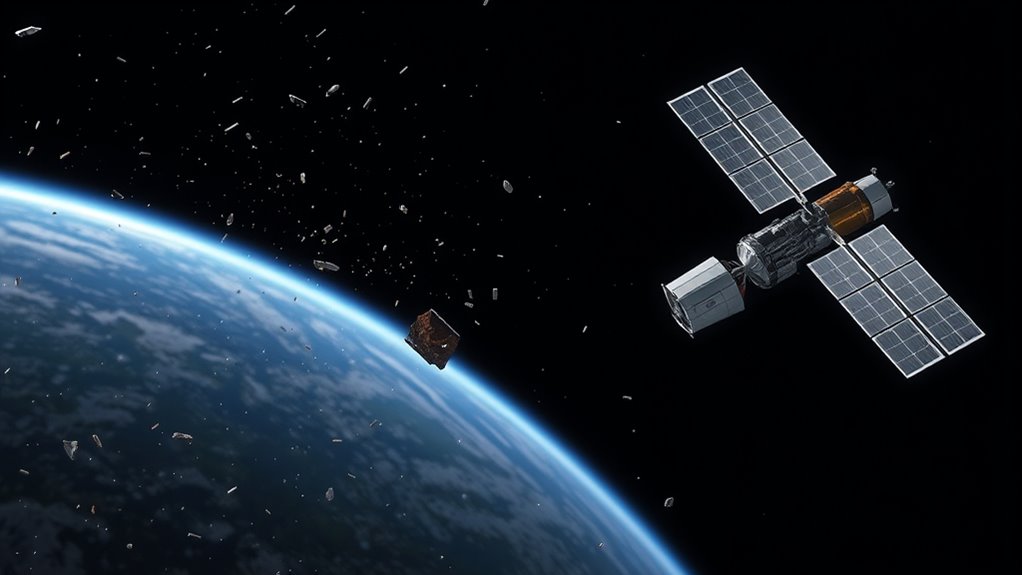
Have you ever wondered what happens when discarded rockets, defunct satellites, and tiny debris clutter Earth’s orbit? This collection of space junk is more than just clutter; it’s a growing threat to active satellites, spacecraft, and even future missions. Satellite debris, consisting of fragments from disintegrated satellites, spent rocket stages, and other debris, travels at staggering speeds—up to 17,500 miles per hour. At these velocities, even a small piece can cause catastrophic damage. As this debris continues to accumulate, the risk of collisions skyrockets, prompting urgent questions about orbital cleanup and debris mitigation.
Discarded rockets and tiny debris threaten active satellites and future missions at speeds up to 17,500 mph.
When a satellite swerves to avoid collision with debris, it’s often a split-second decision that can mean the difference between mission success and disaster. These evasive maneuvers are becoming more frequent as the density of space junk increases. Every time a satellite changes course, it consumes fuel, shortens its operational lifespan, and introduces additional risks. The more debris there is, the more unpredictable and hazardous space becomes. In some cases, debris impacts have created even more fragments, compounding the problem in a damaging cycle. Experts emphasize that proactive debris removal strategies are crucial to reduce collision risks and preserve orbital integrity.
Addressing this crisis requires proactive measures for orbital cleanup. Several technological solutions are being developed, such as robotic arms, nets, and harpoons designed to capture or deorbit debris. Companies and space agencies are also exploring laser systems that can gently push debris into a controlled fall back to Earth, where it burns up harmlessly in the atmosphere. But these solutions are still in experimental stages and face significant logistical and financial hurdles. Meanwhile, international efforts are vital to establish guidelines for responsible satellite design, end-of-life disposal, and debris tracking. Developing advanced debris tracking systems is essential for accurately monitoring debris locations and preventing collisions.
You should understand that every collision avoided is essential to maintaining a sustainable space environment. The current trajectory threatens not only commercial and scientific missions but also the safety of our increasingly crowded orbit. Without effective orbital cleanup strategies, space junk could reach a tipping point where collisions become unavoidable, creating a cascade that makes certain orbits unusable. This situation underscores the importance of international cooperation and innovation in space debris management. Additionally, implementing regulations on satellite end-of-life disposal can significantly reduce future debris creation.
In the end, the ongoing efforts in orbital cleanup aim to reduce satellite debris and restore safer conditions for future missions. It’s a race against time—one that demands swift action, smarter technologies, and global collaboration. If we don’t address this crisis now, the risk of a space junk catastrophe will only grow, jeopardizing the invaluable activities we rely on from space. Proper debris tracking and space debris mitigation are critical components in preventing this escalating threat.
Frequently Asked Questions
How Long Does It Take to Track New Space Debris?
When you ask how long it takes to track new space debris, it generally depends on the efficiency of tracking algorithms and debris cataloging systems. Usually, it takes a few hours to days for ground-based radar and optical systems to detect, confirm, and catalog new debris. Advanced tracking algorithms quickly process data, allowing operators to update debris catalogs promptly, so you get near real-time information to avoid collisions effectively.
What Materials Are Used to Build Space Junk?
You might wonder what materials make up space junk. Typically, debris classification helps identify these materials, which include metal alloys like aluminum and titanium, plastics, and paint fragments. These materials are chosen for their durability and lightweight qualities, but over time, they break down and contribute to space debris. Understanding the material composition aids in tracking, managing, and eventually reducing space junk, helping to protect satellites and future missions.
Can Space Debris Be Safely Removed or Recycled?
So, you’re wondering if space debris can be safely removed or recycled? Well, with innovative recycling methods and debris removal techniques, scientists are trying to clean up this cosmic mess. They’re developing robotic arms, nets, and lasers to scoop or melt debris away. Sure, it’s a tough job, but with a little ingenuity, we might just turn space junk into cosmic compost or at least keep satellites from becoming space trash’s latest victims.
How Does Space Junk Affect Future Satellite Launches?
You’ll find that space junk impacts future satellite launches by increasing orbital congestion and raising collision risks. These hazards make launching and maintaining satellites more challenging and costly. To address this, space agencies implement debris mitigation strategies like designing satellites to burn up upon re-entry and tracking debris carefully. By reducing debris, you can help guarantee safer, more reliable future satellite launches and maintain the sustainability of Earth’s orbital environment.
Are There International Laws Regulating Space Debris Management?
Imagine it’s 1969, and you’re witnessing humans landing on the moon. Today, international treaties like the Convention on Registration of Objects Launched into Outer Space and debris mitigation guidelines govern space debris. These agreements aim to prevent collisions and manage waste, but enforcement varies. While they set standards, there’s no single global law, so space debris remains a shared challenge that needs stronger international cooperation to protect future missions.
Conclusion
So, here you are, marveling at the infinite cosmos, blissfully unaware that every time you scroll through social media, you’re fueling this space junk party. Soon, your favorite satellite might decide to dodge a floating piece of old rocket—just like dodging your responsibilities. Maybe it’s time to contemplate that the universe’s biggest mess isn’t in your inbox, but floating above your head. Careful, or you might just become part of the clutter!
Fall Picks
fall essentials
As an affiliate, we earn on qualifying purchases.