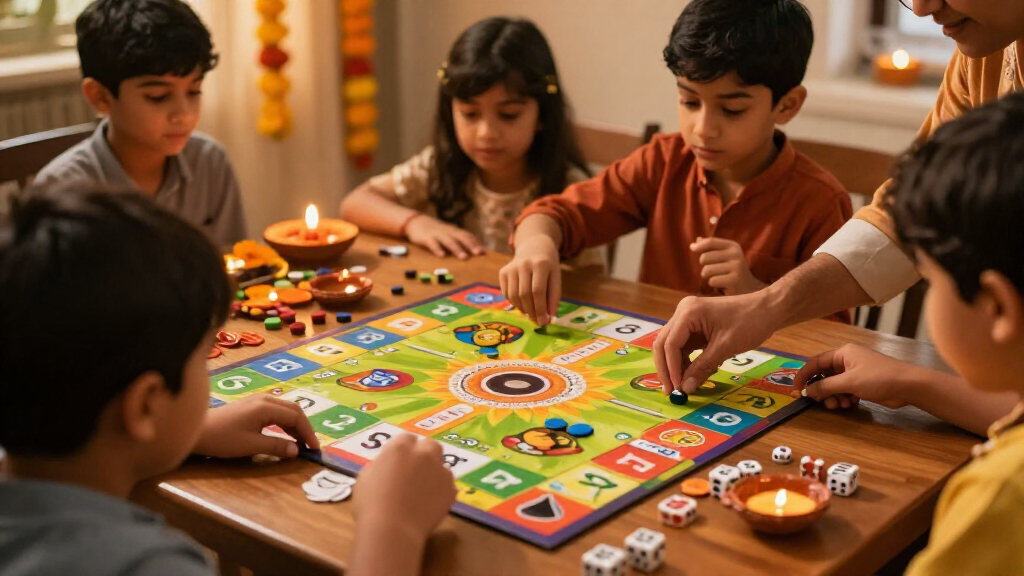
I’d start with Ceiba Tree Diwali Bingo if a classroom or family gathering needs a quick activity for up to 24 players; its large marker supply and simple format make it easy to run repeat rounds. YVAINE Diwali Bingo is the stronger choice when thicker cardstock matters, while Samosa offers a broader cultural word-and-clue game for older players who want more conversation than picture matching. These picks serve different kinds of learning: bingo can help children recognize festive images and take turns, whereas Samosa invites players to recall and explain South Asian references.

Prime made for students and young adults
- Fast, free delivery for dorm and study essentials
- Prime Video and Amazon Music included
- Member-only deals
The main tradeoff is easy group access versus richer play. The three bingo sets share a familiar structure and accommodate as many as 24 players, but their materials, age guidance, and included markers differ. Samosa covers far more cultural references and supports larger groups, though it is recommended for ages 12 and up and may be less accessible to guests unfamiliar with the references. I rank these options by how directly they suit Diwali learning, how well their format fits a gathering, and what the supplied details say about usability—not by assuming that a festive theme alone makes a game educational.
Key Takeaways
- Ceiba Tree is my practical pick for a classroom or large family group that wants quick Diwali-themed rounds and a clearly listed supply of 441 markers.
- YVAINE has the clearest material advantage among the bingo games: its 300 gsm cardstock is specified as thicker, though its listed set includes only 12 marking chips.
- Liliful uses picture cards featuring motifs such as lotus flowers, rangoli, Ganesha, and mandirs, making the imagery a useful conversation prompt; its age recommendation is 12 years and up.
- Samosa is the most varied choice for older groups: it combines Taboo-, Charades-, and Codenames-style play across six cultural categories, but it is not a Diwali-only game.
- All three bingo options are listed for up to 24 players, while Samosa supports 4–20+; choose by activity style and age fit, not player count alone.
| Ceiba Tree Diwali Bingo Game Cards for 24 Players |  | Best Overall for Large-Group Diwali Play | Players: Up to 24 | Age range: 3+ | Included components: 24 game cards, 24 calling cards, 441 bingo markers, instructions | VIEW LATEST PRICE | See Our Full Breakdown |
| Liliful Diwali Bingo Cards Set, 35 Pieces for 24 Players |  | Best for Traditional Diwali Motif Recognition | Players: Up to 24 | Age recommendation: 12 years and up | Pieces: 35 | VIEW LATEST PRICE | See Our Full Breakdown |
| YVAINE Happy Diwali Party Festival of Lights Bingo Game – 24 Player Set |  | Best Bingo Pick for Thicker Cards | Players: 24 | Age range: 24 months and up | Card material: 300 gsm cardstock | VIEW LATEST PRICE | See Our Full Breakdown |
| Samosa Desi Board Game – Indian Taboo Alternative, Bollywood Party Game |  | Best for Older Groups and Broader Cultural Learning | Players: 4–20+ | Recommended age: 12 years and up | Genre: Card game, cultural, desi, family, party | VIEW LATEST PRICE | See Our Full Breakdown |
| educational Diwali board game | Players | Included components | Age range | Material |
|---|---|---|---|---|
| Ceiba Tree Diwali Bingo Game C | Up to 24 | 24 game cards, 24 calling cards, 441 bingo markers, instructions | 3+ | Paper |
| Liliful Diwali Bingo Cards Set | Up to 24 | 24 bingo cards, 10 sheets of marking chips, 1 calling chip | — | Cardstock paper |
| YVAINE Happy Diwali Party Fest | 24 | 24 bingo cards, 12 marking chips, 1 calling chip, game manual | 24 months and up | — |
| Samosa Desi Board Game | 4–20+ | 300 cards, counters, game board, rulesheet | — | — |
More Details on Our Top Picks
Ceiba Tree Diwali Bingo Game Cards for 24 Players
For a group that wants everyone involved without teaching complicated rules, Ceiba Tree is my most practical overall pick. It includes 24 game cards, 24 calling cards, and 441 markers, with instructions for family gatherings, classroom activities, and parties. That clearly stated marker supply gives an organizer a better sense of what arrives than Liliful’s listing, which names marking-chip sheets but not the number of chips. Bingo’s visual format can support children in noticing Diwali-themed pictures and waiting for a call, though the supplied details do not identify the individual images or provide a structured lesson plan.
Compared with YVAINE, Ceiba emphasizes ready-to-run group supplies rather than a specified heavier card stock. YVAINE describes its cards as 300 gsm, a useful distinction for repeated handling, while Ceiba lists paper and does not give storage or durability information. Ceiba’s age range starts at 3+, making its stated age fit broader than Liliful’s recommendation of 12 years and up. Still, adults may need to help younger children manage markers and follow calls; the product description does not spell out accommodations for early readers.
The format is deliberately simple, which is both the attraction and the limit. Quick rounds can leave room for a short conversation about a picture or the festival, but the game itself is not presented as a detailed cultural curriculum. It is intended for indoor use, so it is not a good match for a garden celebration or outdoor fair. I’d choose it over Samosa when the priority is getting a mixed-age group into one shared activity; I’d choose Samosa instead when older guests want clue-giving, wordplay, and deeper cultural recall.
Pros:- Lists 24 game cards and 24 calling cards for a group of up to 24.
- Includes 441 markers, giving organizers a clearly stated supply for play.
- Quick bingo rounds suit classrooms, family gatherings, and parties.
- The listed age range begins at 3+, broader than Liliful’s age recommendation.
Cons:- The game is specified for indoor use only.
- Paper construction is listed, but storage and durability details are not provided.
- The supplied description does not identify the card imagery or offer a lesson plan.
Best for: Families, teachers, and hosts who need an easy indoor Diwali activity for up to 24 people, including younger children with adult support.
Not ideal for: Buyers who need a weather-resistant outdoor game, documented durable or reusable components, or a structured lesson beyond visual bingo play.
- Players:Up to 24
- Age range:3+
- Included components:24 game cards, 24 calling cards, 441 bingo markers, instructions
- Material:Paper
- Theme:Diwali
- Usage:Indoor
- Operation:Manual
Our verdict“I’d pick Ceiba Tree for the clearest large-group setup and accessible Diwali bingo format, while accepting that its paper components and educational depth are not fully specified.”
Liliful Diwali Bingo Cards Set, 35 Pieces for 24 Players
Liliful’s strongest distinction is the named visual vocabulary on its cards: the listing calls out lotus flowers, rangoli, Ganesha, and mandirs. That gives a parent or teacher concrete prompts for a brief discussion while the group plays, rather than relying on a Diwali label alone. The picture-based format also makes the activity less dependent on reading long clues. Compared with Ceiba, which has a lower stated starting age and a precisely listed 441 markers, Liliful places more emphasis on the motifs but recommends the set for ages 12 and up.
The listing says the set supports up to 24 players and includes 24 bingo cards, 10 sheets of marking chips, and one calling chip. Its cardstock construction gives the cards a defined material, but it is still paper cardstock and no thickness, coating, or reusable marker system is specified. That leaves it behind YVAINE for buyers seeking an explicitly stated heavier stock: YVAINE lists 300 gsm cardstock. Liliful does not state how many individual chips come on the sheets, so organizers running a full group may want to check the components before relying on a particular marker-per-player setup.
As an educational activity, the value depends on how the host uses the images. Players can identify familiar motifs and ask what they represent, but the supplied description does not claim that the game explains their meanings. I’d pick Liliful over Ceiba when the specific imagery is a priority and the listed age recommendation suits the group. For younger children, Ceiba is the more natural fit on paper; for repeated handling, YVAINE has the clearer material specification. Liliful is best viewed as a visual conversation starter, not a self-contained Diwali lesson.
Pros:- Picture cards feature named motifs including lotus flowers, rangoli, Ganesha, and mandirs.
- The listed capacity is up to 24 players.
- Simple bingo rules fit family, classroom, and holiday-party settings.
- Cardstock is specified as the card material.
Cons:- The age recommendation is 12 years and up, making it a less direct match for young children than Ceiba.
- Cardstock remains paper, with no coating or thickness specified.
- The number of individual marking chips on the 10 sheets is not stated.
Best for: Hosts and educators who want picture-based bingo featuring recognizable Diwali motifs and whose group fits the stated 12+ age recommendation.
Not ideal for: Families seeking an activity explicitly recommended for preschoolers, or organizers who need a stated chip count or thick, coated cards.
- Players:Up to 24
- Age recommendation:12 years and up
- Pieces:35
- Included components:24 bingo cards, 10 sheets of marking chips, 1 calling chip
- Material:Cardstock paper
- Card size:5.12 × 7.09 in (13 × 18 cm)
- Featured motifs:Lotus flowers, rangoli, Ganesha, mandirs
Our verdict“I’d choose Liliful when Diwali imagery is the teaching prompt, but not when younger age guidance or a precise marker count is the deciding factor.”
YVAINE Happy Diwali Party Festival of Lights Bingo Game – 24 Player Set
YVAINE is the clearest choice in this group when card stock is the deciding factor. Its cards are specified as 300 gsm cardstock and measure 5 by 7 inches, while Ceiba gives no thickness or durability details and Liliful only identifies cardstock paper. That specification may appeal to a host expecting cards to pass through many hands during a family event or classroom activity. It is still paper rather than a non-paper or washable component, so the material advantage should not be mistaken for proof that the set is waterproof or indestructible.
The set lists 24 cards with mandala and fireworks motifs, a calling chip, a game manual, and 12 marking chips. That is the main practical tradeoff against Ceiba: Ceiba lists 441 markers, while YVAINE’s 12-chip count is much smaller on its face. The description does not clarify whether chips are shared, reused, or supplemented in another way, so I would not assume the supplies are equivalent for 24 simultaneous players. Liliful lists 10 sheets of chips but no individual count; YVAINE is more explicit, yet the organizer still needs to consider how marking will work for a full group.
YVAINE’s age range begins at 24 months, the youngest stated starting point among these four products, and its social bingo format can introduce simple turn-taking and number recognition. That makes it more directly suited to very young children than Liliful’s 12+ recommendation, though little ones may need an adult to help follow the calls. The Diwali art adds festive context, but the description does not outline cultural explanations. I’d rank it behind Ceiba for supply clarity and ahead of Liliful for its specified card weight; Samosa remains the better alternative for older players who want active verbal teamwork rather than matching images.
Pros:- Cards are specified as 300 gsm cardstock, unlike the less detailed material descriptions for Ceiba and Liliful.
- The set accommodates up to 24 players.
- Mandala and fireworks artwork gives the activity a festive visual theme.
- The age range begins at 24 months, with adult help likely useful for the youngest players.
Cons:- Only 12 marking chips are listed for a 24-player set, with no explanation of how they are shared.
- The cardstock is still paper and is not described as waterproof or washable.
- The listing does not provide a structured guide to Diwali meanings behind the artwork.
Best for: Families or educators who want Diwali bingo with a clearly specified heavier cardstock and a very young listed age range.
Not ideal for: Large groups that need a clearly generous supply of individual markers, or buyers seeking a fully explained cultural lesson or non-paper components.
- Players:24
- Age range:24 months and up
- Card material:300 gsm cardstock
- Card size:5 × 7 in
- Included components:24 bingo cards, 12 marking chips, 1 calling chip, game manual
- Motifs:Mandala and fireworks
- Item dimensions:6.9 × 4.7 in
Our verdict“I’d favor YVAINE for its explicit 300 gsm card stock and young listed age range, but Ceiba is easier to recommend when marker quantity is the priority.”
Samosa Desi Board Game – Indian Taboo Alternative, Bollywood Party Game
Samosa changes the kind of learning on offer. Rather than matching Diwali pictures, players use clues and shared knowledge across six desi cultural categories, with 1,800 references spanning Bollywood, food, places, and icons. Its mix of Taboo, Charades, and Codenames-style mechanics can prompt players to explain what a reference means or how it connects to their experience. That makes it more conversation-rich than the three bingo sets, but it also makes cultural familiarity a bigger part of the fun.
For an older family gathering, the group size is a meaningful advantage: Samosa lists 4–20+ players, compared with a maximum of 24 for each bingo game. It includes 300 cards, counters, a board, and a rulesheet. The recommended age is 12 years and up, so Ceiba or YVAINE is a more natural option when preschool and early-primary children need to join the main activity. Non-South Asian guests may also need explanations for some references; the listing itself warns that the cultural focus may be less engaging for players who do not recognize them.
This is the least directly Diwali-specific pick in the roundup. It is described as suitable for Diwali, Eid, and other celebrations, so I’d treat it as a cultural party game for the gathering, not as a dedicated Diwali teaching tool. That distinction is why it ranks below the bingo sets for a search focused on educational Diwali games. Still, for a group of teens and adults who want lively teamwork and a wide range of South Asian references, Samosa offers more varied play than repeat bingo rounds. Choose it when the gathering itself is the learning setting; choose a bingo set when Diwali visuals and simple participation are the main goals.
Pros:- Combines Taboo-, Charades-, and Codenames-style mechanics for varied verbal teamwork.
- Includes 1,800 references across six cultural categories.
- Supports 4–20+ players, making it suitable for many party-sized groups.
- The 300-card set gives older groups more varied prompts than a single bingo format.
Cons:- The recommended age of 12+ may exclude younger children from full participation.
- Its South Asian cultural focus may be harder for unfamiliar players to access.
- It is a broad cultural party game, not a Diwali-only educational game.
Best for: Teen and adult groups familiar with South Asian culture who want a high-participation clue game for Diwali and other celebrations.
Not ideal for: Families with children under 12 who need a shared game, or groups seeking a game focused exclusively on Diwali symbols and traditions.
- Players:4–20+
- Recommended age:12 years and up
- Genre:Card game, cultural, desi, family, party
- Included components:300 cards, counters, game board, rulesheet
- Cultural references:1,800 across six categories
- Edition:Standard Edition
- Manufacturer part number:Samosa-001
Our verdict“I’d choose Samosa for older groups seeking lively cultural conversation, but the bingo sets are better aligned with direct Diwali-themed learning and younger players.”
How We Picked
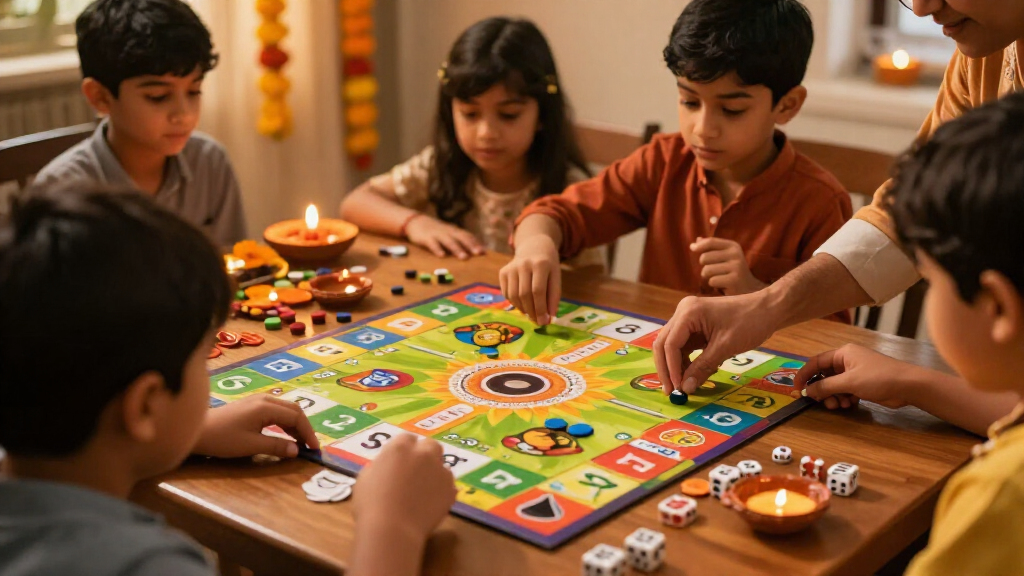
I compared these four options against the promise of educational Diwali play: does the format give players a reason to notice, name, recall, or discuss festival imagery and cultural references? The supplied product details support different kinds of learning, so I distinguish between visual recognition and turn-taking in bingo and broader cultural recall and verbal teamwork in Samosa. I do not treat a themed card or a large component count as proof of a complete lesson.
My ranking also weighs group fit, age guidance, and practical limitations. Each bingo set lists 24-player capacity, but their material details and included marking supplies differ. Ceiba specifies 441 markers, YVAINE lists 12 marking chips, and Liliful includes 10 sheets of marking chips without a stated chip count. Samosa has the broadest stated range at 4–20+ players and 1,800 references, yet it is recommended for ages 12 and up and relies on cultural familiarity more than the bingo sets do.
I give the highest placement to Ceiba because its clearly specified contents make it the most straightforward option for a large group seeking short, repeatable Diwali rounds. YVAINE follows for groups that value thicker cardstock, while Liliful offers especially clear traditional motif examples but has an older age recommendation than a casual children’s bingo activity might suggest. Samosa ranks fourth only for this specific Diwali-focused roundup: it may be the strongest discussion game for older South Asian groups, but its theme is broader and its mechanics are less directly tied to Diwali imagery. Where details such as storage, durability, or exact play time are not supplied, I avoid filling in the gaps.
| educational Diwali board game | Material |
|---|---|
| Ceiba Tree Diwali Bingo Game C | Paper |
| Liliful Diwali Bingo Cards Set | Cardstock paper |
| YVAINE Happy Diwali Party Fest | — |
| Samosa Desi Board Game | — |
Factors to Consider When Choosing Educational Diwali Board Games
I’d choose between these games by asking what the gathering should learn and how many people need to participate. The three bingo sets are the more direct fit for Diwali imagery and simple group play; Samosa is a broader cultural activity for older players.Decide what “educational” should mean for your group
For younger children or a mixed-age class, visual recognition and turn-taking may be the most useful learning goals. Bingo gives players a shared task and can prompt adults to name a motif, ask what it represents, or connect it to a family celebration. Among these options, Liliful names lotus flowers, rangoli, Ganesha, and mandirs, making its picture cards the clearest starting point for a conversation. The product details do not say that the game explains those subjects, so I’d plan to supply the cultural context myself.
For teens and adults, Samosa supports a different kind of learning: clue-giving, word recall, and discussion around South Asian references. Its range is broader than Diwali, which can be an advantage at a gathering celebrating several parts of a family’s culture but a drawback for a lesson focused on the Festival of Lights alone. Choose the format that matches the learning goal rather than assuming every culturally themed game teaches the same material.
Match the age guidance to the people playing
The listed ages vary sharply. Ceiba begins at 3+, YVAINE at 24 months, and Liliful and Samosa are both recommended for ages 12 and up. Those labels make Ceiba and YVAINE the more plausible starting points for families with young children, although adult guidance may still help children follow calls and manage pieces. A very young player may enjoy a picture-based round without being able to read or understand every symbol independently.
For a group spanning children, parents, and grandparents, simple bingo rules can keep the activity accessible, while the content of the cards creates room for extra explanation. Samosa is better suited to a group comfortable with wordplay and cultural references. If younger children are attending, I would not assume they can play it on equal footing based only on the description that it is for families and friends of all ages; the stated recommendation remains 12 years and up.
Check the group size and the marker plan
All three bingo sets list capacity for up to 24 players, making them natural candidates for a classroom or a large family table. The component details, however, deserve a closer look. Ceiba names 441 markers, YVAINE lists 12 marking chips, and Liliful includes 10 sheets of chips without giving a total count. Those descriptions do not establish that the supplies function the same way, so an organizer should check whether the planned group can mark cards comfortably before play begins.
Samosa lists 4–20+ players, which gives it a wider party format but not the same fixed 24-person capacity as the bingo options. The distinction is not simply how many people can join: bingo has individuals following calls at once, while Samosa relies on shared clue-based interaction. I’d choose bingo when every participant should have a card and a straightforward turn, and Samosa when the group is happy to play in a more verbal, team-oriented way.
Weigh component material against repeated use
For repeated classroom or family use, the listed material can affect how comfortable the set feels to handle. YVAINE specifies 300 gsm cardstock, giving it the strongest stated card-weight detail in this comparison. Liliful also identifies cardstock, while Ceiba lists paper. None of those descriptions supplies a complete account of coatings, washability, or long-term storage, so I would not infer that any paper set will withstand spills or rough handling.
Ceiba’s 441 markers make its supply list particularly clear, but the description does not specify a storage box or how the components are packed. YVAINE’s smaller stated chip count calls for a plan if the whole group is playing, and Liliful leaves its individual marker count unstated. If the game will be used often, consider how pieces can be kept together after each session and whether the host is comfortable supplying replacement markers. The available product details do not resolve those practical questions.
Choose a focused festival game or a broader party game
For a specifically Diwali-themed activity, I’d begin with one of the bingo sets. They are designed around Diwali or Festival of Lights artwork and keep the game structure simple, which leaves a host free to add short explanations between rounds. Ceiba is the clearest all-around group setup; YVAINE is the stronger choice for specified card thickness; Liliful is the most explicit about traditional motifs.
Samosa suits a different brief: a lively celebration with older players who enjoy cultural references and fast verbal play. Its Diwali usefulness comes from being suitable for the occasion, not from being dedicated to Diwali subject matter. That makes it a worthwhile alternative when a party needs broad cultural interaction, but a less direct selection for a child-focused Diwali lesson. I’d keep the distinction clear when deciding whether the aim is festival recognition or a wider celebration of South Asian culture.
Frequently Asked Questions
Which game is the best fit for a classroom Diwali activity?
I’d begin with Ceiba Tree for a classroom that needs a simple activity for as many as 24 players, because its listing specifies 24 game cards, calling cards, instructions, and 441 markers. If the teacher prioritizes card thickness, YVAINE specifies 300 gsm cardstock, but its 12 listed marking chips merit a closer look before using it with a full class. Liliful can also prompt motif discussion, though its stated age recommendation is 12 years and up.
Which option is most appropriate for young children?
Based on the supplied age information, YVAINE lists the youngest starting age at 24 months, followed by Ceiba at 3+. Both use bingo, a format that can be played with adult help, though the description does not spell out specific early-learning supports. Liliful and Samosa are both recommended for ages 12 and up, so they are less direct choices for a game centered on preschoolers or younger primary-school children.
Which bingo set has the clearest material advantage?
YVAINE provides the most specific material detail by listing 300 gsm cardstock for its cards. Liliful identifies cardstock paper but gives no weight, while Ceiba lists paper and does not supply durability or storage information. That makes YVAINE the easiest to compare on card thickness, but it does not establish that the cards are waterproof or suitable for rough handling, and its listed marker supply is smaller than Ceiba’s.
Is Samosa a Diwali board game?
Samosa is presented as a cultural party game that can be played at Diwali, Eid, and other celebrations, rather than as a game devoted exclusively to Diwali. Its themes include Bollywood, desi food, places, and icons, with clue-based mechanics for older players. I’d choose it for broader South Asian cultural play and group conversation; for direct Diwali imagery and a simpler visual activity, I’d choose one of the bingo sets.
Which game should I choose for 24 players?
All three bingo sets list a capacity of up to 24 players, so I’d compare their supplies and intended group instead of relying on capacity alone. Ceiba states that it includes 441 markers, YVAINE lists 12 marking chips, and Liliful names 10 sheets of marking chips without a total count. Samosa lists 4–20+ players, so it may suit a large party but is not listed for a fixed group of 24.
Conclusion
For an indoor family gathering or classroom where quick participation matters, I’d choose Ceiba Tree Diwali Bingo: its 24-player setup and stated 441 markers make the group logistics easiest to understand. For a host who puts a clearly specified heavier card stock first, YVAINE is the better bingo alternative, with the caveat that its listed 12 marking chips may need a closer supply check. Pick Liliful when named Diwali motifs are the main conversation prompt and its 12+ age recommendation suits the group.
Choose Samosa for teens and adults who want a more verbal, culturally broad party game, not for a focused Diwali lesson or a gathering centered on young children. My short version: Ceiba for straightforward large-group play, YVAINE for the clearest card-weight detail, Liliful for motif-led discussion, and Samosa for broader South Asian cultural interaction. The right pick depends on whether your priority is simple access, materials, imagery, or conversation.