
🔍 Read the full analysis: Can AI Robots Make Factory Work Easier? on ThorstenMeyerAI.com

Prime made for students and young adults
- Fast, free delivery for dorm and study essentials
- Prime Video and Amazon Music included
- Member-only deals
TL;DR
Industrial robots have moved from hot, dangerous tasks such as handling cast metal to widespread use in factories. Research cited by ThorstenMeyerAI.com finds that robots displaced some U.S. workers, while Germany’s job losses in manufacturing were offset by service-sector gains; the overall effect depends on the setting and the workers counted.
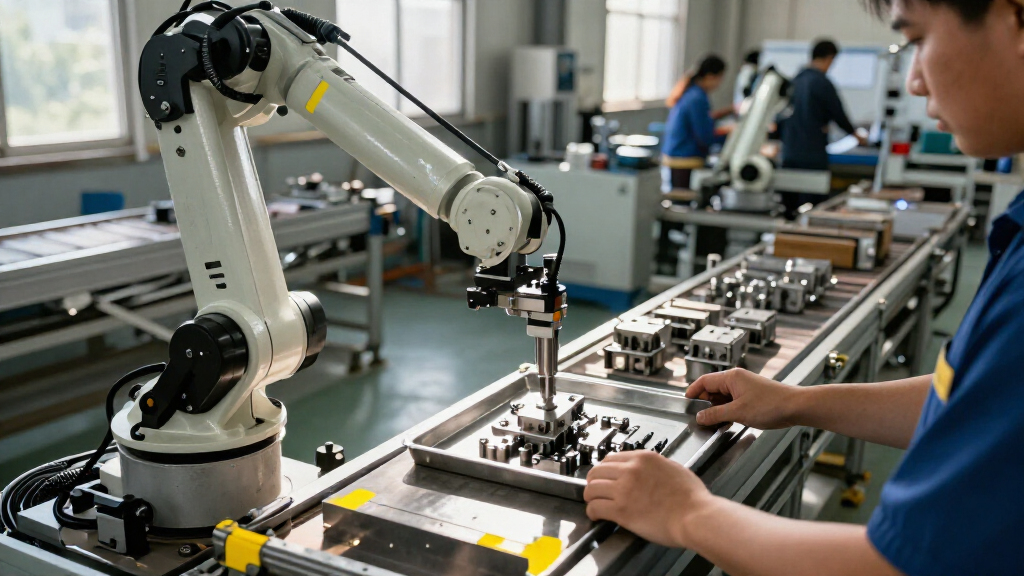
Factory robots now number 5 million worldwide, according to the International Federation of Robotics’ 2025 count, and are used in work ranging from handling hot metal to welding. A November 24 report from ThorstenMeyerAI.com examines whether they make factory work easier and finds that the answer depends on the task and the labor market: robots can take on hazardous jobs, but research also links their adoption to job losses for some workers.
The report traces industrial robotics to Unimate, a 4,000-pound machine installed on a General Motors production line in Trenton, New Jersey, in 1961. It unloaded a die-casting press, handling hot metal parts. The International Federation of Robotics and The Henry Ford museum identify the site as the Ternstedt plant. The report describes this early pattern as machines taking on work that was hot, heavy or dangerous, part of how work is shifting from the factory floor to AI.
Robots later moved into welding. The IFR says that after GM installed Unimate spot-welding robots at its Lordstown, Ohio, plant in 1969, more than 90% of body welding there could be automated, compared with 20% to 40% at traditional plants. The IFR described manual welding as dirty and dangerous, a concern that connects to how factory robots are tied to national security. In Japan, Kawasaki began building licensed Unimate robots as manufacturers faced difficulty finding workers for jobs locally described as hard, dirty and dangerous.
The IFR’s World Robotics report, published September 24, 2026, counted 5 million industrial robots in operation in 2025, 9% more than in 2024 and more than double the total seven years earlier. Factories installed more than 600,000 robots that year; China accounted for 354,000, or 59% of new installations. Those figures describe robot adoption, not how many jobs were lost or how much easier workers’ jobs became.
Infographic 01 · Five million robots
Where the robots work
Sixty-five years after the first Unimate, five million industrial robots work in the world's factories. South Korea has by far the most per worker.
Robots per 10,000 employees in manufacturing · 2024
Where the new robots went · 2025
- China: 354,000 installed, 59% of the world total.
- United States: almost 38,500 (+12%), again the second-largest market.
- Japan 36,219 (−19%) · South Korea 30,000 · Germany fewer than 25,000 (−8%), Europe’s largest market.
Robot density = operational industrial robots per 10,000 employees in manufacturing. China (166 in 2024) is not compared here: the IFR switched to updated Chinese labour data in 2026, which changed the denominator.
Sources: IFR, robot density press release, 8 Apr 2026 (data 2024); IFR, World Robotics 2026 press release, 24 Sep 2026.
Powered by Thorsten Meyer AI
Safer Tasks, Uneven Job Effects
Robots can reduce workers’ direct exposure to heat, heavy lifting and repetitive or hazardous tasks. That does not mean every affected worker benefits in the same way: a machine can remove a dangerous task while also reducing demand for the people who used to perform it. The report’s central distinction is between making particular tasks safer and determining what automation does to total employment.
One U.S. estimate cited by the report comes from economists Daron Acemoglu and Pascual Restrepo. They estimated that, from 1990 to 2007, each additional industrial robot was associated with about 3.3 fewer workers across the U.S. economy, and estimated an overall loss of about 400,000 jobs. These are estimates from a defined period and study, not a count of jobs lost to robots globally or a forecast of current effects.
The report contrasts that result with research on Germany, where higher robot use was associated with the loss of almost two factory jobs per additional robot, alongside service-sector gains of about the same size. The estimated overall employment effect was about zero. Different outcomes mean workers’ experiences can diverge: some may remain in a factory with different tasks, others may lose a position, and people entering the labor market may never get a job that automation removed.
Popular right now

Dyson Airwrap i.d. 6-in-1 Multi-Styler and Dryer

KitchenAid Artisan 5-Qt Tilt-Head Stand Mixer, Cardamom

iRobot Roomba 415X Robot Vacuum & Mop Combo
As an affiliate, we earn on qualifying purchases.
From Die Casting to Millions
Before Unimate entered a factory, inventor George C. Devol filed a U.S. patent in 1954 for a programmed machine that could transfer articles. The patent was granted in 1961. Devol and entrepreneur Joseph Engelberger formed Unimation, whose first robot was sold for $18,000, according to the report; the IFR put its manufacturing cost at $65,000.
Industrial robots spread into welding and other factory operations over the following decades. The report notes that Germany’s KUKA built the Famulus in 1973, which the IFR describes as the first robot with six electromechanically driven axes. The present-day scale is uneven across countries: the IFR’s 2024 robot-density figures, published in April 2026, put South Korea at 1,220 robots per 10,000 manufacturing employees, Germany at 449 and the United States at 307. Density measures robot installations relative to manufacturing employment; it does not by itself show whether workers’ conditions improved or employment fell.
“Each additional industrial robot replaced about 3.3 workers across the U.S. economy.”
— Daron Acemoglu and Pascual Restrepo, as summarized in the report
What Robot Counts Cannot Show
The reported total of robots and annual installations do not establish how many workers have been displaced overall, how many jobs were created elsewhere, or whether working conditions improved for employees at particular plants. The job estimates cited cover specific countries and past periods; the report does not provide a single comparable estimate for the global effects of current deployment.
It is also not clear from the cited figures how benefits and costs are distributed among workers. A robot may take over a hazardous task without eliminating a job, or it may replace a position; the available adoption totals do not distinguish between those outcomes. The report’s supplied material focuses on industrial robotics and historical studies, rather than measuring the effect of newer AI-enabled systems in factories.
Track Jobs Alongside Installations
The next useful evidence will pair robot installation data with employment, wages and workplace-safety measures over time. The report cites the IFR’s current robot totals and density figures, while the employment studies it discusses cover earlier periods. Readers should treat new robot counts as a measure of factory adoption, not as a direct measure of jobs lost or work made easier.
Further comparisons across countries and industries could clarify whether factory job losses are offset by hiring in services or other sectors, and which workers bear the costs. Until those outcomes are measured together, the clearest supported conclusion is narrower: robots have taken on hazardous industrial tasks, while their employment effects vary by place, period and group of workers.
Key Questions
How many industrial robots are operating worldwide?
The International Federation of Robotics counted 5 million operating industrial robots in 2025, 9% more than in 2024. That is a robot count, not a count of jobs replaced.
Do factory robots make work safer?
Robots have taken on tasks including handling hot cast metal and welding, which can expose workers to hazards. The cited figures do not measure safety improvements across factories as a whole.
Do robots reduce employment?
The evidence cited gives different results. Acemoglu and Restrepo estimated job losses linked to industrial robots in the United States from 1990 to 2007, while the report describes German manufacturing losses offset by gains in services. These findings do not establish one outcome for every country or period.
Which country installed the most factory robots in 2025?
China installed 354,000 robots in 2025, or 59% of new installations worldwide, according to the IFR figures cited by the report.
Source: ThorstenMeyerAI.com