
TL;DR

Get school and study supplies delivered free — and shop member deals
- Fast, free delivery on millions of items
- Access to Prime Big Deal Days deals on October 6–7
- Prime Video, Amazon Music and more included
IdeaClyst is a local-first, AI-powered war room for your ideas. It combines an AI council, discovery engine, and founder workspace to validate, critique, and plan your next move quickly and securely. It’s designed to cut the guesswork and help founders choose the right path, faster, by leveraging scientific testing devices and data-driven insights.
Ever stare at three open tabs, each promising your next big hit, and feel that gut-tightening moment of doubt? That’s the founder’s version of decision paralysis. The build part is easy—thanks to modern tools and AI assistants, launching software now takes days, not months. For more on innovative tools, see inside IdeaClyst. The real challenge? Knowing which idea is worth the six-month gamble—something no spreadsheet or gut feeling alone can reliably solve.
Enter IdeaClyst. It’s not just another brainstorming app. It’s a digital war room—your personal, no-cloud, local-first battleground—where ideas get tested, debated, and refined with fierce precision. This isn’t about shallow validation or cheerleading. It’s about making tough calls faster, backed by structured AI debate and real research, similar to the approach discussed on this marketing strategy site. If you’re tired of flying blind, this tool might just be the decision-making edge you need.
A war room for your next idea
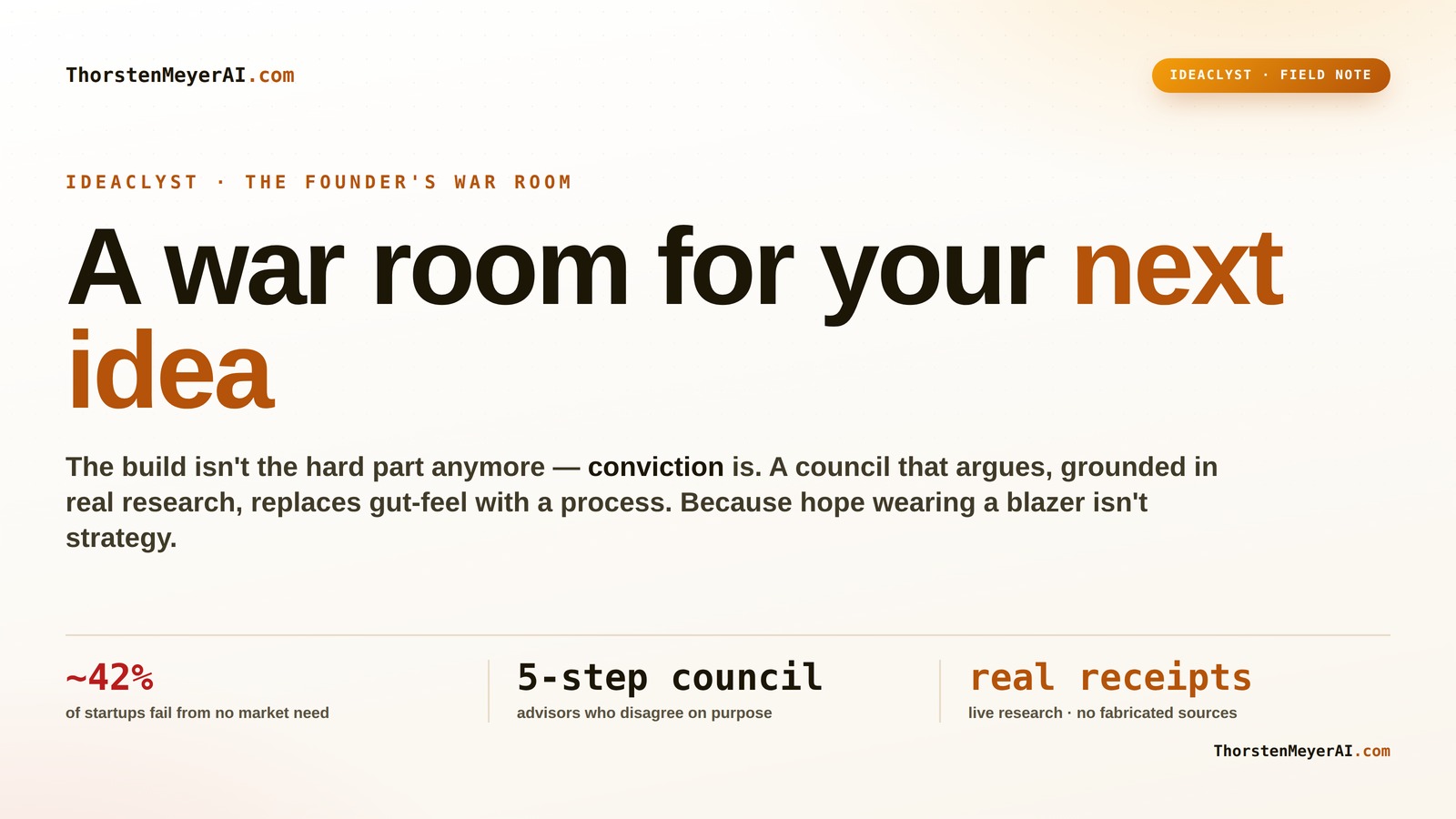
The build isn’t the hard part anymore — conviction is. Knowing which idea deserves the next six months, and being able to defend it. Most founders answer with gut feel and optimistic math. That’s hope wearing a blazer. IdeaClyst replaces it with a process.
The most expensive decision is what to build
The single most valuable thing a tool can do is talk you out of the wrong six months. The numbers make the case better than any pitch.
Three tools in one — on your own machine
Strip away the framing and IdeaClyst is three things at once, all running locally with nothing leaving your laptop.
An AI council
Pressure-tests an idea you bring it — advisors who argue on purpose.
A discovery engine
Finds ideas you didn’t know to look for by hunting real demand signals.
A founder’s workspace
Carries winners from “interesting” all the way to “ready to build.”
Advisors who disagree on purpose
Not one confident, agreeable answer — a structured five-step deliberation where models play different roles and turn on their own work. The disagreement is the feature.
The five-step deliberation
A council that leads with the bad news surfaces the objections you’d otherwise find the expensive way, on month five.
Product strategy
Who’s it for, what’s the wedge, why now, what’s the business model.
Technical architecture
What would it actually take to build — and where’s the risk.
Critique pass
The council turns on its own work. Where’s the hand-waving? What kills this?
Second, independent critique
A different voice, a different angle — so blind spots don’t survive.
Final synthesis
Everything into one coherent founder packet: strategy, architecture, validation, plan.
When IdeaClyst cites a source, it actually fetched it
The hard departure from “ask an AI what it thinks of my startup.” It runs in a strict, real-data-only mode — if it can’t gather genuine evidence, it says so plainly rather than inventing a plausible paragraph.
Confidence with receipts
No fabricated statistics, no imaginary competitors, no made-up citations. The packet survives a skeptical co-founder or a sharp investor because the reasoning has receipts.
Market research first
Scouts the landscape before the council reasons about anything.
Competitor read
Real positioning, pricing signals, feature claims — differentiation vs. reality.
Validation with links
Not “talk to customers” — concrete signals & sources you can click.
From the blank page to build-ready
Evaluation is half the problem; the blank page is the other half. And a plan is worthless if it dies in a tab you never reopen.
Bring a space, not an idea
“AI for accountants,” “tools for indie game studios” — plus your goal and real capacity. It hunts demand signals across HN, Reddit, Product Hunt, GitHub, pricing pages.
- An honest market read — leads with the bad news when a space is hard
- An opportunity map — high pain, thin competition
- Ranked candidates — wedge, who pays, effort, risk, confidence
- each with KILL CRITERIA — when to walk away
A home and a forward path
Every promising idea gets carried forward, with every artifact in plain files on your disk.
- Validation tooling — sprint board, interview list, evidence browser
- Founder profile — a personal-fit lens; same discovery, different advice
- Build workspaces — funnel, personas, landing draft, version history
- “Build this idea” → a PRD + task queue, ready for a coding agent
Key Takeaways
- A digital war room like IdeaClyst centralizes idea critique, helping founders avoid costly mistakes before building.
- The AI council stages disagreements, surfacing hidden risks and assumptions through structured debate.
- Grounding critiques in live web research ensures decisions are based on current, factual data.
- Running entirely offline on your machine keeps your ideas private, secure, and under your control.
- Structured reports and debate summaries turn complex ideas into clear, actionable plans.
AI-powered idea validation software
As an affiliate, we earn on qualifying purchases.
As an affiliate, we earn on qualifying purchases.
Why a War Room Makes You a Better Founder
A war room isn’t just a physical space—it’s a mental model turned into a digital command center. Imagine a place where every idea you have gets scrutinized from every angle, where disagreements are encouraged, and clarity emerges from chaos. That’s the core of what IdeaClyst offers.
For example, a founder working on a new SaaS platform might bring a rough product idea into the AI council. The system then stages a debate: one model questions the target customer segment, while another critiques the technical feasibility. This structured disagreement surfaces blind spots early, saving months of misguided development.
By creating a dedicated space—digital or physical—you make your team’s thinking visible. You foster a culture of rigorous critique, not just optimistic brainstorming. That’s how you turn uncertainty into strategic clarity, fast.
local-first research tools for startups
As an affiliate, we earn on qualifying purchases.
As an affiliate, we earn on qualifying purchases.
How IdeaClyst’s AI Council Delivers Real Debate, Not Fluff
IdeaClyst’s core innovation is its structured AI council—think of it as a panel of experts, each with a different role. The first model acts as a product strategist, the second as a technical architect, and others critique assumptions or validate ideas. These models don’t just agree; they challenge each other.
For instance, when you input an idea—say, a new health app—the council stages a five-step discussion. First, it questions the market size. Next, it assesses technical risks. Then, it critiques the plan’s assumptions. Finally, it synthesizes a clear, actionable report. This process surfaces flaws you might miss alone, and it does so in hours, not weeks. Learn more about effective innovation strategies at this site.
The significance of this structured debate is that it introduces a systematic way to identify weaknesses, tradeoffs, and overlooked risks early in the development process. It pushes you to consider multiple perspectives simultaneously, which reduces bias and groupthink. The rapid feedback loop means you can iterate quickly, improving your idea’s robustness before investing significant time or resources. The tradeoff, of course, is that this process requires honest critique and openness to disagreement—traits that, when embraced, lead to stronger, more resilient ideas.
As an affiliate, we earn on qualifying purchases.
Grounded in Reality: Live Web Research to Avoid Fake Confidence
Most AI tools answer based on their training data—meaning they talk a good game but often miss the mark. For more on AI in business, visit this resource. IdeaClyst changes that by anchoring its council in live web research. It pulls in real-time data, market trends, and authoritative sources to verify claims.
For example, if you ask whether a new market is growing, the system fetches recent reports, news, and stats—like the latest industry growth percentages or competitor moves—giving you a factual basis for your decisions.
This approach is crucial because it prevents the common trap of overconfidence based on outdated or incomplete information. By integrating current data directly into the critique process, IdeaClyst ensures your decisions are rooted in reality, reducing the risk of pursuing false positives or ignoring emerging threats. The implication is that your strategy becomes more adaptable and resilient, as you’re continuously updating your assumptions with fresh, verified insights. Discover more about scientific testing and safety at Chemical CEO. The tradeoff is that it relies on internet access and data availability; in highly niche markets with limited online data, insights might be less comprehensive. Still, for most scenarios, live research grounds your debates and improves decision accuracy significantly.
As an affiliate, we earn on qualifying purchases.
The Local-First Advantage: Keep Your Ideas Private and Secure
Unlike most AI tools that require cloud servers, IdeaClyst runs entirely on your own machine. Your ideas, reports, and plans stay local—safe from data leaks or third-party access.
Imagine a startup founder working late at night, drafting sensitive product strategies. With IdeaClyst, all that work remains on their laptop, encrypted and private. No uploading, no cloud storage—just your ideas, your rules.
This local-first design isn’t just about security. It’s about control. You own your data, can version your reports, and avoid vendor lock-in. For founders who value privacy, this is a game-changer. The implication is that you can iterate more freely without fear of leaks or breaches, fostering a secure environment for sensitive innovation. The tradeoff is that it requires a capable local machine and some technical setup, but for many founders, the security benefits outweigh these considerations.
From Idea to Action: Building a Coherent Founder Packet
The final output of IdeaClyst isn’t a vague recommendation. It’s a comprehensive, organized founder packet—think of it as a strategic briefing that you can share with investors or team members.
This packet synthesizes all the debates, research, and critiques into a clear, structured document. It helps you see the strengths and weaknesses of your idea at a glance, enabling quicker buy-in and alignment.
By consolidating insights into a single report, you create a record of your decision-making process—valuable both for internal reflection and external communication. It also allows you to revisit your initial assumptions and track how your thinking evolved, which is critical for learning and continuous improvement. The tradeoff is that creating this comprehensive packet requires disciplined documentation during debates, but the payoff is a clear, actionable plan that streamlines stakeholder communication and reduces ambiguity.
Making the Most of Your Idea War Room — Tips for Success
- Set clear goals: Know what questions you want answered before starting. This focus helps avoid aimless debate and ensures your efforts are aligned with strategic priorities.
- Invite diverse perspectives: Use the council’s disagreement as a strength, not a weakness. Embracing different viewpoints uncovers blind spots and fosters innovative solutions.
- Update regularly: Keep the debate alive by revisiting and refining your ideas periodically. Continuous iteration helps adapt to new data and market shifts, maintaining relevance and accuracy.
- Keep it visual: Use diagrams, timelines, and charts to make complex ideas clearer. Visual tools help identify patterns and dependencies, making debates more productive.
- Secure your data: Take advantage of the local-first setup to keep your sensitive info safe. Recognizing the importance of privacy can influence how openly your team debates and shares ideas.
For example, a team working on a new SaaS product might run weekly council debates, updating their roadmap and hypotheses as markets shift. This regular cadence ensures that their strategy remains aligned with real-world conditions, and fosters a culture of continuous critical evaluation—crucial for long-term success.
Remote, Hybrid, or Physical — How to Adapt Your War Room
IdeaClyst works perfectly for remote teams as a digital war room—no physical space needed. Just install it locally on each team member’s device, and everyone can debate, critique, and plan from anywhere.
For physical spaces, set up a dedicated corner with whiteboards, sticky notes, and screens showing the digital reports. The key is visibility—keeping the flow of ideas front and center helps reinforce the collaborative process and ensures critical insights aren’t lost.
Hybrid teams can combine both: use IdeaClyst for deep research and debate, then gather around a whiteboard for a quick sync. This flexibility allows teams to leverage the strengths of both approaches, fostering a dynamic environment that adapts to different working styles and needs.
What Results Can You Expect from a Digital War Room?
Expect faster, more confident decisions. Teams using structured debate and real research reduce costly misfires. For example, a startup might cut their product validation time by 50%, hitting market faster and with more certainty.
Beyond speed, the process cultivates a culture of critical thinking and transparency. Clear documentation and ongoing critique help teams identify flaws early, iterate efficiently, and make strategic pivots with less friction. Over time, this leads to a more resilient and adaptable organization. In one case, a SaaS startup reduced their pivot cycle from three months to six weeks, saving thousands in development costs and building a product that truly fit the market—demonstrating how a structured debate environment accelerates learning and growth.
Frequently Asked Questions
What exactly is IdeaClyst?
IdeaClyst is a local-first, AI-powered tool that acts as a digital war room. It helps founders critique, validate, and plan their ideas through structured debates, live web research, and organized reports—all stored securely on your own device.
Is IdeaClyst a physical space or a software tool?
It’s a software tool that runs on your local machine. While it’s inspired by physical war rooms, it’s entirely digital—designed for remote and hybrid teams to collaborate effectively without leaving their laptops.
How does it help me make better startup decisions?
By staging structured debates among AI models and grounding those debates in live research, it surfaces hidden risks and assumptions early. This leads to faster, more confident choices—saving you time and money before you build or pivot.
Can I use IdeaClyst if my team is remote?
Absolutely. It runs locally on each team member’s device, so everyone can participate in debates and critiques regardless of location. It’s perfect for remote, hybrid, or physically co-located teams.
What’s the biggest benefit of a digital war room?
The biggest benefit is turning your idea development into a clear, organized process that surfaces risks early. It reduces guesswork, accelerates decision-making, and creates a record you can revisit or share with stakeholders.
Conclusion
In a world where startup decisions can make or break your company, having a dedicated, debate-driven war room is a game-changer. IdeaClyst offers a local, AI-powered space to challenge your assumptions, verify your facts, and plan with confidence.
Remember: the best ideas don’t become great products by chance—they’re forged in the crucible of honest critique and strategic clarity. Set up your war room today, and turn uncertainty into your greatest advantage.
Fall Picks
fall essentials
As an affiliate, we earn on qualifying purchases.