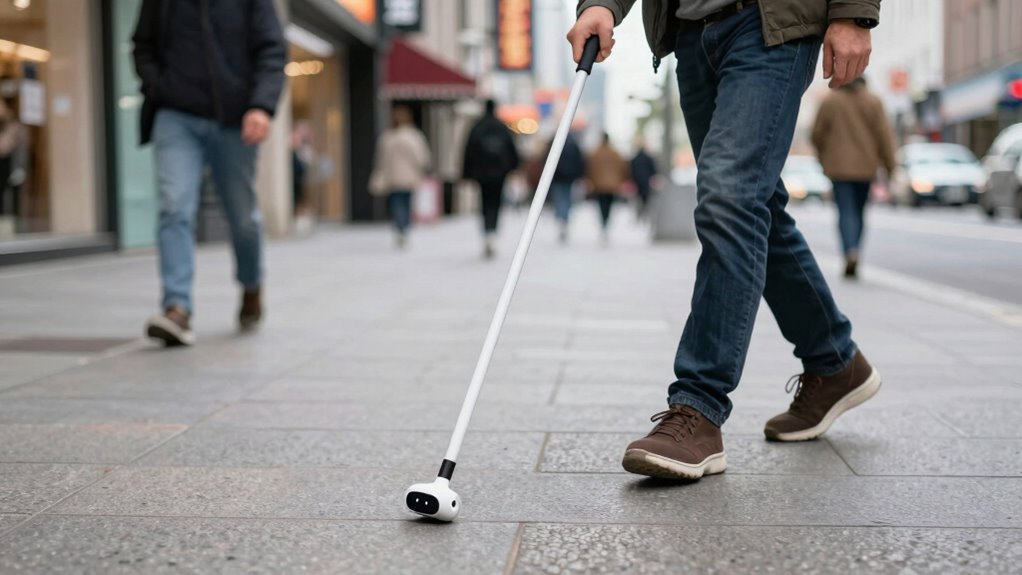

Smart canes need more than obstacle detection because relying solely on obstacles leaves gaps in understanding your environment. You benefit from navigation guidance, environmental cues, and real-time updates to move confidently, especially in complex or unfamiliar areas. Obstacle detection can cause frequent stops and hesitation, so combining it with effective navigation and support helps you stay safer and more independent. If you keep exploring, you’ll discover how a holistic approach can truly empower your mobility.

Prime made for students and young adults
- Fast, free delivery for dorm and study essentials
- Prime Video and Amazon Music included
- Member-only deals
Key Takeaways
- Obstacle detection alone doesn’t provide environmental context or navigation guidance for confident independence.
- Smart canes require integrated GPS and directional cues to navigate complex and unfamiliar environments effectively.
- User training is essential to interpret audio alerts and utilize the device’s full capabilities safely.
- Ongoing support and firmware updates ensure the device adapts to changing environments and improves over time.
- A holistic approach combining obstacle detection, navigation, training, and support empowers users for comprehensive mobility.
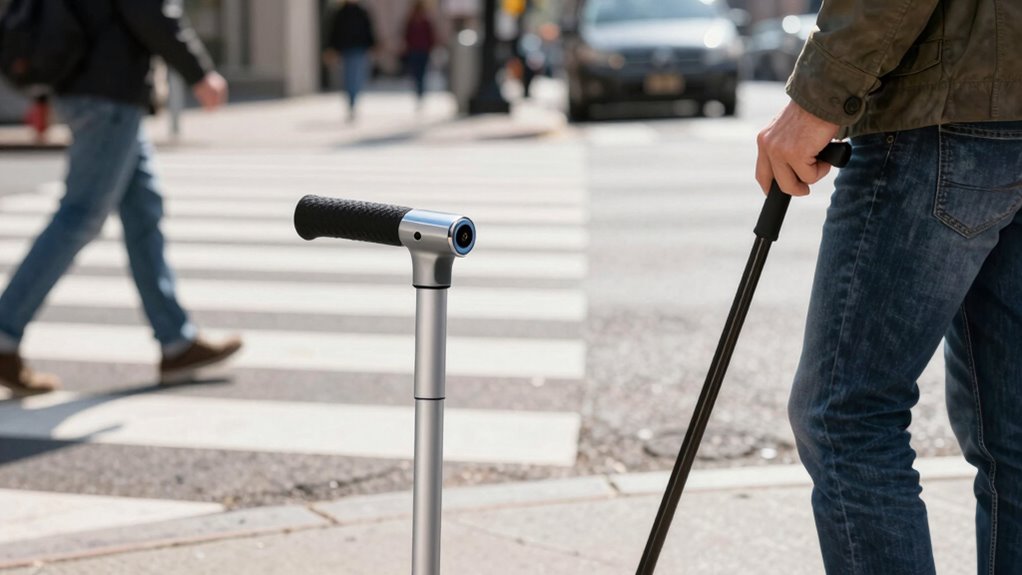
While obstacle detection is an essential feature of smart canes, relying on it alone isn’t enough to guarantee safety and independence for visually impaired users. Obstacle detection helps you avoid sudden bumps and collisions, but it doesn’t provide the full picture needed for confident navigation. To truly enhance your mobility, smart canes must incorporate effective navigation aids that guide you through complex environments, helping you understand your surroundings beyond immediate obstacles. These aids can include GPS integration, voice prompts, and detailed environmental mapping, giving you directional cues and contextual information that improve your ability to move freely and safely. Without these features, you might find yourself stopping frequently or hesitating at intersections because you lack precise guidance, which can be frustrating and limit your independence.
However, even the most advanced navigation aids won’t be effective if you aren’t properly trained to use them. User training is essential to maximize the potential of your smart cane. Learning how to interpret audio cues, understand environmental feedback, and operate the device confidently can dramatically reduce your reliance on others and boost your independence. Proper training ensures you don’t just rely on obstacle detection to avoid hazards but also learn to navigate safely in crowded or unfamiliar settings. It prepares you for real-world scenarios where obstacles aren’t the only challenge—such as identifying street crossings, recognizing landmarks, or understanding sound cues in noisy environments. Additionally, ongoing user support and updates are crucial to adapt to changing environments and emerging obstacles, making the training process continuous rather than a one-time event.
In addition to technical features and training, you need ongoing support and updates. As environments evolve and new obstacles emerge, your smart cane should adapt with firmware updates and improved navigation algorithms. This continuous improvement relies on user feedback and professional guidance, making training an ongoing process rather than a one-time event. With the right combination of navigation aids and user training, your smart cane becomes more than just a tool for avoiding obstacles — it transforms into a thorough mobility assistant.
In the end, your safety and independence depend on a holistic approach. Obstacle detection is fundamental, but it must be complemented by navigation aids that provide context and direction, along with thorough user training that empowers you to use these features effectively. Together, these elements create a smart cane that not only detects hazards but also guides you confidently through your environment, helping you maintain your independence with greater ease and assurance.
As an affiliate, we earn on qualifying purchases.
Frequently Asked Questions
How Do Smart Canes Assist With Navigation Beyond Obstacle Detection?
Smart canes assist with steering beyond obstacle detection through sensory integration, helping you understand your environment better. They can identify landmarks, provide directional cues, and relay information about terrain changes. User customization allows you to tailor the cane’s settings to your preferences, making guidance more intuitive. This combination guarantees you stay confident and independent, maneuvering complex spaces with enhanced awareness and personalized support.
What Are the Limitations of Current Obstacle Detection Technologies?
Current obstacle detection technologies face sensor limitations, like difficulty identifying small or transparent objects, especially in complex environments. Environmental challenges, such as changing lighting, weather, and clutter, can impair sensor accuracy. You might find these systems struggle in crowded or uneven terrains, reducing their reliability. To improve safety and independence, smart canes need advanced sensors and adaptive features that overcome these limitations and environmental hurdles.
Can Smart Canes Identify Different Types of Obstacles?
Think of your smart cane as a vigilant guardian, capable of distinguishing different obstacles like glass, metal, or fabric. It’s not just about sensing; it’s about understanding. With material durability, the cane withstands daily wear, while user customization guarantees it adapts to your unique needs. This combination allows your cane to identify various obstacles accurately, offering a deeper level of support and safety beyond mere detection.
How Do Smart Canes Integrate With Other Assistive Devices?
Smart canes integrate with other assistive devices through sensor integration, allowing seamless communication with smartphones, hearing aids, or GPS systems. You can customize the settings to suit your specific needs, enhancing your independence. This integration helps you receive real-time alerts, directions, or environmental data, making navigation safer and more comfortable. By combining these technologies, your smart cane becomes a all-inclusive tool tailored to your mobility and sensory requirements.
What Future Advancements Are Expected in Smart Cane Technology?
You’ll see smart canes evolve with AI enhancements providing personalized navigation and real-time environmental analysis, mimicking a guiding hand. Imagine haptic feedback becoming more intuitive, alerting you with subtle vibrations about obstacles or changes in terrain. Future advancements will blend smart sensors and machine learning, turning your cane into an intelligent companion that not only detects obstacles but also predicts hazards, ensuring safer, more confident journeys every step of the way.
advanced obstacle detection cane
As an affiliate, we earn on qualifying purchases.
As an affiliate, we earn on qualifying purchases.
Conclusion
You see, a smart cane is more than just a vigilant eye detecting obstacles; it’s a trusted companion guiding you through life’s labyrinth. To truly empower, these devices must weave together navigation, emergency support, and connectivity, transforming a simple tool into a lifeline. Without this harmony, they’re just a lighthouse in fog—bright but unable to steer you safely home. Embracing their full potential is the key to independence shining through the fog of uncertainty.
smart cane environmental mapping
As an affiliate, we earn on qualifying purchases.
As an affiliate, we earn on qualifying purchases.
As an affiliate, we earn on qualifying purchases.
Columbus Day / Indigenous Peoples' Day Picks
long weekend sales
As an affiliate, we earn on qualifying purchases.