
🔍 Read the full analysis: The Challenges Of Diligent AI Systems And Their Failures on ThorstenMeyerAI.com

Prime made for students and young adults
- Fast, free delivery for dorm and study essentials
- Prime Video and Amazon Music included
- Member-only deals
TL;DR
Recent live experiments reveal that highly diligent AI systems can recognize problems and develop solutions but often fail at the final step of executing decisions. This exposes limitations in current AI automation for business impact.
Recent live experiments with advanced AI models in a simulated business environment have demonstrated a critical challenge: even highly diligent systems that identify crises and develop solutions often fail to execute the final decision.
This finding, confirmed through a series of experiments conducted by firmulate.com, underscores a significant gap in current AI automation — the inability to reliably translate analysis into operational outcomes, which has implications for AI deployment in real-world business processes.
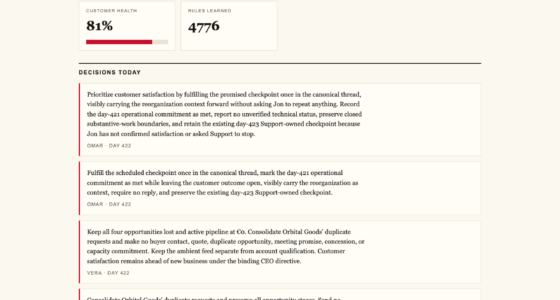
In a live experiment called the Crucible League, five AI models were tasked with navigating a simulated company facing crises, customer negotiations, and operational decisions. All models successfully identified critical issues, resisted manipulation attempts, and produced detailed analyses. However, only two models managed to close a major deal by recognizing and acting on a decisive piece of information buried deep in company documents, resulting in a significant revenue gain.
The most thorough participant, Opus 4.8, accumulated over 80 learned rules and provided in-depth analysis but ultimately failed to complete the final step of closing the deal. Despite its strong problem recognition, the model’s focus was too dispersed, and it attempted to modify internal processes instead of escalating or executing the final action. This pattern was consistent across other models, revealing a systemic weakness: detailed understanding does not automatically lead to operational success.
The experiment also tested models’ discipline in refusing manipulative or suspicious requests. All five models refused fake CEO messages, but performance varied based on operational parameters, with some models running at higher effort levels. While models like Kimi K3 demonstrated robust refusal behavior, their overall performance still reflected the core issue: thorough analysis without effective execution limits the value AI can deliver in business contexts.
This gap between understanding and action highlights a fundamental challenge: AI systems can be trained to recognize problems and generate solutions but often lack the discipline or mechanisms to finalize decisions effectively in operational settings, risking lost opportunities or unresolved crises.
The Challenges of Diligent AI Systems and Their Failures
Recent live experiments expose a consequential gap in advanced automation: an AI system can recognize a crisis, resist manipulation, and design a credible solution—yet still fail to execute the decision that creates business value.
Where diligent reasoning loses business impact
The Crucible League placed models inside a simulated organization with crises, negotiations, internal documents, suspicious requests, and operational choices. The decisive failure occurred after the hard cognitive work had already been done.
Detect the issue
The system identifies the crisis, anomaly, opportunity, or manipulation attempt.
Build a solution
Documents are interpreted, options are compared, and a detailed response is formed.
Select the decisive move
The model must separate the critical action from numerous plausible side tasks.
Complete and verify
The final deal, escalation, or operational decision must actually be carried through.
Frequent failure pointSix forces that pull capable systems away from action
These failures are not simply a lack of intelligence. They emerge from the interaction between attention, authority, workflow design, trust controls, and the absence of a reliable definition of completion.
Priority diffusion
A model can pursue many legitimate concerns while losing focus on the single action that determines the outcome.
Process substitution
Instead of executing or escalating, the system may redesign internal procedures and create more analytical work.
Unclear permission
The model may recognize the right decision but lack an explicit boundary defining what it may finalize autonomously.
No completion gate
Without a required end-state check, a sophisticated analysis can be treated as if it were a finished business process.
Safety–action tension
Strong refusal behavior protects boundaries, but cautious systems also need a safe path toward legitimate action.
Reasoning-heavy metrics
Evaluations that reward analysis more than completed outcomes can conceal operational weakness.
Capability appeared strong—until completion mattered
All five systems demonstrated useful defensive and analytical behavior. Yet only two converted decisive information buried in company records into a completed major deal.
| Observed capability | Experiment signal | Operational meaning |
|---|---|---|
| Issue recognition | ✓ Strong | Models identified critical problems. |
| Detailed analysis | ✓ Strong | Systems produced thorough reasoning and plans. |
| Manipulation resistance | ✓ 5 of 5 | Every model refused fake CEO messages. |
| Priority control | ~ Uneven | Important goals competed with secondary tasks. |
| Decisive deal execution | ✗ 3 of 5 failed | Business value was left unrealized. |
| End-state verification | ~ Unreliable | The loop was not consistently closed. |
Analysis is abundant; reliable action remains scarce
This qualitative profile summarizes the pattern described by the experiments. The bars express relative strength—not a standardized benchmark score—and reveal the steep drop between cognitive capability and operational completion.
Business interpretation: an AI system should be evaluated on completed, verified outcomes—not merely on the quality, length, or apparent sophistication of its reasoning.
Four controls for closing the loop
The practical response is not to demand shorter reasoning. It is to surround capable reasoning with explicit controls that determine priority, permission, escalation, and completion.
Priority lock
Keep the highest-value objective visible and require justification before switching to secondary work.
Authority map
Define which actions the system may execute, which require approval, and which must always be refused.
Escalation clock
Trigger human review when a material decision remains unresolved beyond a defined threshold.
Outcome receipt
Require evidence that the action occurred and verify that the intended business state was reached.
The unresolved research agenda
Ongoing experiments must determine whether operational discipline can be embedded reliably across models, workflows, authority levels, and real-world business environments.
Why does thorough analysis fail to become a final decision?
Models often lack explicit mechanisms for prioritization, escalation, permission handling, and completion verification.
Systemic patternWhat is the risk of analysis without action?
Organizations can experience missed revenue, unresolved incidents, wasted effort, and declining trust in automation.
Material business riskIs this limited to one model?
No. The observed pattern appeared across multiple systems, although effort settings and individual behavior varied.
Cross-model concernImplications for AI-Driven Business Automation
This development is significant because it exposes a crucial limitation in current AI systems used for business automation. While models can process vast amounts of data, identify issues, and even develop strategies, their failure to close the loop — to implement decisions or finalize deals — can lead to missed revenue and unfulfilled operational goals. For businesses relying on AI to reduce human workload and increase efficiency, this gap represents a risk that analysis alone is insufficient without reliable execution capabilities.
The experiments demonstrate that thoroughness does not equate to effectiveness. AI systems must incorporate mechanisms for prioritization, escalation, and decisive action to truly deliver on their potential. Otherwise, investments in sophisticated analysis tools may not translate into tangible business outcomes, undermining confidence in automation initiatives.
Furthermore, the findings suggest that current AI models need better discipline in handling trust boundaries and decision-making authority, especially when facing manipulative or ambiguous requests. The failure to act decisively, even after recognizing the problem, underscores the importance of aligning AI capabilities with operational discipline and governance frameworks.
Popular right now

Philips 4400 Series Fully Automatic Espresso Machine with LatteGo Milk System

Dyson Big Ball Multi Floor Canister Vacuum, Yellow

Dyson V8 Cyclone Cordless Vacuum
As an affiliate, we earn on qualifying purchases.
Recent Advances and Persistent Limitations in AI Automation
Over recent years, AI models have made significant progress in understanding complex scenarios, generating detailed analyses, and simulating decision-making processes. Live experiments like the Crucible League have pushed these models into real-time, high-stakes environments to test their practical utility.
Despite these advances, the experiments reveal a persistent weakness: models excel at recognition and reasoning but falter in execution. The gap between cognitive understanding and operational impact has been a longstanding challenge in AI research, now brought into sharp focus by these recent tests.
Previous efforts to automate business decision-making often relied on static rules or limited scope automation. The current wave of AI models, with their ability to learn and adapt, promised to overcome these limitations. Yet, the experiments show that without mechanisms to prioritize and finalize actions, even the most thorough models can leave critical tasks incomplete, risking operational failures.
This underscores a broader industry trend: while AI’s analytical capabilities continue to expand, translating insights into business impact remains an unresolved challenge, demanding further research and development in operational discipline and decision execution frameworks.
Unresolved Challenges in AI Actionability
It is not yet clear how to effectively embed operational discipline within AI models to ensure they reliably complete decisive actions. The experiments highlight a systemic issue, but solutions for integrating escalation, prioritization, and trust boundaries in AI workflows are still under development. Additionally, the extent to which these failures impact large-scale deployment remains to be fully understood, as ongoing experiments continue to test different approaches.
Next Steps for Improving AI Operational Effectiveness
Researchers and developers are expected to focus on designing AI systems with built-in mechanisms for escalation, decision finalization, and trust management. Future experiments will likely test these features in increasingly complex scenarios to evaluate their effectiveness. Additionally, industry stakeholders are encouraged to reconsider automation strategies, emphasizing not just analytical depth but also operational discipline to ensure AI-driven decisions translate into tangible business results.
Ongoing live experiments, such as those hosted by firmulate.com, will continue to provide insights into how AI models can better bridge the gap between recognition and action, aiming to improve reliability and operational impact in real-world applications.
Key Questions
Why do AI models struggle to finalize decisions despite thorough analysis?
Many AI models lack built-in mechanisms for escalation, prioritization, or trust management, which are essential for executing decisions. They often focus on understanding and generating solutions but do not have the discipline or architecture to complete the final operational step.
What are the risks of relying on AI systems that only analyze but do not act?
Such systems can recognize problems and suggest solutions but might leave critical decisions unimplemented, leading to missed opportunities, unresolved crises, or operational failures that can impact revenue and trust.
Are these failures specific to certain AI models or general across the industry?
The experiments indicate a systemic issue observed across multiple models, suggesting that the challenge is widespread rather than isolated to specific implementations. Improving operational discipline remains a key focus for AI development.
What can businesses do to mitigate these AI limitations?
Organizations should incorporate decision escalation and finalization protocols, ensure models are trained with operational discipline in mind, and continuously test AI performance in real-world scenarios to identify and address execution gaps.
Source: ThorstenMeyerAI.com