
📊 Full opportunity report: Micro-agency Proposal Scope Checker on IdeaNavigator AI — validation score, market gap, and execution plan.

Prime made for students and young adults
- Fast, free delivery for dorm and study essentials
- Prime Video and Amazon Music included
- Member-only deals
TL;DR
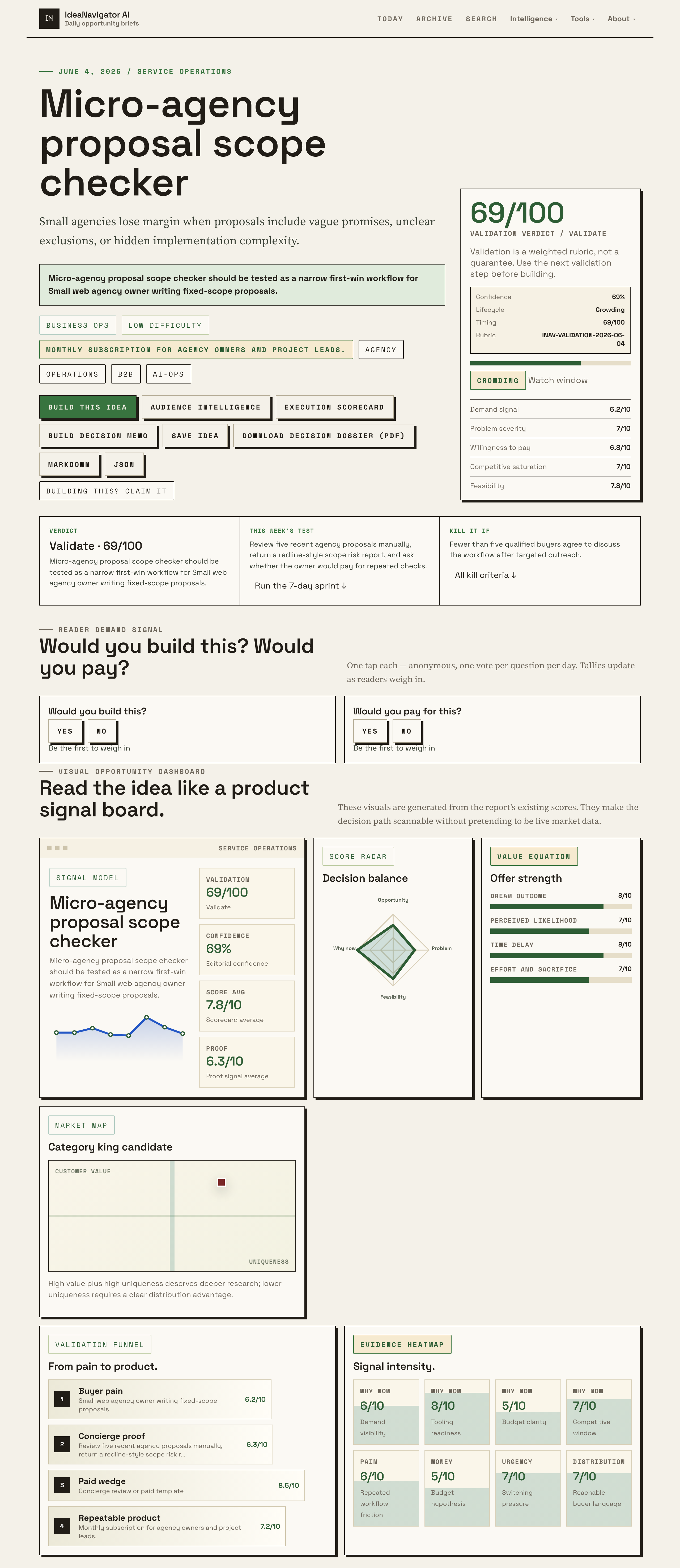
A new AI-powered scope checker for small web agencies is entering testing. It aims to flag vague deliverables and risky integrations in proposals, helping agencies protect margins. The tool is in early validation, with a subscription model planned.
IdeaNavigator AI has begun testing a new proposal scope checker tailored for small web agencies, aiming to identify scope risks early in the proposal process. This tool is designed to help agencies avoid losing margins due to vague promises, unclear exclusions, or hidden complexities, by comparing draft proposals against reusable checklists.
The proposed scope checker is a proof-of-concept that analyzes uploaded proposals to highlight vague deliverables, missing assumptions, risky integrations, and language that could lead to scope creep. The initial testing involves reviewing five recent agency proposals manually, generating a redline-style report that pinpoints potential issues.
According to an anonymous researcher involved in the project, the goal is to validate whether agency owners find value in repeated checks and are willing to pay a monthly subscription for ongoing use. The tool targets small web agencies that often struggle with scope clarity and margin protection in fixed-scope projects.
Why Small Agencies Need Better Scope Management
This development could offer small web agencies a practical way to improve proposal accuracy, reduce scope creep, and protect profit margins. By automating scope risk detection, agencies can deliver clearer proposals, avoid costly misunderstandings, and build stronger client trust. The tool’s success could influence how small agencies manage project scope and risk in a competitive market.
Popular right now

Bose QuietComfort Ultra Wireless Noise Cancelling Earbuds, 2nd Gen, with 20W 2-Port Wall Charger

TCL 85-Inch QM6K QLED Mini LED 4K HDR Smart Google TV, 144Hz

Dyson Airwrap i.d. Multi-Styler with Bluetooth Connectivity
As an affiliate, we earn on qualifying purchases.
Emerging AI Tools for Proposal Clarity in Service Industries
Small web agencies frequently face challenges with scope clarity, which can lead to profit loss and client disputes. Currently, many rely on manual reviews or generic checklists, which are time-consuming and prone to oversight. The idea of using AI to automate scope risk detection has gained interest, with some larger firms experimenting with similar tools. This testing phase by IdeaNavigator AI marks a step toward making such technology accessible and practical for small agencies.
“The goal is to see if a simple, automated check can reliably flag scope issues that typically slip through manual reviews.”
— an anonymous researcher
Unclear Aspects of the Scope Checker’s Effectiveness
It is not yet confirmed how accurately the tool will identify scope risks or whether agencies will find the redline reports actionable. The long-term pricing model and integration into existing proposal workflows remain to be tested. Additionally, the broader market adoption and potential limitations of AI in scope analysis are still uncertain.
Next Steps in Validation and Market Testing
Following initial review of the five test proposals, IdeaNavigator AI plans to gather feedback from participating agencies to refine the tool. If the validation proves successful, the company intends to launch a subscription service, with further development to include more sophisticated analysis and integration options. Broader market testing and user onboarding are expected in the coming months.
Key Questions
How does the scope checker identify risks in proposals?
It compares uploaded drafts against reusable checklists to highlight vague deliverables, missing assumptions, risky integrations, and ambiguous language.
Who is the target user for this tool?
Small web agency owners and project leads who prepare fixed-scope proposals and want to minimize scope creep and margin loss.
Is the scope checker available for use now?
The tool is currently in a testing phase, with validation ongoing based on review of five recent proposals. A commercial launch has not yet been announced.
What are the potential benefits of using this AI tool?
It can help agencies produce clearer proposals, identify scope risks early, reduce costly misunderstandings, and protect profit margins.
Will the tool replace manual proposal reviews?
It is intended to supplement, not replace, manual reviews by providing an initial automated risk assessment that can be used alongside human judgment.
Source: IdeaNavigator AI