
Weather refers to the atmospheric conditions you experience daily, like rain, sunshine, or wind, and can change within hours or days. Climate is the long-term pattern of these conditions in a region, based on decades of data, showing what’s typical over time. Understanding this difference helps you see why weather can be unpredictable while climate stays relatively steady. If you keep exploring, you’ll discover how these concepts influence our environment and daily lives.

Prime made for students and young adults
- Fast, free delivery for dorm and study essentials
- Prime Video and Amazon Music included
- Member-only deals
Key Takeaways
- Weather is the short-term atmospheric condition, while climate is the long-term average of weather patterns in a region.
- Weather varies daily or hourly; climate remains relatively stable over decades or centuries.
- Weather can be unpredictable; climate provides a consistent overview of regional conditions.
- Weather includes immediate conditions like rain or sunshine; climate reflects typical temperature and precipitation trends.
- Climate is influenced by factors like ocean currents and geography, shaping long-term regional climate patterns.
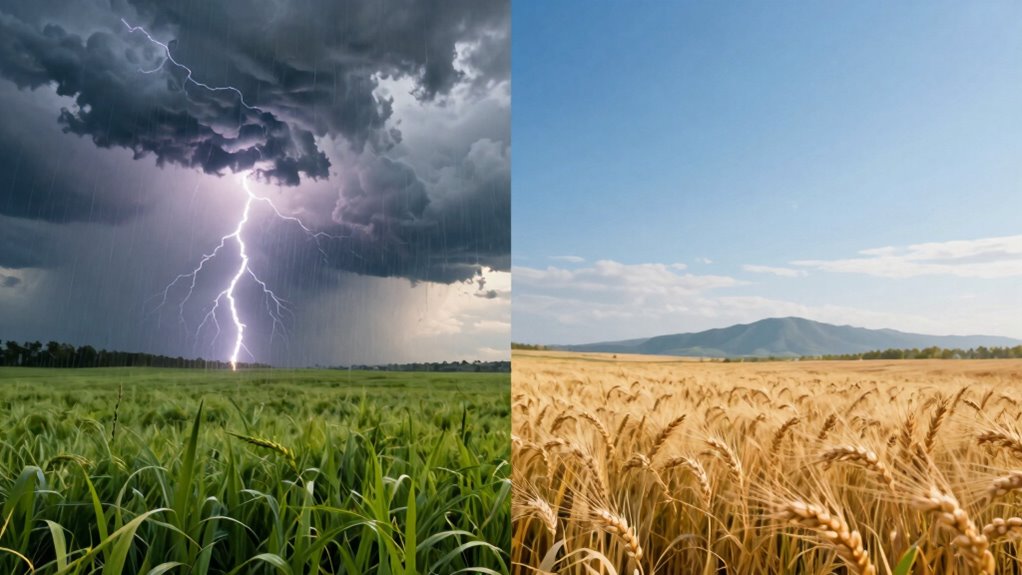
Ever wondered how weather and climate differ? It’s a common question, and understanding the distinction helps you grasp how our environment functions. Weather refers to the atmospheric conditions you experience daily—whether it’s sunny, rainy, windy, or snowy. These atmospheric variations happen over hours or days and are influenced by immediate factors like temperature, humidity, and air pressure. When you check the forecast each morning, you’re looking at weather: the short-term state of the atmosphere at a particular place and time.
Weather is the daily atmospheric condition you experience, changing over hours or days.
Climate, on the other hand, is about the long-term patterns of weather in a specific region. It’s what you expect based on historical data spanning decades or even centuries. Think of climate as the overall character or average of weather in an area—what’s typical for that place over time. For example, if you live in a desert, your climate is generally hot and dry, even though you might encounter occasional rain or cooler days. Climate takes into account the consistent atmospheric variations that shape the environment over a long period, giving you a sense of what the weather tends to be like historically. Recognizing how long-term climate patterns influence regional environments helps deepen your understanding of environmental changes.
Understanding the difference also means recognizing that climate isn’t just a static snapshot; it’s shaped by long-term patterns. These patterns include factors like ocean currents, mountain ranges, and even human activity, which influence the climate’s stability or variability over time. While weather can change from hour to hour or day to day, climate remains relatively steady over long periods, although it can shift due to larger influences like climate change. Analyzing climate variability is essential for assessing future environmental risks and planning accordingly. Additionally, changes in climate patterns can signal broader shifts in global environmental conditions, emphasizing the importance of monitoring these long-term trends. Moreover, understanding the factors influencing climate can help in developing strategies to mitigate adverse effects caused by climate change. Recognizing that climate change is driven by complex interactions of natural and human factors underscores the need for comprehensive approaches to environmental stewardship.
Your daily experience with weather is fleeting and unpredictable in the short term, but climate provides a broader perspective. It helps you understand why certain regions tend to have hot summers or cold winters, and why some areas are more prone to storms or droughts. Climate data is vital for planning agriculture, infrastructure, and responding to environmental challenges. While weather can be a rollercoaster ride of atmospheric variations, climate offers a steady baseline—an understanding of what’s typical for a location over many years.
As an affiliate, we earn on qualifying purchases.
Frequently Asked Questions
How Do Weather Patterns Affect Daily Life Globally?
Weather patterns influence your daily life worldwide by affecting activities, travel, and agriculture. Seasonal variations determine what clothes you wear and how you plan your day. Accurate weather forecasting helps you prepare for storms, heatwaves, or cold snaps, minimizing risks. Globally, these patterns impact economies and ecosystems, so understanding them allows you to adapt, stay safe, and make informed decisions about your routines and long-term plans.
Can Climate Change Reverse and Improve Local Climates?
Can climate change reverse and improve local climates? It’s unlikely, much like trying to turn back time. While some regions might see temporary relief through climate resilience efforts and local adaptation, overall, the damage is hard to undo. Your best hope lies in proactive strategies that minimize harm and help communities adjust. Nature’s clock can’t be rewound, but you can work toward a more sustainable, adaptable future.
What Are the Longest-Term Weather Forecasting Methods?
Long-range forecasting relies on analyzing historical climate data to predict weather patterns weeks or months ahead. You can use statistical models and computer simulations to identify trends and anomalies, giving you insights into potential future conditions. These methods involve studying long-term climate records, atmospheric patterns, and oceanic signals like El Niño, helping you anticipate broader weather trends, although precise day-to-day details remain uncertain.
How Do Weather and Climate Impact Agriculture Differently?
Weather affects agriculture daily, influencing planting schedules and crop resilience through short-term changes like storms or droughts. Climate shapes long-term agricultural planning, determining which crops thrive in your region over years or decades. You must adapt your strategies to these patterns, selecting resilient crops and adjusting practices accordingly. Understanding both helps you mitigate risks, guarantee steady yields, and develop sustainable farming methods tailored to local weather and climate conditions.
Are Weather and Climate Predictions Becoming More Accurate?
Yes, weather and climate predictions are becoming more accurate due to advancements in predictive modeling and improved data accuracy. You’ll find that meteorologists now use sophisticated tools and larger data sets, allowing for better forecasting. These developments help you plan better for weather events and understand long-term climate trends. While uncertainties remain, ongoing technological progress continually enhances the reliability of forecasts, making them more useful for daily life and strategic planning.
digital weather station with humidity
As an affiliate, we earn on qualifying purchases.
As an affiliate, we earn on qualifying purchases.
Conclusion
Think of weather as your daily mood—changing from sunny to stormy in a heartbeat—while climate is like your personality, shaped over years. Just as you can’t judge someone by a single bad day, you can’t judge a climate by just one weather event. Understanding the difference helps you see the bigger picture, guiding you through the weather’s unpredictable dance and the steady rhythm of climate’s story. Embrace this knowledge, and you’ll navigate the skies with confidence.
As an affiliate, we earn on qualifying purchases.
weather and climate educational kit
As an affiliate, we earn on qualifying purchases.
As an affiliate, we earn on qualifying purchases.
Halloween Picks
halloween
As an affiliate, we earn on qualifying purchases.