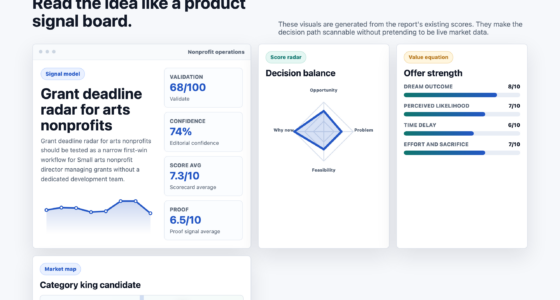

📊 Full opportunity report: The conversion. What turning the largest nonprofit into a company did to charity law. on ThorstenMeyerAI.com — validation score, market gap, and execution plan.

Prime made for students and young adults
- Fast, free delivery for dorm and study essentials
- Prime Video and Amazon Music included
- Member-only deals
TL;DR
OpenAI converted from a nonprofit to a for-profit while retaining control, diverging from standard practices. This change has legal and governance implications for charities.
OpenAI’s nonprofit entity, now the OpenAI Foundation, converted into a for-profit company while retaining control over the for-profit entity, a move that diverges from established charity-to-business conversion practices. This structural change, approved by California and Delaware authorities, raises questions about the legal safeguards intended to protect charitable assets and the future of nonprofit conversions.
Traditionally, nonprofit-to-profit conversions follow a process called divestiture, where the charity sells its assets at fair market value and endows an independent foundation, ensuring assets remain dedicated to charitable purposes. In contrast, OpenAI’s conversion did not involve asset sale; instead, the nonprofit retained control of the for-profit, holding approximately $130 billion in equity, and continued to govern the company. This control-retention model allows the nonprofit to maintain influence and resources, but it challenges the legal framework designed to prevent private inurement and asset diversion. After nearly a year of investigation, California’s Attorney General Bonta and Delaware’s Kathy Jennings approved the conversion on October 28, 2025, based on representations that nonprofit control remains intact. Critics argue this approach blurs the line between charitable and private interests, potentially weakening longstanding protections for charitable assets.The conversion.
What turning the largest
nonprofit into a company
did to charity law.
held, not divested for cash
independent foundations (Blue Cross)
that nonprofit control is preserved
set by settlement, not adjudication
- Charity sells assets at appraised fair value
- An independent foundation inherits the proceeds (Blue Cross → $3B+)
- The charity exits the for-profit entirely
- Protection = the value leaves the for-profit’s control
- Foundation keeps ~$130B equity, not cash
- Keeps controlling the OpenAI Group PBC
- No exit — the value stays inside the company
- Protection = nominal nonprofit control of the for-profit
The conversion redefined what a nonprofit can become — and did so by acquiescence rather than adjudication, on a representation the enforcers accepted rather than a standard a court imposed. The experiment is now running, and the next decade of conversions is watching the result.Thorsten Meyer · The Conversion · AI Governance 05
Legal and Governance Implications of Control-Retention Model
This development questions whether nonprofit control can be genuine or merely nominal, which impacts the integrity of charitable asset protections. If control is real, the structure could enable charities to maintain influence over valuable assets without adhering to traditional divestiture rules, potentially setting a precedent for future conversions. Conversely, if control is superficial, it risks undermining the legal safeguards designed to prevent private benefit and asset diversion, raising concerns about the integrity of charitable law enforcement and oversight.
As an affiliate, we earn on qualifying purchases.
Traditional Charitable Asset Protections and Conversion Practices
Historically, charities converting to for-profit entities have followed the divestiture model, selling assets at fair value and endowing independent foundations, which ensures assets remain dedicated to charitable purposes. This process has been well-tested since the 1990s, especially in healthcare sectors. OpenAI’s approach, approved by regulators, departs from this practice by maintaining control and equity stake, which has not been extensively tested or challenged in legal settings. The approval of this structure by authorities marks a significant shift in how charitable assets can be managed during conversions.
“OpenAI’s control-retention model is either a genuine innovation that better protects the mission or a loophole that undermines charitable-asset law.”
— Thorsten Meyer
As an affiliate, we earn on qualifying purchases.
Unverified Control: Actual vs. Nominal Influence
It remains unclear whether the OpenAI Foundation’s control over the for-profit entity is genuine or merely nominal. The legal approval was based on representations, and the true nature of control can only be assessed when conflicts arise. This uncertainty leaves open the possibility that the structure could be challenged or reinterpreted in the future, depending on how governance plays out in practice.
nonprofit asset management software
As an affiliate, we earn on qualifying purchases.
As an affiliate, we earn on qualifying purchases.
Monitoring and Potential Legal Challenges Ahead
Legal and regulatory authorities may scrutinize the ongoing governance of OpenAI to verify whether the nonprofit truly controls the for-profit. Future disputes or audits could test the legitimacy of the control-retention model. Additionally, other charities may follow this precedent, prompting broader legal debates and potential reforms in charitable asset law to clarify acceptable structures for conversions.
As an affiliate, we earn on qualifying purchases.
Key Questions
How does OpenAI’s conversion differ from traditional charity-to-company conversions?
Unlike traditional conversions that involve selling assets and endowing independent foundations, OpenAI retained control of its for-profit entity, holding significant equity without asset divestiture, which diverges from established practices.
Why is the control-retention model controversial?
Because it challenges the legal safeguards designed to prevent private benefit and asset diversion, raising concerns about whether nonprofit control is genuine or superficial.
What are the legal risks of this conversion approach?
It could weaken the enforceability of asset locks and private-inurement rules, potentially allowing private interests to benefit from charitable assets without proper oversight.
Could this set a precedent for other charities?
Yes, if the control-retention model is accepted as legitimate, other charities might adopt similar structures, which could reshape charitable law and oversight practices.
What happens if the nonprofit’s control is challenged later?
Legal disputes could arise, especially if conflicts reveal that control is nominal rather than real, potentially leading to regulatory action or court decisions redefining acceptable practices.
Source: ThorstenMeyerAI.com
Halloween Picks
halloween
As an affiliate, we earn on qualifying purchases.