
TL;DR

Prime made for students and young adults
- Fast, free delivery for dorm and study essentials
- Prime Video and Amazon Music included
- Member-only deals
Educational science experiment kits are hands-on sets that help children explore science through guided activities, from simple household-material projects to robotics and microscopy. Choose by age fit, safety guidance, learning approach, included supplies, and whether your child can repeat an experiment or change a variable—not by activity count alone.
A box can promise 30 experiments, yet your child may spend more time hunting for batteries than watching anything fizz, spin, or grow. The number on the package is only useful if the activities fit your child, the instructions make sense, and the materials are ready when curiosity strikes.
Educational science experiment kits are hands-on sets that help children explore topics such as chemistry, physics, biology, engineering, and earth science. In this guide, you’ll learn how to compare kits by age fit, safety, learning style, and completeness, and how to turn a single activity into a useful experiment rather than a quick demonstration.
Whether you’re shopping for a rainy Saturday, a classroom station, or a homeschool project, the aim is not to turn your kitchen into a laboratory. It’s to give a young learner a safe way to ask a question, make a prediction, and notice what actually happens.
Choose for your child’s reading level, fine-motor skills, interests, and likely need for adult help—not the age label alone.
Check the instructions for specific safety, supervision, cleanup, and disposal directions before starting.
Compare included materials with the supplies, batteries, and refills you must provide.
Prefer activities that let children make predictions, repeat tests, or change one variable when you want investigation beyond a quick demonstration.
Treat activity counts and category trends as clues, not proof of educational value; verify current product details with the manufacturer.
What a Science Kit Gives Your Child Beyond a Big Reveal
Educational science experiment kits are hands-on sets that guide children through activities where they can observe a result, test an idea, or build something. A kit may focus on one subject, such as circuits, or mix topics through projects in chemistry, biology, and engineering. The learning comes from what the child does with the activity, not from the box alone.
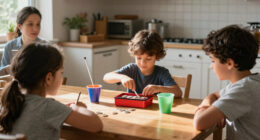
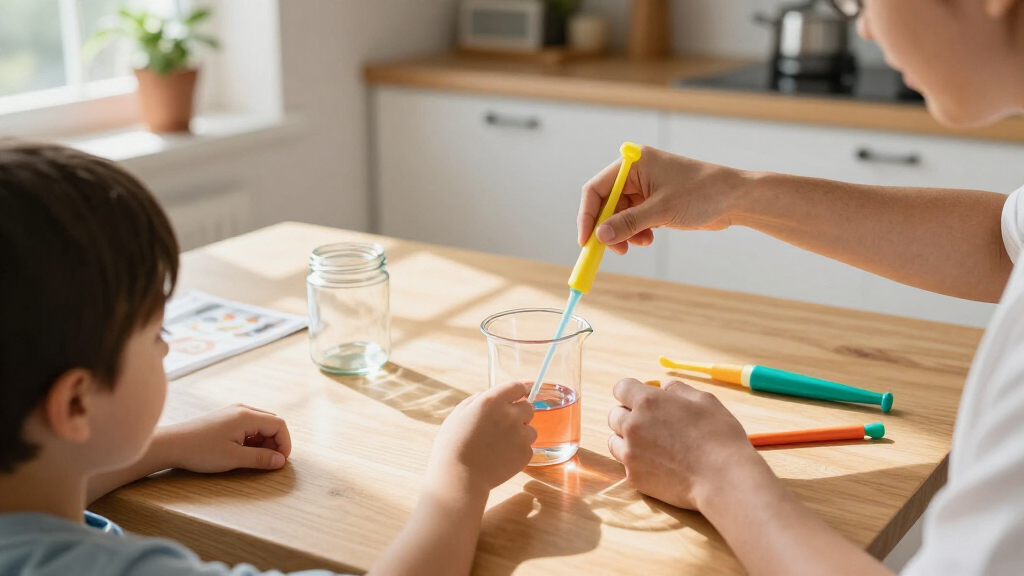
Imagine a child mixing two supplied liquids and watching a color change. The flash of color is fun, but you can extend it with simple questions: What did you predict? Which step changed the color? Would the result differ if you used a different amount? That conversation connects the visible result to observation and cause and effect.
Many kits are hands-on sets that help children explore with a mix of written instructions, tools, and materials. Some offer a guided demonstration; others provide a design challenge, such as building a paper bridge that can hold coins. A guided activity can help a beginner feel capable, while an open-ended one gives a more experienced learner room to test and revise.
A kit is a learning resource, not a guarantee of educational outcomes. A child who rushes through steps may remember the bubbling foam but miss the idea behind it. If you pause to record a prediction and repeat the test with one change, you turn a quick reveal into a small educational science experiment.
children's science experiment kits
As an affiliate, we earn on qualifying purchases.
As an affiliate, we earn on qualifying purchases.
Match the Kit to Your Child’s Age, Skills, and Interests
Educational science experiment kits work best when the reading, fine-motor tasks, and adult support fit the child using them. Check the recommended age, but also look at what the activity asks the learner to do: read several steps, handle small pieces, measure liquid, or follow a diagram. An age label is a starting point, not a promise that every child will work independently.
For example, a younger child may enjoy a simple project that uses household items and clear pictures, while a teen who likes taking gadgets apart may stick with a circuit or robotics kit. If your child is fascinated by pond water, a beginner microscope set may feel more rewarding than a chemistry box, even if the latter advertises more activities. Interest keeps hands moving after the first experiment is over.
Before buying, ask what kind of help you can offer. If a project needs an adult to read the instructions, prepare materials, or supervise each step, that may be a good shared activity—but it is not a fully independent one. A kit that fits your family’s schedule is more likely to leave the cupboard and reach the table.
Use these checks to find a workable match:
- Age and reading level: Can your child follow the directions, alone or with your help?
- Fine-motor demands: Does the activity involve tiny connectors, pipettes, or careful assembly?
- Topic: Does the kit connect to a genuine interest, such as space, plants, or machines?
- Adult role: Does the manufacturer expect close supervision or help with setup?
Matching matters because a project that is too simple can feel like busywork, while one with too many fiddly steps can turn a Saturday afternoon into frustration. Choose a little stretch, not a struggle.
As an affiliate, we earn on qualifying purchases.
Compare Kits by What Children Actually Get to Do
To compare educational science experiment kits fairly, look past the activity count and ask whether children can predict, observe, and change something. A box listing twenty demonstrations may offer less room to investigate than one reusable activity that supports several tests. The table below compares common kit styles; exact materials and features vary by product, so check the current manufacturer details.
| Kit style | What a child might do | What to check | Good fit when |
|---|---|---|---|
| Chemistry | Mix materials and observe a change | Safety steps, disposal guidance, and refill needs | Your learner likes visible reactions |
| Engineering or robotics | Build a structure, circuit, or moving model | Small parts, batteries, and assembly difficulty | Your child enjoys making and fixing |
| Biology or microscopy | Observe prepared samples or living things | What samples and tools are included | Your learner notices plants, insects, or tiny details |
| Earth or environment | Explore soil, weather, rocks, or water | Whether household or outdoor materials are needed | Your child likes nature and collecting observations |
Consider a family choosing between a chemistry kit and a small robotics set. If their child loves watching mixtures fizz but dislikes tiny screws, chemistry may suit them better—provided the adults can supervise the handling and cleanup. If the child likes rebuilding toys, a circuit project may hold attention longer, even if it takes several tries to make a bulb light.
The strongest choice depends on the learner and the activity, not a universal ranking. Look for instructions that explain what an activity demonstrates and invite a prediction or follow-up question. A kit that lets your child change one variable—such as bridge length or the number of supporting pieces—makes repetition meaningful rather than merely doing the same thing twice.
DIY science experiment kits for kids
As an affiliate, we earn on qualifying purchases.
As an affiliate, we earn on qualifying purchases.
Check Safety and Supplies Before the First Experiment
A science kit is ready for home use only when you understand its precautions, supervision needs, and material requirements. Read the manufacturer’s safety directions before opening a project, and follow the guidance for protective equipment, handling, storage, and disposal. No general description can replace the instructions for the particular kit or the rules that apply where you live.
For instance, a child may be excited to begin a project after dinner, only for the first page to call for household items, batteries, or adult help. Check the materials list first; confirm what the box includes and what you must supply. That small bit of preparation can prevent a promising experiment from stopping halfway through.
Use this quick setup routine:
- Read the full activity before inviting your child to start.
- Gather listed supplies and check for missing parts or refill needs.
- Set up the work area as the directions advise, with the required protective items.
- Explain the safety rules in plain language, including what the child should not touch or taste.
- Follow cleanup and disposal instructions rather than improvising.
For a classroom, check how many learners can use the materials at once and whether components can be cleaned, stored, or replaced. At home, a tray can help keep a small activity organized, but it does not replace supervision when the manufacturer calls for an adult. Clear directions and a prepared workspace protect the fun as well as the learner.
age-appropriate science kits for children
As an affiliate, we earn on qualifying purchases.
As an affiliate, we earn on qualifying purchases.
Turn One Activity Into a Real Investigation
A kit activity becomes more than a demonstration when a child makes a prediction, observes carefully, and changes one variable at a time. The simplest routine is: ask a question, write or say a guess, run the activity, record what happened, then decide what to test next. You do not need a lab coat or a complicated worksheet; a scrap of paper and a curious conversation can do the job.
Suppose a child builds a paper bridge and tests how many coins it holds. First ask whether a flat sheet or a folded sheet will support more. After the first test, keep the coin size and placement the same, change only the fold, and count the result. The child gets a satisfying challenge and a clearer chance to connect one design change with one observed outcome.
For a growing project, such as a plant activity, take a quick photo at the same time each day and note what changed. In a circuit project, sketch where the wires connect before rebuilding. These small records help children compare results instead of relying on memory, which can blur after a few exciting trials.
Good instructions support this habit by explaining what to notice and offering a question beyond “Did it work?” If the kit only gives fixed steps, you can still ask what might happen if one safe, manufacturer-approved part of the activity changes. Repeatability matters: a project that can be tested again gives children room to revise a prediction, learn from an unexpected result, and feel that science is something they do—not just something they watch.
Judge Value by Reuse, Support, and Setup—not the Box Count
A science kit offers better practical value when its materials support worthwhile activities, its instructions are clear, and you can use or replace important components. Price and activity count alone cannot tell you whether a kit will suit your family. Check how many projects use the same tools, which supplies you must buy separately, and whether the manufacturer lists refills or replacement parts.
A box with several reusable circuit components may support repeated building challenges, while a larger set of one-time materials could run out after a few sessions. That does not make a consumable kit a bad choice; a child may love a vivid, guided project. It simply means you should compare the experience you are buying with the way your child likes to learn.
Some current category trends include kits focused on robotics, coding, circuits, and design challenges, along with themed sets about space, the environment, or forensic science. Products may also pair physical activities with videos, apps, or online instructions. These are broad category patterns, not a live market survey; features, availability, and safety details change, so check the manufacturer’s current information before choosing a specific product.
Ask whether screen access is required or optional, whether the activities work offline, and what happens when a small part goes missing. A family with limited device access may prefer a kit with complete printed directions. A teacher may care more about durable pieces that several children can share. Useful value is personal: it depends on fit, repeat use, and how easily the kit becomes part of real life.
Frequently Asked Questions
What age is a science experiment kit suitable for?
Follow the manufacturer’s recommended age, then check reading level, small parts, fine-motor tasks, and stated adult-supervision needs. A younger child may enjoy the activity with you even when the kit is not suitable for independent use.
Do children need adult supervision?
Some projects call for more adult involvement than others. Read the specific manufacturer directions before starting, and supervise as instructed, especially when an activity involves materials or tools that need special handling.
Are science experiment kits safe to use at home?
Safety depends on the particular kit and whether you follow its precautions. Check required protective equipment, handling instructions, storage, and disposal guidance before use; do not assume every home activity suits every child or setting.
What supplies do I need to provide?
Check the materials list for household items, batteries, water, or other supplies that the kit may not include. Review it before the activity so you can gather everything and avoid stopping halfway through.
Is a more expensive kit necessarily better?
No. Price does not tell you whether the age fit, instructions, safety information, or activities suit your child. Compare the usable components, repeatability, refill availability, and likely adult setup before deciding.
How can I help my child learn more from a kit?
Ask your child to predict what will happen, observe the result, and describe what changed. When the instructions allow it, repeat the activity while changing one variable; a paper bridge test, for example, can compare two folding designs using the same coins.
Conclusion
Choose a kit your child can safely use, genuinely wants to open, and can learn from more than once. Read the directions, gather the supplies, and make room for one prediction before the first fizz, flash, or wobbly bridge test.
The best experiment may end with a result nobody expected—and a child already asking what to try next.
Halloween Picks
halloween
As an affiliate, we earn on qualifying purchases.