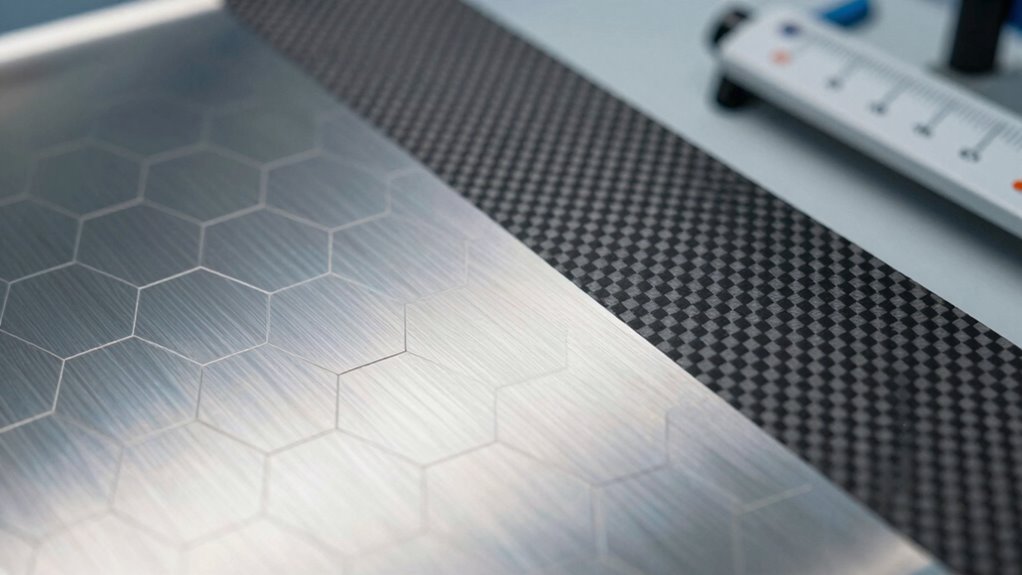

You can create super strong, lightweight materials by using nanotechnology to manipulate structures at the atomic level, embedding nanoscale fibers or particles to reinforce the material. Hierarchical design helps distribute stress efficiently across multiple scales, enhancing resilience without adding weight. Incorporating advanced nanomaterials like carbon nanotubes or graphene further boosts strength while keeping things light. If you’re curious how these innovations come together, there’s more to uncover about the future of high-performance materials.

Prime made for students and young adults
- Fast, free delivery for dorm and study essentials
- Prime Video and Amazon Music included
- Member-only deals
Key Takeaways
- Nanostructuring techniques create materials with optimized atomic arrangements for enhanced strength and reduced weight.
- Incorporating nanoscale fibers like carbon nanotubes and graphene significantly boosts strength-to-weight ratios.
- Hierarchical design distributes stress efficiently across multiple scales, improving overall material resilience.
- Use of advanced nanomaterials enables integration into composites that are both lightweight and ultra-strong.
- Sustainable manufacturing and recycling practices ensure high performance without ecological compromise.

Have you ever wondered how engineers create materials that are both incredibly strong and surprisingly lightweight? It’s a fascinating blend of science and innovation, where tiny adjustments can lead to massive improvements. One of the key factors behind these advanced materials is nanotechnology applications. By manipulating matter at the atomic or molecular level, scientists can design structures that maximize strength while minimizing weight. For example, nanostructured composites incorporate nanoscale fibers or particles that reinforce the material without adding bulk. This approach not only boosts durability but also reduces overall weight, making it ideal for aerospace, automotive, and sports equipment.
Nanotechnology enables the creation of lightweight, ultra-strong materials ideal for aerospace, automotive, and sports applications.
But creating such materials isn’t just about pushing performance boundaries; it’s also about considering environmental impact considerations. As you might imagine, the production and disposal of new materials can have significant ecological footprints. Engineers now focus on developing sustainable nanotechnology applications that reduce waste, lower energy consumption, and use eco-friendly raw materials. For instance, researchers explore biodegradable nanocomposites or recyclable components to ensure that the push for strength and lightness doesn’t come at the planet’s expense. They also evaluate the lifecycle impact of these materials, from extraction and manufacturing to disposal and reuse, aiming for solutions that are both high-performing and environmentally responsible. lifecycle impact assessments are essential in ensuring the sustainability of these innovative materials.
The secret to achieving this delicate balance lies in understanding the internal structure of materials. Strong, lightweight materials often feature a hierarchical design—structures built in multiple scales, from the microscopic to the macroscopic—allowing them to distribute stress efficiently. Engineers employ advanced modeling techniques to predict how these structures will behave under different conditions, optimizing their composition at each level. This meticulous design process, combined with nanotechnology applications, ensures that materials are not only resilient but also as light as possible, without sacrificing safety or functionality.
Moreover, ongoing advancements in nanomaterials open new avenues for innovation. Researchers are experimenting with carbon nanotubes, graphene, and other nanoscale materials that exhibit extraordinary strength-to-weight ratios. These materials can be integrated into composites or coatings to enhance properties further, often with minimal environmental impact when produced responsibly. As you can see, the quest for materials that are both super strong and super light is a complex interplay of cutting-edge science, environmental consciousness, and practical engineering. It’s an exciting field that promises to reshape industries while keeping sustainability front and center. One promising area of research is the development of hierarchical material design, which combines multiple structural levels to optimize both strength and weight effectively.
carbon nanotube reinforced composite materials
As an affiliate, we earn on qualifying purchases.
As an affiliate, we earn on qualifying purchases.
Frequently Asked Questions
How Do Scientists Test the Strength of New Materials?
Scientists test the strength of new materials through material testing, where they apply controlled forces to assess durability, flexibility, and resistance. You might see them perform strength assessment methods like tensile tests, compression tests, or impact tests, which measure how the material responds under various stresses. This process helps determine if the material can withstand real-world conditions, ensuring it’s suitable for its intended lightweight yet strong applications.
Can Lightweight Materials Be Recycled Easily?
They say “what’s old is new again,” and lightweight materials like biodegradable composites are proving that true. These materials can be recycled more easily than traditional options, making them sustainable alternatives. You can often break down biodegradable composites into eco-friendly components, reducing waste and environmental impact. So, yes, lightweight materials can be recycled efficiently, helping you make greener choices for a more sustainable future.
Are Super Strong Materials More Expensive to Produce?
Super strong materials often cost more to produce due to manufacturing challenges and the need for specialized processes. You’ll find that achieving high strength while keeping the process cost-efficient can be difficult, making these materials more expensive. The advanced techniques and raw materials involved contribute to higher costs. So, while they offer impressive performance, the overall production expenses tend to be higher compared to simpler materials.
How Do Material Properties Change Under Extreme Temperatures?
Under extreme temperatures, your materials can experience significant changes. Thermal expansion causes them to expand or contract, which may weaken their structure. If temperatures get high enough, phase shifts can occur, turning solids into liquids or gases, drastically altering their properties. Conversely, at very low temperatures, materials might become brittle and lose their strength. These temperature-induced changes are essential to take into account in designing and using materials in extreme environments.
What Industries Benefit Most From Super Light, Strong Materials?
Like a sword slicing through steel, super light, strong materials cut across industries. You’ll find aerospace innovation soaring higher, as these materials reduce weight and boost fuel efficiency. Sports equipment also benefits, offering players safer, more agile gear. These advancements revolutionize performance and safety, making transportation and athletic pursuits more efficient and dynamic. Their strength and lightness turn dreams into reality, shaping a future where limits are redefined.
graphene lightweight strength materials
As an affiliate, we earn on qualifying purchases.
As an affiliate, we earn on qualifying purchases.
Conclusion
Imagine holding a material that’s both as light as a feather and as strong as steel—seems like magic, right? But it’s science that makes this possible, revealing the secrets of nature and innovation alike. These super materials don’t just push boundaries; they rewrite what’s possible. As you explore their potential, remember: in the quest for strength and lightness, you’re wielding the future itself—bright, daring, and full of endless possibilities.
nanostructured aerospace materials
As an affiliate, we earn on qualifying purchases.
As an affiliate, we earn on qualifying purchases.
high-performance nanomaterial sports equipment
As an affiliate, we earn on qualifying purchases.
As an affiliate, we earn on qualifying purchases.
Columbus Day / Indigenous Peoples' Day Picks
long weekend sales
As an affiliate, we earn on qualifying purchases.