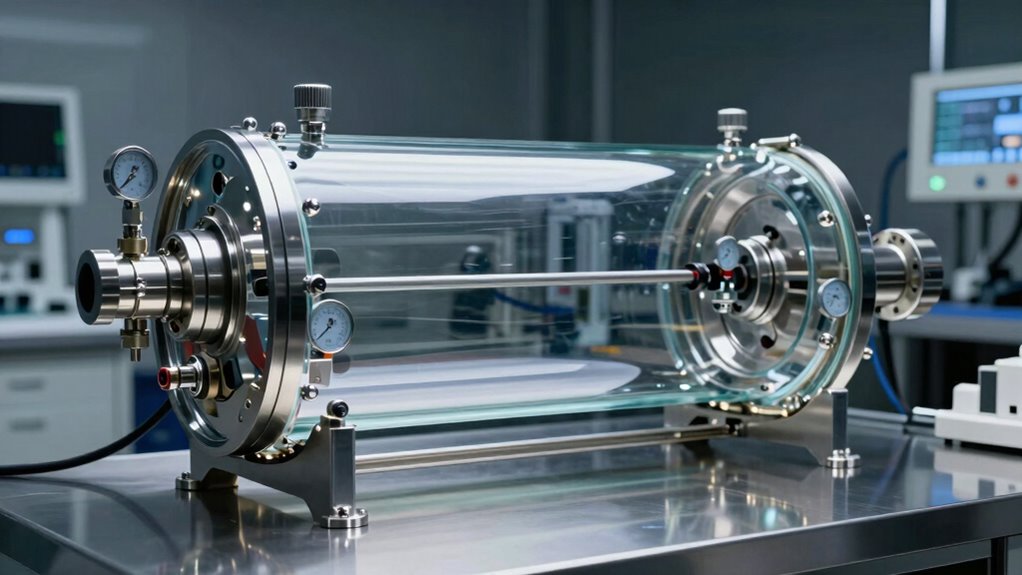
A good vacuum chamber for experiments is built with durable, low-outgassing materials like stainless steel to guarantee a contaminant-free environment. You should prioritize reliable sealing mechanisms, such as high-quality O-rings or welded joints, to prevent leaks. Precise pressure measurement tools, like capacitance manometers and Pirani gauges, help monitor conditions continuously. Designing for easy access and long-term durability ensures stable performance over time. Keep exploring to discover more about maintaining ideal vacuum conditions.

Get school and study supplies delivered free — and shop member deals
- Fast, free delivery on millions of items
- Access to Prime Big Deal Days deals on October 6–7
- Prime Video, Amazon Music and more included
Key Takeaways
- Uses materials like stainless steel to ensure durability, corrosion resistance, and low outgassing in extreme conditions.
- Incorporates high-quality seals and welded joints to prevent leaks and maintain vacuum integrity.
- Equipped with precise pressure measurement instruments suitable for various vacuum levels.
- Designed for easy access, maintenance, and internal uniformity to support consistent experimental conditions.
- Built with durable components for long-term reliability and stable, contaminant-free environments.

Have you ever wondered how scientists create a controlled environment to conduct sensitive experiments? The key lies in a well-designed vacuum chamber, which must meet specific standards to guarantee accurate results. One of the most critical factors is material selection. You need materials that can withstand extreme conditions without outgassing or degrading over time. Metals like stainless steel are popular because they offer durability, corrosion resistance, and low permeability to gases. Sometimes, specialized coatings are added to improve surface properties, reduce contamination, or enhance vacuum integrity. The chamber’s material must also be compatible with the substances you’ll handle, preventing reactions that could interfere with your experiment. Choosing the right materials isn’t just about durability—it’s about maintaining a pure, stable environment that provides reliable data. Ensuring the material’s compatibility with your specific experimental substances is essential for maintaining vacuum quality and preventing contamination. Additionally, selecting materials with low outgassing rates further helps preserve a clean environment, especially in ultra-high vacuum conditions.
Material choice is crucial for stable, contaminant-free vacuum chambers that ensure precise, reliable experimental results.
Pressure measurement plays a key role in maintaining the vacuum’s integrity. You’ll want precise, reliable gauges to monitor the internal pressure constantly. These gauges help you detect leaks early and guarantee the vacuum stays within the desired range. Different pressure measurement devices suit various vacuum levels, from rough vacuum to ultra-high vacuum. For example, capacitance manometers are excellent for accurate readings in high and ultra-high vacuum ranges, while Pirani gauges work well at lower vacuum levels. Proper pressure measurement isn’t just about reading numbers; it’s about actively controlling the environment. You might even incorporate multiple gauges to cover a wide range of pressures, ensuring your setup remains stable throughout your experiment. Regular calibration of these gauges is essential for maintaining accuracy over time. Additionally, understanding the pressure ranges suitable for your specific experiment helps optimize the measurement system for accuracy and reliability. In complex setups, integrating digital controls can enhance real-time monitoring and adjustments.
A good vacuum chamber also features robust sealing mechanisms, such as O-rings or welded joints, to prevent leaks. The sealing quality directly impacts the chamber’s ability to maintain a stable vacuum. The design should facilitate easy access for sample placement, instrument integration, and maintenance without compromising the seal. Additionally, the chamber’s internal geometry should promote uniform conditions, avoiding areas where gases could stagnate or pressure gradients could develop. When selecting materials and designing for pressure measurement, consider how each component interacts to sustain an environment free of contaminants and fluctuations. Proper sealing and material choices together are vital for preserving the integrity of the vacuum environment. Using high-quality seals and considering the seal’s durability ensures long-term performance and reliability in demanding experimental conditions.
As an affiliate, we earn on qualifying purchases.
Frequently Asked Questions
How Often Should Vacuum Chambers Be Inspected for Leaks?
You should inspect your vacuum chamber for leaks regularly, ideally before each use and as part of your maintenance schedule. Conduct leak detection tests at least monthly if used frequently, or after any maintenance or repairs. Consistent inspections help catch leaks early, ensuring your experiments stay accurate. Keeping a detailed maintenance schedule and performing routine leak detection will prolong your chamber’s lifespan and maintain ideal vacuum conditions.
What Is the Typical Lifespan of a Vacuum Chamber?
A vacuum chamber’s lifespan often mirrors the resilience of a seasoned oak, enduring years with proper care. Typically, it lasts 10 to 20 years, but material durability and diligent chamber maintenance are key. Regular inspections, timely repairs, and gentle handling help stave off wear, ensuring your chamber remains a steadfast vessel for experiments. With attentive upkeep, you can extend its life and keep your scientific pursuits thriving.
Can Vacuum Chambers Be Customized for Specific Experiments?
Yes, vacuum chambers can be customized for specific experiments. You choose from various vacuum chamber materials, like stainless steel or aluminum, to suit your needs. Chamber customization allows you to add ports, viewports, or specialized fittings, guaranteeing compatibility with your equipment. By tailoring the design, you optimize performance, reduce contamination risks, and ensure precise control over experimental conditions, making your setup more efficient and reliable.
What Safety Precautions Are Necessary When Operating a Vacuum Chamber?
When operating a vacuum chamber, you must prioritize safety by ensuring the vacuum seal is secure to prevent leaks. Always monitor the pressure gauge regularly to avoid over-pressurization or implosion risks. Wear appropriate protective gear, such as gloves and goggles, and follow proper procedures for evacuating and venting the chamber. Never bypass safety features, and keep an emergency plan ready in case of equipment failure.
How Do Different Materials Affect Vacuum Chamber Performance?
Different materials substantially impact vacuum chamber performance. You need to take into account material compatibility to prevent outgassing or corrosion that could compromise vacuum quality. A smooth surface finish minimizes particle release and leaks, ensuring a tighter seal and more stable environment. Using compatible materials with proper surface finishes helps maintain vacuum integrity, reduces contamination risks, and extends your chamber’s lifespan, ultimately leading to more accurate and reliable experimental results.
As an affiliate, we earn on qualifying purchases.
Conclusion
Now that you know what makes a good vacuum chamber, imagine the possibilities it opens up. With the right design, precision, and materials, you could push the boundaries of your experiments further than ever before. But there’s one essential detail you might be overlooking—something that could make or break your entire project. Are you ready to discover the secret to mastering the perfect vacuum environment and taking your experiments to the next level? The answer might just surprise you.
capacitance manometer for vacuum
As an affiliate, we earn on qualifying purchases.
As an affiliate, we earn on qualifying purchases.
As an affiliate, we earn on qualifying purchases.
Evergreen bestsellers Picks
bestsellers
As an affiliate, we earn on qualifying purchases.