
Laminar flow hoods are essential for maintaining your work environment sterile and contamination-free. They create a controlled airflow that directs clean, filtered air over your work surface, trapping particles and bacteria. This prevents airborne contaminants from affecting your samples or experiments. They also protect you from hazardous biological agents or chemicals. Properly functioning hoods guarantee safety and accuracy, which is critical in sensitive tasks. To discover how to maximize their effectiveness, keep exploring further.

Prime made for students and young adults
- Fast, free delivery for dorm and study essentials
- Prime Video and Amazon Music included
- Member-only deals
Key Takeaways
- They create a sterile environment by unidirectional airflow, preventing contamination during sensitive procedures.
- HEPA filters trap airborne particles, bacteria, and contaminants, maintaining high cleanliness standards.
- They protect users from exposure to biological agents and hazardous fumes.
- Proper maintenance ensures effective filtration, preserving workspace integrity and safety.
- Their use is essential in microbiology, pharmaceuticals, and medical research where contamination control is critical.

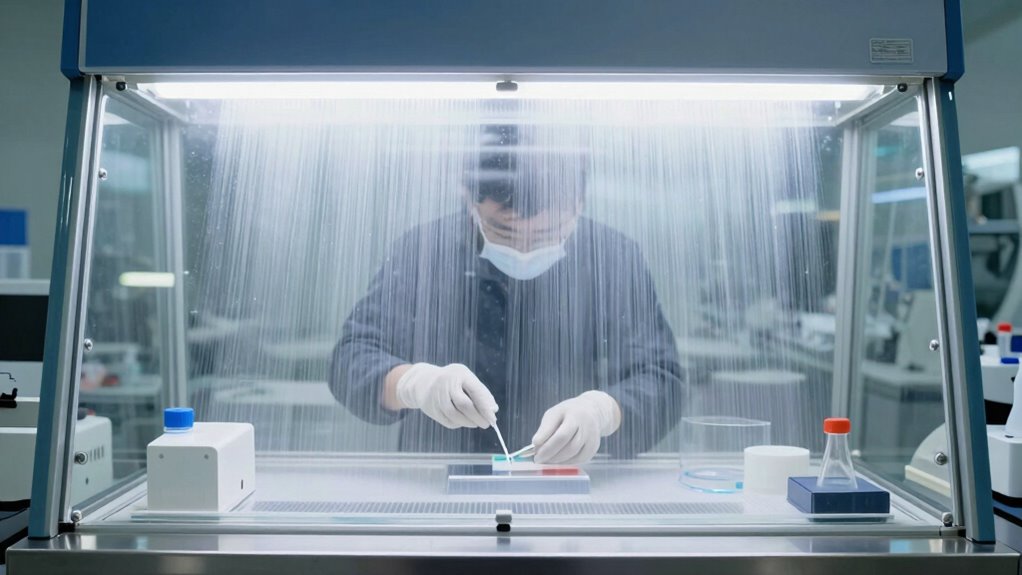
Have you ever wondered how laboratories maintain a sterile environment for delicate experiments? The answer lies in the essential role of laminar flow hoods. These specialized enclosures are designed to create a controlled, sterile workspace by directing a constant, unidirectional flow of filtered air over the work surface. This consistent airflow is achieved through advanced air filtration systems, typically involving HEPA filters that trap particles, bacteria, and other contaminants. Without this precise air filtration, airborne particles could compromise sensitive samples or experiments, leading to inaccurate results or contamination.
Laminar flow hoods create sterile workspaces by directing filtered, unidirectional air over surfaces, preventing contamination.
Laminar flow hoods are critical for workplace safety, especially in settings where maintaining high standards of cleanliness isn’t just important but necessary. The controlled environment helps protect both the user and the samples from potential hazards. When operated correctly, these hoods minimize the risk of exposure to harmful biological agents or chemical vapors, creating a safer work environment. You’ll find them widely used in microbiology labs, pharmaceutical manufacturing, medical research, and electronics assembly—anywhere contamination control is paramount. By preventing the spread of airborne contaminants, laminar flow hoods guarantee that your workspace remains sterile, reducing the likelihood of cross-contamination that could jeopardize experiments or compromise products.
The significance of laminar flow hoods extends beyond just maintaining cleanliness. They also support workplace safety by controlling airflow patterns that prevent the escape of dangerous aerosols or fumes. This containment capability protects you from inhaling potentially hazardous substances while working with infectious agents, chemicals, or other sensitive materials. Additionally, the consistent airflow helps keep the environment within the hood stable and free of disruptive drafts that might disturb delicate procedures, ensuring precision and accuracy. Proper understanding and maintenance of air filtration systems are essential to ensure these hoods function effectively and provide the safety and cleanliness required in sensitive environments.
In essence, these hoods are an indispensable part of any lab that requires strict control over environmental conditions. They provide a reliable barrier against contamination and airborne pollutants by continuously filtering and directing air in a way that preserves both safety and integrity. When you work with a laminar flow hood, you’re not just guaranteeing the quality of your results; you’re also protecting your health and that of your colleagues. Proper maintenance and understanding of how air filtration works within these systems are key to maximizing their effectiveness, making them a cornerstone of safe, clean, and reliable laboratory work.
HEPA filter for laminar flow hood
As an affiliate, we earn on qualifying purchases.
As an affiliate, we earn on qualifying purchases.
Frequently Asked Questions
How Often Should Laminar Flow Hoods Be Inspected and Maintained?
You should inspect and maintain your laminar flow hood regularly, ideally following a monthly maintenance schedule. During these checks, make sure air filtration systems are functioning properly, filters are clean or replaced as needed, and airflow remains unimpeded. Consistent maintenance keeps your hood in peak condition, reducing contamination risks and ensuring a safe, sterile work environment. Regular inspections help catch issues early, maintaining the integrity of your clean work space.
Can Laminar Flow Hoods Be Used for All Types of Laboratory Work?
You can’t use laminar flow hoods for all types of laboratory work because their airflow patterns are designed mainly for contamination control in sensitive procedures. They excel at protecting samples from airborne contaminants but may not be suitable for work involving hazardous chemicals or processes requiring higher airflow rates. Always assess your specific needs and confirm the hood’s design matches your work’s safety and contamination control requirements.
What Are the Common Signs of a Malfunctioning Laminar Flow Hood?
You’ll notice a malfunctioning laminar flow hood if you see airflow disruption, where the airflow isn’t steady or consistent. Unusual noises or vibrations can also indicate issues. Additionally, if you observe visible contamination on the filter or surfaces inside the hood, it’s a sign the filter may be contaminated or clogged. Regular checks help catch these signs early, ensuring your work remains clean and protected from contamination.
Are Laminar Flow Hoods Cost-Effective for Small-Scale Labs?
Yes, laminar flow hoods can be cost-effective for small-scale labs. You should conduct a cost analysis, considering initial purchase, maintenance, and energy expenses, to determine affordability. Additionally, evaluate space requirements; these hoods typically need a dedicated area, but their efficient design can save space compared to larger cleanroom setups. If your workflow demands sterile conditions, investing in a laminar flow hood offers reliable, long-term value.
How Do Laminar Flow Hoods Compare to Biosafety Cabinets?
Think of laminar flow hoods as the precise artisans of clean work, while biosafety cabinets act as versatile protectors. Laminar flow hoods feature uniform airflow patterns driven by HEPA filtration, ensuring contaminant-free environments for delicate tasks. Biosafety cabinets, however, include additional safety features for handling hazardous materials. If your focus is on maintaining a sterile workspace without hazardous risks, laminar flow hoods excel in delivering consistent, gentle airflow to keep your work pristine.
As an affiliate, we earn on qualifying purchases.
Conclusion
Think of a laminar flow hood as a protective shield in your workspace, like a lighthouse guiding ships safely through foggy waters. It keeps contaminants at bay, ensuring your work stays pure and precise. Without it, your efforts are like steering stormy seas without a compass—uncertain and risky. So, trust in the power of your laminar flow hood, and let it be your beacon of cleanliness, guiding your work safely to success every time.
As an affiliate, we earn on qualifying purchases.
As an affiliate, we earn on qualifying purchases.
Halloween Picks
halloween
As an affiliate, we earn on qualifying purchases.