

Water is one of the weirdest substances because of its unique molecular structure and hydrogen bonding. Its bent shape causes it to form strong yet temporary bonds, leading to unusual properties like high surface tension, high boiling point, and ice floating on water. These behaviors help sustain life and regulate climate. If you keep exploring, you’ll discover how these peculiar traits make water essential for Earth’s stability and living organisms.

Prime made for students and young adults
- Fast, free delivery for dorm and study essentials
- Prime Video and Amazon Music included
- Member-only deals
Key Takeaways
- Water’s hydrogen bonding creates unique properties like high surface tension and high boiling point, uncommon in other liquids.
- Ice floats because its crystalline lattice is less dense than liquid water, thanks to hydrogen bonds.
- Water has an unusually high specific heat capacity, stabilizing temperatures and supporting life.
- Its molecular structure leads to complex behaviors, such as forming extensive hydrogen bond networks.
- Water’s properties are crucial for climate regulation and sustaining aquatic ecosystems in cold environments.
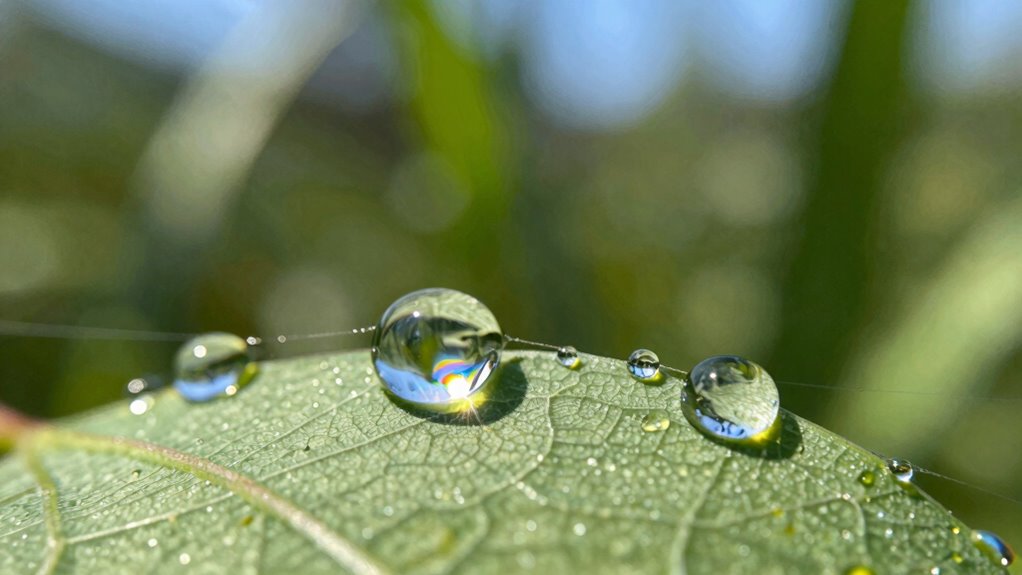
Have you ever wondered why water behaves so strangely compared to other substances? It’s because of its unique molecular structure and the way its molecules interact through hydrogen bonding. Unlike most liquids, water’s molecules are arranged in a way that creates some really unusual properties. Each water molecule is made up of two hydrogen atoms bonded to one oxygen atom, forming a bent shape. This molecular structure isn’t just simple; it’s what makes water special. The oxygen atom holds a slight negative charge, while the hydrogen atoms carry a slight positive charge. These partial charges enable water molecules to stick together through hydrogen bonds, which are a type of attractive force stronger than typical dipole interactions but weaker than covalent bonds.
Hydrogen bonding is the key to many of water’s odd behaviors. When water molecules come close, the positive hydrogen of one molecule is attracted to the negative oxygen of another. This creates an extensive network of bonds that constantly form and break, giving water its fluidity and high surface tension. Because of these bonds, water has an unusually high boiling point relative to its molecular weight, meaning it stays liquid over a wide temperature range. This is *crucial* for life on Earth, as it helps regulate temperature and provides a stable environment for biological processes. The molecular structure of water plays a vital role in its ability to support life and influence environmental conditions. Additionally, the hydrogen bonds contribute to water’s cohesive properties, which are essential for processes like capillary action in plants.
Another strange trait stems from the molecular structure and hydrogen bonding: water’s solid form, ice, is less dense than liquid water. When water freezes, the molecules arrange themselves into a crystalline lattice stabilized by hydrogen bonds, creating more space between molecules. This makes ice less dense and allows it to float. If water didn’t do this, bodies of water would freeze from the bottom up, drastically affecting aquatic life. The fact that ice floats is directly tied to the way hydrogen bonds organize water molecules into an open, hexagonal structure when frozen. Additionally, the extensive hydrogen bonding network requires a considerable amount of energy to break, which explains water’s high specific heat capacity and its ability to act as a climate moderator.
You might also notice water’s high specific heat capacity, which means it can absorb a lot of heat before warming up. This again relates to hydrogen bonds, which require additional energy to break. That’s why oceans and lakes act as heat reservoirs, moderating climate and providing a stable environment. The molecular structure and hydrogen bonding make water a remarkable substance—one that sustains life, influences climate, and keeps Earth’s ecosystems in balance. Its strange behaviors are not just quirks but essential features rooted in its molecular makeup.
As an affiliate, we earn on qualifying purchases.
Frequently Asked Questions
How Does Water’s Surface Tension Compare to Other Liquids?
Water’s surface tension is higher than most liquids because of hydrogen bonding and molecular cohesion. These strong forces pull water molecules together at the surface, creating a sort of skin. Compared to other liquids, water’s surface tension allows it to form droplets and support small objects, like insects. You’ll notice this effect when observing water beads or when tiny insects walk on it without sinking.
Why Does Water Expand When It Freezes?
When water freezes, it expands about 9%, a surprising fact given most substances contract. This happens because of water’s molecular structure during its phase change; as it cools, molecules form a crystalline lattice that keeps them farther apart. Unlike other liquids, water’s unique hydrogen bonds cause this expansion, making ice less dense than liquid water and allowing it to float—an essential feature for aquatic life.
Can Water Conduct Electricity in Pure Form?
Pure water doesn’t conduct electricity well because it lacks free ions needed for electrical conductivity. The purity effects mean that in its purest form, water has very low electrical conductivity. However, even tiny impurities or dissolved gases can increase conductivity, making it easier for electricity to pass through. So, while pure water isn’t a good conductor, slight contamination considerably improves its ability to conduct electricity.
How Does Water’s Specific Heat Capacity Affect Climate?
Water’s high specific heat capacity helps you understand its role in climate regulation and temperature moderation. When the environment heats up, water absorbs excess heat, preventing sudden temperature spikes; when it cools, water releases stored heat, keeping temperatures stable. This balancing act influences weather patterns, ocean currents, and overall climate stability. You experience this firsthand in coastal areas where water’s temperature buffers extreme weather, promoting a more consistent climate.
Why Is Water Considered a Universal Solvent?
You see, water is called a universal solvent because its molecular structure allows it to dissolve many substances. The polar nature of water molecules, created by chemical bonding, enables them to interact with various compounds. These interactions break down the substances into their individual molecules or ions, making water incredibly effective at dissolving solids, gases, and even some organic materials, which is essential for biological and environmental processes.
hydrogen bonding water experiment kit
As an affiliate, we earn on qualifying purchases.
As an affiliate, we earn on qualifying purchases.
Conclusion
So next time you take a sip of water, remember just how strange and fascinating this simple molecule truly is. Its unique properties, like floating when frozen and sticking to itself, make it unlike any other substance on Earth. Isn’t it amazing how something so common can be so weird and wonderful? Water’s quirks remind you that even the simplest things can hold the most intriguing secrets waiting to be explored.
water surface tension demonstration kit
As an affiliate, we earn on qualifying purchases.
As an affiliate, we earn on qualifying purchases.
As an affiliate, we earn on qualifying purchases.
Halloween Picks
halloween
As an affiliate, we earn on qualifying purchases.