
Scientists study tiny changes in starlight during exoplanet transits, when a planet passes in front of its star. By analyzing how specific wavelengths of light are absorbed, they identify atmospheric gases like water vapor, methane, and oxygen. Advanced spectroscopic techniques help interpret these spectral signatures, despite challenges from clouds and noise. Space and ground telescopes have different strengths, and future tech will make these atmospheric clues even clearer—if you keep exploring, you’ll discover how these methods reveal distant worlds.
Key Takeaways
- Scientists analyze small dips in starlight during transits to identify atmospheric gases via their unique absorption features.
- Transit spectroscopy compares the star’s light at different wavelengths to detect specific atmospheric molecules like water vapor or methane.
- Variations in light intensity and spectral signatures reveal atmospheric composition, cloud cover, and weather patterns on the exoplanet.
- Advanced instruments and calibration techniques enhance detection of faint atmospheric signals amid noise and cloud interference.
- Space telescopes avoid Earth’s atmospheric interference, providing clearer data for interpreting exoplanet atmospheric fingerprints.

Spectroscopy: The Key to the Stars: Reading the Lines in Stellar Spectra (The Patrick Moore Practical Astronomy Series)
As an affiliate, we earn on qualifying purchases.
As an affiliate, we earn on qualifying purchases.
How Do Light Changes Reveal Exoplanet Atmospheres?
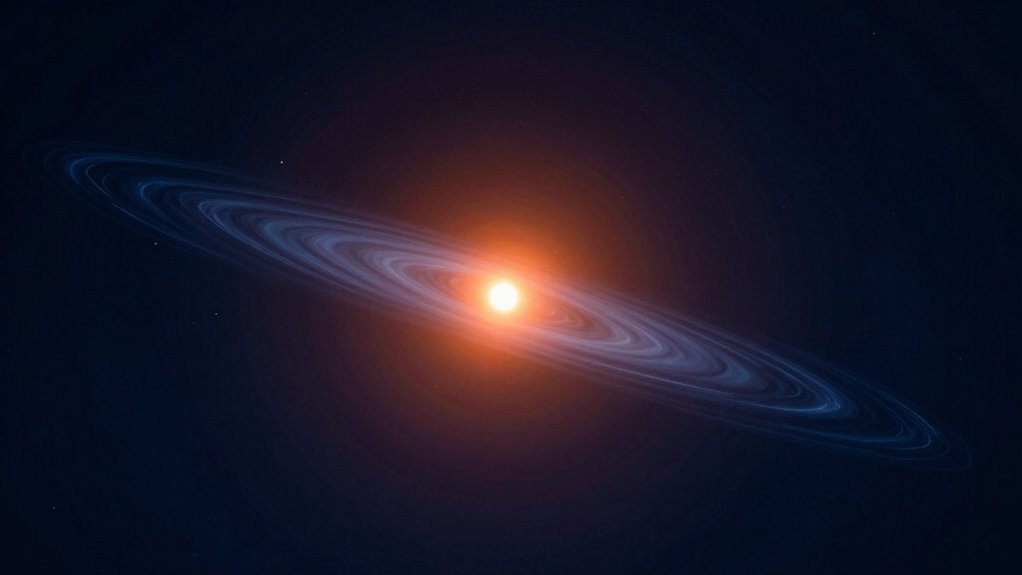
When an exoplanet passes in front of its star, the light from the star filters through the planet’s atmosphere. This filtering reveals clues about the atmospheric dynamics shaping that world. Variations in the star’s light, such as specific wavelengths absorbed or scattered, indicate the presence of gases and particles. These changes also hint at planetary weather patterns, like storms or cloud cover, influencing how light interacts with the atmosphere. By analyzing these subtle shifts, you can infer the composition and behavior of the atmosphere, revealing its complexity. The way light dims or shifts provides a window into the planet’s atmospheric dynamics, helping you understand how heat, gases, and weather systems circulate within the atmosphere. This process is fundamental to reading exoplanet atmospheres from afar. Additionally, advanced spectroscopic techniques enable scientists to detect even faint atmospheric signatures, further unlocking the secrets of distant worlds. Moreover, improvements in instrument sensitivity allow for more precise measurements, revealing finer details of atmospheric composition.
exoplanet atmosphere analysis tools
As an affiliate, we earn on qualifying purchases.
As an affiliate, we earn on qualifying purchases.
What Is Transit Spectroscopy and How Does It Detect Gases?

Transit spectroscopy is a technique that astronomers use to identify the gases in an exoplanet’s atmosphere by analyzing the starlight that passes through it during a transit. When the planet crosses in front of its star, some light filters through the atmospheric layers, revealing absorption features unique to specific gases. By studying these spectral signatures, you can infer the exoplanet’s composition and refine atmospheric modeling. This method helps distinguish between different types of atmospheres, from thick, cloudy layers to clear skies. The process involves measuring tiny dips in starlight at various wavelengths, which correspond to absorption by gases like water vapor, methane, or oxygen. These insights help build a detailed picture of the planet’s atmospheric makeup, essential for understanding its nature and potential habitability.
Transit spectroscopy analyzes starlight passing through an exoplanet’s atmosphere to identify gases and assess habitability.
Additionally, precise measurements are crucial for detecting subtle spectral variations that indicate the presence of biosignatures or habitability markers. Advances in spectroscopic techniques continue to improve our ability to analyze exoplanet atmospheres with greater accuracy. Recent developments in instrument sensitivity enable astronomers to detect even faint signals from distant worlds, broadening our understanding of planetary diversity across the galaxy.

Grating Spectroscopes and How to Use Them (The Patrick Moore Practical Astronomy Series)
As an affiliate, we earn on qualifying purchases.
As an affiliate, we earn on qualifying purchases.
How Do Scientists Interpret Spectral Signatures?
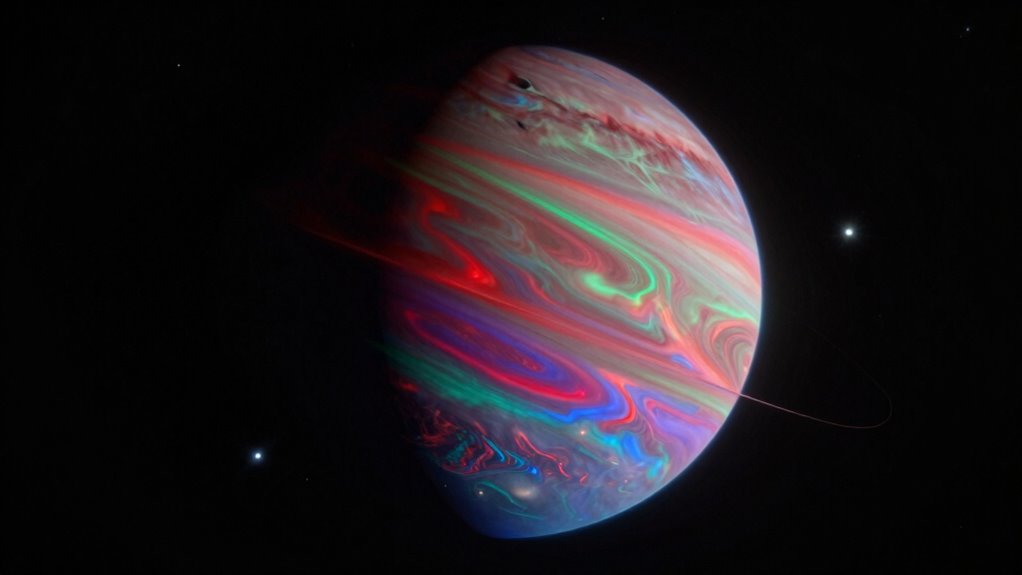
When scientists analyze light from exoplanets, they look for unique patterns that reveal the presence of specific gases. These spectral signatures act like fingerprints, helping researchers identify chemical compounds in the atmosphere. By studying these signatures, they can piece together the planet’s atmospheric composition and better understand its environment. Additionally, advanced instruments enable precise detection of these signals, uncovering details that can hint at potential habitability.
Detecting Unique Light Patterns
Scientists interpret spectral signatures by examining the specific patterns of light absorbed or emitted by an exoplanet’s atmosphere. These spectral fingerprints reveal clues about the atmospheric composition, helping you identify gases like water vapor or methane. To detect unique light patterns, you analyze the depth and position of absorption lines, which vary with different molecules. You also compare observed spectra with laboratory data to confirm the presence of specific compounds. Additionally, factors like temperature and pressure influence spectral features, adding complexity. Variations in light intensity over time can highlight atmospheric dynamics, cloud cover, or storms. By carefully studying these patterns, you piece together a detailed picture of what’s floating in the atmosphere, revealing secrets hidden in the faint flickers of distant worlds. Incorporating advanced analysis techniques enhances the accuracy of interpreting these spectral signatures, enabling scientists to uncover even subtler atmospheric phenomena. Understanding the impact of instrument sensitivity and resolution is essential for accurately capturing and analyzing these faint signals, further improving our knowledge of exoplanet atmospheres. Furthermore, spectral calibration ensures that the data collected remains precise and reliable across different observations and instruments. Recognizing the influence of natural atmospheric variability can also help differentiate between genuine signals and observational noise, leading to more accurate interpretations. Employing statistical modeling can assist in distinguishing true atmospheric features from random fluctuations, improving confidence in the results.
Analyzing Chemical Signatures
Interpreting spectral signatures involves analyzing the specific patterns of light absorbed or emitted by an exoplanet’s atmosphere. These spectral fingerprints reveal the atmospheric composition, showing which molecules are present. When light passes through or reflects off an atmosphere, certain wavelengths are absorbed by gases like water vapor, methane, or oxygen. By examining these absorption features, you can determine what chemicals exist in the atmosphere. Scientists compare the observed spectral fingerprints to known signatures from different molecules. This comparison often requires spectral analysis techniques to ensure accurate identification. Additionally, understanding the molecular absorption properties helps improve the precision of these interpretations. This process allows you to identify the presence of key compounds that may indicate habitability or other atmospheric processes. Accurately interpreting these signatures helps paint a detailed picture of an exoplanet’s environment, bringing you closer to understanding worlds beyond our solar system. Understanding the spectral analysis techniques used in this process is essential for making accurate interpretations.

Acxico 3Pcs/Set Universal 0.965inch/24.5mm Telescope Eyepiece Set H20mm H12.5mm SR4mm for Astronomy Photography Accessory Kits
Only for 0.965"/24.5mm Telescope Eyepiece Set.Multi-coated.Suitable for 0.965"/24.5mm telescope eyepiece filters.The lowest magnification being the H20 eyepiece, the…
As an affiliate, we earn on qualifying purchases.
As an affiliate, we earn on qualifying purchases.
What Challenges Do Clouds and Noise Present?

Clouds can block or distort the light signals scientists rely on, making it harder to interpret atmospheric compositions accurately. Noise from instruments and cosmic sources can also obscure faint spectral signatures, leading to uncertainties. These challenges require sophisticated techniques to distinguish real signals from interference. Additionally, luminosity variations in the observed light pose further difficulties in extracting precise atmospheric data. Understanding the spectral signatures of different atmospheric components is essential for accurate analysis, but the presence of clouds and noise complicates this process significantly. Employing advanced data processing methods can help mitigate some of these issues by filtering out noise and correcting for cloud effects. Moreover, researchers often develop noise reduction algorithms to improve the clarity of spectral data.
Cloud Interference Complexities
Cloud interference presents significant hurdles when studying exoplanet atmospheres through light. Cloud cover can obscure or distort signals, making it difficult to detect specific atmospheric features. Atmospheric scattering caused by clouds diffuses light, complicating the interpretation of spectra. Variations in cloud density and composition can lead to inconsistent data, affecting measurement accuracy. Thick cloud layers can block the planet’s surface signals altogether. Additionally, dynamic cloud patterns cause temporal changes, adding noise to observations. These factors collectively hinder scientists from accurately analyzing atmospheric composition and conditions. Understanding cloud variability is essential for improving the accuracy of exoplanet atmospheric studies, especially as remote sensing technologies continue to advance. Moreover, the cloud composition itself can vary widely, influencing how light interacts with the atmosphere and further complicating data analysis. Recognizing how cloud dynamics change over time can help scientists develop better models to interpret these complex signals. Furthermore, cloud behavior varies across different planetary environments, adding another layer of complexity to atmospheric observations.
Noise Obscuring Signals
The presence of atmospheric noise considerably complicates the task of analyzing exoplanet signals. This noise can stem from instrument calibration issues or Earth’s own atmosphere, making it harder to detect faint signals. To combat this, scientists use data smoothing techniques to filter out random fluctuations. However, noise can still obscure key features, leading to misinterpretations. Imagine a table showing different noise sources:
| Noise Source | Effect on Data | Mitigation Strategy |
|---|---|---|
| Instrument Drift | Signal distortion | Regular calibration |
| Earth’s Atmosphere | Signal interference | Data smoothing |
| Cosmic Rays | Spurious signals | Data filtering |
| Thermal Noise | Reduced sensitivity | Cooling detectors |
| Calibration Errors | Inaccurate readings | Precise calibration |
Understanding and addressing these noise sources are essential to accurately read exoplanet atmospheres. Additionally, advances in noise reduction techniques are continuously improving our ability to interpret faint signals amidst interference. Recent developments in instrument sensitivity also play a crucial role in enhancing detection accuracy.
How Do Space and Ground Telescopes Compare?
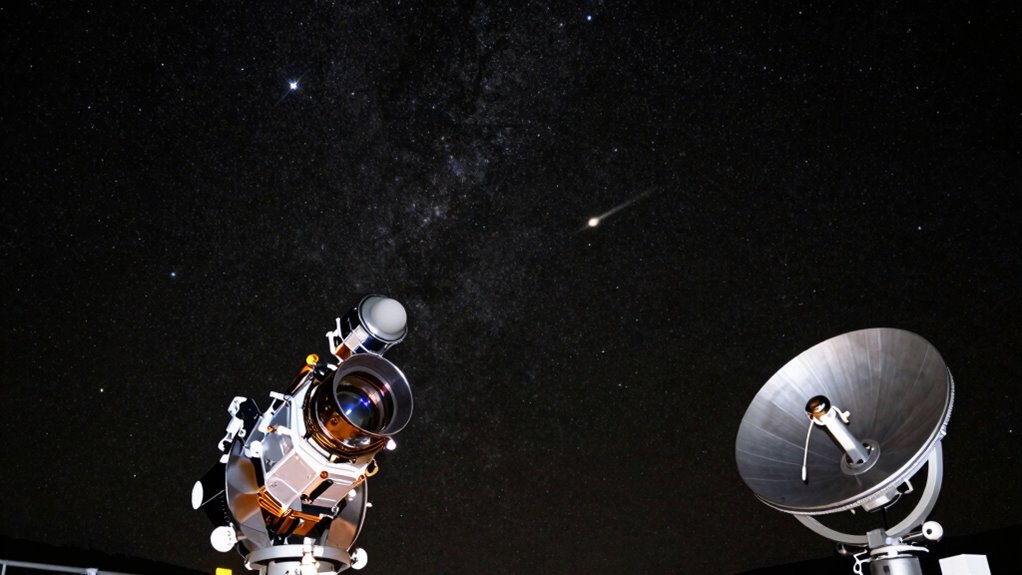
Have you ever wondered how space and ground telescopes compare when it comes to studying exoplanet atmospheres? Space telescopes, like Hubble, excel at remote sensing because they avoid Earth’s atmospheric interference, providing clearer data. Ground-based telescopes, however, benefit from larger mirrors, enabling more detailed spectroscopy techniques. They can be upgraded and maintained more easily, offering flexibility for new instruments. Space telescopes operate in wavelength ranges blocked by Earth’s atmosphere, such as ultraviolet and infrared. Ground telescopes often use adaptive optics to correct atmospheric distortion, improving observation quality. Both types complement each other: space telescopes deliver pristine data, while ground telescopes offer versatility and larger collecting areas for detailed analysis. This synergy advances our understanding of exoplanet atmospheres effectively.
What Exoplanet Atmospheres Tell Us About Habitability?

Exoplanet atmospheres reveal critical clues about their potential to support life. By analyzing their composition, you can identify possible biosignatures—gases like oxygen, methane, or water vapor—that suggest biological activity. Detecting these signatures through precise spectroscopic measurements indicates habitability. Atmospheric modeling helps interpret these signals, considering factors like temperature, pressure, and chemical interactions, to assess if an environment could sustain life. You can compare these models against known planetary conditions to evaluate whether an exoplanet’s atmosphere is conducive to life or if it’s hostile. While no biosignature detection confirms life, it narrows down promising candidates for further study. Understanding these atmospheric clues deepens your insight into where life might exist beyond Earth.
What Future Technologies Will Improve Atmosphere Measurements?

What new technologies are on the horizon to enhance your ability to analyze exoplanet atmospheres? Quantum sensors are emerging as game-changers, offering unprecedented sensitivity to detect faint atmospheric signals. Adaptive optics systems will continue to improve, correcting for atmospheric distortion and sharpening your observations. These advancements will help you distinguish exoplanet light from stellar noise more effectively. Additionally, next-generation telescopes with larger apertures will gather more light, boosting resolution. Integrated data processing techniques, like machine learning, will automate and refine analysis. Finally, space-based observatories will eliminate Earth’s atmospheric interference altogether, providing clearer views of distant atmospheres. Together, these innovations will allow you to probe atmospheres with greater detail, pushing the boundaries of what’s possible in exoplanet research.
Frequently Asked Questions
Can Exoplanet Atmospheres Be Studied During Non-Transit Periods?
Yes, you can study exoplanet atmospheres during non-transit periods by analyzing stellar variability and atmospheric dynamics. During these times, astronomers observe subtle signals like phase curves and reflected light, revealing atmospheric composition and weather patterns. This approach allows you to gather data even when the planet isn’t passing in front of its star, offering a continuous glimpse into the exoplanet’s atmospheric behavior and helping to understand its climate and structure.
How Accurate Are Current Models for Interpreting Atmospheric Data?
You might think current models are perfect, but spectral modeling still has limitations. While they provide valuable insights into chemical composition, uncertainties remain due to factors like data quality and complex atmospheric processes. These models are improving rapidly, yet they can’t capture every detail. So, you should see them as powerful tools—helping you understand exoplanet atmospheres, but not giving you absolute certainty.
What Role Do Artificial Intelligence and Machine Learning Play in Analysis?
You leverage machine learning to enhance data analysis, making it faster and more accurate. Artificial intelligence helps you detect subtle patterns in light flickers, which traditional methods might miss. Machine learning algorithms process vast amounts of atmospheric data, refining models and improving interpretations. This technology empowers you to identify atmospheric compositions and conditions more precisely, pushing the boundaries of exoplanet research and bringing new discoveries within your reach.
Are There Known Exoplanets With Atmospheres Similar to Earth’s?
You’ll find that some exoplanets show atmospheric compositions similar to Earth’s, especially regarding biosignature detection. Scientists analyze these atmospheres for gases like oxygen, methane, and water vapor, which could suggest habitability. While no exoplanet has been confirmed as truly Earth-like yet, ongoing research and advanced telescopes keep revealing candidates with atmospheres that might harbor life, bringing us closer to understanding other worlds.
How Long Does It Typically Take to Analyze a Single Exoplanet’s Atmosphere?
Ever wondered how long it takes to analyze a single exoplanet’s atmosphere? It usually spans from days to weeks, depending on data complexity. You’ll rely on spectroscopic techniques to gather atmospheric data, then spend time on data processing to interpret the signals. Sometimes, the process’s duration extends if the signals are faint or noisy. Are you ready to plunge into this fascinating, meticulous scientific adventure?
Conclusion
Just like a secret whispered through a flickering candle, each light change reveals the stories hidden in exoplanet atmospheres. By decoding these subtle signals, you open worlds beyond our reach, unveiling their mysteries and potential for life. As technology advances, you become a pioneer, shining a torch into the cosmic dark. Every discovery is a step closer to understanding our universe’s grand tapestry—reminding you that even the faintest flicker can illuminate the unknown.