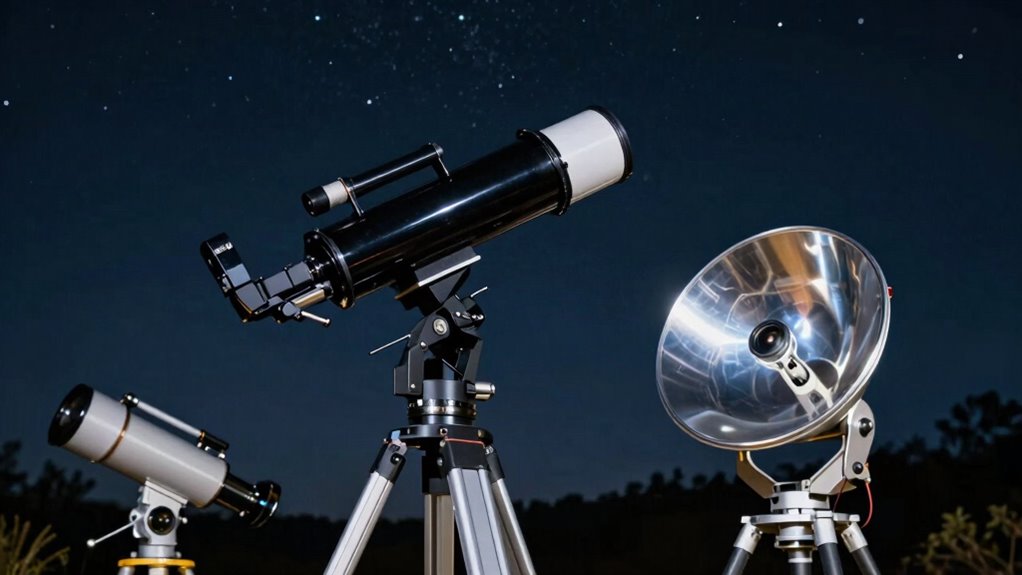

If you’re choosing between a refractor, reflector, or Schmidt-Cassegrain telescope, consider your viewing goals, budget, and whether portability matters. Refractors are ideal for sharp lunar and planetary views and are easy to use, making them great for beginners. Reflectors offer larger apertures at lower costs, perfect for deep-sky objects but need more maintenance. Schmidt-Cassegrain telescopes are versatile and portable, suitable for both planetary and deep-sky observing. Keep exploring to discover which suits you best and why.

Prime made for students and young adults
- Fast, free delivery for dorm and study essentials
- Prime Video and Amazon Music included
- Member-only deals
Key Takeaways
- Refractors are ideal for beginners and high-contrast planetary viewing, requiring minimal maintenance.
- Reflectors offer larger apertures for deep-sky objects at lower costs but need collimation.
- Schmidt-Cassegrain telescopes combine portability and versatility, suitable for both planetary and deep-sky observations.
- Mount and eyepiece compatibility significantly impact ease of use and viewing quality.
- Choose based on your viewing goals, budget, and preferred maintenance level for an optimal experience.
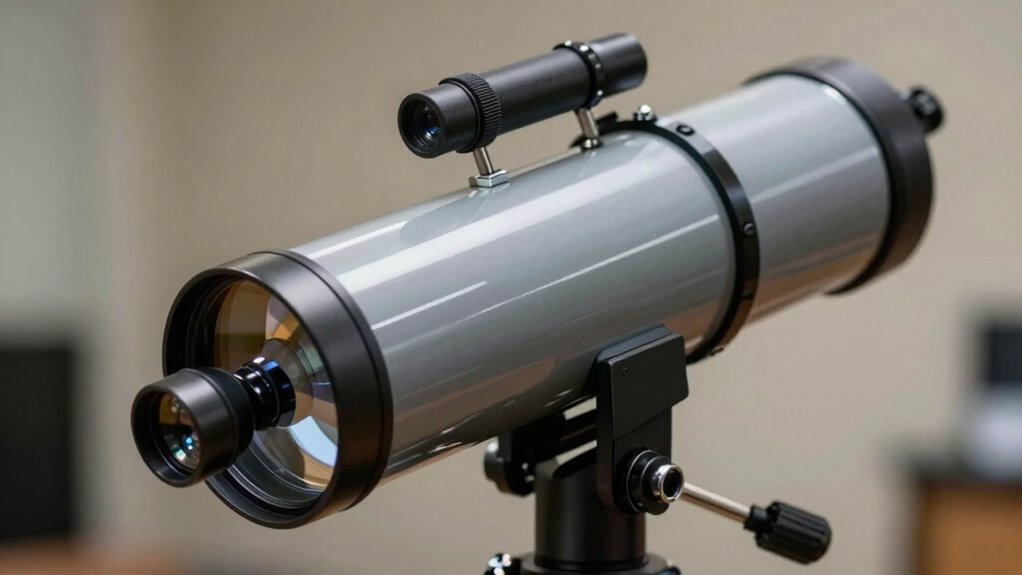
Are you curious about which telescope type best suits your stargazing adventures? Choosing between a refractor, reflector, or Schmidt-Cassegrain depends on what you want to see, how much you’re willing to spend, and how you plan to use your telescope. Each type offers unique advantages, and understanding these can help you make an informed decision. An important aspect to consider is eyepiece selection, which directly impacts your viewing experience. The right eyepiece can sharpen detail and increase comfort, especially when paired with the appropriate mount type. For example, refractors often come with sturdy, straightforward mounts that are easier for beginners, making them ideal if you want a hassle-free setup. Reflectors, on the other hand, usually require a sturdy, equatorial mount to handle their weight and provide smooth tracking, especially for long-exposure astrophotography. Schmidt-Cassegrain telescopes combine features of both and benefit from versatile mount types, often supporting computerized mounts that simplify navigation. Understanding telescope types can significantly influence your overall experience and satisfaction with your equipment.
Choosing the right telescope and eyepieces enhances your stargazing experience and suits your observing goals.
If you’re just starting out, a refractor might be your best choice. Their simple design ensures durability, minimal maintenance, and sharp, high-contrast images of planets and the moon. Plus, they typically come with user-friendly mount types, like altazimuth mounts, which are easy to operate for quick setup and comfortable viewing sessions. When it comes to eyepiece selection, sticking to a few versatile options will cover most viewing needs, from planetary detail to wide-field views of star clusters. Refractors excel at high-contrast, crisp images, making them perfect for detailed lunar and planetary observations. Additionally, their low-maintenance design ensures fewer adjustments over time, which is especially beneficial for beginners.
If you’re interested in deep-sky objects and more versatile viewing, reflectors could be better. They usually offer larger apertures at a lower cost, allowing you to see fainter objects. Reflector telescopes need a stable, often equatorial mount for precise tracking, especially if you’re into astrophotography. The eyepiece selection here is critical—wider fields of view with lower magnification are great for scanning large star fields, while higher magnifications reveal nebulae and galaxies in more detail. They require a bit more maintenance, like collimation, but reward you with impressive views of deep-sky wonders.
Schmidt-Cassegrain telescopes strike a balance between portability, versatility, and power. Their compact design makes them easy to transport, and they work well with computerized mounts that simplify locating objects. These mounts often have tracking features, which are essential for astrophotography or detailed viewing. When choosing eyepieces, look for those with a range of focal lengths to maximize the telescope’s versatility. With a Schmidt-Cassegrain, you get a good all-around telescope suited for both planetary and deep-sky observing, making it a popular choice among enthusiasts who want flexibility without sacrificing image quality.
refractor telescope for beginners
As an affiliate, we earn on qualifying purchases.
As an affiliate, we earn on qualifying purchases.
Frequently Asked Questions
Which Telescope Type Is Best for Astrophotography?
For astrophotography, you should choose a telescope with excellent mount stability and minimal lens aberrations. A refractor typically offers sharp images, low aberrations, and steady mounts, making it ideal for capturing detailed celestial objects. Reflectors are great for deep-sky imaging but may require additional adjustments. Schmidt-Cassegrain telescopes combine portability with good optical quality, but their optical design can introduce some aberrations. Overall, a well-mounted refractor often provides the best results for astrophotography.
How Do I Choose a Telescope for Beginner Astronomers?
You should pick a beginner telescope with easy mounting types like altazimuth or equatorial mounts, which simplify setup and tracking. Look for aperture sizes around 70-130mm, offering a good balance between light-gathering power and portability. Choose a model that feels sturdy, easy to use, and suits your interests—whether planetary viewing or wide-field sky observations. This approach helps you enjoy astronomy without overwhelm, building confidence as you learn.
What Maintenance Is Required for Different Telescope Types?
Think of your telescope like a well-tuned orchestra—each part needs care to perform its best. For different types, you’ll need to clean optical coatings gently and check mount stability regularly. Refractors require minimal maintenance, while reflectors need occasional mirror realignment. Schmidt-Cassegrain scopes benefit from periodic cleaning of their optical coatings and ensuring mount stability, especially after transportation or rough weather, to keep your stargazing smooth and clear.
Can I Upgrade My Telescope Later?
Yes, you can upgrade your telescope later. You might add different mounting options for stability or ease of use, or improve image quality by upgrading lens coatings. As your skills grow, you may want to upgrade accessories like eyepieces or filters. Keep in mind, some upgrades might require compatible mounts or additional adapters, so plan ahead to guarantee your telescope can support future enhancements smoothly.
Which Telescope Offers the Best Value for Money?
You get the best bang for your buck with a versatile refractor or a solid Dobsonian reflector. They often come with good mounting options and durable optical coatings, making them easy to upgrade and maintain. Refractors are great for sharp images, while reflectors usually offer more aperture for your money. Either way, you can’t go wrong if you pick a model that balances quality, features, and affordability.
large aperture reflector telescope
As an affiliate, we earn on qualifying purchases.
As an affiliate, we earn on qualifying purchases.
Conclusion
Choosing the right telescope depends on your needs and budget. For instance, if you’re a beginner interested in easy setup and portability, a refractor might be perfect. Imagine you’re planning your first stargazing night; a Schmidt-Cassegrain offers versatility and compactness, making it ideal. Remember, no matter which you pick, the joy of discovering the universe is what truly counts. Happy stargazing!
Schmidt-Cassegrain computerized telescope
As an affiliate, we earn on qualifying purchases.
As an affiliate, we earn on qualifying purchases.
telescope eyepiece set for astrophotography
As an affiliate, we earn on qualifying purchases.
As an affiliate, we earn on qualifying purchases.
Halloween Picks
halloween
As an affiliate, we earn on qualifying purchases.