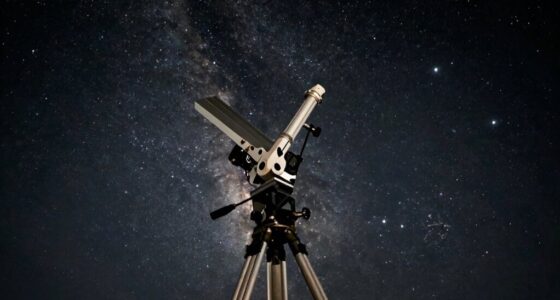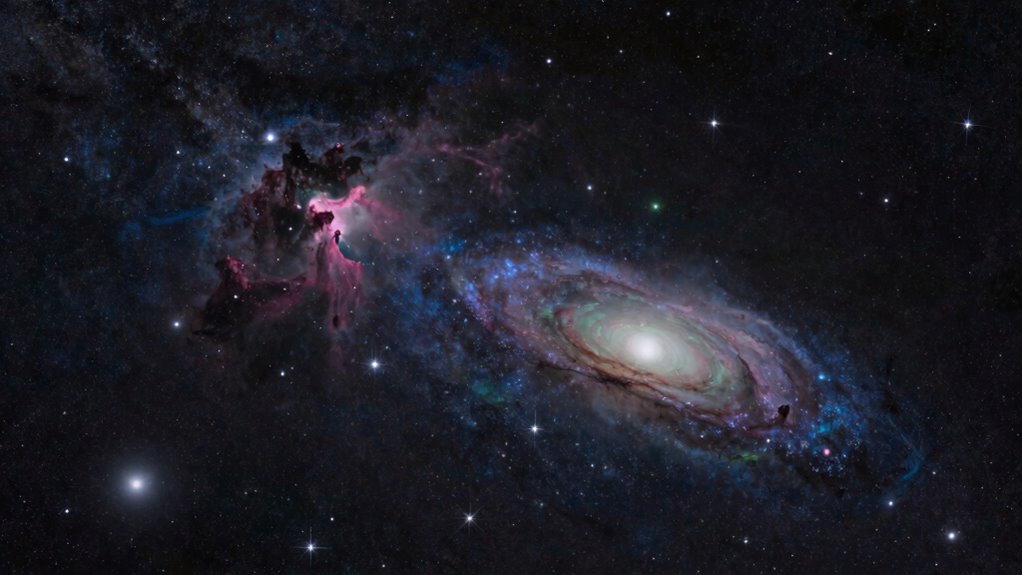

When astronomers talk about deep sky, they refer to the universe beyond what you can see with your eyes alone. It includes distant objects like galaxies, nebulae, star clusters, and other celestial phenomena visible through telescopes. These structures reveal the universe’s history, its ongoing evolution, and the forces that shape it. Exploring deep sky uncovers the universe’s hidden layers, offering fascinating insights and stunning sights you can discover with a telescope if you keep exploring further.

Prime made for students and young adults
- Fast, free delivery for dorm and study essentials
- Prime Video and Amazon Music included
- Member-only deals
Key Takeaways
- Deep Sky refers to objects beyond our solar system visible through telescopes.
- It includes galaxies, nebulae, star clusters, and other celestial structures.
- These objects are not visible to the naked eye and require specialized observation tools.
- Studying Deep Sky helps understand cosmic history, galaxy formation, and universe evolution.
- It encompasses the universe’s distant, mysterious regions rich in celestial phenomena.
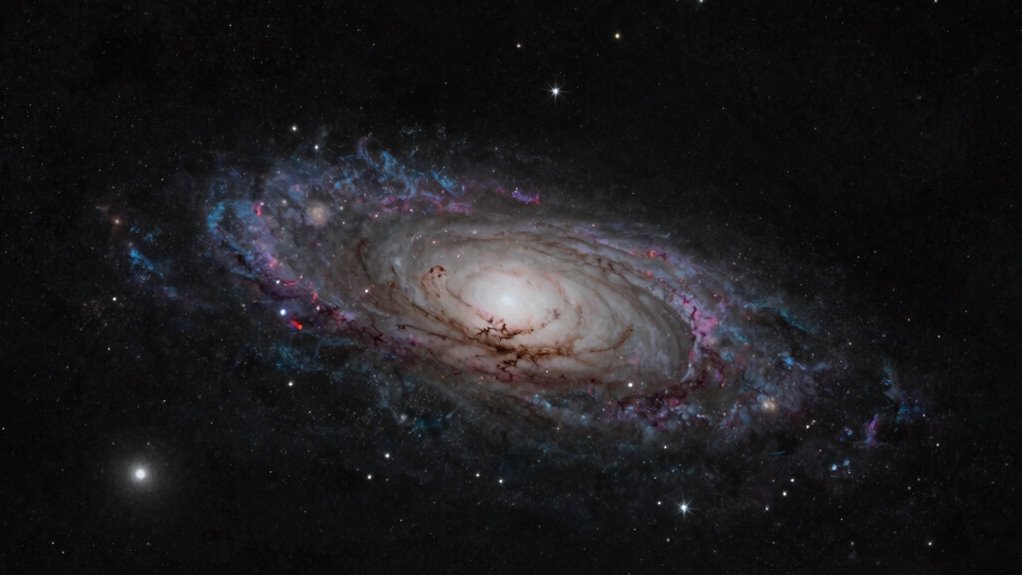
Have you ever wondered what lies beyond our night sky’s brightest stars? When astronomers talk about “deep sky,” they’re referring to the vast universe that extends far beyond the familiar constellations and planets you can see with the naked eye. This domain encompasses everything outside our solar system that’s still visible through telescopes—galactic structures, nebulae, star clusters, and distant galaxies. These objects are part of what makes the universe so fascinating, offering glimpses into celestial phenomena that reveal the universe’s history, composition, and evolution.
Deep sky objects aren’t just more stars; they’re complex structures that tell stories of cosmic forces at work. Galactic structures, for example, include spiral galaxies like our own Milky Way, elliptical galaxies, and irregular galaxies. Each type showcases unique arrangements of stars, gas, and dark matter, shaped by gravity and cosmic interactions over billions of years. These structures can be vast, stretching across hundreds of thousands of light-years, and contain billions or even trillions of stars. Observing these galactic structures helps astronomers understand how galaxies form, grow, and sometimes collide, leading to spectacular celestial phenomena.
Celestial phenomena are also prominent in the deep sky. These include nebulae—massive clouds of gas and dust where new stars are born, or remnants of exploded stars, like supernova remnants, glowing brightly across space. Some nebulae are so luminous that they can be seen from Earth with modest telescopes, offering a colorful view of the universe’s ongoing lifecycle. Deep sky also features star clusters—groups of stars born from the same molecular cloud, which serve as laboratories for studying stellar evolution. When you look at the deep sky through a telescope, you’re witnessing the universe in a dynamic state, full of activity and change that shapes the cosmos. Exploring these objects provides valuable insights into the evolution of galaxies and the forces that drive cosmic change.
In essence, “deep sky” signifies the universe’s hidden layers—those fascinating celestial phenomena and galactic structures that extend beyond what’s visible to the naked eye. By exploring these regions, astronomers uncover clues about the universe’s origins, its ongoing processes, and its ultimate fate. It’s a realm of mystery, beauty, and discovery, inviting you to see beyond the stars and understand the vast, intricate cosmos that surrounds us.
deep sky telescope for beginners
As an affiliate, we earn on qualifying purchases.
As an affiliate, we earn on qualifying purchases.
Frequently Asked Questions
How Do Astronomers Classify Deep Sky Objects?
You classify deep sky objects based on their celestial object types through deep sky classification. Astronomers look at features like brightness, shape, and spectral properties to identify galaxies, nebulae, star clusters, or supernova remnants. They analyze light and other signals to determine their characteristics. This process helps you understand their composition and distance, making it easier to categorize these celestial objects and study their roles in the universe.
What Tools Are Used to Observe Deep Sky Objects?
You use powerful telescopes to peer into the universe’s hidden treasures. Spectroscopic analysis acts like a cosmic fingerprint scanner, revealing composition and motion of deep sky objects. You also rely on precise telescope calibration to sharpen your view, ensuring every star and galaxy comes into focus. These tools transform your gaze into a voyage of discovery, allowing you to unveil the universe’s mysteries one faint glow at a time.
Are Deep Sky Objects Visible to the Naked Eye?
Deep sky objects can sometimes be visible to the naked eye, depending on their brightness and your viewing conditions. Bright objects like certain nebulae and star clusters are more visible in dark, clear skies, especially away from light pollution. However, many deep sky objects are faint, requiring binoculars or telescopes. Your ability to see them relies on their brightness and the clarity of the sky, so good visibility conditions are essential for a better view.
How Far Away Are Typical Deep Sky Objects?
Most deep sky phenomena are incredibly distant, often thousands or even millions of light-years away, showcasing vast celestial distances. You’d be amazed how far these objects, like galaxies and nebulae, are from Earth. Despite their immense distances, they’re visible through telescopes, revealing the universe’s grandeur. Their remote locations highlight the incredible scale of space, reminding you of the vast cosmic expanse that surrounds us and the incredible distances astronomers study.
What Is the Most Distant Deep Sky Object Observed?
You’re looking at one of the universe’s most distant deep sky objects, a galaxy over 13.4 billion light-years away. This object is part of the cosmic web, woven with dark matter and cosmic filaments that stretch across space. Its incredible distance means you’re peering back into the universe’s infancy, revealing how galaxies formed and evolved amidst the vast dark matter structures that thread through the cosmos.
best astrophotography telescope for deep sky objects
As an affiliate, we earn on qualifying purchases.
As an affiliate, we earn on qualifying purchases.
Conclusion
Now that you know what deep sky means, you’re ready to venture beyond the visible veil and explore the universe’s hidden horizons. Explore dazzling dwarf galaxies, mysterious nebulae, and distant dwarf planets with daring delight. Remember, the deep sky dares you to discover, dream, and immerse yourself into the divine dance of distant stars. So, step confidently into this cosmic canyon, where curiosity creates clarity and the universe unfolds endlessly before you.
As an affiliate, we earn on qualifying purchases.
As an affiliate, we earn on qualifying purchases.
Halloween Picks
halloween
As an affiliate, we earn on qualifying purchases.