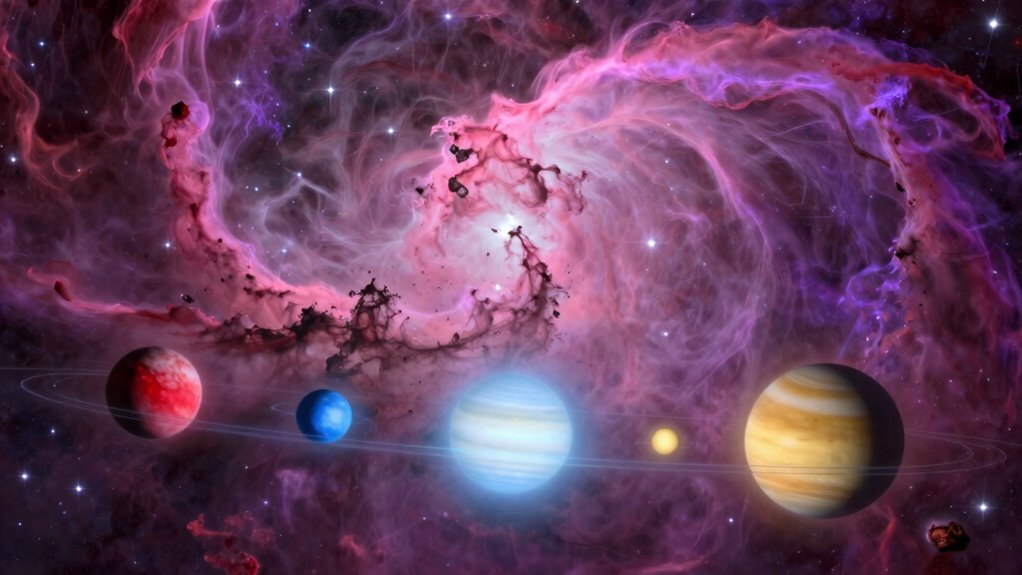

You might wonder how planets got their names, and it all dates back to ancient mythologies. Early cultures named celestial bodies after gods and goddesses, linking their traits to these divine figures. Romans heavily influenced modern names, like Mercury, Venus, Mars, Jupiter, and Saturn. Even today, new planets and objects follow these tradition-inspired naming patterns, keeping cultural stories alive. If you want to uncover more fascinating details, there’s plenty more to discover about this celestial naming journey.

Prime made for students and young adults
- Fast, free delivery for dorm and study essentials
- Prime Video and Amazon Music included
- Member-only deals
Key Takeaways
- Planet names originate from ancient mythologies, often linked to gods and goddesses representing their characteristics.
- Roman conventions heavily influenced modern planetary naming, maintaining myth-based traditions.
- Early astronomers continued using mythological names for newly discovered planets and celestial bodies.
- Naming conventions ensure cultural continuity, linking scientific discoveries with historical narratives.
- Modern names reflect a blend of science and cultural stories, preserving ancient myths in space exploration.
Have you ever wondered how the planets in our solar system got their names? It’s a fascinating story rooted in planetary myths and shaped by long-standing naming conventions. When ancient civilizations looked up at the night sky, they saw celestial bodies that seemed alive with stories and personalities. These stories, or planetary myths, influenced how they named each planet. The Romans, in particular, left a lasting mark with their naming conventions, which we’ve largely inherited today. They named planets after gods and goddesses whose qualities they believed reflected the planets’ characteristics.
Ancient myths and Roman gods shaped the names of our planets, linking celestial bodies to stories of gods, heroes, and divine qualities.
For example, Mercury, the swiftest planet, was named after the Roman messenger god, known for his speed and agility. The Romans saw Mercury’s quick movement across the sky as fitting for their deity. Venus, shining brightly and beautiful, was named after the goddess of love and beauty. Mars, with its reddish hue, was associated with the god of war, symbolizing blood and conflict. Jupiter, the largest planet, was named after the king of gods, embodying authority and power. Saturn was named after the god of agriculture and time, perhaps due to its slow movement through the sky. These names weren’t chosen arbitrarily; they stemmed from planetary myths that connected the celestial bodies to divine stories and qualities.
The naming conventions for planets have evolved over centuries, but many of their original roots remain clear. Early astronomers, especially during the Renaissance, continued to use myth-based names because they carried cultural significance and made it easier to remember and categorize celestial objects. Even as science advanced and we discovered more about these planets, the myth-inspired names stuck around. The tradition persisted partly because of respect for historical practices and partly because these names help us connect with ancient cultures and their stories.
Interestingly, not all planets have myth-based names. When new planets or objects in the solar system were discovered, astronomers often followed the existing naming conventions or chose names from mythology that fit the celestial body’s appearance or nature. This consistency helped maintain a sense of order and tradition in astronomy. Today, planetary myths and naming conventions continue to influence how we think of space, lending a human touch to the vast, cold universe. So, next time you look at Mars or Venus, remember that their names carry stories from ancient mythologies, connecting us to a time when the sky was full of gods, heroes, and endless wonder. Additionally, the cultural significance of these names helps us appreciate the historical context behind astronomy and how societies have long looked to the stars to understand their world.
As an affiliate, we earn on qualifying purchases.
Frequently Asked Questions
Are All Planets Named After Mythological Gods?
No, not all planets are named after mythological gods. In planet naming history, many planets, like Mercury, Venus, Mars, Jupiter, and Saturn, are named after Roman gods, reflecting cultural influences on planet names. However, some planets, such as Uranus and Neptune, are named after Greek mythology or modern discoveries. Cultural influences on planet names vary, showcasing a mix of mythological, historical, and scientific inspirations.
How Do Exoplanets Get Their Names?
You probably know that exoplanets get their names from their host stars, followed by a lowercase letter, starting with “b.” The exoplanet discovery process involves detecting these planets through methods like transit or radial velocity, which can be tricky—leading to naming controversies in astronomy. Notably, with over 5,000 confirmed exoplanets, naming conventions help scientists keep track amid the vast universe.
Why Do Some Planets Have Multiple Names?
You might notice some planets have multiple names due to the planet naming history and cultural influences on planet names. Different cultures and scientific communities historically named planets independently, leading to variations. For example, ancient civilizations gave planets names based on gods or myths, while modern astronomy often uses catalog numbers. These diverse origins contribute to the multiple names, reflecting the rich cultural and historical influences that shape how we identify celestial bodies.
Who Decided the Naming Conventions for Planets?
Imagine a grand tapestry woven with the threads of planet naming history; you see, astronomers and early scholars, acting as the master weavers, decided the conventions. The astronomer naming authority, mainly in the 20th century, set the standards, drawing from mythology, history, and Latin roots. Their goal was consistency, ensuring each celestial body’s name echoed its story, guiding us through the cosmos with a shared language.
Are There Any Planets With Names That Are Not From Mythology?
You’ll find that most planets have names rooted in mythology, reflecting the planet naming history influenced by ancient cultures. However, some planets, like Pluto, are named after mythological figures rather than direct mythological stories. Cultural influences on planet names show a mix of mythological, historical, and sometimes modern inspirations, but nearly all celestial bodies in our solar system are named from mythological origins, with very few exceptions outside that tradition.
As an affiliate, we earn on qualifying purchases.
Conclusion
As you reflect on how planets earned their names, remember they’re like silent storytellers—each symbol carrying echoes of ancient worlds and human curiosity. Their names are keys to revealing mysteries, bridging the cosmos and our history. Just as stars guide sailors through the night, these names illuminate our journey of discovery, reminding you that in the vast universe, every name holds a piece of the story, waiting for you to unravel its secrets.
solar system mythological models
As an affiliate, we earn on qualifying purchases.
As an affiliate, we earn on qualifying purchases.
As an affiliate, we earn on qualifying purchases.
Halloween Picks
halloween
As an affiliate, we earn on qualifying purchases.