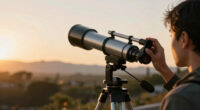
Light pollution filters help you see more stars by blocking artificial lights from sources like sodium and mercury vapor lamps that cause sky glow. They target specific spectral lines, reducing the brightening of the sky and boosting contrast for clearer views through telescopes or binoculars. While they won’t turn a heavily light-polluted sky into a dark one, they considerably improve your observing experience in urban or suburban areas. Keep exploring to discover how to get the most from these helpful tools.
Key Takeaways
- Light pollution filters target specific spectral lines from sodium and mercury lamps to reduce sky glow.
- They enhance contrast and clarity of celestial objects by filtering out artificial light emissions.
- Filters are most effective in urban areas with traditional lighting, less so with broad-spectrum LED lights.
- They improve viewing quality without transforming heavily light-polluted skies into dark skies.
- Proper attachment to eyepieces and understanding local light sources maximize their effectiveness.

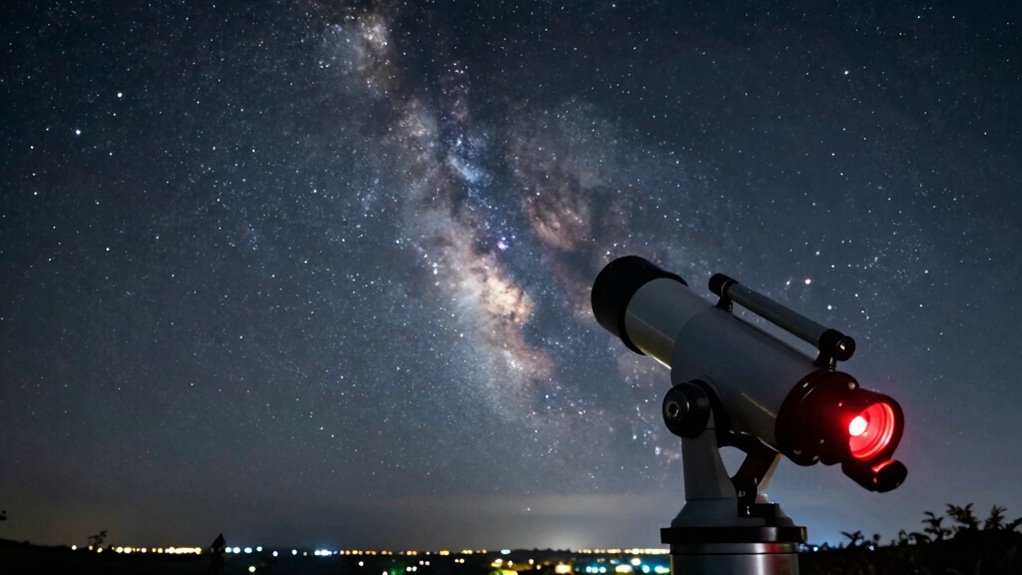
Most light pollution filters target the specific spectral lines emitted by common outdoor lighting, especially sodium and mercury vapor lamps. These sources produce a lot of sky glow that washes out the contrast of celestial objects, making it difficult to see details through your telescope or binoculars. By blocking these particular wavelengths, your filter enhances the contrast and clarity of what you’re viewing, giving you a more detailed and vivid view of the night sky. This is especially helpful if you’re in an urban or suburban environment where full dark sky conditions are hard to find. Instead of traveling miles away from city lights, you can simply attach a filter to your eyepiece and enjoy a much clearer view right from your backyard.
However, it’s important to understand what a light pollution filter can and cannot do. While it dramatically improves sky glow reduction and enhances urban sky visibility, it doesn’t turn a heavily light-polluted sky into a dark sky. If the sky is extremely bright, the filter’s effectiveness diminishes, and you might still struggle to see faint objects. Additionally, these filters work best for bright emission lines and are less effective against broad-spectrum light, like LED lighting, which is becoming more common. Still, for most traditional city lighting, they make a noticeable difference. Understanding the spectral lines that these filters target can help you choose the right one for your observing needs.
Using a light pollution filter is a simple but effective way to maximize your observing sessions. It’s a cost-efficient tool that leverages technology to help you see more of the universe, even when you’re surrounded by artificial lights. You’ll find that your views become sharper, with more contrast, revealing details that would otherwise remain hidden behind the haze of urban sky glow. Ultimately, these filters empower you to enjoy the night sky more fully, regardless of where you are, by cutting through the light pollution and bringing the stars closer to your eyes. Recognizing the types of light sources that contribute most to sky glow can further enhance your filter choices and observing experience.
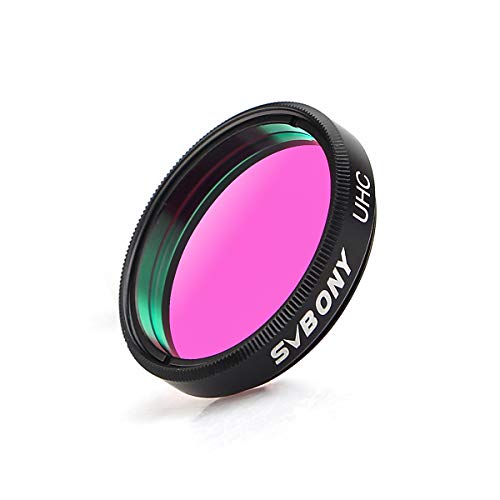
SVBONY Telescope Filter 1.25" UHC Filter Astrophotography to Improve The Image Contrast Reduces Light Pollution (1.25 inch)
UHC filters or light pollution reduction filters are designed to selectively reduce the transmission of certain wavelengths of…
As an affiliate, we earn on qualifying purchases.
As an affiliate, we earn on qualifying purchases.
Frequently Asked Questions
Do Light Pollution Filters Work With Smartphone Cameras?
Yes, light pollution filters can work with smartphone cameras, but their effectiveness depends on sensor enhancement and filter compatibility. These filters reduce unwanted artificial light, improving your night sky images. Make sure the filter fits your phone’s camera lens properly, and look for one designed for smartphone use. While they won’t turn your phone into a professional astrophotography camera, they can greatly enhance your captures of stars and celestial objects.
Can Filters Improve Astrophotography in City Environments?
You can absolutely improve your city astrophotography with filters—sky glow doesn’t stand a chance against their power. These filters considerably reduce light pollution, enhancing contrast and revealing more stars. While they won’t turn your photos into images taken in pristine skies, their effectiveness is impressive, making your shots clearer and more detailed. With the right filter, you’ll capture celestial beauty even amidst the bright city lights.
Are Expensive Filters Always Better Than Cheaper Options?
No, expensive filters aren’t always better than cheaper options. It depends on filter types and your specific needs. High-quality filters often provide better light pollution reduction and durability, but some budget-friendly filters can still improve your astrophotography considerably. You should consider cost effectiveness by balancing quality and price, and test different filters to see which ones enhance your images without overspending. Ultimately, the best filter suits your budget and shooting conditions.
How Do Filters Affect Color Accuracy in Images?
Filters can slightly alter color accuracy by affecting color balance and image saturation, but the impact is usually minimal if you choose quality filters. Some cheaper filters may introduce color casts or reduce saturation, complicating post-processing. However, with proper white balance adjustments and shooting in RAW, you can compensate for these effects, ensuring your images retain true colors while still reducing light pollution.
Can Filters Be Used for Both Visual Observing and Photography?
Yes, you can use filters for both visual observing and photography. Different filter types, like narrowband or broadband, enhance visual clarity by reducing light pollution and improving contrast. For photography, filters help capture clearer, more vivid images by selectively blocking unwanted light. When choosing filters, consider your specific needs, whether for observing or capturing images, to guarantee peak performance in both applications.
SVBONY Telescope Filter 1.25" UHC Filter Astrophotography to Improve The Image Contrast Reduces Light Pollution (1.25 inch)
UHC filters or light pollution reduction filters are designed to selectively reduce the transmission of certain wavelengths of…
As an affiliate, we earn on qualifying purchases.
As an affiliate, we earn on qualifying purchases.
Conclusion
If you’re worried that light pollution filters might limit your view or make your images look unnatural, think again. These filters actually enhance your night sky photography by reducing unwanted glare and improving contrast, giving you clearer, more vibrant images. Don’t let the fear of losing authenticity hold you back—filters help you capture the true beauty of the stars without sacrificing quality. Give them a try, and you’ll see just how much they can elevate your astrophotography experience.

Celticbird Telescope 1.25" Moon & Sky-Glow Filter for Celestron, Orion, Sky-Watcher, Meade, William and Any Brands Models (1.25 inch, Moon)
It is an eyepiece filter for reducing the brightness of the moon and planets and improving contrast.
As an affiliate, we earn on qualifying purchases.
As an affiliate, we earn on qualifying purchases.

WEOOEN 1.25inch Light Pollution Filter for Telescope, Perfect for Viewing Moon and Planets, Metal Cell and Optical Glass
This telescope filter selectively blocks specific wavelengths of light associated with urban sky glow, enhancing the contrast of…
As an affiliate, we earn on qualifying purchases.
As an affiliate, we earn on qualifying purchases.