
📊 Full opportunity report: How The EU's New Driver Monitoring Camera Mandate Affects Every Car Buyer on IdeaNavigator AI — validation score, market gap, and execution plan.

Prime made for students and young adults
- Fast, free delivery for dorm and study essentials
- Prime Video and Amazon Music included
- Member-only deals
TL;DR
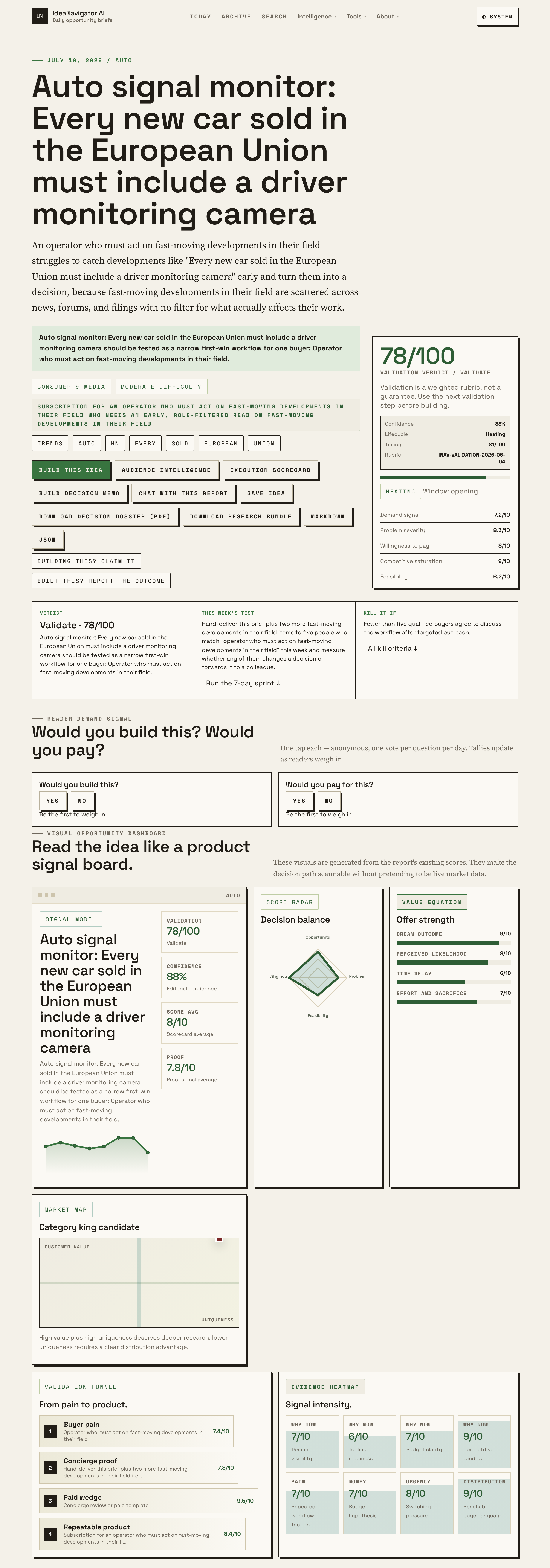
EU General Safety Regulation requirements are driving adoption of driver monitoring technology, including cameras, in new cars sold in the European Union. We examine what the rules actually mandate, the timeline for different vehicle categories, and the open questions around privacy and enforcement.
A claim circulating widely online — that every new car sold in the European Union must include a driver monitoring camera — has put a spotlight on the EU’s General Safety Regulation, a phased mandate that requires advanced driver assistance systems, including driver drowsiness and attention warning, on new vehicles. The claim, surfaced with a high relevance score on Hacker News and tracked by IdeaNavigator AI, is directionally tied to real regulation but oversimplifies what the law technically requires and when it applies. For car buyers across the EU, the practical effect is that monitoring technology is becoming standard equipment — with real consequences for price, privacy, and how cars are serviced.
The regulatory basis is Regulation (EU) 2019/2144, the General Safety Regulation adopted in 2019, which sets out mandatory safety systems for vehicles sold in the EU. From July 2024, all new vehicle types (newly approved models) had to be fitted with systems including intelligent speed assistance, driver drowsiness and attention warning, and event data recorders. From July 2026, these requirements extend to all new vehicles sold, not just newly approved types — this is the date that makes the technology effectively universal for new cars.
The widely shared claim states the requirement specifically as a driver monitoring camera. In practice, most major manufacturers are implementing driver drowsiness and attention warning with in-cabin cameras that track eye movement, head position, and gaze direction, because camera-based systems perform the task more reliably than steering-input-based alternatives. However, the regulation mandates the outcome — detecting driver fatigue and distraction — rather than prescribing a specific sensor. Some vehicles use steering behaviour analysis instead of, or alongside, cameras.
What is confirmed is the regulatory trajectory and the industry response: European market vehicles from brands including Volvo, Mercedes-Benz, BMW, Ford, and others increasingly ship with camera-based monitoring as standard. What is a simplification is the blanket statement that a camera itself is legally required in every car. Buyers should also note that these rules apply to new cars sold in the EU; existing vehicles are not retrofitted, and national rules outside the EU differ — the United Kingdom has retained substantially similar requirements post-Brexit.
What This Means for Car Buyers
For anyone buying a new car in the EU after July 2026, driver monitoring technology will be effectively unavoidable, since it will be a condition of type approval and sale. The immediate buyer-facing consequences are threefold. First, cost: the systems add component and integration expense, which is typically folded into vehicle pricing, though manufacturers have had years to plan for it and prices have not shifted dramatically in isolation. Second, privacy: in-cabin cameras raise questions about what is recorded, where data is stored, and whether it can be accessed by insurers, dealers, or authorities. Event data recorders, which are separately mandated, already capture pre-crash vehicle data. Third, behaviour: drivers may find warnings triggered by looking away from the road, and how systems handle moments like adjusting navigation or checking mirrors varies between manufacturers.
There is also a safety dimension that regulators emphasise: driver distraction and fatigue remain major contributors to serious road collisions in the EU, and the European Commission has framed these systems as part of its Vision Zero road safety strategy. Whether the technology measurably reduces collisions at population scale will take years of accident data to establish, and that evidence is not yet available.
How the Mandate Came Together
The General Safety Regulation was adopted in November 2019 following agreement between the European Parliament and Council, updating a package of vehicle safety rules that had largely stood since 2009. The regulation introduced more than a dozen mandatory systems, of which driver drowsiness and attention warning is one, alongside lane-keeping assistance, advanced emergency braking, and intelligent speed assistance. The EU deliberately built in a two-stage timeline — new type approvals first (July 2024), then all new registrations (July 2026) — to give manufacturers lead time to redesign models.
The current wave of public attention, tracked by IdeaNavigator AI as a fast-moving item among operators monitoring the automotive sector, reflects the fact that the July 2026 all-vehicles deadline is now approaching, meaning mainstream models that previously lacked the technology are being updated or discontinued. Similar mandates are progressing elsewhere, including in China and among US safety agencies evaluating distraction-monitoring rules, though none yet mirror the EU’s universal requirement.
Open Questions on Cameras and Data
Several points remain unclear or contested. The regulation does not explicitly mandate a camera, so which sensor approach a given model uses varies and buyers must check individual specifications. Data handling is the largest open question: the EU’s GDPR applies to any personal data these systems process, but how manufacturers implement local processing versus transmission, retention periods, and access by third parties such as insurers is not standardised and varies by brand. It is also not yet clear how member states will handle enforcement and homologation checks for systems that underperform in real-world conditions, nor whether the July 2026 deadline will apply cleanly to all remaining non-compliant models, as low-volume manufacturers sometimes receive derogations. Finally, no independent evaluation has yet established the real-world collision-reduction effect of camera-based monitoring at fleet scale.
Timeline to Full Coverage in 2026
The key milestone is July 2026, when the drowsiness and attention warning requirement, along with the wider safety package, applies to all new cars sold in the EU regardless of when their type was first approved. Between now and then, buyers will see remaining non-compliant variants phased out and updated models launched with camera-based monitoring as standard. Expect continued debate over data governance, including possible European Data Protection Board guidance on in-cabin camera processing, and manufacturer announcements about how — or whether — monitoring data leaves the vehicle. Buyers who want to know exactly what a specific car records should request the manufacturer’s data privacy notice for the driver assistance systems before purchase.
Key Questions
Does every new car in the EU literally have to have a camera watching the driver?
Not exactly. The regulation requires a driver drowsiness and attention warning system in all new cars sold from July 2026, and most manufacturers use in-cabin cameras to deliver it, but the law mandates the capability, not a specific sensor. Some vehicles use steering-behaviour monitoring instead.
When does this take effect?
Newly approved vehicle types had to comply from July 2024. From July 2026, the requirement applies to all new cars sold in the EU, which is when coverage becomes effectively universal.
Does my existing car need to be retrofitted?
No. The rules apply to new vehicles sold, not to cars already on the road. Existing vehicles can continue to be driven and sold second-hand without the technology.
Who can access the camera data?
This is not fully settled. GDPR applies to any personal data processed, and most manufacturers state that monitoring is processed locally and not stored. However, practices vary by brand, and buyers should review the specific vehicle’s data privacy documentation.
Will these systems make cars more expensive?
The technology adds component and engineering cost that is generally absorbed into overall vehicle pricing. Manufacturers have had a multi-year phase-in period, and no separate, uniform price impact has been documented.
Source: IdeaNavigator AI
Halloween Picks
halloween
As an affiliate, we earn on qualifying purchases.