
📊 Full opportunity report: The GLP-1 Access Index: Availability And Cash Prices In The US on IdeaNavigator AI — validation score, market gap, and execution plan.

Prime made for students and young adults
- Fast, free delivery for dorm and study essentials
- Prime Video and Amazon Music included
- Member-only deals
TL;DR
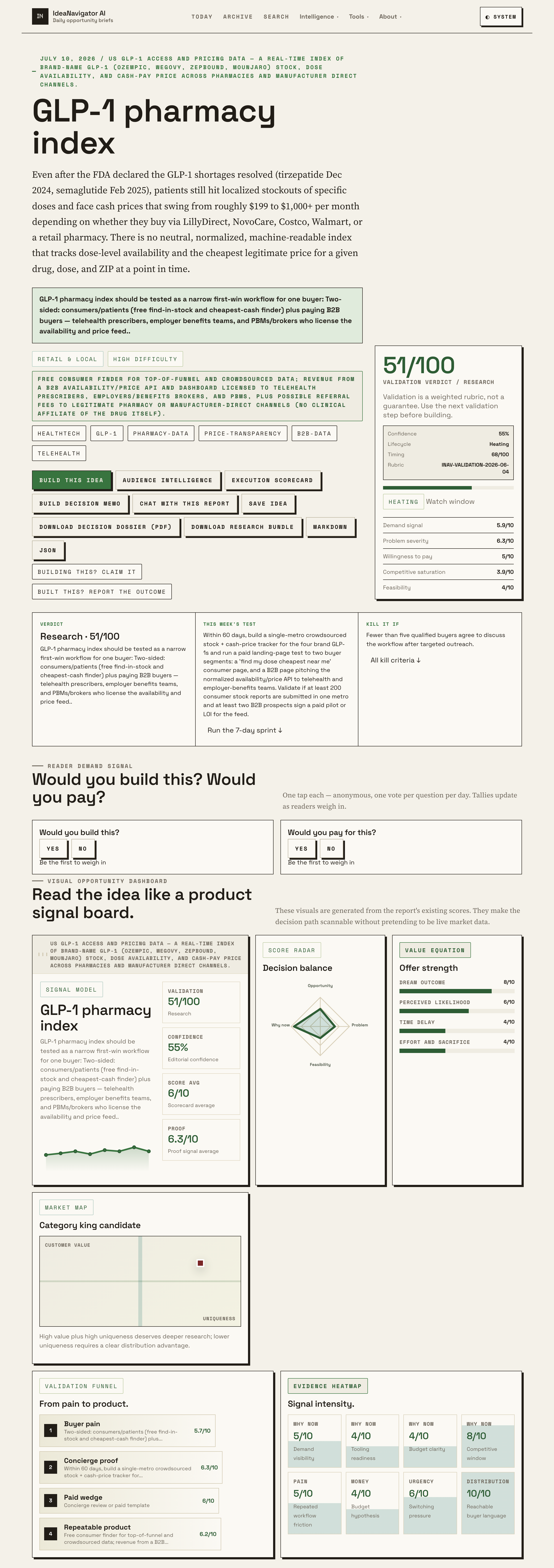
A proposal calls for a U.S. index that lets patients compare cash prices and report dose-level availability for four brand-name GLP-1 drugs. The concept also targets telehealth providers and employer benefits buyers, but it remains an unvalidated business proposal rather than a launched service.
IdeaNavigator AI has proposed a U.S. index to help patients find brand-name GLP-1 drugs in stock and compare cash prices by dose and ZIP code. The proposal responds to localized dose-level stock gaps and widely varying cash prices that can persist even after the drugs were removed from the FDA shortage list; the index has not been reported as launched or independently validated.
The proposed free consumer tool would cover Ozempic, Wegovy, Zepbound and Mounjaro. Patients would search by drug, dose and ZIP code, then compare reported availability and cash prices from manufacturer-direct channels, Costco, Walmart and retail pharmacies. The proposal describes prices ranging from roughly $199 to more than $1,000 per month, depending on the product and channel. It does not provide a dated price survey, a dose-by-dose breakdown or a method for verifying those figures, so they should be read as an approximate range in the proposal rather than a current quote.
Availability data would initially rely on crowdsourced stock reports, paired with normalized public price information. The concept also includes alerts when a particular dose becomes available. A separate paid product would package the availability and price data as an API or dashboard for telehealth prescribers, employer benefits teams, pharmacy benefit managers and brokers.
To test demand, IdeaNavigator AI suggests a 60-day, single-metro pilot. Its proposed targets are at least 200 consumer stock reports and two business prospects signing a paid pilot or letter of intent. Those are proposed validation thresholds, not results: no pilot, customer commitments or consumer submissions are reported.
Why Dose-Level Data Matters
A national shortage designation does not tell a patient whether a particular pharmacy has a particular dose today. A dose- and location-specific view could make that gap easier to identify, while comparable cash prices could help people see how costs differ across legitimate purchasing channels. The proposal addresses a practical search problem: availability and price are spread across multiple providers rather than displayed in one normalized place.
The business case rests on buyers needing the same information at scale. The proposal says employers report GLP-1 drugs account for roughly 20% of pharmacy spending, but it gives no survey, timeframe or definition for that figure. If employers and prescribing services do face substantial costs and fragmented supply information, a reliable feed could help them understand local access and pricing. Whether they would pay for the data remains to be tested.
For patients, accuracy would be central to the tool’s value. A crowdsourced report can become stale quickly, and a listed cash price may depend on eligibility, dose, supply limits or other terms. The proposal does not specify how the service would verify listings or display the time of the last stock check. Without clear freshness and price conditions, comparisons could mislead users making time-sensitive decisions.
Top picks for "acces index availability"
As an affiliate, we earn on qualifying purchases.
From Shortages to Fragmented Listings
The proposal describes a market shift after the FDA determined that the tirzepatide shortage was resolved in December 2024 and the semaglutide shortage in February 2025. Those dates concern the FDA shortage status; they do not establish that every dose became consistently available at every pharmacy. The index concept is aimed at the difference between a national status and what a patient can find locally.
At the same time, manufacturers and retail channels have introduced or promoted cash-pay options, including LillyDirect, NovoCare, Costco and Walmart. The proposal also points to the TrumpRx portal in February 2026 as part of the expanding landscape. It argues that the growth of separate channels has left prices difficult to compare in a single format. No individual channel’s current price or eligibility rules are established here.
The proposal further links the market change to deadlines that affected compounders after the branded-drug shortages were resolved. It does not detail those deadlines or their effects on specific patients or products. Its central claim is narrower: removing a drug from the shortage list did not create a common public index of local dose availability and cash prices.
Questions About Data Quality
No index or pilot results are reported. The proposal does not identify a launch operator, participating pharmacies, data partnerships or a schedule for updating listings. It also does not explain whether pharmacies would confirm stock directly, how reports would be checked, or what safeguards would prevent outdated or duplicate submissions from appearing current.
The proposed price range lacks a dated methodology and detailed comparison criteria. It remains unclear which doses, quantities, discounts or eligibility conditions are included in the cited monthly figures. The proposal also gives no evidence that employers spend roughly 20% of pharmacy budgets on GLP-1 drugs, and it does not identify the employers or reporting period behind that estimate.
Commercial viability is also unproven. The suggestion to sell data to telehealth providers and benefits buyers is a business hypothesis; no buyer commitments or paid pilots are cited. The proposal mentions possible referral fees from pharmacies or manufacturer-direct channels, but does not describe how those relationships would be disclosed or kept separate from rankings.
The Proposed 60-Day Pilot
The next step proposed is a single-metro test lasting 60 days, combining consumer stock reports and cash-price listings for the four named brand drugs. A consumer page would test searches for the cheapest nearby dose, while a separate business page would pitch the data feed to telehealth and employer-benefits buyers.
The proposal sets two measures for deciding whether to proceed: 200 or more consumer stock reports in the metro and at least two prospects signing a paid pilot or letter of intent. No start date or results are given. Until such a test is run and the data’s accuracy is demonstrated, the index remains a proposed response to fragmented access information.
Key Questions
Has the GLP-1 Access Index launched?
No launch is reported. The index is presented as a proposal with a suggested 60-day pilot.
Which drugs would the proposed index cover?
The proposed consumer tool would track Ozempic, Wegovy, Zepbound and Mounjaro by drug, dose and ZIP code.
Does removal from the FDA shortage list mean every dose is available?
No. The proposal says local stock gaps can remain after shortage status changes. It does not provide pharmacy-level evidence or current availability figures.
How would the index make money?
The proposal suggests licensing an availability and price API or dashboard to telehealth providers, employers, benefits brokers and pharmacy benefit managers. It also mentions possible referral fees, but reports no paying customers.
What would count as a successful pilot?
The suggested targets are at least 200 consumer stock reports in one metro and at least two business prospects signing a paid pilot or letter of intent within 60 days.
Source: IdeaNavigator AI
Halloween Picks
halloween
As an affiliate, we earn on qualifying purchases.