
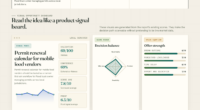
📊 Full opportunity report: The $9 Billion Signature Tax: How DocuSign’s Business Model Survives on One Assumption on ThorstenMeyerAI.com — validation score, market gap, and execution plan.

Prime made for students and young adults
- Fast, free delivery for dorm and study essentials
- Prime Video and Amazon Music included
- Member-only deals
TL;DR
A self-hosted, open source digital signature tool called DocuSeal has emerged as a free alternative to DocuSign, which is valued at $9 billion. This development questions the sustainability of DocuSign’s high-margin business model.
In 2026, a new open source digital signature platform called DocuSeal has demonstrated that it can be deployed in 30 minutes at a cost of approximately $5, directly challenging the business model of DocuSign, a company valued at $9 billion.
DocuSeal, built in 2023 by a Ruby developer, is an open source project licensed under AGPL-3.0 that replicates core features of proprietary digital signature services. It has amassed over 11,800 GitHub stars and is maintained through a combination of community support and a commercial tier. The platform supports multiple field types, API integrations, compliance with major regulations like ESIGN, UETA, and GDPR, and can be deployed on inexpensive VPS providers such as Hetzner or DigitalOcean for around €45 annually.
Contrasting with DocuSign, which charges enterprise clients between $24,000 and $156,000 annually depending on team size, DocuSeal offers a near-zero-cost alternative for most use cases. For example, a 50-person team could save over 99% annually—up to $38,937—by switching from DocuSign to self-hosted DocuSeal. The process involves five simple steps, including VPS provisioning, domain pointing, Docker deployment, and server lockdown, taking roughly 28 minutes according to the developer’s guide.
While DocuSeal lacks certain features like federal government contract compliance and some EU notarial processes, it provides functionally equivalent capabilities for everyday business documents, raising questions about the long-term viability of high-margin SaaS signature services.
The $9 billion signature tax.
DocuSign’s business model survives on one assumption.
A 50-person team pays $24,000 to $39,000 per year to put names on PDFs. Not because the tech is hard. The cryptographic signature math has been solved for thirty years. The legal frameworks are a quarter-century old. There is no moat. There is one assumption holding it together: that you will not bother to look at the alternative.
You are rationing digital signatures in 2026.
Stop and look at that sentence again. You are rationing — keeping a count, watching the meter, deciding whether this contract is worth using one of your remaining envelopes — a function whose actual cost to perform is somewhere between zero and one cent per signature. You are doing this in 2026, on a function that has been a commodity since 1999.
Same job. Different bill. Four team sizes.
Pure SaaS-vs-VPS comparison. As your team grows, the absolute savings grow linearly while relative savings asymptote at ~99.9%. The DocuSign business model assumes per-seat pricing on a function that has no per-seat marginal cost.
Five commands. Production-grade signature platform.
PostgreSQL 18 + DocuSeal app + Caddy reverse proxy with automatic Let’s Encrypt SSL. Verified against the official docusealco/docuseal repository at v2.2.9. 28 minutes if everything goes smoothly; 45 if DNS is slow.
Production deploy · $5/month VPS → live signature platform.
ssh root@IP
5 min
sign.you.com → IP · Cloudflare proxy OFF
5 min
curl -fsSL get.docker.com | sh · entire install
3 min
docker-compose.yml · set .env · docker compose up -d
10 min
DocuSign is not the only $9B company built on this assumption.
Same dynamic. Per-seat pricing on a function with near-zero marginal cost. Open-source alternative is mature, properly licensed, and runs on a $5 VPS. A typical 50-person company running 5–8 of these is paying $40K–$120K/year that’s structurally replaceable.
The first time you do this, you save $30,000. The savings are the surface. The actual outcome is that you stop trusting the SaaS price tag entirely.
How to Replace DocuSign in 30 Minutes for $5 a Month
The complete DocuSeal self-host guide for 2026. Every command tested. Every cost verified. Every workflow ready to run today.
- 30-min deploy walkthrough · v2.2.9
- 4 hosting options ranked by cost
- Production docker-compose.yml
- 13 field types · DocuSign mapping
- API patterns · CRM, billing, contracts
- Cost comparison · 1, 10, 50, 200 sizes
- Compliance · ESIGN, eIDAS, GDPR, HIPAA
- The 12-category replacement framework
- 5 questions before any SaaS swap
- Honest maintenance accounting
Implications for SaaS Digital Signature Market
The emergence of DocuSeal suggests that the core technology behind digital signatures is effectively a commodity, undermining the high margins of companies like DocuSign. This could accelerate a shift towards open source, self-hosted solutions, especially among cost-conscious enterprises, potentially disrupting a market valued at over $9 billion. It also highlights the risk for SaaS providers relying on proprietary, non-differentiated services that can be easily replicated and hosted independently.
self-hosted digital signature software
As an affiliate, we earn on qualifying purchases.
As an affiliate, we earn on qualifying purchases.
Industry Background and Market Dynamics
Since 1999, digital signatures have been supported by open standards and legal frameworks such as ESIGN, UETA, and eIDAS, which ensure their legal validity across jurisdictions. Despite this, the industry has maintained high pricing, with companies like DocuSign charging thousands annually per team, based on the assumption that most users will not pursue low-cost or open source alternatives. The recent rise of DocuSeal, an open source project with rapid deployment and minimal cost, exposes this assumption as flawed. Historically, digital signatures have been a commodity, but SaaS providers have relied on network effects, proprietary integrations, and brand trust to sustain premium pricing.
“Our goal was to create a fully functional, open source alternative that anyone can deploy in under 30 minutes for about $5. The response shows there’s a real demand for cost-effective solutions.”
— DocuSeal developer
open source digital signature tool
As an affiliate, we earn on qualifying purchases.
As an affiliate, we earn on qualifying purchases.
Unanswered Questions About Market Impact
It remains unclear how quickly and broadly organizations will adopt open source self-hosted signatures over proprietary SaaS solutions. Additionally, the extent to which regulatory compliance and enterprise features will be integrated into projects like DocuSeal is still evolving. The long-term impact on DocuSign’s valuation and the overall industry remains uncertain, as legal and contractual dependencies may limit immediate switching for some clients.
As an affiliate, we earn on qualifying purchases.
Next Steps for Industry Adoption and Development
Expect continued growth of open source digital signature platforms like DocuSeal, with potential for more enterprise features and stricter compliance integration. Large organizations may test and gradually adopt self-hosted solutions, especially as awareness of the commodity nature of the core technology increases. Meanwhile, SaaS providers might innovate on ecosystem features, security, and integrations to maintain their market share. Regulatory bodies and large clients could also influence adoption patterns through contractual and compliance requirements.
As an affiliate, we earn on qualifying purchases.
Key Questions
Can DocuSeal fully replace DocuSign for enterprise use?
While DocuSeal offers many comparable features and can be deployed quickly at minimal cost, it currently lacks some enterprise-specific compliance and integration features required for certain government or highly regulated sectors. Adoption for full enterprise use may depend on future development and regulatory acceptance.
The potential exists, especially among cost-sensitive organizations and smaller businesses. However, large enterprises with complex compliance needs and existing contracts may continue using proprietary solutions in the near term. The market could shift gradually as open source solutions mature.
What legal or regulatory risks are associated with self-hosted signatures?
Self-hosted solutions like DocuSeal meet major compliance standards such as ESIGN, UETA, and GDPR, but organizations must ensure proper implementation and security. Regulatory acceptance of open source solutions may vary by jurisdiction, and some sectors may require specific certifications or integrations that are not yet available.
How does the cost of deploying DocuSeal compare to ongoing SaaS fees?
Deploying DocuSeal costs approximately €45 annually on a VPS, plus minimal operational costs, representing a dramatic reduction compared to SaaS fees, which can reach tens of thousands of dollars per year for similar usage levels.
Will this open source alternative threaten the future of SaaS digital signature providers?
It introduces a significant competitive threat, especially if organizations recognize the commodity nature of the core technology. SaaS providers may need to innovate on security, compliance, and ecosystem features to maintain their market positions.
Source: ThorstenMeyerAI.com
Halloween Picks
halloween
As an affiliate, we earn on qualifying purchases.