🔍 Read the full analysis: What IBM’s CEO Says About Bringing AI On-Premises on ThorstenMeyerAI.com

Prime made for students and young adults
- Fast, free delivery for dorm and study essentials
- Prime Video and Amazon Music included
- Member-only deals
TL;DR
IBM CEO Arvind Krishna argued on the company’s October 21 earnings call that open-weight AI models can deliver about 90% of frontier-model performance at a fraction of the token cost, and that large enterprises can begin with two or three racks. An independent benchmark puts the leading downloadable model at 80% of the current proprietary leader; the economics of running models on-premises also depend on utilization, staffing and infrastructure.
IBM CEO Arvind Krishna used the company’s October 21 earnings call to make the case that enterprises can run open-weight AI models on their own infrastructure at a fraction of the token cost of leading closed models. He said such models are “90% as effective” at roughly 10% to 25% of the cost, but an independent benchmark cited in the source material puts the best currently downloadable model at 80% of the proprietary leader.
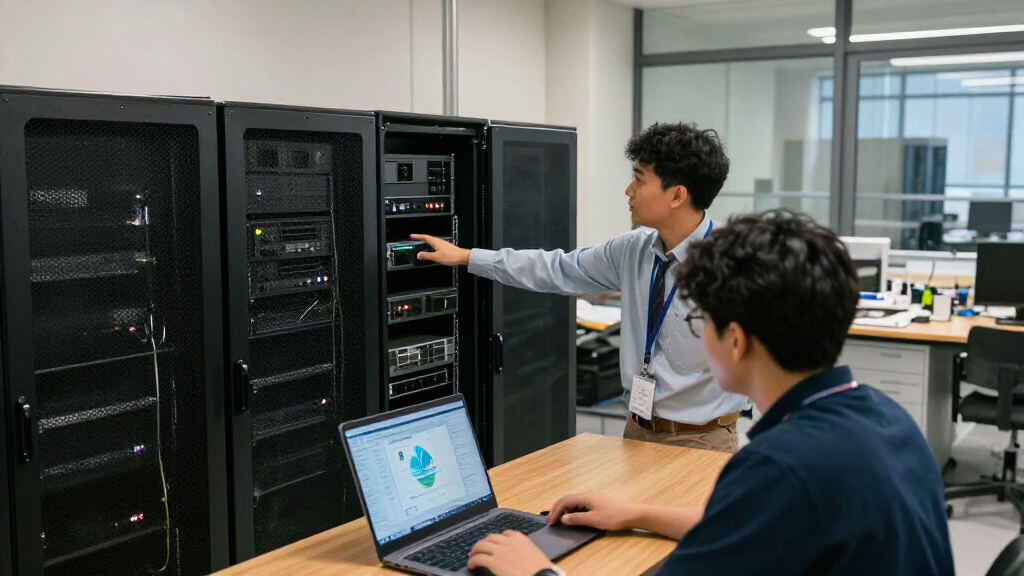
In the call’s question-and-answer session, Krishna said a large enterprise could start with “two or three racks” and use open-weight models for routine tasks such as summarizing email, reviewing contracts and answering customer calls. He described the economics as a trade-off: pay much less for a model that is good enough for many tasks, rather than use the most capable model for every request. These figures and examples are Krishna’s argument, not a guarantee that every organization will see the same savings or results.
Krishna also framed on-premises and private-cloud deployment as a way to retain control of data and logs. He said banks and trading firms want AI systems run “in a way that is sovereign,” and that open weights provide permission and intellectual-property rights to run models on enterprise infrastructure or private clouds. The precise rights depend on each model’s licence; the label “open-weight” alone does not establish that every use is permitted.
Artificial Analysis’ Intelligence Index, as read October 26, gives MiMo-V2.6-Pro a score of 46.3, compared with 57.6 for proprietary Claude Opus 5.5. That makes the downloadable model about 80% of the leader on this index. The source says Kimi K3.1 Pro scores 55.1, or 96% of the leader, but its weights had only been promised by November 4. Until they are released, it cannot be counted as a downloadable model.
IBM's 90% claim, checked
Open weights reach 80% of the leader
Krishna says open-weight models are "90% as effective". On an independent index the best model you can download today reaches 80% of the best closed one, up from about half two years ago.
Best open model as a share of the best closed
Artificial Analysis Intelligence Index, current version, best downloadable vs. best proprietary model at each date.
What Krishna said
Illustrations from the earnings call, not a named benchmark.
- Late 2024"70" vs. "20 or 30"Krishna, Q3 call, 21 Oct · no named benchmark
- Late 2025"70 to 50"Krishna, Q3 call, 21 Oct · no named benchmark
- Now"90% as effective"Krishna, Q3 call, 21 Oct · no named benchmark
Top downloadable models today
Intelligence Index score and licence type. Read the licence before the leaderboard.
| Model | Index | Licence |
|---|---|---|
| MiMo-V2.6-Pro Xiaomi | 46.3 | MIT |
| DeepSeek V4.1 Flash 1017 DeepSeek | 45.1 | MIT |
| GLM-5.3 Z AI | 44.8 | own commercial licence |
| Step 5 Preview StepFun | 43.7 | own commercial licence |
| Muse Spark Open Meta | 38.9 | licence with conditions |
In points the gap did not shrink: 7.5 points at the end of 2024, 11.3 today. Closed models moved too.
Sources: Artificial Analysis, Intelligence Index v4.3.2 (read 26 Oct 2026), IBM Q3 2026 earnings call transcript (21 Oct 2026), Artificial Analysis on Kimi K3.1 Pro (23 Oct 2026).
Powered by Thorsten Meyer AI
The Cost of Running AI In-House
The choice matters because token price is only one part of the bill. Buying hardware can lower costs when it is kept busy, but idle capacity, electricity, cooling, networking and specialist staff can weaken the case. The source compares an eight-GPU H200 server listed from $172,643 with renting the same GPU class on AWS for $63.30 an hour. Its estimate says purchase cost is recovered in about 114 days at full utilization, but about 15 months at 25% utilization, before operating expenses.
That gap makes workload volume and utilization central to any on-premises business case. A company with steady, high-volume inference and strict data-control needs may value ownership differently from one with irregular demand or limited infrastructure expertise. Krishna acknowledged the skills issue himself, asking where enterprises would find “kernel engineers” and people to manage networking. He said that capability gap remains for all but the most sophisticated enterprises, while using frontier cloud models is “the easy answer.”
IBM has a commercial interest in this direction. It sells infrastructure and expects on-premises AI demand to support sales of its Spyre accelerator cards. The source also reports that IBM’s mainframe revenue fell 20% in the quarter, 18 months into the z17 cycle, citing The Register. That business interest does not invalidate Krishna’s argument, but it is relevant when weighing the company’s cost and performance claims.
Popular right now

TCL 85 Designer Series QD-Mini LED TV (Model 85A400U) with Google Smart TV

Shark Navigator Robot Vacuum with Self-Empty Base, Dark Grey (RV2120AE)

Vitamix Propel Series 750 Professional-Grade Blender, 4 Programs, Black
As an affiliate, we earn on qualifying purchases.
Benchmark Gains and Licensing Limits
Krishna illustrated the narrowing performance gap by describing a broad comparison in which open models moved from scores of 20 or 30 against a leading model at 70 in late 2024, to 50 against 70 in late 2025. Those were illustrative figures, not results from a named benchmark. The source instead uses Artificial Analysis’ index, which applies the same ten evaluations across models and identifies whether weights are downloadable.
On that index, the open-to-proprietary score ratio rose from 51% at the end of 2024 to 74% at the end of 2025, 68% at the end of June 2026 and 80% on October 26, 2026. The source’s comparison also shows the absolute point gap widening from 7.5 points at the end of 2024 to 11.3 points in October 2026. The ratio improved because the models’ scores changed at different rates; the gap did not shrink in raw points.
Price comparisons also depend on how a model is accessed. The source says hosted DeepSeek V4.1 Flash 1017, whose weights are MIT-licensed, costs 3% to 6% of Claude Opus 5.5’s list price. It also cites closed model GPT-6 Luna at $0.10 per million input tokens and $0.50 per million output tokens. These examples show that a closed model can also be inexpensive, and that a low hosted token price does not by itself establish the savings from buying and operating hardware.
Costs, Scores and Weights Still Shift
The benchmark comparison is a snapshot from October 26, 2026, and its scores do not establish how models will perform on a particular company’s tasks. Krishna’s “90%” figure is not tied to a named evaluation in the account, while the independent index puts the leading downloadable model at 80% of the proprietary leader. Results may differ across tasks, model versions and evaluation methods.
The cost figures are also not a complete ownership calculation. The hardware payback estimates exclude staff, cooling and networking, and depend heavily on utilization. The source does not provide enough information to calculate a typical enterprise’s total cost of ownership or to verify IBM’s separate claim that its llm-d project runs large models at five to ten times lower cost.
Kimi K3.1 Pro’s weights had not shipped as of the source’s October 26 check, and the source says no licence had been published. Its score therefore does not yet show that enterprises can legally and practically download and deploy it. Model licences vary, and some impose conditions; organizations must check the relevant terms rather than infer usage rights from a benchmark listing.
Watch for Weights and Deployment Data
The next concrete test for the near-90% comparison is whether Kimi K3.1 Pro’s promised weights arrive by November 4, and under what licence. More broadly, the benchmark will change as model developers release new versions, so the October 26 figures should be treated as a dated snapshot rather than a lasting ranking.
For IBM, the practical test is whether enterprises move from evaluating open-weight models to running them at sustained utilization on IBM or other infrastructure. Evidence on deployment costs, workload performance and operational requirements would help establish whether the savings Krishna described hold beyond token-price comparisons. The source does not give a timeline for such customer results.
Key Questions
What did IBM CEO Arvind Krishna say about on-premises AI?
Krishna said open-weight models can cost about 10% to 25% as much per token as frontier models while being “90% as effective.” He argued that enterprises can run them on their own infrastructure or private clouds, and said a large organization could start with two or three racks.
Does an independent benchmark confirm the 90% figure?
Not exactly. On the Artificial Analysis Intelligence Index read October 26, 2026, the highest-scoring downloadable model cited was at 80% of the leading proprietary model. Kimi K3.1 Pro was at 96% on the index, but its weights had not yet been released.
Does running AI on-premises always cost less?
No. The economics depend on utilization and operating costs, including staff, cooling and networking. The source’s hardware estimate reaches payback much faster at full utilization than at 25%, and does not include those additional expenses.
What should a company check before using an open-weight model?
Companies should review the model’s licence and usage conditions, test performance on their own workloads, and estimate infrastructure and staffing costs. A downloadable model’s benchmark score alone does not establish its rights, suitability or total cost.
Source: ThorstenMeyerAI.com