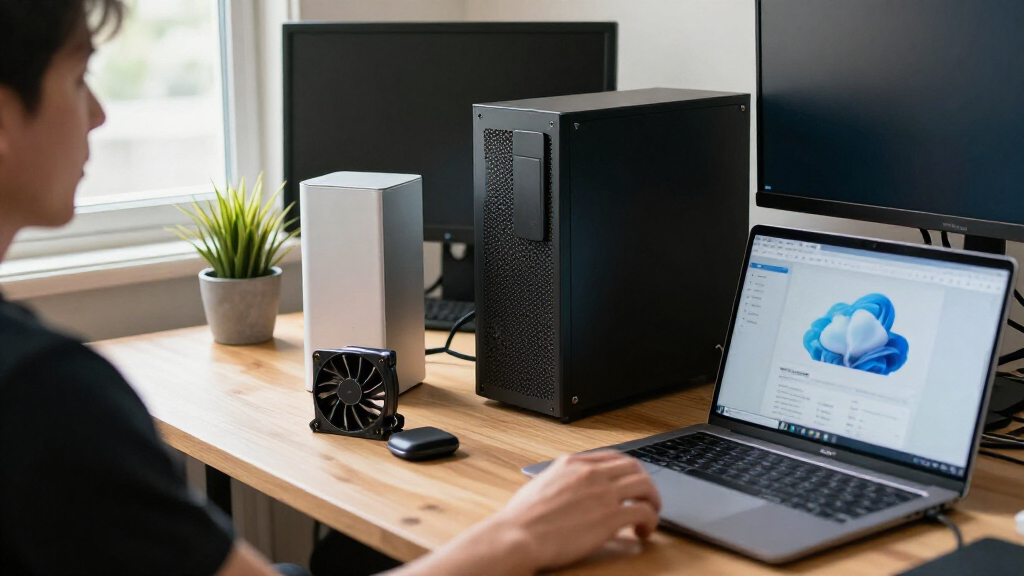

🔍 Read the full analysis: Which Setup Suits Your AI Project: Local Mac, GPU PC Or Cloud API? on ThorstenMeyerAI.com

Prime made for students and young adults
- Fast, free delivery for dorm and study essentials
- Prime Video and Amazon Music included
- Member-only deals
TL;DR
A November 19 comparison of Apple and Nvidia specifications and AI-tool documentation finds no single best setup for every AI project. Macs can suit always-on agents and local models that fit their unified memory; Nvidia PCs offer broader CUDA support, while cloud APIs remain necessary for leading closed models.
A comparison published by ThorstenMeyerAI.com on November 19 says the best setup for an AI project depends on whether it needs an always-on agent, local model inference, training or access to closed models. Its review of Apple and Nvidia specifications and AI-tool documentation points to Macs for some low-power and large-memory local workloads, Nvidia PCs for CUDA-oriented software, and cloud APIs for models that cannot be downloaded.
The article’s central distinction is between running an agent and running its model. If an agent sends requests to a cloud model, the local computer mainly handles the agent loop, files and tools; it does not need to hold the model’s weights. Apple lists the base Mac mini’s idle power draw as 4 watts, though that figure describes idle operation, not power use under a sustained AI workload.
For local inference, the article emphasizes memory capacity. Apple lists Mac mini configurations up to 64 GB of unified memory, while Mac Studio configurations reach 128 GB with M5 Max or 512 GB with M5 Ultra. Nvidia’s GeForce RTX 5090 has 32 GB of on-card memory. The article uses a rough estimate of half a gigabyte of weights per billion parameters at 4-bit precision: on that basis, a 70-billion-parameter model needs about 35 GB for weights alone, before overhead and context. Actual memory needs vary by model and workload.
Software support is another dividing line. The article says common local tools, including MLX, Ollama, LM Studio and llama.cpp, support Apple hardware, and MLX tools document LoRA and QLoRA fine-tuning. Nvidia remains better served by software built around CUDA: the article notes that vLLM ships precompiled CUDA binaries, while its Apple-silicon option is a community-maintained plugin. These are documentation-based comparisons, not results from a shared performance test.
Decision guide · local AI hardware
Which machine fits which AI job?
Five common jobs, one after another, with the machine that fits each best on today’s specifications.
First question: does the model run in the cloud, or on your own machine? If it runs in the cloud, the box only keeps the agent going.
The job
- 1An agent that calls cloud models, running around the clock
→ Mac mini - 2A private assistant with a small open model
→ Mac mini - 3Huge open models with hundreds of billions of parameters
→ Mac Studio - 4Tools built for Nvidia’s CUDA, training, serving many users
→ GPU PC - 5The strongest models and the hardest tasks
→ Cloud API
The machine
Mac mini
up to 64 GB · 4 W at idle
Mac Studio
up to 512 GB · 385 W at most
GPU PC
32 GB on the card · 575 W card
Cloud API
strongest models · per-token bills
Sources: Apple, Mac mini and Mac Studio technical specifications and power pages; Nvidia, GeForce RTX 5090 specifications; all retrieved November 19, 2026. Matching of jobs to machines: our reading, not a buying recommendation.
Graphic: Powered by Thorsten Meyer AI
Matching Hardware to AI Workloads
The comparison matters because buying a machine for AI involves trade-offs between memory, software compatibility, power and cost, rather than a single universal measure of performance. A computer that can keep an agent running cheaply may not be able to load a large model locally, while a system with enough memory may not support every serving tool as directly as an Nvidia setup.
For developers and small teams, the distinction can shape both upfront spending and ongoing operations. Apple’s published prices on November 19 started at $2,499 for an M5 Max Mac Studio and $5,499 for an M5 Ultra configuration. Nvidia did not list a price for the RTX 5090 on its product page, and a full PC’s cost depends on its other components. Cloud APIs avoid buying high-end local hardware but require use of a provider’s service and models; the article does not compare API costs.
The practical takeaway is to start with the workload: whether the model must run locally, how much memory it needs, which tools it must use and whether the project requires training or serving requests to multiple users. The article itself describes its decision matrix as an interpretation of specifications and documentation, not a buying recommendation or a substitute for testing a specific project.
Popular right now

Sony WH-1000XM6 Wireless Noise-Cancelling Headphones – Midnight Blue

Dyson V9 Motorbar Cordless Vacuum

Bose QuietComfort Wireless Noise-Cancelling Headphones, Twilight Blue
As an affiliate, we earn on qualifying purchases.
What the Specifications Show
The comparison follows an earlier article on what Mac mini configurations with 16 to 64 GB of memory can run. It broadens the discussion to Mac Studio systems, Nvidia graphics PCs and cloud services, using product specifications and software documentation checked on November 19, 2026. Those sources establish published capabilities, but they do not provide a controlled, head-to-head benchmark of the machines.
Apple’s unified-memory design lets its CPU and GPU access the same memory pool, according to Apple’s MLX documentation. Nvidia’s RTX 5090 instead has a 32 GB graphics-memory ceiling on the card; the article cites Ollama documentation showing that a model can be split between GPU and system memory when it does not fit entirely on the GPU. Splitting memory may make loading possible, but the article supplies no direct speed comparison for that arrangement.
Power figures also need to be read in context. Apple lists the M5 Ultra Mac Studio’s maximum system draw at 385 watts, while Nvidia rates the RTX 5090 card at 575 watts and recommends a 1,000-watt power supply for the PC system. Those figures refer to different scopes—a complete Mac versus a graphics card and a recommended PC supply—so they should not be treated as a like-for-like consumption test.
“The CPU and GPU have direct access to the same memory pool.”
— Apple, in MLX documentation
Performance Depends on the Model
The article does not establish which machine is faster across specific models or tasks. Apple publishes memory-bandwidth figures for its Mac Studio chips, but the comparison identifies no shared token-speed benchmark against the RTX 5090. Nvidia’s cited product page gives a 512-bit memory interface but, according to the article, no bandwidth figure for a direct comparison.
Actual results will depend on the model, quantization, context length, software and whether the model fits in fast memory. The article’s parameter-to-memory calculation is a rule of thumb for weights, not a full estimate of the memory required to run a model. It also does not compare cloud API pricing, latency, privacy terms or service availability, and it does not test the named systems under the same conditions.
Claims about product capabilities are attributed to Apple, Nvidia or tool documentation; they are not independent findings. The source material also notes that clustering Macs is possible but involves setup requirements, including Thunderbolt 5 links between machines and a macOS Recovery setting. How much that approach benefits a particular project is not established here.
Test the Intended Workload
The next step for anyone choosing hardware is to check the memory needs and software requirements of the model and tools they intend to use, then test that workload on the proposed setup. The article does not announce a product launch or a new benchmark, and it gives no timetable for further testing.
For a local deployment, that means checking whether the model and its working context fit in available memory, whether the serving or fine-tuning software supports the machine, and what performance looks like in practice. For a cloud-based project, the remaining checks include provider pricing, latency, data-handling terms and access to the required model. Those factors are outside the comparison’s published specification review.
Key Questions
Is a Mac mini enough to run an AI agent?
It can be enough when the agent calls a cloud model and the Mac runs the loop, files and tools. The source says the required computer depends on the workload; a Mac mini’s memory ceiling matters if you want to run the model locally.
Which setup is best for running large models locally?
There is no universal winner in the comparison. A Mac Studio can offer more unified memory than an RTX 5090’s 32 GB of on-card memory, while a GPU PC has broader CUDA support. Model fit and software compatibility both matter.
Can a Mac be used to fine-tune models?
According to the cited documentation, Apple’s MLX tools support LoRA and QLoRA, and PyTorch’s Mac backend supports GPU training. The article cautions that larger fine-tunes need substantial memory and that not every operation is supported on the Mac GPU.
Does the comparison prove that an Nvidia PC is faster?
No. It reviews specifications and tool documentation but reports no direct, controlled token-speed comparison between an Nvidia PC and a Mac. Performance will depend on the model, configuration and software.
When is a cloud API the better fit?
A cloud API is needed to access leading closed models that cannot be downloaded, according to the article. It can also let a smaller local machine run an agent without holding model weights, though the comparison does not assess API cost or data terms.
Source: ThorstenMeyerAI.com