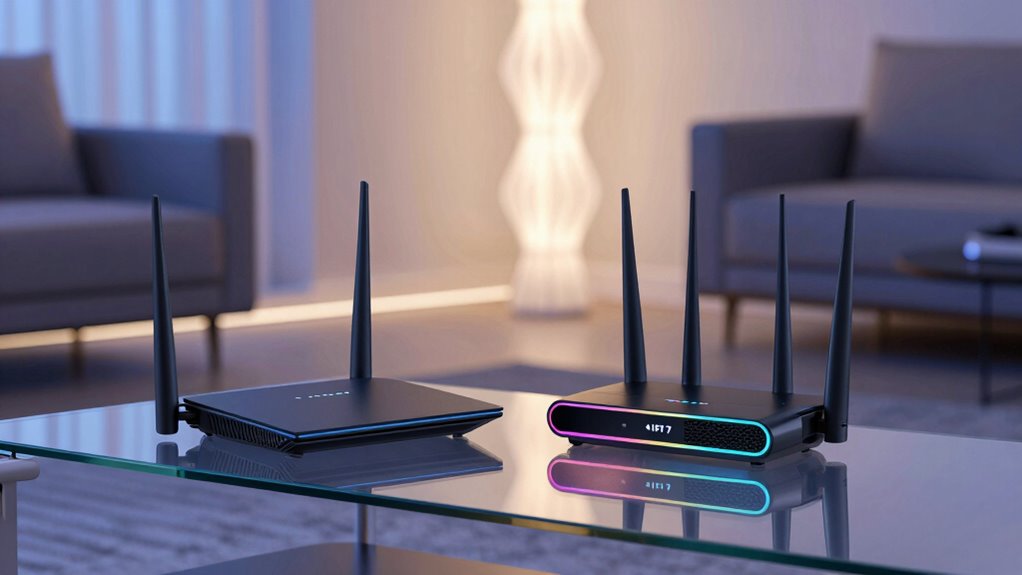

If you’re considering an upgrade, focus on Wi-Fi 6E first, as it offers immediate benefits like less interference and improved stability in crowded homes. It expands your network’s capacity and handles multiple devices better. Wi-Fi 7 promises faster speeds and advanced features but is still in development and less compatible with current gadgets. Knowing these differences helps you choose what fits your needs now and what to plan for next—more details await.

Prime made for students and young adults
- Fast, free delivery for dorm and study essentials
- Prime Video and Amazon Music included
- Member-only deals
Key Takeaways
- Wi-Fi 6E offers immediate improvements in interference reduction and signal stability for current devices and smart home setups.
- Wi-Fi 7 promises higher speeds (over 30 Gbps) and multi-band operation, ideal for future-proofing high-bandwidth needs.
- Compatibility with existing devices favors Wi-Fi 6E as a practical upgrade now, while Wi-Fi 7 benefits depend on future device support.
- Wi-Fi 6E reduces congestion in crowded environments, providing more reliable connections today.
- Wi-Fi 7 is still in development; home users should consider current priorities—stability now versus cutting-edge speed later.
Wi-Fi 6E, on the other hand, introduces the 6 GHz band, reducing interference and congestion that often plague crowded networks. This means your devices, from smart thermostats to security cameras, can operate with less lag and fewer disruptions. Signal stability becomes more reliable, especially in homes with multiple connected devices, because the additional spectrum helps prevent bottlenecks. If your home has many gadgets that need to communicate seamlessly, Wi-Fi 6E’s expanded bandwidth can markedly improve your experience. Additionally, Wi-Fi 6E’s spectrum expansion provides a significant advantage in densely populated areas where network interference is common. Incorporating network congestion reduction strategies can further enhance your home’s wireless performance. Moreover, because Wi-Fi 6E operates in the newly available 6 GHz band, it offers a future-proof solution as more devices adopt this standard.
Wi-Fi 7, on the other hand, promises even more. It builds on Wi-Fi 6E’s foundation but pushes the envelope with potential speeds exceeding 30 Gbps and enhanced features like multi-link operation, which allows devices to connect across multiple bands simultaneously. For you, this means reduced latency and smoother streaming, gaming, and video conferencing. Plus, Wi-Fi 7 aims to optimize smart home integration further. As smart devices become more sophisticated, requiring consistent, high-quality connections, Wi-Fi 7’s advanced technology ensures your smart home ecosystem remains responsive and dependable. You’ll notice fewer connection drops, better handling of high-bandwidth tasks, and more efficient management of multiple devices.
However, it’s worth considering that Wi-Fi 7 is still in development and not yet widely available. Even if you’re enthusiastic to upgrade, your current devices may not support the new standard right away. In contrast, Wi-Fi 6E is already available in many routers and devices, offering immediate improvements in signal stability and smart home integration. If your priority is a more stable network with fewer interruptions, especially in a busy household with numerous smart gadgets, Wi-Fi 6E provides a practical upgrade now. For those seeking cutting-edge speeds and future-proofing, waiting for Wi-Fi 7 might be worthwhile, but keep in mind that the benefits will only materialize as compatible devices hit the market. Ultimately, your choice depends on your current setup and your desire for enhanced performance in your connected home.
As an affiliate, we earn on qualifying purchases.
Frequently Asked Questions
How Does Wi-Fi 7 Impact Smart Home Device Compatibility?
Wi-Fi 7 enhances device integration by supporting improved protocol compatibility, making it easier for your smart home devices to connect seamlessly. You’ll notice faster setup, more stable connections, and better overall performance for your smart gadgets. As Wi-Fi 7 adopts advanced standards, it guarantees future-proof device integration, allowing new smart home devices to work effortlessly without compatibility issues, providing a smoother, more reliable smart home experience.
Are There Security Differences Between Wi-Fi 6E and Wi-Fi 7?
Wi-Fi 6E and Wi-Fi 7 are like different shields for your network. Wi-Fi 7 introduces advanced encryption standards and improved threat detection, making it more secure than Wi-Fi 6E. While both support strong security, Wi-Fi 7’s enhancements help protect your devices from evolving cyber threats more effectively. So, if security matters most, Wi-Fi 7 offers a noticeable edge over Wi-Fi 6E.
Will Wi-Fi 7 Require New Routers or Can Existing Ones Upgrade?
Wi-Fi 7 will likely require new routers, as existing ones probably won’t support its advanced features. You might get some firmware updates to improve compatibility, but full access to Wi-Fi 7’s speeds and capabilities will need a compatible router. Check your router’s compatibility before upgrading. If it’s not compatible, plan for a new router that supports Wi-Fi 7 to enjoy the best performance and security features.
How Do Wi-Fi 6E and Wi-Fi 7 Perform in Congested Environments?
Think of Wi-Fi 6E and Wi-Fi 7 as traffic controllers in a crowded city. They excel at interference mitigation, reducing signal clashes, and enhancing signal stability, even in congested environments. Wi-Fi 7, with its advanced technology, handles interference better than Wi-Fi 6E, providing a smoother, more reliable connection. This means you’ll experience fewer disruptions and faster speeds, even when many devices compete for bandwidth.
What Are the Environmental Impacts of Upgrading to Wi-Fi 7?
Upgrading to Wi-Fi 7 impacts the environment mainly through increased energy consumption and manufacturing footprint. As newer devices often require more power, your energy bills might rise, and the production process adds to electronic waste and resource use. While Wi-Fi 7 offers better performance, consider whether the environmental costs align with your values. Opt for energy-efficient devices and responsible recycling to minimize your ecological impact.
As an affiliate, we earn on qualifying purchases.
Conclusion
So, as you explore the latest Wi-Fi tech, remember that faster speeds and lower latency might sound tempting, but your old router’s quirks could still be your biggest hurdle. Irony is, while Wi-Fi 7 promises revolutionary upgrades, your everyday streaming and browsing might not notice much change—until, of course, your internet suddenly disconnects during that essential video call. Sometimes, chasing the newest just means missing the most important connection: simplicity.
As an affiliate, we earn on qualifying purchases.
As an affiliate, we earn on qualifying purchases.
Halloween Picks
halloween
As an affiliate, we earn on qualifying purchases.