

Prime made for students and young adults
- Fast, free delivery for dorm and study essentials
- Prime Video and Amazon Music included
- Member-only deals
Key Takeaways
- The top picks balance optical power with ease of use, favoring models with automated GoTo systems for hassle-free star hunting.
- Budget models like the Gskyer 70mm excel for beginners but lack advanced tracking features of higher-end options.
- Size and portability vary widely; compact models are perfect for quick setup, while larger telescopes offer more detailed views but require more space.
- App-enabled features significantly enhance user experience, especially for those unfamiliar with manual star charts.
- Tradeoffs often involve balancing cost against optical quality and automation capabilities, with premium models offering the most comprehensive features.




More Details on Our Top Picks
Celestron NexStar 127SLT Computerized Telescope – Compact Maksutov-Cassegrain Design with SkyAlign Technology
This model stands out for its compact design combined with a 127mm aperture, making it ideal for home stargazing without sacrificing image brightness. Compared to larger scopes like the NexStar 8SE, the 127SLT offers easier transport and setup, especially for those with limited space. However, its Maksutov-Cassegrain optical design means it’s less suited for astrophotography, focusing purely on visual observation. The SkyAlign technology significantly simplifies alignment, making it accessible for beginners, but those new to astronomy might still find the initial setup a bit challenging without guidance. The included software enhances understanding and planning, providing a comprehensive experience in a small package.
Pros:- Compact and lightweight for easy transportation
- Easy SkyAlign setup technology simplifies initial alignment
- Large 127mm aperture delivers bright, detailed images
- Includes astronomy software for learning and planning
Cons:- Limited to visual observation, no astrophotography support
- Requires external power for computerized functions
- May be difficult for complete newcomers without guidance
Best for: Beginners who want a portable, user-friendly telescope for quick setup and visual viewing at home
Not ideal for: Advanced astronomers seeking astrophotography capabilities or wide-field deep-sky imaging
- Aperture:127mm
- Optical Design:Maksutov-Cassegrain
- Database:40,000+ celestial objects
- Tripod:Adjustable steel
- Alignment Technology:SkyAlign
- Included Software:Starry Night Special Edition
- Warranty:2 years
Bottom line: This telescope is perfect for beginners seeking a portable, straightforward system for visual stargazing at home.
Celestron NexStar 8SE Schmidt-Cassegrain Computerized Telescope Bundle with Eyepiece/Filter Kit
The NexStar 8SE offers an impressive 8-inch aperture, making it the clear choice for those who want detailed views of planets, stars, and nebulae. Compared to the 130SLT, it provides superior light-gathering power, especially for faint deep-sky objects, but at a higher price and greater weight. Its Schmidt-Cassegrain design is more complex but delivers sharper images, which is advantageous for serious hobbyists. The SkyAlign system keeps setup quick, yet the scope’s size and weight require some effort for transport and storage. The included accessory kit adds value, but the larger size may be less appealing for casual or mobile users.
Pros:- Massive 8-inch aperture for bright, detailed images
- Excellent for deep-sky objects and planetary observation
- SkyAlign simplifies setup despite its size
- Includes comprehensive accessory kit for diverse observing
Cons:- Heavy and less portable than smaller models
- Higher price point may be prohibitive for beginners
- Complex optical system requires some familiarity
Best for: Intermediate to advanced enthusiasts wanting powerful, detailed celestial views and versatile observing options
Not ideal for: Casual stargazers or those needing a lightweight, portable telescope for frequent outdoor use
- Aperture:8 inches
- Type:Schmidt-Cassegrain
- Mount:Computerized GoTo
- Compatibility:StarSense AutoAlign
- Included Accessories:Eyepiece/Filter kit
- Portability:Dismantles into compact pieces
Bottom line: This telescope is best suited for dedicated amateurs seeking deep-sky detail and high performance, accepting the tradeoff of portability.
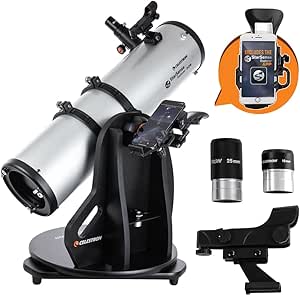
Celestron StarSense Explorer DX 130AZ App-Enabled Telescope – 130mm Newtonian Reflector with Smartphone Dock & StarSense App
The StarSense Explorer DX 130AZ makes star-hopping and celestial identification approachable for newcomers with its smartphone app integration. Compared to the manual StarSense LT 114AZ, the 130mm aperture provides brighter, more detailed views of the Moon and planets, appealing to entry-level users eager for quality images. Its Newtonian design offers good contrast but can suffer from minor light loss and collimation issues if not maintained. The app-guided navigation simplifies object location, though it depends on a compatible smartphone, which may limit usability on older devices. The manual altazimuth mount is simple to operate, but not ideal for tracking moving objects over long periods.
Pros:- User-friendly app-guided star locating
- Bright 130mm aperture allows detailed lunar and planetary views
- Includes multiple eyepieces and smartphone dock
- Affordable for entry-level astronomy
Cons:- Dependent on a compatible smartphone
- Manual mount less stable for precise tracking
- Limited to smartphone compatibility, may not work with older devices
Best for: Beginner stargazers who want an easy, app-supported experience with a focus on visual observation
Not ideal for: Experienced astronomers or astrophotographers seeking advanced tracking or imaging features
- Aperture:130mm
- Type:Newtonian Reflector
- Mount:Altazimuth
- Eyepieces:10mm and 25mm
- Compatibility:Android 12+, iOS 18+
- Warranty:2 years
Bottom line: This telescope is ideal for newcomers wanting a straightforward, app-enhanced stargazing experience with good image quality.
Celestron NexStar 130SLT Computerized Telescope – 130mm Newtonian Reflector, Portable, SkyAlign Technology
The NexStar 130SLT combines portability with a decent 130mm aperture, making it a practical choice for outdoor enthusiasts who value quick setup and reliable tracking. Compared to the NexStar 8SE, it’s more manageable for transport and storage but offers less light-gathering power, limiting deep-sky viewing. Its Newtonian design provides bright images of the Moon and planets but can require occasional collimation to maintain optimal image quality. The SkyAlign technology makes setup straightforward, though manual adjustments might challenge absolute beginners. Its software options add educational value, but its visual-only focus limits advanced imaging prospects.
Pros:- Portable and lightweight for outdoor use
- SkyAlign technology simplifies setup
- Large 130mm aperture offers bright, detailed views
- Includes software for interactive sky exploration
Cons:- Requires batteries or external power
- Manual setup can be challenging for absolute beginners
- No astrophotography features
Best for: Casual astronomers who want a portable, easy-to-use telescope for occasional home use
Not ideal for: Serious astrophotographers or users seeking high-end deep-sky imaging capabilities
- Aperture:130mm
- Optical Design:Newtonian Reflector
- Mount Type:Computerized Altazimuth (NexStar+)
- Tripod:Adjustable Steel
- Software Included:Starry Night Basic Edition
- Object Database:Over 4,000 objects
Bottom line: This scope works well for beginners wanting a portable and straightforward telescope for visual stargazing at home or on the go.
Celestron StarSense Explorer LT 114AZ App-Enabled Telescope – 114mm Newtonian Reflector for Beginners
The StarSense Explorer LT 114AZ offers a straightforward, budget-friendly option with a 114mm aperture, ideal for beginners focused on casual home stargazing. Its smartphone app guides users to celestial objects, making star-hopping accessible for those unfamiliar with night sky navigation. Compared to the larger 130mm models, it offers slightly less brightness but remains effective for lunar and planetary views. The manual altazimuth mount is simple, but its stability can vary depending on the setup, and it lacks advanced features for tracking or imaging. Its affordability makes it a compelling choice for first-time users, but it’s less suited for those wanting long-term or serious observing sessions.
Pros:- Very affordable and easy to operate
- App-guided star locating simplifies learning
- Decent 114mm aperture for clear views of the Moon and planets
- Smartphone dock included for enhanced experience
Cons:- Manual mount can be less stable for sustained tracking
- Limited to basic altazimuth movement
- Requires a compatible smartphone for full functionality
Best for: Absolute beginners seeking an affordable, easy-to-use telescope with app support for casual observing
Not ideal for: Users wanting advanced features, astrophotography, or long-term serious astronomy
- Aperture:114mm
- Type:Newtonian Reflector
- Mount:Altazimuth
- Connectivity:iPhone & Android compatible
- Included:Smartphone dock, StarSense Explorer app
- Warranty:2 years
Bottom line: This telescope is suitable for absolute beginners seeking a cost-effective, simplified introduction to astronomy at home.
Celestron NexStar 5SE Computerized Telescope – 5-Inch Schmidt-Cassegrain Optical Tube with Fully Automated GoTo Mount
The Celestron NexStar 5SE stands out for offering a balance of portability and advanced features, making it ideal for both beginners and more experienced users interested in planetary, lunar, and deep-sky viewing. Its 5-inch Schmidt-Cassegrain optics deliver bright, high-contrast images that rival larger telescopes, yet its fully automated GoTo mount simplifies object location, which is a step above manual setups like the Gskyer. Compared with the 8-inch NexStar 8SE, this model is more manageable for home use without sacrificing too much light-gathering power. However, the included 25mm eyepiece offers only around 50x magnification, which limits detailed planetary viewing unless additional eyepieces are purchased. The initial alignment process can be tricky for newcomers, but once set, it provides reliable tracking. This pick makes the most sense for users seeking a portable, feature-rich telescope that can handle a variety of celestial targets without requiring extensive setup time.
Pros:- Portable and quick to set up without tools
- Automated GoTo system simplifies object finding
- High-quality Schmidt-Cassegrain optics with bright views
- Suitable for planetary, lunar, and deep-sky observation
Cons:- Limited initial magnification with included eyepiece
- Alignment process can be challenging for beginners
- Additional eyepieces needed for detailed viewing
Best for: Intermediate hobbyists who want a portable, all-around telescope with automated object locating.
Not ideal for: Users who prefer high-magnification planetary detail or deep-sky astrophotography without extra accessories.
- Aperture:5 inches (127 mm)
- Optical Design:Schmidt-Cassegrain
- Mount Type:Computerized GoTo
- Object Database:40,000+ objects
- Eyepieces Included:25mm Plossl
- Magnification:50x
- Optical Coatings:Starbright XLT
- Wedge for astrophotography:Built-in
- Warranty:2 years
Bottom line: A versatile choice for those who want a portable, feature-rich telescope that can handle a broad range of celestial targets.
Celestron StarSense Explorer 150AZ App-Enabled Telescope – 150mm Tabletop Dobsonian with Smartphone Dock & StarSense App
The Celestron StarSense Explorer 150AZ makes star gazing approachable for newcomers thanks to its intuitive smartphone-guided system, which is a major upgrade over manual, non-app telescopes like the Gskyer. Its 150mm Newtonian reflector gathers ample light, revealing bright lunar craters, planetary details, and some deep-sky objects with ease. The compact tabletop Dobsonian base enhances portability, but its stability can vary depending on setup, and the manual tracking isn’t as precise as motorized alternatives like the NexStar 5SE. While the smartphone app offers real-time object suggestions and sky maps, it relies heavily on your device’s compatibility, requiring iOS 18+ or Android 12+, which could exclude some users. This telescope is perfect for beginners who want guided, bright views without the complexity of motorized mounts, though it’s less suited for serious astrophotography or long-term tracking.
Pros:- Easy to set up and operate, ideal for beginners
- Smartphone app offers real-time navigation and object suggestions
- Bright, detailed views of the Moon, planets, and deep-sky objects
- Portable and lightweight for travel
Cons:- Dependent on a compatible smartphone for full functionality
- Manual tracking less accurate than motorized mounts
- Tabletop base may limit stability for some users
Best for: Novice astronomers who want simple setup and guided sky exploration with their smartphone.
Not ideal for: More experienced stargazers seeking precise tracking or astrophotography capabilities without smartphone reliance.
- Aperture:150mm
- Type:Newtonian reflector
- Base:Tabletop Dobsonian
- Eyepieces:10mm and 25mm
- Compatibility:iOS 18+, Android 12+
- Warranty:2 years
Bottom line: An excellent starter telescope for those who prefer guided viewing with smartphone assistance and portability.
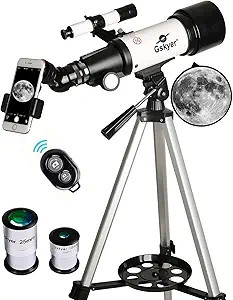
Gskyer 70mm Aperture 400mm AZ Mount Astronomical Refracting Telescope for Kids & Beginners
The Gskyer 70mm Refracting Telescope offers an accessible entry point for kids and beginners curious about the night sky. Its 70mm aperture and 400mm focal length deliver decent images of the Moon and brighter planets, making it a practical choice for casual use. The fully coated optics and included smartphone adapter enable easy astrophotography, while the wireless remote simplifies capturing images. Compared with larger telescopes like the NexStar 5SE, this model sacrifices some detail and brightness but gains in portability and ease of use. The manual focus may be less precise for detailed astrophotography, and its limited magnification (variable with eyepieces and Barlow) might restrict deep-sky viewing. This telescope suits families or young explorers wanting simple, fun astronomy without the complexity of motorized mounts.
Pros:- Easy to assemble and use, perfect for beginners and kids
- Includes smartphone adapter and wireless remote for photos
- Portable with adjustable tripod and carry bag
- Affordable entry-level option
Cons:- Magnification depends on additional accessories
- Manual focus may limit detailed imaging
- Limited to basic astronomical observations
Best for: Parents and kids or beginners seeking a straightforward, portable telescope for casual sky viewing and basic astrophotography.
Not ideal for: Serious astronomers looking for high-magnification, detailed planetary or deep-sky observations.
- Aperture:70mm
- Focal Length:400mm
- Mount Type:Altazimuth
- Magnification:Variable
- Coating:Fully coated optics
- Finder Scope:5×24 with crosshairs
- Power Source:Smartphone adapter, wireless remote
- Accessories:Carrying bag, phone adapter
Bottom line: A solid choice for beginners and families seeking simple, portable sky exploration and casual astrophotography.
Celestron 114LCM Computerized Newtonian Telescope – Beginner-Friendly 114mm Reflector with GoTo Mount
The Celestron 114LCM provides an approachable way for beginners to explore the night sky, equipped with a 114mm reflector and a fully motorized GoTo mount that can locate over 4,000 celestial objects. Compared to the 5-inch NexStar 5SE, this model offers a larger aperture, which translates into brighter images of the Moon, planets, and some deep-sky objects. It’s more budget-friendly and includes multiple eyepieces and a red dot finder, making initial setup smoother. However, its optics are more limited than higher-end refractors or Schmidt-Cassegrain models for detailed planetary or astrophotography work. The software included, Starry Night Basic Edition, is suitable for beginners but may feel basic for advanced users. This telescope makes a great educational tool and a reliable starter for those wanting an automatic object locator without heavy equipment.
Pros:- Automatic object location for over 4,000 celestial objects
- Includes multiple eyepieces and red dot finderscope
- Comes with beginner-friendly astronomy software
- Lightweight, portable design
Cons:- Initial setup and alignment can take time
- Optics are less suited for high-magnification detailed viewing
- Software features are basic for seasoned astronomers
Best for: Beginners and students interested in learning astronomy with automatic object tracking and educational software.
Not ideal for: Advanced astronomers seeking detailed planetary imaging or deep-sky astrophotography without upgrades.
- Optical Diameter:114mm
- Mount Type:Motorized Altazimuth with GoTo
- Eyepieces:25mm, 9mm
- Software Included:Starry Night Basic
- Alignment Method:SkyAlign
- Weight:Lightweight
Bottom line: A practical, beginner-oriented telescope ideal for educational use and learning the night sky with automated tracking.
Celestron NexStar 8SE Computerized Telescope – 8-Inch Schmidt-Cassegrain Optical Tube with Fully Automated GoTo Mount
The Celestron NexStar 8SE offers a significant leap in light-gathering capability with its 8-inch Schmidt-Cassegrain optics, making it the prime choice for those seeking detailed lunar, planetary, and deep-sky views from home. Its fully automated GoTo mount with SkyAlign technology simplifies setup, providing quick object location even in light-polluted areas. Compared to the 5-inch NexStar 5SE, the 8SE excels in revealing fainter objects and finer details, though it’s less portable due to its larger size. Its compatibility with various accessories allows for advanced astrophotography, but the system’s complexity might overwhelm first-time users without prior experience. The 8-inch aperture does involve a steeper learning curve and higher cost, but it remains unmatched for home astronomers aiming for serious viewing and imaging.
Pros:- Large 8-inch aperture for detailed lunar and deep-sky views
- Automated GoTo with quick sky alignment
- Versatile for astrophotography and long-exposure imaging
- Compatible with a wide range of accessories
Cons:- More complex setup and learning curve for beginners
- Heavier and less portable than smaller models
- Higher price point for casual users
Best for: Dedicated amateur astronomers seeking high-performance deep-sky observation and astrophotography at home.
Not ideal for: Casual hobbyists or those with limited space who prefer smaller, simpler setups.
- Aperture:8 inches
- Optical:Schmidt-Cassegrain
- Mount:Fully automated GoTo
- Object Database:40,000+ objects
- Warranty:2 years
- Weight:Not specified
Bottom line: A powerful, feature-rich telescope best suited for dedicated hobbyists aiming for detailed observation and astrophotography at home.
How We Picked
Our evaluation focused on key factors such as optical performance, automation features, ease of setup, build quality, and value for money. We prioritized telescopes with reliable GoTo systems and intuitive controls, as these are essential for home stargazing without extensive technical knowledge. We also considered portability for those who want to move their setup easily, along with user reviews highlighting real-world usability. The ranking reflects a combination of technical specifications, user experience, and overall versatility, ensuring options suit a variety of needs and budgets.Factors to Consider When Choosing Best Computerized Telescopes For Home Stargazing
Choosing the best computerized telescope for home stargazing involves understanding several critical factors. Beyond raw specifications, it’s important to consider how the telescope fits your skill level, space, and specific stargazing interests. Avoid common pitfalls like overestimating your needs or opting for overly complex models that can overwhelm beginners. The following factors will help you make a more informed decision and get the best value for your investment.Optical Diameter and Power
The aperture size, measured in millimeters, determines how much light the telescope gathers. Larger apertures reveal fainter objects and finer details, making models like the 8-inch NexStar 8SE ideal for serious enthusiasts. However, bigger scopes tend to be heavier and less portable. For casual home use, a 130mm or 150mm aperture offers a nice balance of light-gathering and convenience, especially if space is limited.Automation and Ease of Use
Automated GoTo mounts simplify locating celestial objects, which is especially helpful for beginners or those unfamiliar with star charts. Look for models with reliable tracking, quick alignment procedures, and user-friendly interfaces. More advanced users might prefer manual controls for greater flexibility, but these often demand a steeper learning curve. Remember, automation can reduce frustration and maximize viewing time, but it generally adds to the cost.Size, Portability, and Storage
Consider where you’ll keep and use your telescope. Compact, lightweight models like the Gskyer or StarSense Explorer LT 114AZ are easier to move around and store, making them suitable for small spaces or occasional outdoor use. Larger telescopes like the NexStar 8SE offer spectacular views but require more setup space and may be less convenient for quick stargazing sessions. Balance your space constraints with your desire for viewing power.Compatibility and App Features
Many modern telescopes incorporate smartphone apps for control and star mapping, dramatically improving the user experience. Check if the app is compatible with your device and easy to operate. App-enabled models like the StarSense Explorer series allow for quick alignment and object identification, especially beneficial for those new to astronomy. However, reliance on apps can sometimes lead to connectivity issues or increased complexity.Budget and Long-Term Value
While budget options can be sufficient for casual stargazing, investing a bit more often yields better optics, durability, and automation features. Consider your long-term interests—if you plan to advance your skills, a mid-range or premium telescope might be more cost-effective over time. Beware of very cheap models that may underperform or break easily, leading to additional expenses down the line.Frequently Asked Questions
Is a larger aperture always better for home stargazing?
Generally, yes. A larger aperture allows you to see fainter objects and finer details, enhancing your overall viewing experience. However, bigger scopes also tend to be heavier, more expensive, and less portable. For home use, especially if space is limited, a balance between size and optical power—such as a 130mm or 150mm aperture—provides a good compromise, offering good visibility without sacrificing convenience.Are app-enabled telescopes worth the extra cost?
App-enabled telescopes often deliver a more intuitive experience, especially for beginners unfamiliar with star charts or manual controls. They simplify alignment and object identification, reducing setup time and frustration. However, they can depend on smartphone connectivity, which may occasionally cause issues. If you prefer a straightforward, tech-assisted experience, investing in an app-enabled model can be well worth the added expense.Should I prioritize automation or manual control?
Automation offers ease of use, quick object location, and tracking, making it ideal for casual or beginner astronomers. Manual controls, on the other hand, provide a more hands-on experience that can deepen your understanding of the night sky but require more skill and patience. For most home users, especially newcomers, automation tends to be the smarter choice, while experienced hobbyists might prefer manual or semi-automatic options.How important is portability for a home telescope?
Portability is mainly relevant if you plan to move your telescope frequently or have limited storage space. Compact models like the StarSense Explorer LT 114AZ are easy to set up and store, making them suitable for apartment dwellers or those with limited outdoor space. Larger telescopes, such as the NexStar 8SE, are more cumbersome but offer superior viewing capabilities. Consider your space and usage habits before choosing a model.Is it better to buy a bundle or a single telescope?
Bundles often include useful accessories like eyepieces, filters, and carrying cases, providing better value for newcomers who want a complete setup. However, some bundles may include items you won’t use or need, so assess whether the included gear aligns with your interests. For experienced users, buying a high-quality telescope separately might be preferable to customize your setup and avoid unnecessary extras.Conclusion
For beginners seeking an easy, reliable start, the Celestron StarSense Explorer LT 114AZ offers great automation and affordability. Advanced hobbyists aiming for detailed views should consider the Celestron NexStar 8SE, which combines power with automation. Those on a budget can find satisfactory options like the Gskyer 70mm, while dedicated enthusiasts may prefer premium models like the NexStar 8SE or 5SE for their superior optics. Overall, your choice depends on your experience level, space, and how much automation you want—there’s a perfect model for every home stargazer.Halloween Picks
halloween
As an affiliate, we earn on qualifying purchases.