
Choosing the best dobsonian telescope for serious beginners can be challenging, as this category balances ease of use with powerful performance. The Sky-Watcher Flextube 200 Dobsonian stands out for its large 8-inch aperture that reveals detailed celestial objects, while the Sky-Watcher Heritage 150 offers a compact, budget-friendly option perfect for smaller spaces. Another notable pick is the Celestron StarSense Explorer 10-inch, which adds smartphone-based alignment for effortless setup. The main tradeoffs involve balancing size, complexity, and price—larger telescopes often deliver better views but can be harder to handle. Keep reading for a detailed breakdown of these options to find the best match for your astronomy journey.
Key Takeaways
- The best dobsonian telescopes for serious beginners combine large aperture with user-friendly features.
- Collapsible and tabletop models offer portability but may sacrifice some viewing stability compared to full-sized setups.
- App-enabled features like StarSense can simplify alignment but often come at a higher cost.
- Investing in a sturdy mount and good optics will significantly improve viewing experience for beginners.
- Price range varies widely; it’s possible to get excellent performance without overspending if you focus on essential features.






More Details on Our Top Picks
Sky-Watcher Heritage 150 Tabletop Dobsonian Telescope
The Sky-Watcher Heritage 150 stands out as the most versatile option for those starting out with serious interest in astronomy. Its large 150mm aperture delivers impressive detail on the Moon and planets, rivaling larger scopes like the Flextube 200 but in a more compact, portable form. The collapsible design simplifies storage and transport, making it ideal for those with limited space or who want to take their telescope on trips. However, its tabletop setup means it’s less suited for deep-sky astrophotography or extended tracking sessions, and manual collimation can be tricky for newcomers. Compared to the Flextube 200, it sacrifices some aperture size for convenience, but this tradeoff makes it more manageable for most beginners. Overall, this scope is perfect for serious beginners who want quality visuals without the bulk of a full-sized mount.Pros:- Large 150mm aperture for detailed planetary views
- Collapsible design for easy storage and transport
- Stable tabletop base reduces vibrations
- Bright, clear images of the Moon and planets
Cons:- Limited to tabletop use, restricting deep-sky photography
- Requires manual collimation, which can be challenging for beginners
Best for: Beginners who want a high-quality, portable telescope for planetary and lunar observation without the complexity of a full mount.
Not ideal for: Users interested in deep-sky astrophotography or long tracking sessions, as it lacks motorized tracking and full mount options.
- Aperture:150mm
- Focal Ratio:f/5
- Focal Length:750mm
- Mirror Type:Borosilicate parabolic
- Focuser:1.25-inch helical
- Design:Collapsible tabletop
- Features:Radiant Aluminum Quartz coating, rubber feet
Bottom line: This telescope offers an excellent balance of performance and portability for serious beginners focused on planetary observation.
Sky-Watcher Flextube 200 Dobsonian 8-inch Collapsible Large Aperture Telescope
The Sky-Watcher Flextube 200 offers a significant leap in aperture size with its 8-inch mirror, providing brighter images and more detail than smaller scopes like the Heritage 150. Its collapsible design makes it easier to store and transport than traditional large Dobsonians, but it still weighs around 40 pounds, which can be cumbersome for some users. The included accessories—eyepieces, finder scope, and smooth azimuth movement—make it a comprehensive starter kit for serious beginners eager to explore deep-sky objects and planets. Unlike the smaller Heritage 150, this model is better suited for those ready to handle a slightly heavier, more involved setup but who still prefer a simple manual mount over GoTo systems. It balances large aperture capabilities with beginner-friendly features, making it ideal for those looking to expand their astronomical pursuits.Pros:- Large 8-inch aperture for bright, detailed deep-sky views
- Collapsible design for easier transport and storage
- Includes essential accessories for beginner astronomy
- Smooth azimuth movement with Teflon bearings
Cons:- Weight may be heavy for users with limited strength
- Assembly required, which may be intimidating for some
- Primarily designed for terrestrial and astronomical viewing, not astrophotography
Best for: Beginners ready to upgrade to a larger aperture with a portable, easy-to-assemble Dobsonian.
Not ideal for: Those seeking a lightweight or fully motorized telescope for extended tracking or astrophotography, as it lacks motorized GOTO features.
- Aperture:8 inches
- Weight:40 pounds
- Optical Design:Dobsonian
- Mirror Coating:94% fully multi-coated
- Included Accessories:2-inch Crayford focuser, eyepieces, finderscope
- Design:Collapsible
Bottom line: This model is well-suited for beginners seeking a significant leap in aperture with manageable portability.
Dianfan 90mm Aperture 800mm Refractor Telescope for Adults, Portable with Tripod & Phone Adapter
The Dianfan 90mm refractor combines portability with decent optical quality, making it a flexible choice for beginners interested in both astronomy and outdoor activities like birdwatching. Its 90mm aperture and 800mm focal length produce bright, sharp images, comparable to the 90mm refractor in the roundup, but with added convenience thanks to its included stainless steel tripod and phone adapter. While it doesn’t boast the advanced features of larger scopes, its manual focus and straightforward setup make it accessible for casual stargazing and outdoor exploration. Compared to the more specialized telescopes, this model offers more versatility, especially for family outings. Still, its limited ability for detailed astrophotography and manual focus may frustrate more dedicated users.Pros:- Bright, sharp images with fully coated lenses
- Portable with sturdy tripod and carry bag
- Versatile for astronomy, birdwatching, and outdoor use
- Easy setup suitable for families and beginners
Cons:- Limited to manual focus, less convenient for quick adjustments
- Magnification range may not satisfy advanced astronomers
- Basic features may limit deep-sky detail exploration
Best for: Outdoor enthusiasts and casual astronomers who want a portable, easy-to-use telescope for multiple activities.
Not ideal for: Serious astrophotographers or users seeking highly detailed celestial images, as it lacks motorized focus and advanced tracking.
- Aperture:90 mm
- Focal Length:800 mm
- Eyepieces:32×–240×
- Mount:Altazimuth
- Focus Type:Manual
- Features:Fully coated lenses, phone adapter
Bottom line: This refractor provides a flexible, portable platform for beginners seeking outdoor versatility and straightforward operation.
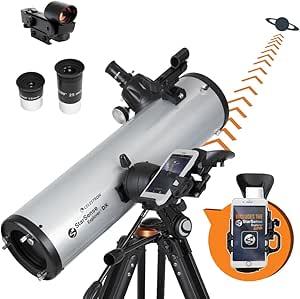
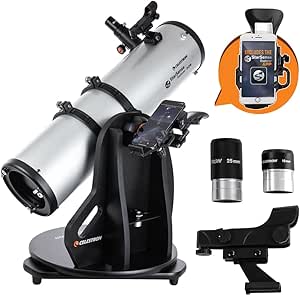
Celestron StarSense Explorer DX 130AZ App-Enabled Telescope
The Celestron StarSense Explorer DX 130AZ offers a unique experience by integrating smartphone technology for celestial navigation, making it attractive for tech-oriented beginners. Its 130mm Newtonian reflector gathers bright images of the Moon and planets, rivaling more traditional scopes like the Heritage 150 in brightness but adding the convenience of app-guided alignment. This makes locating objects more accessible for those unfamiliar with manual star-hopping. However, reliance on a smartphone app means it’s less suitable for users who prefer traditional manual operation or want to avoid potential compatibility issues. Its basic altazimuth mount is straightforward, but the absence of motorized tracking limits long observation sessions. Overall, this model is ideal for beginners eager to combine astronomy with modern tech features.Pros:- App-guided star alignment simplifies setup
- Bright 130mm reflector offers detailed views
- Includes multiple eyepieces and full-height tripod
- User-friendly for beginners with smartphone compatibility
Cons:- Requires a compatible smartphone for full functionality
- Manual tracking may be less precise for extended observations
- Limited to basic altazimuth mount, not motorized
Best for: Tech-savvy beginners who want guided star-hopping and interactive features for quick, engaging observations.
Not ideal for: Users who prefer traditional telescopes without smartphone dependence or seek advanced tracking capabilities for astrophotography.
- Aperture:130mm
- Mount Type:Altazimuth
- Eyepieces:10mm and 25mm
- Tripod:Full-height
- Compatibility:Android 12+, iOS 18+
- Warranty:2 years
Bottom line: This telescope is a strong choice for beginners eager to blend digital technology with traditional astronomy for quick and engaging sky viewing.
90mm Aperture Refractor Telescope for Beginners and Kids
The 90mm Aperture Refractor Telescope offers a straightforward, portable setup with a range of magnifications from 30x to 180x, making it suitable for both kids and beginners interested in casual astronomy. Its manual focus and included accessories, such as a phone adapter and adjustable tripod, mirror the features of the Dianfan scope but with a wider magnification range. This versatility makes it appealing for families or users who want a multi-purpose outdoor tool. However, while it provides bright images of the Moon and planets, its basic features mean it won’t satisfy those seeking heavy-duty deep-sky imaging or high-precision tracking. Compared to larger or more advanced models, this telescope emphasizes ease of use over advanced capabilities.Pros:- Bright, detailed images with 90mm aperture
- Versatile magnification options for all ages
- Portable with adjustable tripod and carry bag
- Includes smartphone adapter for basic astrophotography
Cons:- Manual focus may require adjustments for sharp images
- Limited advanced features for deep-sky exploration
- Basic tripod may limit stability for high magnifications
Best for: Families or beginners who want an easy-to-use, portable telescope for casual skywatching and outdoor activities.
Not ideal for: Serious amateur astronomers or those wanting detailed astrophotography, as it lacks motorized tracking and advanced features.
- Aperture:90mm
- Focal Length:600mm
- Magnifications:30x to 180x
- Eyepieces:10mm, 25mm
- Barlow Lens:3x
- Mount:Altazimuth
- Tripod Height Range:20″ to 48″
Bottom line: This refractor provides a user-friendly, portable experience perfect for families and beginner stargazers seeking casual outdoor observation.
80mm Aperture 500mm Refractor Telescope for Beginners with Tripod and Phone Adapter
This portable 80mm refractor stands out for its versatility, offering bright, sharp images suitable for both celestial and terrestrial viewing. Its included accessories, like the smartphone adapter and multiple eyepieces, make it highly accessible for beginners and families exploring the night sky or nature. Compared with larger, more complex scopes like the Celestron StarSense Explorer 10-inch, this model sacrifices some magnification power but gains in ease of use and portability. The build quality of its accessories could be improved, and its magnification range is limited for serious deep-sky observing. Nonetheless, it makes a compelling choice for casual stargazing and educational outings, especially for those prioritizing simplicity and transportability over deep-sky detail.
Pros:- Bright, sharp, and wide views suitable for astronomy and terrestrial use
- Includes comprehensive accessories like tripod, smartphone adapter, and stickers
- Easy to assemble and lightweight for outdoor adventures
Cons:- Magnification may be insufficient for advanced celestial observation
- Build quality of accessories could be more durable
Best for: Beginners, families, and outdoor enthusiasts seeking an easy-to-use, portable telescope for casual astronomy and terrestrial viewing
Not ideal for: Advanced amateur astronomers or deep-sky astrophotographers who need higher magnification and more robust build quality
- Aperture:80mm
- Focal Length:500mm
- Magnification Range:20X to 150X
- Eyepieces:25mm & 10mm
- Barlow Lens:3X
- Tripod Height:16.9–44.4 inches
Bottom line: This scope is ideal for beginners and families prioritizing portability and ease of use over high magnification or deep-sky capabilities.
Celestron StarSense Explorer 10-inch App-Enabled Telescope – 254mm Dobsonian with Smartphone Dock & StarSense App
The Celestron StarSense Explorer 10-inch provides a powerful, large-aperture experience paired with innovative smartphone-guided object location, making it a standout for those interested in exploring the night sky with minimal frustration. Its 254mm mirror delivers detailed views of the Moon, planets, and deep-sky objects, rivaling larger scopes like the Sky-Watcher Flextube 200 but with a more intuitive, app-driven approach. The tradeoff is its bulkier size and the necessity of a compatible smartphone for optimal use, which could be limiting for some users. The manual tracking isn’t as precise as computerized mounts, but for casual observation and learning, it offers an excellent balance of power and convenience, especially for beginners who want automation without complexity.
Pros:- Large 10-inch aperture for detailed celestial views
- Smartphone app with sky recognition simplifies object locating
- Stable manual altazimuth base provides smooth movement
Cons:- Requires a compatible smartphone for full functionality
- Bulkier and heavier than smaller models
Best for: Beginners who want an easy, app-supported way to locate objects and are comfortable with a larger, heavier setup
Not ideal for: Travelers or space-limited users who prefer lightweight, compact scopes, or those seeking advanced astrophotography
- Aperture:254mm
- Type:Dobsonian reflector
- Compatibility:iPhone & Android
- Warranty:2 years
Bottom line: This scope is best suited for beginners eager to combine power with smart, guided sky exploration, accepting its size and smartphone dependency.
Celestron Signature Series Moon by Robert Reeves Astronomical Telescope
This compact Dobsonian-style telescope excels at providing bright, detailed views of the Moon and planets, making it perfect for beginners interested primarily in lunar and planetary features. Its 76mm spherical mirror offers impressive clarity for its size, and the included lunar educational resources add extra value. Compared with larger scopes like the Sky-Watcher Heritage 150, it is much more portable and easier to transport, but its smaller aperture limits deep-sky observation potential. The basic mount is suitable for casual use, yet less stable for tracking fast-moving objects or astrophotography. It’s an excellent choice for outdoor exploration and lunar studies, especially for those who prioritize mobility and educational content over deep-sky performance.
Pros:- Compact, lightweight, and highly portable
- Provides bright, detailed lunar and planetary views
- Includes educational lunar features and resources
Cons:- Limited aperture size restricts deep-sky observing
- Basic mount may lack stability for precise tracking
Best for: Beginners and outdoor enthusiasts focused on lunar and planetary viewing, or those needing a portable, educational telescope
Not ideal for: Deep-sky astronomers seeking large apertures for faint object viewing or astrophotography
- Aperture:76mm
- Type:Dobsonian-style
- Included features:Custom lunar features wrap, Lunar Landscape eBook
- Warranty:2-year US warranty
Bottom line: This telescope is ideal for lunar and planetary observation on the move, especially for beginners seeking portability and educational value.
150EQ Newtonian Reflector Telescope for Adults and Beginners with Accessories
The 150EQ Newtonian offers a substantial 150mm aperture, making it a strong candidate for those eager to observe deep-sky objects, planets, and the Moon with clarity. Its stable German equatorial mount allows for smoother tracking compared to altazimuth models like the Celestron StarSense LT 114AZ. This model’s set of accessories, including multiple eyepieces and a moon filter, makes it versatile for both casual and more serious amateur astronomers. The main tradeoff is the initial setup time and weight, which can be cumbersome for quick trips or less experienced users. Overall, it provides a significant step up in power and stability for those ready to explore beyond basic stargazing, but it isn’t the lightest or simplest for casual outings.
Pros:- Large 150mm aperture for bright, detailed images
- Stable German equatorial mount for smooth tracking
- Complete accessory package simplifies setup and viewing
Cons:- Assembly requires some initial calibration and setup time
- Heavier tripod limits portability for frequent transport
Best for: Beginners with some prior experience who want to explore deep-sky objects and appreciate stable tracking
Not ideal for: Users seeking a lightweight, quick-setup telescope or those new to assembly and calibration
- Aperture:150mm
- Focal Length:650mm
- Eyepieces:25mm & 10mm
- Magnification Range:26X to 130X
- Mount:German Equatorial
- Accessories:Phone adapter, moon filter, carry bag
Bottom line: This telescope is best for beginners committed to deep-sky observation who can handle its setup and weight.
Celestron StarSense Explorer LT 114AZ App-Enabled Telescope – 114mm Newtonian Reflector for Beginners
The Celestron StarSense Explorer LT 114AZ simplifies beginner astronomy through its smartphone app-guided object location, offering an approachable entry into the night sky. Its 114mm aperture provides bright views of the Moon, planets, and some deep-sky objects, comparable to smaller entry-level scopes like the 90mm Aperture Refractor. While the manual altazimuth mount is straightforward, it limits tracking precision, especially for extended viewing or astrophotography. Its compatibility depends on the user’s device; older phones may not support the app fully. This model excels for casual users who want guided viewing with minimal setup, but it’s less suited for those interested in long-term, more precise tracking or astrophotography.
Pros:- User-friendly with guided object locating via app
- Bright, detailed views of Moon, planets, and deep-sky objects
- Includes two eyepieces and a sturdy full-height tripod
Cons:- Requires a compatible smartphone, which may limit some users
- Manual mount means less precise tracking for extended observations
Best for: Beginners new to astronomy who want guided sky viewing via smartphone and an easy, lightweight setup
Not ideal for: Users aiming for advanced tracking, astrophotography, or those with incompatible smartphones
- Aperture:114mm
- Type:Newtonian Reflector
- Mount:Manual Altazimuth
- Eyepieces:10mm & 25mm
- Compatibility:iOS 18+, Android 12+
- Tripod:Full-height
Bottom line: This scope offers a simple, guided introduction to astronomy for beginners, accepting some limitations in tracking and device compatibility.
SkyWatcher Flextube 250 SynScan Dobsonian 10-inch Collapsible Computerized GoTo Telescope
The SkyWatcher Flextube 250 SynScan stands out as the most capable choice for those seeking a serious beginner telescope with room to grow. Its large, 10-inch aperture delivers exceptional brightness and detail, surpassing smaller options like the Gskyer 70mm in deep-sky performance. The collapsible design offers a significant advantage in portability compared to traditional big Dobsonians, making storage and transport more manageable. The built-in WiFi and automated tracking with a 42,000-object database provide a modern, user-friendly experience, ideal for those who want to explore with minimal fuss. However, its substantial weight (72 pounds) and complex setup mean it’s less suited for casual or inexperienced users who prefer simplicity. This model makes the most sense for enthusiasts ready to invest in a high-performance, feature-rich telescope that can handle advanced observing, with the tradeoff of portability and price.
Pros:- Large 10-inch aperture delivers bright, detailed views of deep-sky objects
- Collapsible design significantly improves portability for a telescope of this size
- Built-in WiFi and SynScan system enable remote control and automated object tracking
Cons:- Heavy weight makes transportation and setup physically demanding
- Setup complexity may challenge beginners with limited technical experience
Best for: Serious beginners who want a large aperture, automation, and future expansion capabilities without sacrificing portability
Not ideal for: Casual stargazers or those with limited space who prefer lightweight, simple setups and less technical complexity
- Aperture:10 inches
- Focal Length:1200 mm
- Weight:72 pounds
- Mirror Coating:Fully multi-coated borosilicate
- Object Database:42,000 objects
- Included Accessories:2-inch Crayford focuser, 25mm and 10mm eyepieces, 9×50 finder scope
- Collapsible Design:Yes
- WiFi:Built-in
Bottom line: This telescope is best suited for motivated beginners willing to handle its size and complexity for top-tier viewing performance.
Celestron StarSense Explorer 150AZ App-Enabled Telescope – 150mm Tabletop Dobsonian with Smartphone Dock & StarSense App
The Celestron StarSense Explorer 150AZ makes star mapping and object identification accessible through its innovative app-guided system, making it ideal for newcomers who want immediate engagement. Its 150mm aperture offers bright, crisp images, comparable to the 150EQ in clarity, but with much simpler operation. The tabletop Dobsonian mount keeps setup straightforward, perfect for smaller spaces or portable use. Unlike the SkyWatcher Flextube 250, this model forgoes motorized tracking, making manual adjustments necessary for precise observations. Its reliance on a smartphone for sky recognition is a double-edged sword—easy for beginners, but limiting for those who prefer standalone operation. This pick is best for beginners eager to explore with guided assistance, though less suited for those seeking advanced features or astrophotography.
Pros:- Easy to use with smartphone-based star recognition and guidance
- Bright 150mm aperture provides detailed views of planets and deep sky objects
- Compact, tabletop design enhances portability and ease of setup
Cons:- Dependent on a smartphone for operation, which may limit independence
- Manual tracking can be less precise for prolonged viewing or astrophotography
Best for: Beginners looking for an intuitive, app-supported stargazing experience with bright optics
Not ideal for: Advanced amateur astronomers or those interested in astrophotography, due to manual tracking limitations
- Aperture:150mm
- Type:Reflector
- Mount:Altazimuth tabletop Dobsonian
- Eyepieces:10mm and 25mm
- Compatibility:iOS 18+, Android 12+
- Warranty:2 years
Bottom line: This telescope is ideal for beginners who want guided, smartphone-assisted stargazing without complex setup or motorized tracking.
150EQ Astronomical Professional Telescope for Adults with Phone Adapter, Moon Filter, Stainless Tripod, and Carrying Bag
The 150EQ combines high optical quality with robust construction, making it suitable for both beginners and those with some experience. Its 150mm aperture yields bright, detailed images across a broad range of celestial objects, comparable to the Celestron StarSense Explorer 150AZ. The equatorial mount allows for more precise tracking than simple altazimuth mounts, but it requires a learning curve and manual adjustment, unlike the automated systems on the SkyWatcher Flextube 250. Its sturdy stainless steel tripod ensures stability, and the included accessories like the phone adapter and Moon filter expand observing options. However, its weight (14 kg) and manual operation make it less suitable for frequent, casual trips. This telescope makes sense for those wanting a balance of quality and portability with room to develop more advanced skills.
Pros:- High-quality 150mm aperture produces bright, detailed images
- Sturdy stainless steel tripod ensures stable viewing
- Includes useful accessories like phone adapter and Moon filter
Cons:- Relatively heavy, less convenient for frequent transport
- Manual tracking requires some skill and practice
Best for: Amateur astronomers seeking a high-quality optical instrument with manual tracking and portability for outdoor use
Not ideal for: Total beginners or those seeking fully motorized, hands-free operation and ultra-lightweight setup
- Aperture:150mm
- Focal Length:650mm
- Eyepieces:Two eyepieces (26x–130x)
- Mount:Equatorial
- Tripod:Stainless steel
- Included Accessories:Phone adapter, Moon filter, Carrying bag
Bottom line: This telescope is well-suited for enthusiasts who want a durable, high-performance optical device with manual tracking capability for outdoor astronomy.
Gskyer 70mm Aperture 400mm AZ Mount Astronomical Refracting Telescope for Kids and Beginners
The Gskyer 70mm is a compact, lightweight refractor that offers surprisingly good optics for its size, making it a solid choice for absolute beginners and young explorers. Its 400mm focal length provides decent magnification options with included eyepieces and a 3x Barlow lens, comparable to the Koolpte 80mm in basic performance but at a lower cost. The fully coated optics ensure clear images, and the adjustable tripod along with accessories like a smartphone adapter and wireless remote expand its functionality for casual stargazing and even beginner astrophotography. Nonetheless, its manual focus and small aperture limit its effectiveness for detailed deep-sky viewing, especially compared to larger, more capable models like the SkyWatcher Flextube 250. It’s an excellent starter scope for portability and ease of use, with some compromises on image power and durability.
Pros:- Lightweight and easy to carry for travel and outdoor use
- Includes smartphone adapter and remote for casual astrophotography
- Fully coated optics provide clear, sharp images
Cons:- Limited aperture reduces ability to view faint objects in detail
- Manual focus can be challenging for very young users
Best for: Young beginners or those seeking a portable, simple telescope for basic lunar and planetary viewing
Not ideal for: Serious astronomy enthusiasts or those wanting to observe faint deep-sky objects regularly
- Aperture:70mm
- Focal Length:400mm
- Magnification:Variable
- Finderscope:5×24
- Mount Type:Altazimuth
- Additional Features:Wireless remote, smartphone adapter, carry bag
Bottom line: This telescope is perfect for beginners and kids who want an easy-to-use, portable scope for basic lunar and planetary viewing, with some limitations on power and durability.
Koolpte 80mm Aperture 600mm F/6.7 Refractor Telescope for Adults & Beginners with AZ Mount Tripod, Phone Adapter, Carrying Bag, Wireless Control
The Koolpte 80mm offers a balanced combination of aperture, portability, and features at a reasonable price point. Its 600mm focal length delivers higher magnification potential compared to the Gskyer 70mm, making it more capable for planetary and lunar observations, especially with the included Barlow lens. The fully multi-coated optics ensure sharp images, and the lightweight design with an adjustable tripod makes it easy to set up for quick sky sessions. While it doesn’t match the automation or large aperture of the SkyWatcher Flextube 250, it provides enough power for casual deep-sky viewing and terrestrial use, with a straightforward manual operation. The main tradeoff is that its build quality might not be as durable as premium models, and its maximum magnification is limited without additional accessories. It’s a versatile, budget-friendly option for those wanting a step up from basic scopes.
Pros:- Good balance of aperture and focal length for general use
- Lightweight, portable, and easy to set up
- Includes multiple accessories like phone adapter and carry bag
Cons:- Magnification potential limited without additional accessories
- Build quality could be more durable for frequent outdoor use
Best for: Beginners seeking a versatile, easy-to-use telescope with decent magnification and portability
Not ideal for: Those aiming for high-end astrophotography or ultra-detailed deep-sky imaging, due to limited advanced features
- Aperture:80mm
- Focal Length:600mm
- Magnification:24X and 60X (with accessories)
- Mount:Altazimuth
- Additional Features:Phone adapter, wireless remote, carry bag
Bottom line: This telescope offers excellent value for beginners who want a versatile and portable instrument for a variety of observations.
How We Picked
The products in this roundup were selected based on their combination of aperture size, build quality, ease of setup, and overall value for serious beginners. We prioritized telescopes that balance performance with straightforward operation, avoiding overly complex models that might intimidate newcomers. The ranking considers customer reviews, brand reputation, and feature set, especially focusing on telescopes that excel at delivering clear, detailed views of planets, the Moon, and deep-sky objects. Additional factors like portability, accessories, and future upgrade potential were also evaluated to ensure these options suit a variety of beginner needs without overwhelming them with technicalities.Factors to Consider When Choosing Best Dobsonian Telescopes For Serious Beginners
When selecting a dobsonian telescope as a serious beginner, several key factors influence long-term satisfaction and performance. Understanding these will help you avoid common mistakes like choosing a size that’s too heavy, or a model with features you’ll never use. Prioritize aperture size for better light collection, but balance it with ease of handling. Consider the mount’s stability and whether it offers smooth tracking. Budget constraints matter, but investing in quality optics and mount stability often yields better viewing experiences. Lastly, think about future expandability—will this telescope grow with your skills?Aperture Size and Light Gathering
In dobsonian telescopes, aperture size directly influences how much light the telescope can collect, which determines how faint and detailed objects appear. For serious beginners, an 8-inch aperture strikes a good balance—large enough to reveal Jupiter’s cloud bands and faint nebulae, yet still manageable for most users. Larger apertures, like 10 inches, offer even more detail but increase weight and setup complexity. Smaller models, while portable, tend to limit viewing potential, especially for deep-sky objects. Choosing the right aperture depends on your space, portability needs, and your desire for detailed views.
Ease of Setup and Use
While larger telescopes provide better views, they can be intimidating to set up and align correctly. Many beginners benefit from models with simple, intuitive assembly and minimal maintenance. Collapsible or tabletop designs can reduce setup time, but often sacrifice stability. Features like automatic alignment or smartphone apps, such as StarSense, help streamline the process and make initial observations less frustrating. Avoid models that require extensive adjustments or technical knowledge unless you’re prepared for a learning curve. Ease of use encourages more frequent viewing and ongoing engagement with astronomy.
Build Quality and Stability
Sturdy construction and a stable mount are essential for clear, shake-free viewing. Cheap or flimsy mounts tend to wobble, which can ruin the viewing experience, especially at higher magnifications. For serious beginners, investing in a durable base and a smooth, responsive azimuth or altitude control makes a noticeable difference. Consider models with high-quality materials and precise bearings—these help maintain focus and ease tracking objects across the sky. Balancing portability with stability is key: too light and the telescope wobbles, too heavy and it becomes difficult to transport or set up.
Accessories and Future Expandability
While a good telescope is the core, accessories like additional eyepieces, filters, and a sturdy tripod can enhance viewing. Many models come with basic accessories, but upgrading can significantly improve image quality. Additionally, consider if the telescope can accommodate future upgrades, such as motor drives or computerized mounts, which can turn a good beginner scope into a more advanced setup. Don’t overlook the value of a good carry case or storage options, especially if you plan to transport the telescope frequently. Planning for future needs ensures your investment remains useful as your skills grow.
Price and Value
Price ranges for dobsonian telescopes vary widely, from budget-friendly models around $300 to premium setups exceeding $1000. While it might be tempting to opt for the cheapest option, investing a bit more often results in better optics, build quality, and overall satisfaction. Focus on models that offer a strong combination of aperture, stability, and ease of use rather than just low cost. Remember, a well-made telescope can last for years and provide rewarding views, making it a more worthwhile investment over cheaper, less capable alternatives.
Frequently Asked Questions
Is an 8-inch dobsonian suitable for a beginner?
Absolutely. An 8-inch dobsonian provides a significant increase in light-gathering ability over smaller models, making it ideal for viewing planets, the Moon, and deep-sky objects. Its size strikes a good balance between performance and portability, and many models are designed with beginner users in mind. While it requires a bit more effort to set up and transport than smaller scopes, the quality of views it offers makes it a popular choice for serious beginners ready to explore more than just basic objects. Proper handling and a stable mount ensure a comfortable experience even for first-timers.
Should I choose a collapsible or fixed dobsonian for a beginner?
Both options have their advantages, but collapsible dobsonians tend to be more popular for beginners due to their portability. They can be broken down into smaller parts for easier transport and storage, which is helpful if you have limited space or plan to travel with your telescope. Fixed models are generally more stable because of their solid construction, but they tend to be bulkier and harder to move around. If portability and storage are priorities, a collapsible model makes more sense; otherwise, a fixed model can offer slightly better stability for stationary use.
What is the benefit of an app-enabled dobsonian?
App-enabled dobsonians, like those with StarSense technology, simplify the process of locating objects in the night sky by automating alignment and target acquisition. This feature reduces setup time and technical frustration, especially for beginners who are still learning the constellations and navigation. It also provides guided tours and real-time information about objects you’re viewing, enriching the experience. However, these features often come at a higher cost and require a compatible smartphone or tablet, so weigh the convenience against your budget and comfort with technology.
Is a larger aperture always better for a beginner?
Generally, yes, because larger apertures gather more light and reveal finer details. However, bigger scopes are heavier, bulkier, and more challenging to set up, which can be discouraging for beginners. If you’re just starting out, it’s wise to choose an aperture that provides excellent views without overwhelming you with weight and complexity. An 8- or 10-inch dobsonian is often the sweet spot—large enough to provide impressive images but still manageable for a new user willing to learn proper setup and handling techniques.
Conclusion
For serious beginners, the Sky-Watcher Flextube 200 Dobsonian offers an excellent mix of large aperture and portability, making it the best overall choice. If budget is a concern, the Sky-Watcher Heritage 150 delivers solid performance at a more accessible price point. Those seeking a premium experience with smart features should consider the Celestron StarSense Explorer 10-inch. For newcomers prioritizing simplicity, a smaller, stable model like the Gskyer 70mm works well as an introductory telescope. Ultimately, your choice depends on your space, budget, and long-term astronomy goals—these recommendations cover a range of needs to help you start your stargazing journey with confidence.