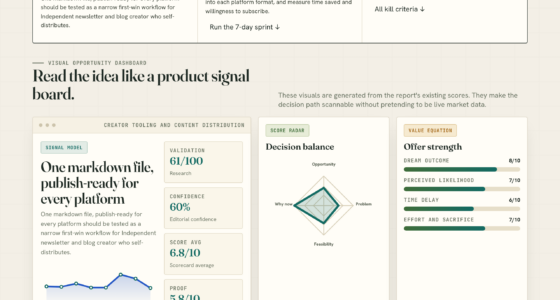

📊 Full opportunity report: Should You Use Mistral Forge? A Buyer’s Decision Guide on ThorstenMeyerAI.com — validation score, market gap, and execution plan.
TL;DR
Mistral Forge is a powerful, sovereign AI platform suited for high-stakes, data-sensitive environments. However, it’s not ideal for most organizations due to its complexity and specific requirements. This guide helps determine if Forge fits your needs.
Mistral Forge is a full-lifecycle, sovereign AI development platform that offers advanced capabilities for specific, high-consequence use cases. However, most organizations should not consider it unless they meet strict conditions, due to its complexity and cost.
The core insight from Thorsten MeyerAI indicates that Forge is best suited for organizations with high data sovereignty needs, proprietary knowledge that influences reasoning, and sufficient technical maturity. It is not recommended for general-purpose AI tasks or organizations lacking the infrastructure to manage complex models.
Forge’s strengths lie in environments such as government, defense, regulated finance, and industrial sectors, where data sensitivity and control are paramount. However, its deployment requires a well-governed, structured data environment and internal capabilities for ongoing model management. For most other use cases, simpler and cheaper tools like retrieval-augmented generation (RAG) or fine-tuning are more appropriate.
Should you use Mistral Forge? A buyer’s decision guide
Forge isn’t overrated — it’s over-reached-for. A scalpel for a specific, high-value incision, wrong for most jobs. Here’s the honest filter: who it fits, what to use instead, and the red flags that mean “not this, not now.”
- Gov / defense — language, law, process; air-gapped
- Regulated finance — compliance internalized
- Industrial / mfg — specialist constraints & data
- Telecom · deep-code tech — proprietary specs / codebase
- …but only the data-mature, high-consequence, sovereign ones
- You want an assistant / doc-search / support bot → RAG
- Knowledge changes often or must be cited/deleted → RAG
- Low data maturity — fix the data first
- You need cheap, fast, easily updatable
- Small org · no ML capacity · no sovereignty need
- Can’t answer IP / portability / lock-in questions
- No PoC beating a RAG + fine-tune baseline
Forge is a precise instrument for deep domain reasoning + sovereignty + lifecycle control, for orgs mature enough to wield it. For the vast majority the honest answer is not Forge, not yet, maybe never — and that’s fit, not failure. Even the sovereignty-driven buyer has a lighter, reversible choice in self-hosted open weights. The discipline isn’t picking the most powerful tool — it’s matching the tool to the job, the data, and the maturity you actually have, and demanding proof before you commit. Sequence for almost everyone: 1 prompt + RAG → 2 targeted fine-tune → 3 Forge only if a measured gap remains. Climb, don’t leap.
Why This Matters for Enterprise AI Buyers
Understanding when Mistral Forge is appropriate helps organizations avoid costly misallocations of resources. Many companies risk over-investing in complex models when simpler solutions suffice, especially if they lack the data maturity or sovereignty requirements. Properly assessing fit can save time, money, and operational risk, making this decision critical for strategic AI deployment.
Google ADK and Gemini Enterprise Agent Platform: Build, Deploy, Govern, and Scale Production-Ready AI Agents for Enterprise Workflows
As an affiliate, we earn on qualifying purchases.
As an affiliate, we earn on qualifying purchases.
Key Conditions and Use Cases for Forge
Forge’s ideal adopters include governments, regulated financial institutions, and industrial firms with proprietary data and high-stakes use cases. The platform is designed for environments where data sovereignty, model reasoning, and operational control are non-negotiable. Its deployment is often on-premises or air-gapped, with models tailored to local language, law, and technical standards.
Most enterprises, however, are not yet ready for Forge, due to data governance challenges, lack of technical expertise, or the need for more flexible, less costly solutions. The platform’s complexity and resource requirements mean it should be reserved for specific scenarios where its benefits outweigh the significant investment.
“Choosing Forge without meeting all four key conditions is likely to lead to wasted resources and unmet expectations.”
— Industry expert

Intelligent Health: The Movement to Unify Data, Harness AI, and Empower People to Thrive
As an affiliate, we earn on qualifying purchases.
As an affiliate, we earn on qualifying purchases.
Remaining Questions About Forge’s Deployment
It is not yet clear how many organizations will meet all four conditions necessary for Forge’s effective use. The platform’s complexity and the high technical bar may limit its adoption, and ongoing developments could expand or restrict its applicability.
![Express Schedule Free Employee Scheduling Software [PC/Mac Download]](https://m.media-amazon.com/images/I/41yvuCFIVfS._SL500_.jpg)
Express Schedule Free Employee Scheduling Software [PC/Mac Download]
- User-friendly drag & drop scheduling: Simple shift planning interface
- Manage time-off and leave: Add sick leave, breaks, holidays
- Email schedules to staff: Send schedules directly via email
As an affiliate, we earn on qualifying purchases.
As an affiliate, we earn on qualifying purchases.
Next Steps for Potential Users and Market Trends
Organizations interested in Forge should assess their data maturity, sovereignty needs, and technical capacity. Meanwhile, vendors and developers are likely to improve more accessible, flexible alternatives that may challenge Forge’s niche in the enterprise market. Further case studies and user experiences will clarify its real-world fit.

AI Networking Cookbook: Practical recipes for AI-assisted network automation and development
As an affiliate, we earn on qualifying purchases.
As an affiliate, we earn on qualifying purchases.
Key Questions
Is Mistral Forge suitable for small or mid-sized companies?
No, Forge is designed for organizations with high data sovereignty needs, mature data management, and technical capacity—conditions uncommon in smaller firms.
What are the main alternatives to Forge for enterprise AI?
Cheaper and more flexible options include retrieval-augmented generation (RAG), fine-tuning existing models, or open-weight models hosted on-premises with RAG integration.
Can organizations switch from Forge to other solutions later?
Yes, especially if their data maturity or sovereignty requirements change. Replacing Forge with lighter, more adaptable tools can be more cost-effective and less complex.
What are red flags indicating Forge is not suitable?
If your use case involves frequently updating knowledge, requires simple document search, or your data isn’t well-governed, Forge is likely not appropriate.
Source: ThorstenMeyerAI.com