
TL;DR

Get school and study supplies delivered free — and shop member deals
- Fast, free delivery on millions of items
- Access to Prime Big Deal Days deals on October 6–7
- Prime Video, Amazon Music and more included
A study published in April 2026 in Nature Communications identified several complex traveling-wave patterns in recordings from awake people performing memory tasks. Different tasks were associated with distinct patterns, but the findings do not establish that the waves cause the brain to reorganize or process information.
A team studying electrical activity in the brains of awake people found several distinct traveling-wave patterns during memory tasks, including waves that spread outward, converge, or spiral. The study, published in April 2026 in Nature Communications, links different patterns with different tasks and adds evidence that traveling waves may be part of how the brain handles information in real time. It does not show that the waves themselves cause those mental processes.
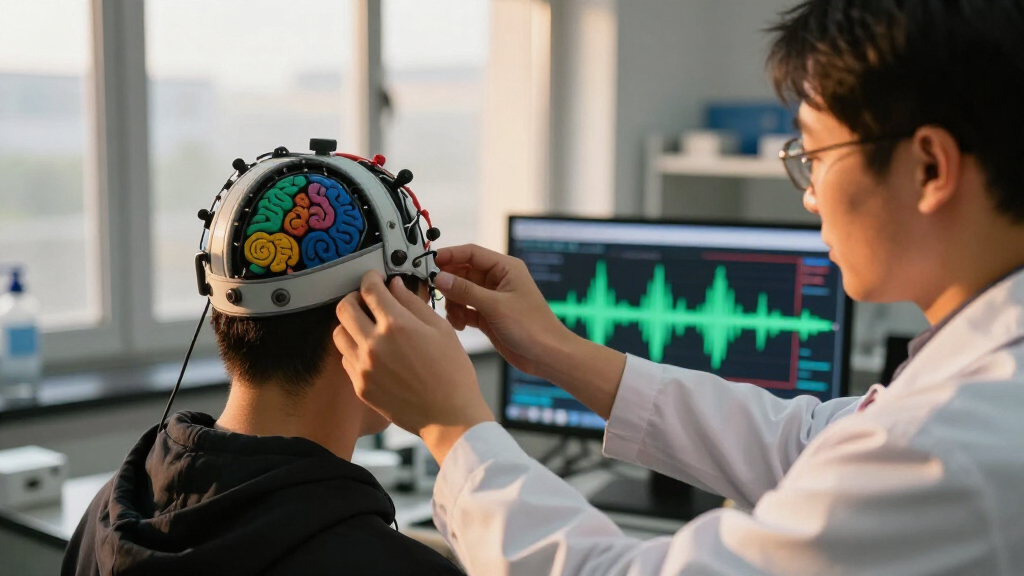
The researchers used intracranial electrodes to record activity across areas of the cortex while participants completed two memory exercises. One asked them to recall words shown on a screen; the other involved navigating a virtual environment and remembering where objects were located. The recordings revealed a wider range of patterns than the relatively simple waves described in earlier work.
The observed patterns included source waves that appeared to spread from a location, sink waves that converged toward one, and spiral-like waves. The team reported that different behavioral tasks were associated with distinct patterns. The findings broaden the picture from waves moving mainly back-to-front or front-to-back across the cortex to more varied spatial arrangements.
The recordings were made using electrodes placed inside the brain for clinical care of people with severe epilepsy, with participants’ permission. That method can capture activity with greater spatial and temporal detail than scalp EEG, but it is available only in particular clinical circumstances. The report does not provide enough information to establish how common each wave pattern is across people or whether the same patterns occur in everyday settings.
Wave Patterns and Real-Time Thought
Neurons can alter their connections over days or months, while behavior and attention can change within seconds. Researchers are investigating whether large-scale waves offer a way for brain activity to shift rapidly to meet those changing demands. The new results make that possibility more specific: rather than a single kind of traveling signal, the cortex may show different wave geometries associated with different tasks.
The association matters because it could help researchers understand how brain regions coordinate during memory and other mental activity. If future work establishes that wave patterns contribute to information processing, they could become a useful way to study how the brain organizes activity across space and time. For now, the study documents patterns and task relationships; it does not prove a mechanism or point to an immediate clinical application.
The work also challenges an older interpretation of waves as little more than a by-product of neural activity. Earl K. Miller, a cognitive neuroscientist at the Massachusetts Institute of Technology, said researchers are moving from asking whether traveling waves are relevant toward treating them as a major feature of how the cortex processes information. That is a view about the direction of the field, not a conclusion established by this single study.
As an affiliate, we earn on qualifying purchases.
From Scalp Signals to Cortex
Brain electrical activity has been measured since the 1920s using electrodes on the scalp, a method known as electroencephalography, or EEG. EEG captures broad oscillations whose frequencies are commonly described as alpha, beta, gamma, and theta. Those signals change with states such as attention, memory, and sleep, but recording from outside the skull limits how precisely researchers can map activity across the brain.
Intracranial recordings offer a closer view, though they are generally collected when electrodes have been placed for medical reasons, such as locating the source of seizures in people with severe epilepsy. In a 2024 study in Nature Human Behavior, researchers including Joshua Jacobs and Uma Mohan described waves moving in opposite directions across the cortex during memory tasks. Jacobs said the direction could reflect the propagation of information between visual areas toward the front of the brain and higher-level memory regions.
The April 2026 study, involving Jacobs and Anup Das, extended that research by finding more varied patterns during verbal and spatial memory exercises. The work is part of an emerging effort to determine whether traveling waves are simply a signature of underlying neural activity or help coordinate it.
“The work coming out is moving this from ‘Are they relevant?’ to ‘This is a major motif of how the cortex processes information.’”
— Earl K. Miller, cognitive neuroscientist at the Massachusetts Institute of Technology
As an affiliate, we earn on qualifying purchases.
What the Recordings Cannot Establish
The reported link between task type and wave pattern is an association; the study does not establish that a particular wave causes memory encoding, recall, or navigation. It also remains unclear how the different patterns arise, how consistently they appear across people, and whether they occur in other kinds of thinking or in ordinary daily life.
Intracranial recordings provide detailed measurements but come from a limited group of participants whose electrodes were implanted for clinical care. The available source material does not specify the number or demographics of participants, the size of the effects, or whether the findings have been independently replicated. Those limits make it premature to generalize the patterns to the whole population or treat them as a diagnostic tool.
As an affiliate, we earn on qualifying purchases.
Testing the Waves’ Role
The next step for researchers is to test whether these patterns do more than track a person’s task. Further studies could examine how reliably wave forms correspond to particular mental demands and whether changing or disrupting a pattern changes performance. Replication in additional participants and tasks would help establish how broadly the findings apply.
No clinical use or follow-up milestone is specified in the source material. Until more evidence is available, the study is best understood as a detailed observation of brain activity during memory tasks—and a basis for further research into whether traveling waves help coordinate the cortex.
As an affiliate, we earn on qualifying purchases.
Key Questions
What did the 2026 study find?
Using intracranial electrodes, researchers observed source, sink, and spiral-like traveling-wave patterns while participants completed verbal and spatial memory tasks. Different tasks were associated with distinct patterns.
Do the waves cause memory or thought?
The study does not establish that they do. It documents patterns associated with tasks, but the waves could be part of information processing or a signal produced by other neural activity.
How were the brain signals recorded?
Researchers recorded electrical activity using electrodes placed inside the brain for clinical care of people with severe epilepsy, with participants’ permission. This method provides more detailed local measurements than scalp EEG but is not routinely used in healthy volunteers.
Could the findings lead to a medical treatment?
No treatment or diagnostic use is reported. More research is needed to confirm the findings, understand what produces the wave patterns, and determine whether they have a causal role.
Source: hn
Evergreen bestsellers Picks
bestsellers
As an affiliate, we earn on qualifying purchases.