
Space telescopes detect invisible light like ultraviolet, infrared, X-ray, and radio waves using advanced detectors that turn these signals into images and data. Each type reveals different cosmic features, from star nurseries hidden in dust to explosive black holes and energetic supernovae. Combining these wavelengths gives you a fuller picture of the universe’s hidden worlds. If you keep exploring, you’ll discover how these tools help uncover mysteries beyond what your eyes can see.
Key Takeaways
- Space telescopes detect various wavelengths like ultraviolet, infrared, X-ray, and radio, revealing phenomena invisible in visible light.
- Different light types uncover specific cosmic environments, such as star formation in infrared and black hole activity in X-ray.
- Infrared telescopes see through cosmic dust, revealing hidden stellar nurseries and early star formation regions.
- Ultraviolet and X-ray observations explore high-energy events, like supernovae and neutron stars, invisible in normal light.
- Combining multiple wavelengths provides a comprehensive view, uncovering hidden structures and complex processes in the universe.
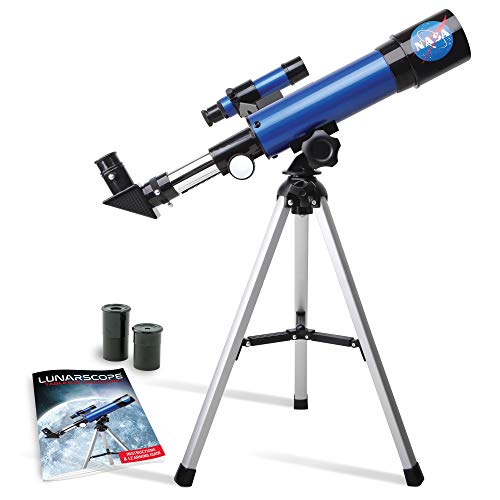
NASA Lunar Telescope for Kids – 90x Magnification, Includes Two Eyepieces, Tabletop Tripod, and Finder Scope- Kids Telescope for Astronomy Beginners, Space Toys, NASA Gifts (Amazon Exclusive)
INSPIRE CURIOSITY – The NASA Lunar Telescope allows your child to see the moon in incredible detail; the…
As an affiliate, we earn on qualifying purchases.
As an affiliate, we earn on qualifying purchases.
How Do Space Telescopes Detect Invisible Light?
How do space telescopes see light that’s invisible to our eyes? They use advanced detector technology to pick up wavelengths beyond visible light, like infrared or ultraviolet. These detectors convert incoming photons into electrical signals, allowing scientists to analyze the light’s properties. Spectral analysis then helps interpret these signals, revealing details about celestial objects that are hidden to the naked eye. Unlike ground-based telescopes, space telescopes avoid atmospheric interference, making their detectors more sensitive and accurate. This combination of precise detector technology and spectral analysis enables you to explore the universe in new ways, uncovering phenomena like black holes, star formation, and cosmic radiation that remain invisible in ordinary light. Additionally, technological advancements in detector sensitivity continue to expand our ability to observe the universe in diverse wavelengths, opening up new observational possibilities for astrophysics. Advances in sensor technology are also helping scientists capture clearer images of faint astronomical objects, further enhancing our understanding of the cosmos.

Celestron – NexImage 20 Solar System Camera – 20MP AR2020 Back-Illuminated CMOS Sensor – High-Resolution Imager for Lunar, Planetary & Solar Astrophotography, USB-C, ROI, Autoguiding
FAST, HASSLE-FREE IMAGING: Plug-and-play planetary camera connects easily to your telescope and computer so you can start capturing…
As an affiliate, we earn on qualifying purchases.
As an affiliate, we earn on qualifying purchases.
Types of Light and What They Reveal About the Universe
Space telescopes detect different types of light beyond what our eyes can see, revealing a wealth of information about the universe. This includes the cosmic background radiation, which offers clues about the universe’s origins, and the way light interacts with dark matter, shaping galaxy formation. Understanding various light types helps you see beyond visible colors and uncover hidden phenomena. Consider these key insights:
Space telescopes reveal hidden universe secrets through different types of light beyond our sight.
- Ultraviolet light uncovers hot, energetic regions like star-forming areas. These observations help scientists understand the processes that lead to star birth and the evolution of galaxies.
- X-ray and gamma-ray observations reveal high-energy events such as black hole activity. They are essential for studying the most extreme environments in space and understanding phenomena like neutron stars and supernovae.
- Microwave radiation provides details about the cosmic background, helping you understand the universe’s early moments and the distribution of dark matter. This cosmic microwave background acts as a snapshot of the universe shortly after the Big Bang.
- Different light wavelengths are detected using specialized space telescopes, which extend our vision into the electromagnetic spectrum, revealing phenomena invisible to the naked eye.

Sheal II – Nasa's Shuttle High Energy Astrophysics Laboratory. 'Broad Band X-ray Telescope/diffuse X-ray Spectrometer'
As an affiliate, we earn on qualifying purchases.
As an affiliate, we earn on qualifying purchases.
Infrared Space Telescopes: Peering Through Dust and Finding Star Birthplaces
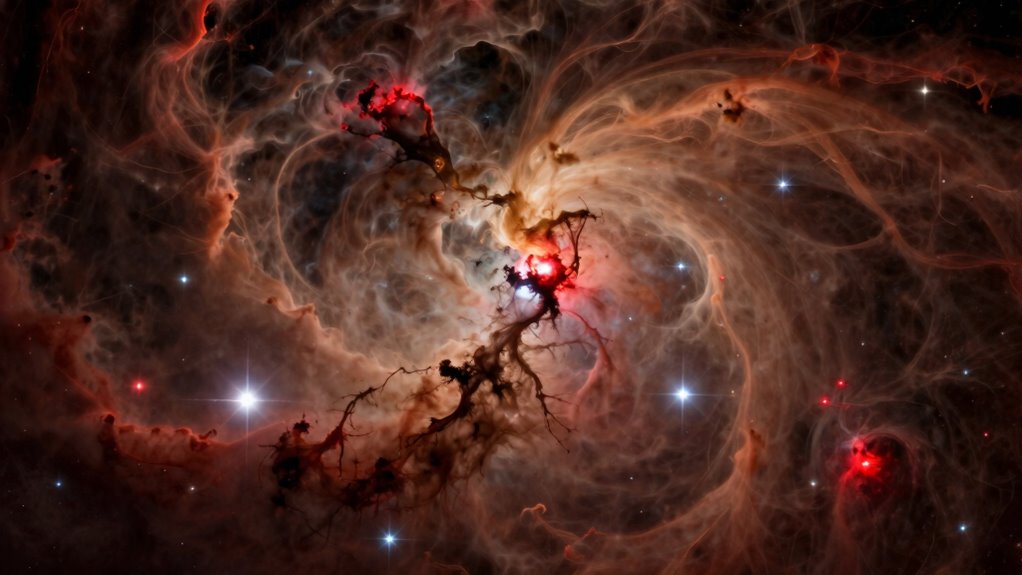
Infrared space telescopes can see through thick cosmic dust that blocks visible light, revealing hidden star-forming regions. This ability uncovers sites where new stars are born, invisible to other telescopes. Their infrared wavelength range makes them essential for studying these otherwise concealed stellar nurseries. Additionally, the Gold IRA market offers diverse investment options, reflecting the growing interest in tangible assets like precious metals. Utilizing Free Floating techniques can also help optimize observational data and improve image clarity, making the most of the infrared capabilities. Incorporating advanced data processing methods further enhances the detection of faint objects in the infrared spectrum, maximizing the scientific return of these observations. Implementing calibration procedures ensures data accuracy and consistency across different observational sessions.
Dust Penetration Capabilities
Infrared space telescopes excel at seeing through dense clouds of cosmic dust that obscure visible light, allowing you to explore regions of star formation hidden from other types of telescopes. This is because infrared light can penetrate interstellar dust more effectively, reducing the effects of light absorption. By doing so, you gain access to areas where new stars are forming, which are otherwise concealed. To understand their capabilities better:
- Infrared wavelengths can pass through thick dust clouds that block visible light, revealing hidden structures.
- Dust absorption diminishes at longer infrared wavelengths, enabling clearer views of star-forming regions.
- These telescopes detect the heat emitted by interstellar dust warmed by forming stars, providing indirect clues about star birth processes.
This ability makes infrared telescopes essential for uncovering hidden cosmic phenomena.
Hidden Star Formation Sites
Infrared space telescopes reveal star formation sites hidden behind dense dust clouds that block visible light. These stellar nurseries are often shrouded by cosmic dust, making them invisible to optical telescopes. Infrared wavelengths pass through dust easily, allowing you to observe the birthplaces of stars. This capability uncovers regions where new stars form deep within dusty clouds, otherwise hidden from view. Here’s a quick look at some features of these star-forming regions:
| Feature | Description | Significance |
|---|---|---|
| Stellar Nurseries | Birthplaces of new stars | Key to understanding star formation |
| Cosmic Dust | Obscures visible light | Allows infrared observation |
| Dense Clouds | Hide star-forming regions | Require infrared to see through |
| Infrared Glows | Reveal hidden activity | Indicate ongoing star birth |
Additionally, the ability of infrared light to penetrate dust is crucial for astronomers studying these regions in detail, as it enables detailed observations that are impossible with visible light. Understanding these stellar nurseries provides valuable insights into the lifecycle of stars and the evolution of galaxies.
Infrared Wavelength Advantages
Because dust clouds block visible light, telescopes that detect infrared wavelengths are vital for uncovering hidden star formation regions. Infrared observations allow you to peer through dense dust, revealing newborn stars and protostars otherwise invisible. These telescopes leverage spectral analysis to identify the chemical composition of star-forming regions, providing insight into their development. Accurate wavelength calibration guarantees precise measurements, essential for distinguishing between different infrared sources. Key advantages include:
- Penetrating dust clouds to observe obscured stellar nurseries.
- Enabling spectral analysis to determine the physical and chemical properties of star-forming material.
- Improving data accuracy through meticulous wavelength calibration, enhancing the detection of faint objects.
Together, these benefits make infrared telescopes indispensable for exploring the universe’s hidden stellar birthplaces.

Fundamentals of Radio Astronomy: Observational Methods (Series in Astronomy and Astrophysics)
As an affiliate, we earn on qualifying purchases.
As an affiliate, we earn on qualifying purchases.
Ultraviolet and X-ray Telescopes: Exploring Explosive Events and Hot Objects
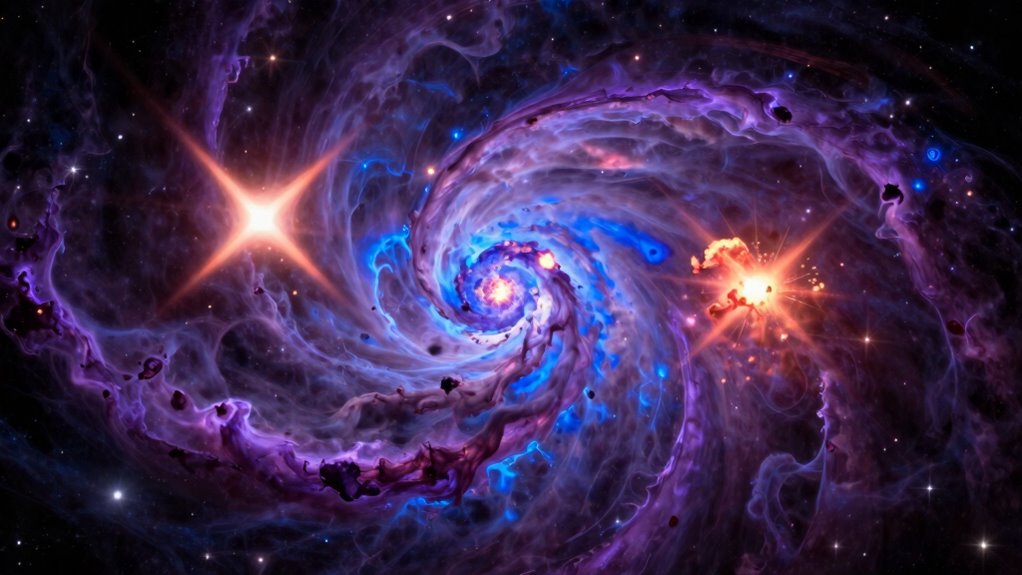
Ultraviolet and X-ray telescopes allow astronomers to observe some of the universe’s most energetic and dynamic phenomena, such as explosive stellar events and hot, dense objects. These telescopes reveal high-energy processes that are invisible in visible light, like supernova explosions and black hole accretion disks. They also enable cosmic ray detection and gamma ray observations, providing insights into the universe’s most extreme environments. This data helps us understand how matter behaves under intense gravity and heat. The following table summarizes key features:
| Observation Type | Target Phenomena | Significance |
|---|---|---|
| Ultraviolet | Hot stars, nebulae | Star formation, stellar winds |
| X-ray | Black holes, supernovae | Extreme gravity, explosive events |
| Cosmic Ray Detection | High-energy particles | Particle origins, universe’s energetic processes |
| Gamma Ray Observations | Gamma-ray bursts | Most energetic explosions in space |
Radio Space Telescopes: Listening to the Faintest Signals From Space
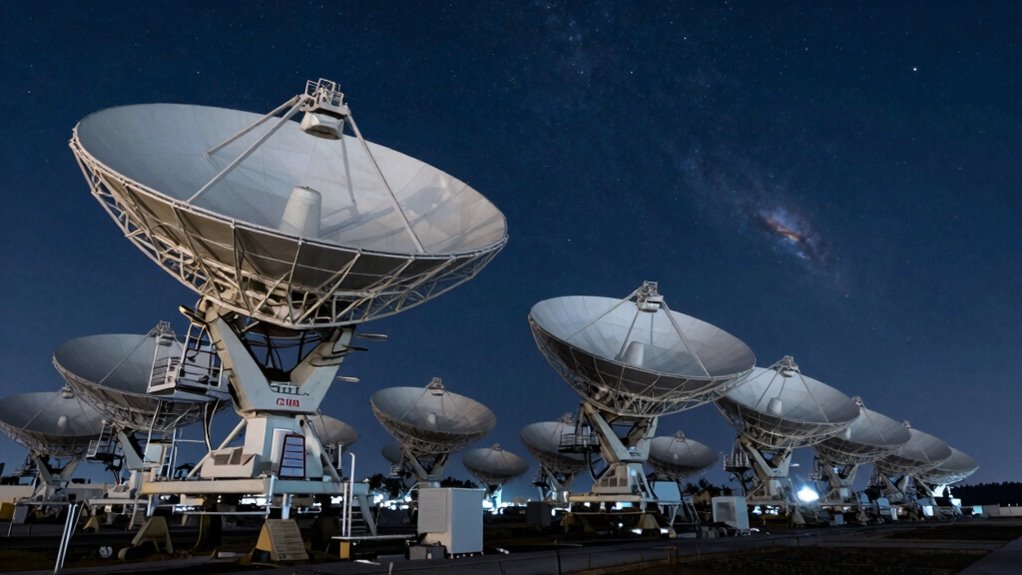
Radio space telescopes detect the faintest cosmic radio waves that tell us about the universe’s past. They must overcome Earth’s interference to pick up clear signals from deep space. By doing so, you can explore the universe’s origins and uncover secrets hidden in these distant signals. Additionally, the development of innovative technologies in telescope design continues to enhance our ability to observe these elusive signals with greater precision. Advances in antenna design and signal processing techniques are crucial for improving detection capabilities and reducing noise interference. Incorporating advanced calibration methods further refines data accuracy, enabling more detailed cosmic observations. Recent breakthroughs in noise reduction methods are also significantly enhancing our capacity to distinguish genuine signals from background interference. Moreover, ongoing research into signal amplification techniques promises to further boost the sensitivity of radio telescopes, opening new windows into the cosmos.
Detecting Cosmic Radio Waves
Have you ever wondered how scientists pick up the faint whispers of the universe’s most distant objects? Detecting cosmic radio waves involves tuning into signals so weak they’re often buried in cosmic noise. To do this effectively, radio telescopes use advanced techniques like:
- Signal amplification – boosting faint signals to detectable levels.
- Filtering out cosmic noise – reducing background interference for clearer readings.
- Precise directional sensing – pinpointing the source among billions of potential signals.
- Proper maintenance and calibration of equipment are also essential to ensure accurate data collection. Regular calibration helps maintain optimal performance and data integrity, especially in the face of environmental factors. Additionally, employing noise reduction techniques can significantly improve the clarity of the received signals. Incorporating advanced signal processing methods further enhances the detection of faint signals amidst the cosmic noise. Understanding the importance of sensitive instrumentation is crucial for capturing the faintest signals from space.
These methods allow you to listen to the universe’s invisible broadcast. Without signal amplification, these faint signals would vanish into cosmic noise, making it impossible to study distant phenomena like pulsars or black hole jets. Radio space telescopes turn these tiny whispers into meaningful data, uncovering secrets of the cosmos.
Overcoming Earth’s Interference
While advanced techniques help space-based telescopes detect faint signals from distant objects, Earth’s atmosphere and human-made signals still pose significant challenges. Earth’s atmosphere absorbs and distorts radio waves, making ground-based observations difficult and limiting the clarity of received signals. Atmospheric distortion, caused by fluctuations in temperature, humidity, and ionization, further interferes with the signals, blurring or blocking vital data. To overcome this, scientists build radio telescopes in remote locations with minimal human-made interference or launch space-based radio observatories beyond Earth’s atmosphere. These strategies reduce atmospheric interference, allowing clearer, more precise listening to the universe’s faintest signals. Radio wave propagation plays a crucial role in understanding how signals are affected by Earth’s atmospheric conditions. By doing so, we improve our ability to explore distant cosmic phenomena that would otherwise remain hidden or distorted by Earth’s atmospheric effects.
Exploring the Universe’s Origins
Ever wonder how scientists uncover the universe’s earliest moments? Radio space telescopes help you listen to faint signals from the cosmos, revealing secrets about its origins. By detecting the cosmic microwave background, you can learn about conditions just after the Big Bang. These signals also help you explore dark matter, which influences galaxy formation and large-scale structure. To deepen your understanding, consider these key points:
- Radio telescopes pick up long-wavelength signals that other telescopes miss.
- These signals provide insights into the universe’s infancy, including fluctuations in cosmic microwave background radiation.
- Listening for faint signals from dark matter helps explain its role in shaping the universe’s structure over billions of years.
Through this technology, you get closer to understanding how everything began.
Why Combining Multiple Wavelengths Gives a Complete View of the Cosmos
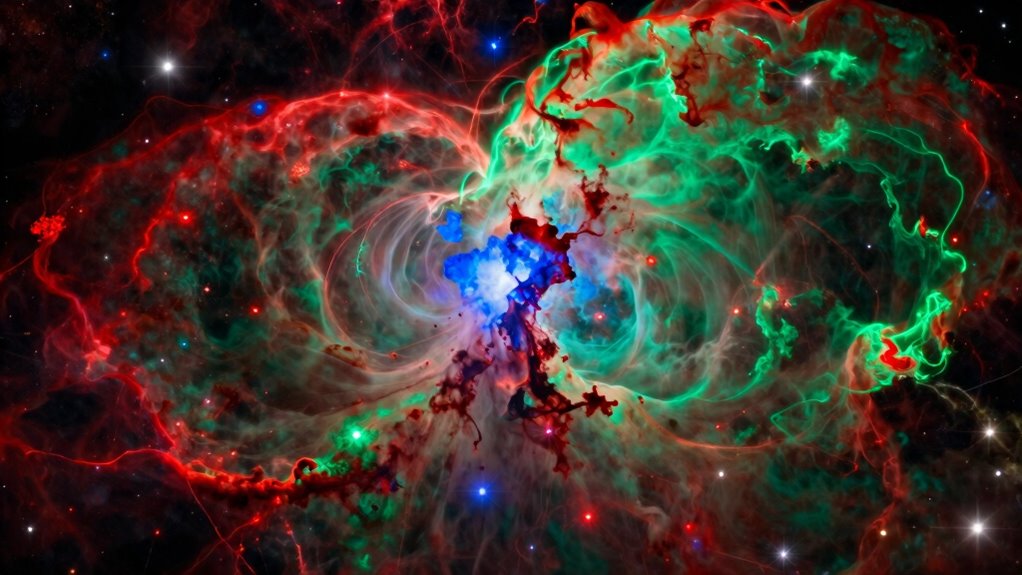
Combining multiple wavelengths allows astronomers to see different aspects of celestial objects that appear similar in visible light but reveal entirely different features in other parts of the spectrum. For example, infrared observations can uncover alien atmospheres, revealing chemical compositions and weather patterns hidden in visible light. X-ray and radio waves help detect phenomena like black holes and dark matter, which are invisible otherwise. By integrating data across these wavelengths, you gain a more complete picture of the universe’s complexity. This multi-spectrum approach uncovers hidden structures and processes, enabling you to understand phenomena that would remain unseen if you relied solely on visible light. Understanding electromagnetic radiation is key to interpreting these diverse observations. Ultimately, using different wavelengths transforms your view of the cosmos from a flat image into a rich, detailed universe.
Frequently Asked Questions
How Do Space Telescopes Differ From Ground-Based Telescopes in Detecting Invisible Light?
You see that space telescopes differ from ground-based ones because they can detect invisible light like infrared imaging and gamma ray detection without atmospheric interference. The Earth’s atmosphere blocks much of this radiation, but space telescopes orbit above it, capturing clearer images of the universe’s hidden worlds. This enables you to explore phenomena like black holes and distant galaxies that are invisible in visible light.
What Challenges Are Involved in Building and Operating Telescopes for Different Light Wavelengths?
Building and operating telescopes for various light wavelengths is a monumental task—you’re literally trying to catch whispers from the universe! You face challenges like precise instrument calibration to guarantee accurate readings and thermal regulation to prevent heat from distorting signals. Different wavelengths demand specialized materials and cooling systems, making the process complex. Overcoming these hurdles allows you to unseal the universe’s secrets hidden in invisible light, revealing worlds beyond your wildest dreams.
How Do Scientists Interpret Data Collected Across Multiple Wavelengths to Understand the Universe?
You interpret data across multiple wavelengths by performing spectral analysis to identify unique signatures of celestial objects. Data integration plays a vital role, allowing you to combine observations from different light types, revealing a complete picture of the universe. This approach helps you understand phenomena like star formation or black hole activity, providing insights that are invisible in just one wavelength. Your ability to synthesize this information reveal the universe’s hidden secrets.
Can Space Telescopes Detect Signals From Extraterrestrial Civilizations?
Imagine hunting for a needle in a cosmic haystack—you might wonder if space telescopes can detect extraterrestrial signals. While they primarily observe light and other waves, specialized instruments like radio telescopes can listen for alien communication. They scan the universe for unusual signals that could hint at extraterrestrial civilizations. So, yes, space telescopes have the potential to catch alien communication, but it’s a complex and ongoing quest.
What Future Advancements Are Expected in Space Telescope Technology for Observing Invisible Light?
Future space telescope advancements will include quantum imaging, which enhances sensitivity to faint signals, and adaptive optics that correct atmospheric distortions, even in space. These technologies will markedly improve your ability to observe invisible light, revealing details previously hidden. Expect sharper images and deeper insights into distant worlds, helping you explore exoplanets, cosmic phenomena, and the universe’s mysteries with unprecedented clarity and precision.
Conclusion
By using different types of space telescopes, you can uncover hidden details about the universe that visible light alone can’t reveal. Combining these wavelengths provides a fuller picture, supporting the theory that the cosmos is more complex than it appears. This multi-spectrum approach isn’t just about seeing more—it’s about understanding the true nature of celestial phenomena, showing that the universe’s secrets often lie just beyond our visible reach.