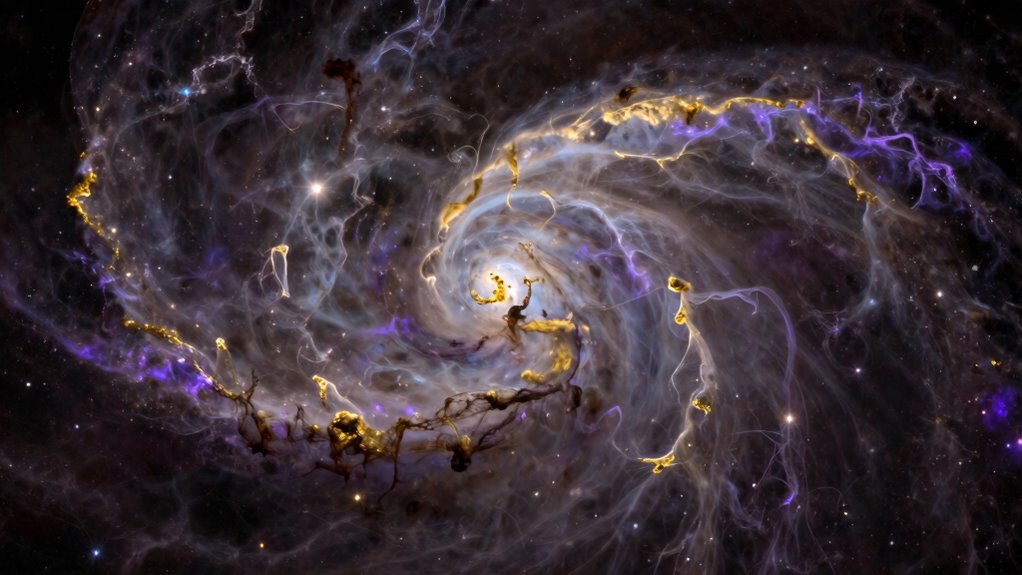

Cosmic dust is more than tiny particles floating in space — it’s the starting point for building planets. When dust grains collide, they stick together, gradually forming larger objects called planetesimals, which grow into planetary cores. Factors like temperature, magnetic fields, and dust properties influence how quickly this happens. Without these minuscule particles, planets like Earth wouldn’t exist, and understanding this process reveals the fascinating journey from dust to worlds. Keep exploring to uncover the full story behind planet formation.
Key Takeaways
- Tiny dust particles collide and stick together, initiating the formation of larger planetary building blocks.
- Dust composition and properties influence the rate and nature of planetesimal and planetary core growth.
- Environmental factors like temperature and magnetic fields affect dust behavior and aggregation processes.
- Accumulated dust forms planetesimals, which serve as seeds for planetary cores through gravitational attraction.
- Variations in dust characteristics contribute to the diversity of planets and their formation timelines.
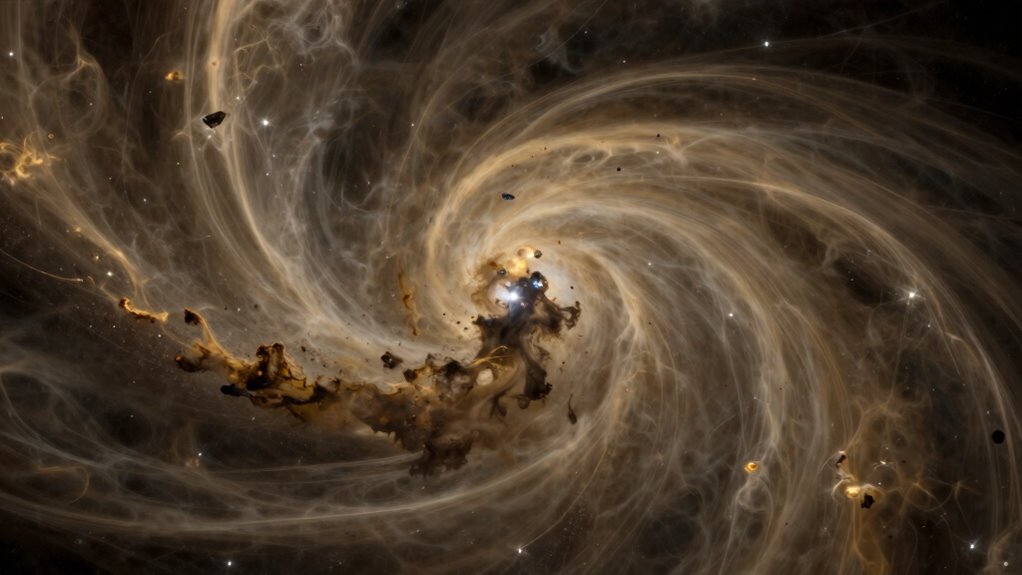
Have you ever wondered how tiny dust particles in space come together to form planets? It’s a fascinating process that begins with cosmic dust—minuscule particles floating through the vastness of space. These particles, often no larger than a speck of sand, are the building blocks of entire worlds. When you look up at the night sky, it might seem like planets are massive and distant, but in reality, their formation starts with countless small dust grains colliding and sticking together over millions of years. This cosmic dust clumps together through a process called accretion, where particles collide and adhere, gradually growing larger.
Cosmic dust particles collide and stick, gradually building planets over millions of years through a process called accretion.
As these tiny dust particles stick, they form larger aggregates. Over time, these aggregates grow into tiny planetesimals—solid objects that can be several kilometers across. These planetesimals are essential because they serve as the seeds for planetary cores. When enough cosmic dust accumulates, gravity takes over, pulling more material inward and causing these planetesimals to collide and merge. This process speeds up as the objects grow larger, leading to the formation of planetary cores—dense, central regions that eventually become the heart of a planet. The mass and composition of these cores depend on the materials available in the surrounding dust cloud, influencing what kind of planet will eventually emerge.
You might think that the process is straightforward, but it’s actually quite complex. Factors like the temperature of the surrounding gas and dust, the presence of magnetic fields, and the turbulence within the protoplanetary disk all influence how cosmic dust behaves. For example, in warmer regions, dust particles might vaporize or fail to stick together effectively. Conversely, in cooler areas, particles are more likely to stick and grow. The formation of planetary cores from cosmic dust is a delicate balance, but it’s this very process that sets the stage for the diversity of planets we see in our universe. Interestingly, this process is closely linked to the composition of planetary materials, which impacts the characteristics of the resulting planets. Additionally, the presence of dust influences the formation of planetary atmospheres and their evolution over time.
Furthermore, recent studies suggest that dust grain properties, such as their size and composition, play a crucial role in determining how efficiently planets can form in different environments. The properties of dust grains can also affect the growth rate of planetesimals, impacting the timeline of planetary formation. Researchers have found that even slight variations in dust grain characteristics can significantly alter the overall process, highlighting the importance of these tiny particles. In essence, cosmic dust isn’t just debris floating aimlessly through space. It’s the fundamental ingredient in planetary formation, gradually building up from tiny grains to massive planetary cores. Without this dust, planets like Earth wouldn’t exist. The next time you gaze at a planet or a star, remember that its origins trace back to these tiny, seemingly insignificant particles that, through countless collisions and mergers, created the worlds we observe today.

Science Can Solar System for Kids, Talking Astronomy Solar System Model Kit, Planetarium Projector with 8 Planets STEM Space Toys for 3 4 5+ Years Old Boys Girls
Immersive Solar System Projector: Our solar system for kdis is nice STEM toys for 5+ year old who…
As an affiliate, we earn on qualifying purchases.
As an affiliate, we earn on qualifying purchases.
Frequently Asked Questions
How Do Dust Particles Influence the Speed of Planet Formation?
Dust particles markedly influence the speed of planet formation by promoting dust aggregation, which accelerates the process. When dust clumps together, it forms larger bodies that collide and stick, speeding up planetary core formation. Your understanding of how these tiny particles come together reveals that their ability to stick and grow is essential, as it shortens the timescale for planets to develop from small dust grains into full-fledged worlds.
What Types of Dust Are Most Common in Protoplanetary Disks?
Did you know that interstellar dust makes up about 1% of the mass in protoplanetary disks? The most common types are silicate and carbonaceous dust grains. These particles, originating from dying stars, grow through dust grain growth, forming larger clumps that eventually lead to planetesimals. Their prevalence and composition are essential, shaping the building blocks of planets and influencing the overall architecture of planetary systems.
Can Dust Composition Affect the Size of Forming Planets?
Yes, dust composition substantially affects the size of forming planets. You see, dust grain aggregation depends on chemical composition diversity; some materials stick together more easily, forming larger clumps. These larger particles accelerate planet formation by creating bigger building blocks. Conversely, certain compositions hinder aggregation, resulting in smaller planets. So, understanding dust chemistry helps explain why some planets grow bigger than others in different regions of a protoplanetary disk.
How Does Dust Interact With Magnetic Fields in Space?
You might think dust particles just drift aimlessly, but magnetic fields influence them through magnetic alignment. When dust particles charge via interactions with cosmic rays or radiation, they become sensitive to magnetic forces, causing them to align along magnetic field lines. This dust charging helps particles stick together or disperse, impacting planet formation. So, magnetic interactions shape how dust behaves, ultimately influencing the building blocks of planets.
What Is the Role of Dust in Creating Planetary Atmospheres?
Dust contributes to creating planetary atmospheres by undergoing chemical reactions that release gases, shaping the atmosphere’s composition. Its thermal properties help regulate temperature, influencing atmospheric stability and climate. You’ll find dust particles acting as condensation nuclei for cloud formation, impacting weather patterns. By interacting with radiation, dust also affects heat retention, playing an essential role in developing and maintaining planetary atmospheres, making them habitable and dynamic environments.
cosmic dust sample kit
As an affiliate, we earn on qualifying purchases.
As an affiliate, we earn on qualifying purchases.
Conclusion
Next time you look up at the night sky, remember that tiny dust particles are the hidden architects of planets. Imagine a young star system where dust clumps together, gradually forming a new planet—just like in the case of the TRAPPIST-1 system. Your curiosity about these microscopic building blocks reveals how something so small can lead to the creation of worlds. Dust may be tiny, but its role in shaping the cosmos is truly enormous.
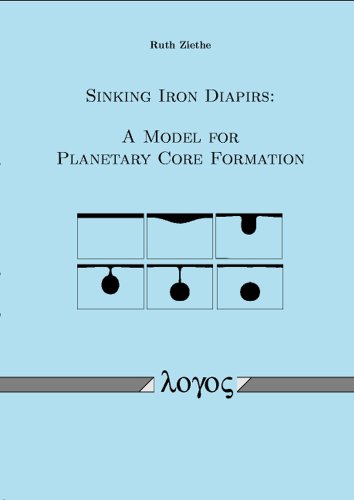
Sinking Iron Diapirs: A Model for Planetary Core Formation
As an affiliate, we earn on qualifying purchases.
As an affiliate, we earn on qualifying purchases.
protoplanetary disk simulation kit
As an affiliate, we earn on qualifying purchases.
As an affiliate, we earn on qualifying purchases.