

Oceans absorb most of our excess heat because they have a high thermal capacity, meaning they can store large amounts of heat without quickly changing temperature. They act as natural buffers, slowing down temperature rises on land and in the atmosphere. Marine currents help distribute this heat across the globe, preventing hotspots and stabilizing climate patterns. If you want to understand how oceans play a crucial role in climate change, keep exploring their fascinating functions.
Key Takeaways
- Oceans have a high thermal capacity, allowing them to store large amounts of heat without rapid temperature increases.
- Marine currents distribute heat globally, helping to regulate land and atmospheric temperatures.
- As global temperatures rise, oceans absorb excess heat, acting as a buffer against rapid climate change.
- Oceans’ ability to absorb heat prevents immediate atmospheric warming but leads to issues like ocean warming and sea level rise.
- Their role as Earth’s primary heat sink is essential for maintaining climate stability and mitigating temperature extremes.
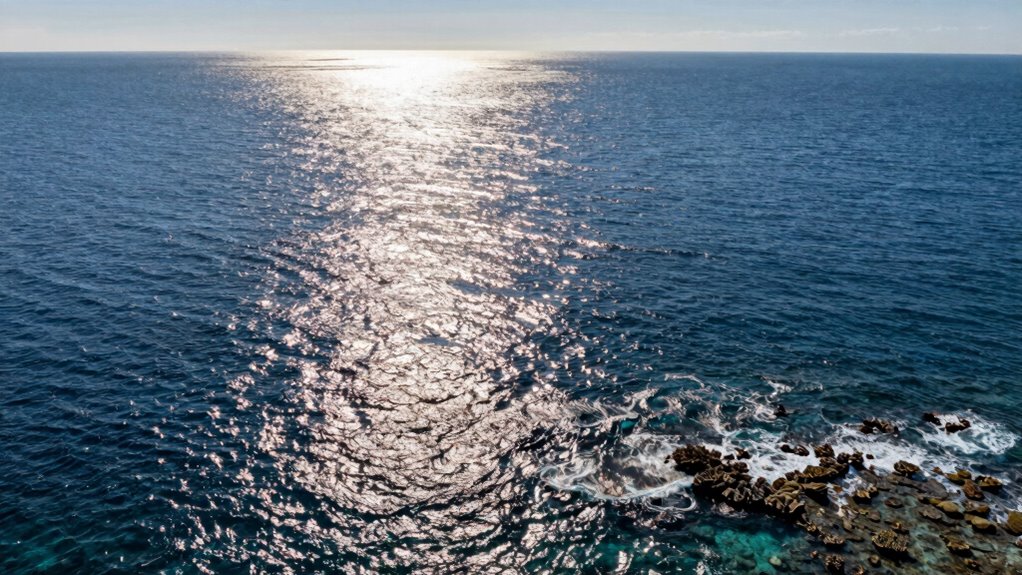
Have you ever wondered how the vast oceans play a essential role in regulating Earth’s climate? The answer lies in their incredible ability to absorb and store heat, which helps moderate global temperatures. Oceans act as massive heat reservoirs, thanks to their high thermal capacity. Unlike land, which heats up and cools down quickly, water changes temperature more slowly, allowing the oceans to act as a buffer against rapid climate shifts. When the sun’s energy reaches Earth, a significant portion is absorbed by the oceans, reducing the immediate impact on land and atmosphere. This slow heat exchange is fundamental because it stabilizes climate patterns and supports life across the planet. Additionally, the thermal capacity of oceans enables them to absorb vast amounts of heat without significant temperature increases, illustrating their crucial role in climate regulation.
Oceans absorb and store heat, stabilizing Earth’s climate and supporting life through slow, vital heat exchange.
Marine currents are the ocean’s conveyor belts, moving warm and cold water across vast distances. These currents distribute heat from equatorial regions toward higher latitudes, which helps regulate temperatures in different parts of the world. For example, the Gulf Stream carries warm water from the tropics up along North America’s eastern coast, warming the climate of nearby regions. Conversely, cold currents like the California Current cool down surrounding areas, balancing temperatures and influencing weather patterns. Without these currents, climate would be much more volatile, with some areas experiencing extreme heat or cold. Their movement also promotes mixing of water layers, preventing the surface from heating too rapidly and maintaining a stable environment for marine life.
The thermal capacity of oceans allows them to absorb enormous amounts of heat without a drastic change in temperature. This capacity means that as global temperatures rise, oceans take on much of the excess heat, preventing the atmosphere from warming too quickly. However, this comes with consequences. The absorbed heat contributes to the ongoing problem of climate change, leading to ocean warming, melting ice caps, and rising sea levels. Furthermore, warmer oceans affect marine ecosystems, disrupting habitats and the species that depend on them. The vastness of the oceans and their ability to hold heat make them a core component in the global climate system. They act as both a heat sink and a source of energy that influences weather and climate patterns worldwide.
Ultimately, the oceans’ role in absorbing heat underscores why they are central to understanding climate change. Their capacity to store heat, facilitated by marine currents, helps regulate Earth’s temperature but also means they are vulnerable to the impacts of excess heat. Recognizing this interplay is essential for addressing our ongoing heat problem and protecting our planet’s future.
![ACA12127 1:35 Academy USMC AH-1Z Cobra 'Shark Mouth' [Model Building KIT]](https://m.media-amazon.com/images/I/51n+69EWuVL._SL500_.jpg)
ACA12127 1:35 Academy USMC AH-1Z Cobra 'Shark Mouth' [Model Building KIT]
This is a plastic model kit. Assembly and painting is required.
As an affiliate, we earn on qualifying purchases.
As an affiliate, we earn on qualifying purchases.
Frequently Asked Questions
How Do Ocean Currents Influence Heat Absorption?
Ocean currents influence heat absorption through surface mixing and wind patterns. When winds blow across the ocean, they create surface mixing that helps distribute heat more evenly, allowing warm water to move into colder regions. These wind patterns drive currents that carry heat away from the equator toward the poles, regulating global climate. Without these processes, heat absorption would be less efficient, affecting weather and climate patterns worldwide.
What Role Do Deep Ocean Layers Play in Heat Storage?
Deep layer dynamics profoundly shape heat storage in oceans. These layers act as thermal insulators, trapping warmth beneath the surface. When surface heat penetrates, it settles into these deep layers, where it can stay for centuries. This process influences long-term climate patterns, making the deep ocean essential in understanding global warming. You can see how the deep layers’ capacity to hold heat impacts Earth’s overall climate stability.
How Does Salinity Affect Ocean Heat Absorption?
Salinity variability influences how much heat the ocean can absorb because higher salinity increases water density, allowing it to hold more heat. Evaporative processes raise salinity near the surface, enhancing heat absorption in those areas. Conversely, lower salinity from freshwater input reduces heat capacity. So, fluctuations in salinity directly impact the ocean’s ability to store heat, affecting climate regulation and global temperature dynamics.
Can Ocean Heat Absorption Impact Marine Life?
Ocean heat absorption can considerably impact marine life by causing coral bleaching and disrupting marine migration patterns. As temperatures rise, corals become stressed and bleach, which weakens reefs and threatens biodiversity. Warmer waters also force marine species to migrate to cooler areas, upsetting ecosystems and fishing industries. You might notice these changes in your local marine environment, highlighting how climate shifts directly affect marine life and ocean health.
How Quickly Do Oceans Respond to Climate Change?
Oceans respond to climate change relatively slowly due to climate feedbacks and ocean stratification. You’ll notice gradual warming over decades, as surface layers absorb heat first, while deeper layers change more slowly. Climate feedbacks, like increased greenhouse gases, amplify warming, but stratification can trap heat in surface waters, delaying full ocean response. Overall, it’s a gradual process, but ongoing climate change accelerates this response, impacting global weather and ecosystems.

ZHAOYZZY The Layers Ocean Zones Poster Science Posters for Classroom Painting Canvas Wall Posters Art Picture Print Modern Family Decor Posters 12x18inch(30x45cm)
NOTE: All poster prints may vary slightly from what you see on your screen due to the resolution…
As an affiliate, we earn on qualifying purchases.
As an affiliate, we earn on qualifying purchases.
Conclusion
You might wonder if the oceans will keep absorbing heat forever. The truth is, they can’t. If we continue to warm our planet, the oceans will become overwhelmed, leading to devastating effects like rising sea levels and extreme weather. It’s a stark reminder that our actions matter. By acting now, we have a chance to protect these crucial heat sinks and guarantee a safer future for everyone. The choice is ours—don’t let the oceans carry the burden alone.

GAOLLY 6-Piece Spirit Level Set (12", 16", 20", 24", 32", 40"), Level Set with Magnetic Torpedo, 45°/90°/180°Bubbles Measuring, Aluminium Alloy Levels, Open Top View Design
Vials of the level set provide a maximum accuracy of 0.0005-inch/ft, this will allow you to complete your…
As an affiliate, we earn on qualifying purchases.
As an affiliate, we earn on qualifying purchases.

Replacement Pentair 520272 Air/Water/Solar Temperature Sensor, 20-Feet Cable for Pool/Spa 12 Month Warranty
Offers the same functionality as the OEM part at a more affordable price. Backed by a 12-month warranty…
As an affiliate, we earn on qualifying purchases.
As an affiliate, we earn on qualifying purchases.